








Corruptions of Christianity:
Catholicism
Unmasking the World's Largest Pagan Cult

![Corruptions of Christianity: Catholicism - Book Cover [creationliberty.com]](../images/store14a.png)
Corruptions of Christianity: Catholicism
This 395-page book is free to read here on our website, or available for purchase in paperback/Kindle on Amazon.

Free Evangelism Tract
A counter to the "Catholics Come Home" campaign — download and print this free double-sided tract to hand out.
The second reason I wrote this book is to warn Catholics. I am aware that very few Catholics would ever pick up this book just based on the title, let alone open up to the first page to read it, but if by the grace of God any practicing Catholic is reading this paragraph, I want to encourage you for the brave step you have just taken to understand the truth of Scripture because it is not always easy to open your mind to learn about something that goes against everything you have been taught, especially if you were Catholic-educated as a child.
Just remember that studying a matter thoroughly is something that the Lord God declares to be a righteous deed:
The heart of the righteous studieth to answer:
but the mouth of the wicked poureth out evil things.
-Proverbs 15:28
And have no fellowship with the unfruitful works
of darkness, but rather reprove them.
-Ephesians 5:11
The fruit of the righteous is a tree of life;
and he that winneth souls is wise.
-Proverbs 11:30
This is not to say that a born-again Christian cannot exist in the Catholic Church, but if they are of Christ, and they have access to God's Word (to read it for themselves), they will NOT remain in Catholicism for very long because they will not follow the voice of strangers:
And when he putteth forth his own sheep, he goeth before them, and the sheep follow him: for they know his voice. And a stranger will they not follow, but will flee from him: for they know not the voice of strangers.
-John 10:4-5
Be ye not unequally yoked together with unbelievers: for what fellowship hath righteousness with unrighteousness? and what communion hath light with darkness? And what concord hath Christ with Belial? or what part hath he that believeth with an infidel? And what agreement hath the temple of God with idols? for ye are the temple of the living God; as God hath said, I will dwell in them, and walk in them; and I will be their God, and they shall be my people. Wherefore come out from among them, and be ye separate, saith the Lord, and touch not the unclean thing; and I will receive you, And will be a Father unto you, and ye shall be my sons and daughters, saith the Lord Almighty.
-2 Corinthians 6:14-18
Judge not according to the appearance, but judge righteous judgment.
-John 7:24
judge (v): to compare facts or ideas, and perceive their agreement or disagreement, and thus to distinguish truth from falsehood
(See 'judge', American Dictionary of the English Language, Noah Webster, 1828, retrieved June 27, 2023, [webstersdictionary1828.com])
Study to shew thyself approved unto God, a workman that needeth not to be ashamed, rightly dividing the word of truth.
-2 Timothy 2:15
For every one that asketh receiveth; and he that seeketh findeth; and to him that knocketh it shall be opened.
-Luke 11:10
But the natural man receiveth not the things of the Spirit of God: for they are foolishness unto him: neither can he know them, because they are spiritually discerned.
-1 Corinthians 2:14
(Read There is No Saving Grace Without Repentance here at creationliberty.com for more details.)
In short, Catholics typically speak honor to God and praise to Jesus, but their hearts are far from Him because they look to Catholic tradition instead of God's Word.
This people draweth nigh unto me with their mouth, and honoureth me with their lips; but their heart is far from me. But in vain they do worship me, teaching for doctrines the commandments of men.
-Matthew 15:8-9
For godly sorrow worketh repentance to salvation not to be repented of:
but the sorrow of the world worketh death.
-2 Corinthians 7:10
Am I therefore become your enemy, because I tell you the truth?
-Galatians 4:16
And because I tell you the truth, ye believe me not... He that is of God heareth God's words: ye therefore hear them not, because ye are not of God.
-John 8:45-47
For this people's heart is waxed gross, and their ears are dull of hearing, and their eyes they have closed; lest at any time they should see with their eyes, and hear with their ears, and should understand with their heart, and should be converted, and I should heal them.
-Matthew 13:15
Then said Jesus to those Jews which believed on him, If ye continue in my word, then are ye my disciples indeed; And ye shall know the truth, and the truth shall make you free.
-John 8:32
Sanctify them through thy truth: thy word is truth.
-John 17:17
And with all deceivableness of unrighteousness in them that perish; because they received not the love of the truth, that they might be saved.
-2 Thessalonians 2:10
If ye love me, keep my commandments.
-John 14:15
Go ye therefore, and teach all nations, baptizing them in the name of the Father, and of the Son, and of the Holy Ghost: Teaching them to observe all things whatsoever I have commanded you: and, lo, I am with you alway, even unto the end of the world. Amen.
-Matthew 28:19-20
But strong meat belongeth to them that are of full age, even those who by reason of use have their senses exercised to discern both good and evil.
-Hebrews 5:14
|
RICHARD BENNETT: "I also had bought, before I went into the monastery, a Bible. |
This is just one example, and we will see many more examples like it in this book. According to this former priest, Catholic priests are not trained in the Word of God; rather, they follow after pagan philosophers, learning the traditions and doctrines of men, and absorbing the rudiments (i.e. first teachings) of the world.
Beware lest any man spoil you through philosophy [a way of thinking] and vain deceit [lies] , after the tradition of men, after the rudiments [first teachings] of the world, and not after Christ.
-Colossians 2:8
Let's begin by looking at a brief overview of the history of the Catholic Church so we can understand the foundation of the world's largest and most deceptive religious cult...
"The Roman Catholic Church traces its history to Jesus Christ and the Apostles. "
-Francis C. Oakley & Jaroslav J. Pelikan, "Roman Catholicism," Encyclopedia Britannica, retrieved Nov 16, 2017, [britannica.com/topic/Roman-Catholicism]
Notice that Britannica did not state it as a verifiable fact, but rather, they said the Catholic Church traces its history back to Christ, and that is because, despite what many people might believe, the Catholic Church does not have evidence of that history. It is nothing more than their claim to that narrative. If you continue to read Britannica's article, they go on to give more specific details, but before I even read it, I guessed what they were likely going to do because this follows the pattern of many religious cults that claim to be "Christian."
Since the Catholic Church claims it began with the apostles in the first century, what they would likely do is bring up the book of Acts to start off Catholicism's supposed "origins," then skip 300 years ahead in the timeline (without any historical evidence to back it up) to get to the true date of their origin, and that is exactly what they did. The Catholic Church tells a story with a 300-year time gap, which is not "tracing" anything; it is only conjecture. (i.e. Conjecture is just a guess based on feelings and/or opinions without facts, evidence, and proof.)
To save space in this book, I am going to summarize the story the Catholic Church provides about its history. However, before I do that, I want readers to keep in mind that this is ONLY the Catholic Church's CLAIM to their history; meaning that, depending on which part is being addressed, little to no evidence exists to support their claims.
The general claim of the Catholic Church is that Peter, an apostle of Christ, was the first Pope, or head authority over the Church, and he instituted its structure in the early days after Christ. About 300 years later (i.e. time gap), Christians were persecuted because Rome had declared Christianity illegal, and some organization was needed to apply for Rome's approval of a new religion. In addition, the Catholic Church alleges that Christians of that day wanted to make some sort of "New Jerusalem" for Christianity in the Roman Empire, so the Roman Emperor Constantine who they allege happened to have converted to Christianity about the same time, legalized Christianity in Rome, and became the new Pope. This all sounds light-hearted and pleasant, but it is a fanciful LIE because numerous details of actual history are removed from Catholic textbooks, and the average Catholic has no idea they are deceived.
Though Catholics claim their origins started with Christ, in reality, the origin of Catholicism started in 312 AD with a Roman leader named Constantine I, his involvement in the Battle of Milvian Bridge, and his use of a pagan symbol that is known today as the "labarum." The battle was a war between Constantine and Maxentius, who fought over the title of Roman Emperor, but before the battle began, Constantine claimed to have had a vision that led him to believe he was under divine protection, but in order for his army to gain that same protection, he needed to put a special symbol on the shields of his soldiers to gain this power.
Before we go any further, it should be noted that this is enough evidence for us to see that Constantine's claims and actions had nothing to do with Jesus Christ. There is no place in Scripture where Jesus ever instructed His disciples that He would come to their aid if they used icons and symbols, and I will quote the supporting Scripture in a moment.
If you meet Catholics who speak of this event, they will repeat a general narrative that Constantine used a cross symbol, like that which Christ was crucified upon, which supposedly came from Constantine's vision. In fact, the corrupt news publication Christianity Today Magazine reports on this:
"In October 312, Constantine and his forces marched toward Rome. Arrayed against them were the armies of Maxentius—four times greater. At stake was control of Rome and sole rule of the Western Empire. According to Christian historian Eusebius, the troubledConstantine sought help in prayer to his father's god . Constantine then had avision of a cross of light emblazoned [overtly displayed] against the sun and saw the words In hoc signo vinces: 'In this sign you will win.' ... The emblem [symbol] was thought of as incorporating a cross...Constantine incontrovertibly [without a doubt] adopted it as a token of his Christian allegiance. "
-David F. Wright, "Constantine's Famous Emblem," Christianity Today, retrieved Mar 15, 2018, [christianitytoday.com/history/issues/issue-27/constantines-famous-emblem.html]
Constantine's father, Constantius Chlous, was a pagan, and so Constantine was raised up in paganism and believed in pagan lore, and thus (assuming that Constantine actually had some "vision," and did not just make this up as a smart military strategy to keep up the morale of his troops), Constantine was called upon by his pagan gods, not the Christian God of the Bible. Constantine later alleged that his father was a Christian, but the great persecution by Rome against the Christians started in 303, AFTER Constantius Chlous's military victory over the Carpians and Germania, which means, according to the timeline, Constantine's father would have (according to Constantine's claim) supposedly declared himself to be a "Christian," and then started hunting and slaughtering Christians after his alleged "conversion," which makes no sense.
|
In short, the story has a lot of holes, and it gets worse as it goes. |
Constantine's personal advisor, Lactantius, documented more details about this symbol:"Constantine was directed in a dream to cause |
 |
The hand of the Lord prevailed, and the forces of Maxentius were routed. He fled towards the broken bridge; but the multitude pressing on him, he was driven headlong into the Tiber."
-Ernest C. Richardson & Bernhard Pick, The Ante-Nicene Fathers: Translations of the Writings of the Fathers Down to A.D. 325, C. Scribner's Sons, Vol. 7, 1905, p. 318, [Princeton University]
The "Tiber" refers to the Tiber River, where Constantine's enemies drowned. Maxentius's body was later recovered, Constantine decapitated Maxentius's head, and then paraded it around the city in a victory celebration. Constantine's vision was later claimed to be from the Christian God of the Bible, and that this symbol was from God, but the Bible tells us that is a lie:
Forasmuch then as we are the offspring of God, we ought not to think that the Godhead is like unto gold, or silver, or stone, graven by art and man's device. And the times of this ignorance God winked at; but now commandeth all men every where to repent:
-Acts 17:29-30
This includes even the cross symbol that is plastered on almost every church building, along with necklaces, statues, tattoos, etc. Also, the so-called "Jesus fish" is pagan in its origin, and does not represent God, Christ, or Christianity in any way. To "wink" means that God is closing His eyes to the ignorant people who use these symbols, and I would exhort born-again Christians to repent (i.e. have grief and godly sorrow) of their idolatry, and get rid of their idols.
(Read "Christian Symbols Are Not Christian" here at creationliberty.com for more details.)
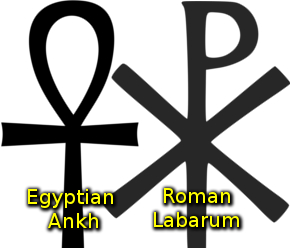
The explanation given by the Catholic Church for why Constantine chose the "labarum" symbol is not even close to why it was originally crafted. It was not only designed after the Egyptian ankh (crux ansata, which means "cross with a handle"), which is commonly used in paganism to represent gods and goddesses of the afterlife (which is why it is so commonly associated with mummies), but the labarum is also designed after a symbol of a Persian god:
"LABARUM:
-William Harwood, Dictionary of Contemporary Mythology: Third Edition (2011), World Audience Inc, 2017, p. 284, ISBN: 9781544601403
Soldiers at this time already commonly worshipped Mithra, so before we continue, I would like to propose my theory of what actually happened: The odds of winning this war were heavily in favor of Maxentius because his army was four times larger than Constantine's army, and under those circumstances of low-morale, it becomes very difficult to keep soldiers from abandoning their duties and fleeing the battlefield because they know that, even if they do not die on the battlefield, this was a war to see who would become the next Emperor of Rome, and that means the losing army would be executed by the new emperor. So to prevent his soldiers from fleeing, Constantine claims he had a "vision" in a dream, and the vision instructed him to use a symbol that, miraculously, just so happened to be attributed to the god most of them worshiped, and thus, they would believe that they would be under divine protection as they marched into battle, which would boost morale.
After Constantine got his soldiers onto the battlefield with their morale boosted, he burned the bridge behind them, so none of his soldiers could run away. Then, if he won, the people would see Constantine as divine, believing he is a god himself, and that will be important later (in chapter seven) when we find out that the Pope of Rome is considered by the Catholic Church to be a god.
It was not until about a decade after this battle that Constantine declared himself to be a "Christian," which leads us to question if the events of this battle were supposed to be the crux (pun intended) of his conversion. Why did it take Constantine so long to declare his "Christian" status? As we just read, Constantine did not "convert" to Christianity until many years after this battle, so why is this battle connected to his alleged conversion? That is certainly food for thought. Nevertheless, what Constantine did is called idolatry, which is a practice of heathens/pagans, and has nothing to do with the Lord Jesus Christ and His church.
(Read "The Biblical Understanding of Idolatry" here at creationliberty.com for more details.)
Ye shall make you no idols nor graven image, neither rear you up a standing image, neither shall ye set up any image of stone in your land, to bow down unto it: for I am the LORD your God.
-Leviticus 26:1
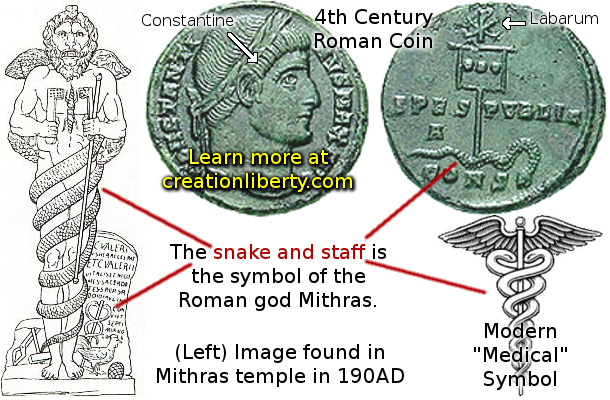
In case anyone did not recognize it, the Mithras symbol is also where we get the "medical" (caduceus) symbol commonly found in the U.S. today. Even the commonly sworn "Hippocratic Oath" was originally sworn to pagan gods and goddesses, but those pagan gods were removed from the oath to "Americanize" it. This helps demonstrate the true origins behind modern-day "medicine," and it is one of the many reasons why modern "medical science" physicians, working hand-in-hand with the pharmaceutical industry, are killing more people than they are helping.
(Read "The Cure for Cancer," "The United Vacci-Nations," and Psychology: Hoodwinked by the Devil here at creationliberty.com for more details; the word pharmakeia, where we get the root word for pharmaceutical, literally means "sorcery.")
Because the symbol Constantine used formed Greek letters that spelled out the Greek word for "anointed," or "christ," (i.e. khi+rho = khristos) therefore, the heathen who followed Constantine claimed in ignorance that it was the Christian God of the Bible who gave him the vision for the pagan symbol. It is claimed that this led to Constantine's conversion to "Christianity," but there is no solid evidence of this; rather, it seems he was guided down that path by some influential people around him, and later on in his life, he eventually claimed to be Christian.
There is also a misconception that Constantine legalized Christianity, but that is not the case because he was only a co-regent (joint ruler) at the time of his victory over Maxentius. The plan was brought to the ruler at that time, Emperor Galerius, in 311 AD by Licinius and Constantine, and it was Galerius who allowed the practice of Christianity, better known as the Edict of Toleration. The edict only stated that Christians would be tolerated, or allowed to practice, but they were not endorsed by Rome like all the other pagan religions, and without endorsement, Roman governors would not have been allowed to be Christians. This makes much more sense because it would have been a crime for Constantine to claim Christian revelation while he battled for the title of Emperor of Rome in 312 AD, which would mean he would have been acting against Roman law, and it would not have looked good on his claim to the throne. (i.e. If he really were of Christ, that would not have stopped him, but this was all a political game.)
(See John Horsch, A Short History of Christianity, self-published, 1903, p. 46, [Columbia University]; See also A. Edward Sieciensk, Constantine: Religious Faith and Imperial Policy, Taylor & Francis, 2017, p. 32, ISBN: 9781351976121)
It is for these reasons that the true beginning of the Catholic Church started with Constantine's deceptive and demonic vision in 312 AD (i.e. it was not from God); however, because Catholicism is typically viewed in terms of organization rather than foundation (because looking at the foundation would reveal it as paganism), it is more commonly said that their origin was in 325 AD with the First Council of Nicaea. The Council of Nicaea is commonly claimed by Catholics to be the first ecumenical "Christian" organization in the history of the world.
ecumenical (adj): universal, united
(See 'ecumenical', Random House Dictionary, 2017, [dictionary.com]; See also Collins English Dictionary, 10th Edition, William Collins Sons & Co, 2012)
For example, the following authors document the Rus, followers of a culture of eastern Russia and Ukraine, who were a conversion project for the Catholics in the 12th century. Notice that their pagan beliefs did not change, but they simply added "Christian" doctrine to their paganism:
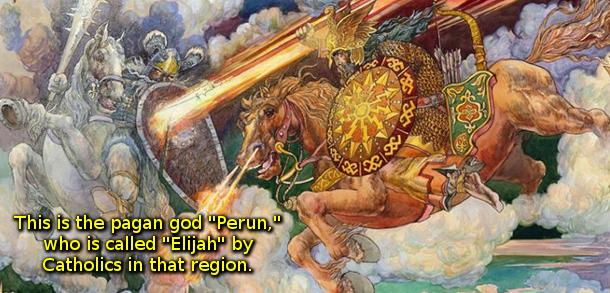
"The pagan Rus in all probability shared the Nordic gods and beliefs common to the people of Scandinavia. Pagan Slavs worshipped Perun, the god of lightning and thunder. The Rus probably identified him with Thor, the Viking god of rain and thunder. The Rus also believed in good and evil spirits among the wood and river spirits... The conversion to Christianity [i.e. Catholicism], which happened earlier in the south closer to Constantinople and in urban areas,did not mean cessation [the stopping] of all pagan practices. Many Rus maintained a double faith, attending church [i.e. Catholic temples] yet continuing to participate in pagan festivals, such as summer solstice celebrations. With time the two faiths merged into one, as pagan mythological became identified with Christian historical figures. Perun was identified with the prophet Elijah, depicted as riding a fiery chariot. "
-Carl Waldman & Catherine Mason, Encyclopedia of European Peoples, Infobase Publishing, Vol. 2, 2006, p. 674, ISBN: 9781438129181
This is just one example to help demonstrate the point, and I will show more instances of this later, but the fact is that the Catholic Church has, from its very beginning, followed the tradition of Rome to adopt all pagan religions into one ecumenical (i.e. unified) organization. The practice of calling the same god or goddess by a variety of names from different cultures is a tradition witches are accustomed to:
"When envisioning the Goddess and God, many of the Wicca see them as well-known deities from ancient religions. Diana, Pan, Isis, Hermes, Hina, Tammuz, Hecate, Ishtar, Cerridwen, Thoth, Tara, Aradia, Artemis, Pele, Apollo, Kanaloa, Bridget, Helios, Bran, Lugh, Hera, Cybele, Inanna, Maui, Ea, Athena, Lono, Marduk--the list is virtually endless . Many of these deities, with their corresponding histories, rites and mythic information furnish the concept of deity for Wiccans."
-Scott Cunningham, Wicca: A Guide for the Solitary Practitioner, Llewellyn Worldwide, 2010, ISBN: 9780738717159; Cunningham practiced witchcraft for over twenty years, and even after his death in 1993, is still highly regarded as an expert in the craft.
Thus, it was not that paganism secretly infiltrated Catholicism and shed a negative light on it (as most Catholics like to claim), but rather, Catholicism was inherently pagan from the very beginning, and we will see more evidence of this in later chapters. Their goddess "Mary" is one of the many names for pagan goddesses, and Catholics have, in a blasphemous manner, attributed the holy name of Jesus to their false god. Christians need to understand that when members of the Catholic Church say the name "Jesus," they are not referring to the Lord Jesus Christ of Scripture, nor when they say "Mary," are they referring to the Mary talked about in the Bible, but rather, they worship the same gods as the pagans of Rome. (The name "Mary" has become just another name for the goddess of witches, and I will demonstrate that in chapter six.)
It would take many volumes of books to talk about every aspect of political debate and religious heresy that was going on at the time the Roman Catholic Church was formed, which was the claimed purpose of forming an "ecumenical church," or in other words, they claimed a corporate church under Rome was necessary to dispel false doctrines. For example, Arianism was a belief picked up by a large number of heretics that claimed Jesus Christ was a created being, but not God Himself (which is what Jehovah's Witnesses believe today); however, for the purpose of this teaching, such political matters are meaningless because there have always been false doctrines proposed by false prophets for the past six thousand years of history. What matters is that the Council of Nicaea claimed to establish a set of beliefs that would be permanently labeled as "Christian" doctrine, but this was done under the pretense of bringing all under the authority of Rome, and as we will find out in later chapters, the path that begins in pagan idolatry only ends in death and destruction.
Though Catholics (and other heretical church organizations around the world) will typically praise the Council of Nicaea, the newly formed Catholic Church was the beginning of centuries of torture and death against those born again in Christ. (We will learn more about that in chapter eight.) The Council developed what is known as the "Nicene Creed," which states:
"I believe in one God, the Father almighty, maker of heaven and earth, of all things visible and invisible. I believe in one Lord Jesus Christ, the Only Begotten Son of God, born of the Father before all ages. God from God, Light from Light, true God from true God, begotten, not made, consubstantial with the Father; through him all things were made. For us men and for our salvation he came down from heaven, and by the Holy Spirit was incarnate of the Virgin Mary, and became man. For our sake he was crucified under Pontius Pilate, he suffered death and was buried, and rose again on the third day in accordance with the Scriptures. He ascended into heaven and is seated at the right hand of the Father. He will come again in glory to judge the living and the dead and his kingdom will have no end. I believe in the Holy Spirit, the Lord, the giver of life, who proceeds from the Father and the Son, who with the Father and the Son is adored and glorified, who has spoken through the prophets. I believe in one, holy, catholic and apostolic Church. I confess one Baptism for the forgiveness of sins and I look forward to the resurrection of the dead and the life of the world to come. Amen."
-Encyclopaedia Britannica, "Nicene Creed," retrieved Nov 17, 2017, [britannica.com/topic/Nicene-Creed]
Of course, if you have been born again in the Lord Jesus Christ, you may have found yourself in agreement with all of that quote. I agree with it as well. However, the problem is not profession of belief because even the devils believe these things, and those devils can transform themselves to appear to be the ministers of righteousness; rather, the problem is a lack of righteous judgment in which we look at the fullness of a man's doctrine, and the fruits he produces, to discern truth from falsehood, which means once we judge the fullness of what they say and do, we will understand that the members of the Nicene Council, just as all Catholics today, ddi not believe in that creed as it is written.
Thou believest that there is one God; thou doest well:
the devils also believe, and tremble.
-James 2:19
For such are false apostles, deceitful workers, transforming themselves into the apostles of Christ. And no marvel; for Satan himself is transformed into an angel of light. Therefore it is no great thing if his ministers also be transformed as the ministers of righteousness; whose end shall be according to their works.
-2 Corinthians 11:13-15
Judge not according to the appearance, but judge righteous judgment.
-John 7:24
(Read "Unbiblical Cop-Outs: Don't Judge Me!" here at creationliberty.com for more details.)
judge (v): to compare facts or ideas, and perceive their agreement or disagreement, and thus to distinguish truth from falsehood
(See 'judge', American Dictionary of the English Language, Noah Webster, 1828, retrieved Aug 22, 2020, [webstersdictionary1828.com])
Then Jesus said unto them, Take heed and beware of the leaven of the Pharisees and of the Sadducees... Then understood they how that he bade them not beware of the leaven of bread, but of the doctrine of the Pharisees and of the Sadducees.
-Matthew 16:6-12
A little leaven leaveneth the whole lump.
-Galatians 5:9
(Read "False Converts & Eternal Security" here at creationliberty.com for more details.)
This people draweth nigh unto me with their mouth, and honoureth me with their lips; but their heart is far from me.
-Matthew 15:8
Ye shall know them by their fruits. Do men gather grapes of thorns, or figs of thistles? Even so every good tree bringeth forth good fruit; but a corrupt tree bringeth forth evil fruit.
-Matthew 7:16-17
Woe unto you, scribes and Pharisees, hypocrites! for ye are like unto whited sepulchres, which indeed appear beautiful outward, but are within full of dead men's bones, and of all uncleanness.
-Matthew 23:27
| Catholicism is nothing more than a transformation and fusion of witchcraft and idolatry. |
For example, the Catholic Church has restructured, rebuilt, and renamed many famous pagan sites around the world; one of those being the city of Aphrodisias (also called Stauropolis, Caria, and Geyre), a pagan Greek city in which Aphrodite, a pagan sex goddess, was worshipped. (One can only imagine the amount of fornication and sodomy that took place in that location.) The Catholic Church took possession of this location and renamed it "City of the Cross" because they wanted it to appear "Christian" to the masses, while at the same time honoring the site because of its pagan influence; thus, the Catholic Church is famous for taking wicked abominations against God, slapping a "jesus" label on them, and calling them "good."
(See Sheila D. Campbell, The Mosaics of Aphrodisias in Caria, PIMS, 1991, p. 33, ISBN: 9780888443670)
Woe unto them that call evil good, and good evil; that put darkness for light, and light for darkness; that put bitter for sweet, and sweet for bitter!
-Isaiah 5:20
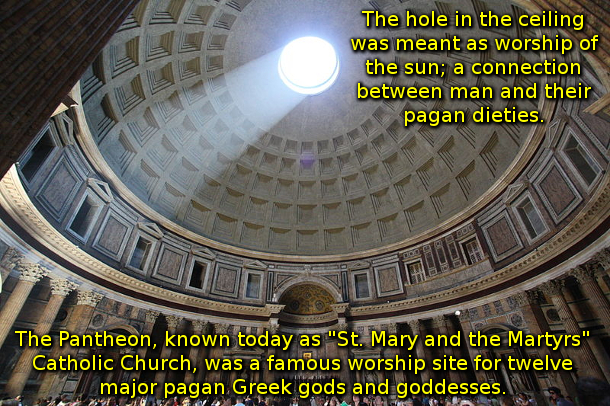
(See J. Bell, Bell's New Pantheon; or Historical Dictionary of the Gods, Demi-Gods, Heroes, self-published, Vol. 1, 1790, p. 226, [New York Public Library]; See also George Weigel, Roman Pilgrimage: The Station Churches, Basic Books, 2013, p. 387, ISBN: 9780465027699)
The argument you may hear from the typical Catholic is that these sites were "Christianized," but not only is Catholicism not Biblical Christianity, but there is no Biblical mandate to convert worldly, pagan traditions and inventions to Jesus. All throughout the Bible, the Lord God destroyed pagan culture because it had to be cleansed; NEVER did He instruct the Jews or Christians to take what the pagans had created and use it for His glory.
And the LORD spake unto Moses in the plains of Moab by Jordan near Jericho, saying, Speak unto the children of Israel, and say unto them, When ye are passed over Jordan into the land of Canaan; Then ye shall drive out all the inhabitants of the land from before you, and destroy all their pictures, and destroy all their molten images, and quite pluck down all their high places:
-Numbers 33:50-52
And when the LORD thy God shall deliver them before thee; thou shalt smite them, and utterly destroy them; thou shalt make no covenant with them, nor shew mercy unto them... But thus shall ye deal with them; ye shall destroy their altars, and break down their images, and cut down their groves, and burn their graven images with fire.
-Deuteronomy 7:2-5
(Read "Abortion: Paganism, Satanism, Sacrifices, and Witchcraft" here at creationliberty.com for more details.)
A good tree cannot bring forth evil fruit, neither
can a corrupt tree bring forth good fruit.
-Matthew 7:18
In another example, Pope Paul VI released an official decree called Nostra Aetate (i.e. In This Age of Ours), which states clearly that other pagan religions, like Buddhism and Hinduism, are accepted in the Catholic Church, and that these other religions contain a path to perfection, illumination, and truth in philosophy:
"Thus, inHinduism men explore the divine mystery and express it both in the limitless riches of myth and theaccurately defined insights of philosophy . They seek release from the trials of the present life by ascetical practices [i.e. religious practices of self-denial, living in poverty], profound meditation andrecourse to God in confidence and love .Buddhism in its various forms testifies to the way of life by which men can, with confidence and trust,attain a state of perfect liberation and reach supreme illumination eitherthrough their own efforts or by the aid of divine help. So, too,other religions which are found throughout the world attempt in their own ways to calm the hearts of men by outlining a program of life covering doctrine, moral precepts and sacred rites. The Catholic Church rejects nothing of what is true and holy in these religions. "
-Pope Paul VI, "Declaration on the Relation of the Church to Non-Christian Religions: Nostra Aetate," Oct 28, 1965, retrieved July 25, 2018, [https://www.vatican.va/archive/hist_councils/ii_vatican_council/documents/vat-ii_decl_19651028_nostra-aetate_en.html]
As we can see, the Catholic Church has always embraced pagan doctrines and beliefs, just as Rome did. There is nothing true or holy in these false religions with their pagan gods, but the Catholic Church, being of like-mind with their wicked doctrines, declares the heathen to be "brethren," and to that point, I would not disagree; meaning that Hinduism, Buddhism, Islam, and every other flavor of pagan doctrine in between, are all yoked together with the wicked Catholic Church under the leadership of the Devil, and we born again Christians should be sanctified (divided) from them.
(Read "Islam: Religion of Terror" here at creationliberty.com for more details.)
We will see more examples in subsequent chapters that the Catholic Church has been one of the world's primary beacons of fusing paganism with so-called "Christianity," and sadly, the modern-day church buildings and churchgoers have adopted their traditions. From holidays, to ceremonies, building construction, to clergy—most of what we see in the modern "evangelical" or "protestant" church building denominations has been adopted from pagan Rome through the Catholic Church, but before we get to all that, I believe it is best that we start by looking at their doctrine.
(Read "Denominations Are Unbiblical" here at creationliberty.com for more details.)
The purpose of this chapter was to demonstrate that the Catholic Church had a pagan root of witchcraft, and that they maintain those traditions to this day; therefore, as we will see later, it still has the pagan fruit of witchcraft. However, without knowing any history, we can discern the evil of the Catholic Church by simply looking at its doctrine and comparing it with the Word of God.
But they that will be rich fall into temptation and a snare, and into many foolish and hurtful lusts, which drown men in destruction and perdition. For the love of money is the root of all evil: which while some coveted after, they have erred from the faith, and pierced themselves through with many sorrows. But thou, O man of God, flee these things; and follow after righteousness, godliness, faith, love, patience, meekness.
-1 Timothy 6:9-11
purgatory (n): (Lat., "purgare", to make clean, to purify) in accordance with Catholic teaching is a place or condition of temporal [i.e. temporary] punishment for those who, departing this life in God's grace, are, not entirely free from venial faults, or have not fully paid the satisfaction [i.e. debt] due to their transgressions
(See Edward Hanna, "Purgatory," The Catholic Encyclopedia, Robert Appleton Company, Vol. 12, 1911, retrieved Nov 22, 2017, [newadvent.org/cathen/12575a.htm])
Catholicism claims that God's grace, which is supposed to be obtained through repentance (i.e. grief and godly sorrow of wrongdoing) and faith on the blood of Jesus Christ, is NOT enough to pay the debt of sin, and that is completely contradictory to what the Bible teaches us:
Now to him that worketh is the reward not reckoned of grace, but of debt. But to him that worketh not, but believeth on him that justifieth the ungodly, his faith is counted for righteousness.
-Romans 4:4-5
And if by grace, then is it no more of works: otherwise grace is no more grace. But if it be of works, then is it no more grace: otherwise work is no more work.
-Romans 11:6
grace (n): favor; good will; kindness; the free unmerited love and favor of God
(See 'grace', American Dictionary of the English Language, Noah Webster, 1828, retrieved Mar 15, 2018,[webstersdictionary1828.com])
| The Bible teaches us it is impossible to work for grace; we either have one or the other, but we cannot have both. |
When discussing the doctrine of Scripture, I would normally take readers to the section of the Bible that talks about the subject, but in this case, there is no Scriptural backing for purgatory; or in other words, the Catholic Church is not getting this idea from any known verse of Scripture. There is nowhere in the Bible that even remotely mentions such an idea as purgatory, but oddly enough, the Council of Trent in 1545 (i.e. the 19th ecumenical meeting of Catholic leaders to establish their official doctrine) claimed that there was Scriptural backing for purgatory:
"Whereas the Catholic Church, instructed by the Holy Ghost, hasfrom the Sacred Scriptures and the ancient tradition of the Fathers taught in Councils and very recently in this General Councilthat there is a Purgatory , and thatthe souls therein detained are helped by the suffrages [series of prayers] of the Faithful, but principally by the acceptable Sacrifice of the altar ; the Holy Synod [governing body] enjoins on the Bishops that they diligentlyendeavor to have the sound doctrine of the Fathers in Councils regarding Purgatory everywhere taught and preached, held and believed by the Faithful ."
-Council of Trent, Session XXV, quoted by Francis J. Ripley, This Is the Faith: A Complete Explanation of the Catholic Faith, TAN Books, 1999, ISBN: 9781618901613; Ripley was a life-long Catholic and Jesuit priest.
There are a number of blatantly false statements that were made by the Council of Trent, the first being that the "
There is a popular Catholic magazine called Catholic Answers, which is officially approved by bishops of the Catholic Church, that says the question of purgatory is one of the "most common single question[s]" they receive at conferences and via email, so Catholic author Tim Staples (priest and graduate of Catholic theology at Mount St. Mary's Seminary in Maryland) attempts to answer it. He first states what the Catechism of the Catholic Church (official manual/rulebook of the Catholic Church) says about purgatory, so let's read it from the Vatican website:
"All who die in God's grace and friendship, but still imperfectly purified, are indeed assured of their eternal salvation; butafter death they undergo purification, so as to achieve the holiness necessary to enter the joy of heaven ."
-Catechism of the Catholic Church, "III. The Final Purification, or Purgatory: 1030," retrieved Nov 22, 2017, [https://www.vatican.va/archive/ENG0015/__P2N.HTM]
After reading this quote, I have a question: How do you know if you are in God's grace and friendship? Of course, the Bible answers that question, as I will demonstrate later, but after thoroughly researching Catholicism, it seems that Catholics cannot answer that question, which is why Catholic Answers gets so many inquiries about it.
Furthermore, Catholic Answers offers what is known as an 'oxymoron':
oxymoron (n): a figure of speech by which a locution produces an incongruous, seemingly self-contradictory effect, as in "cruel kindness" or "to make haste slowly"
(See 'oxymoron', Random House Dictionary, 2020, [dictionary.com]; See also Collins English Dictionary, 10th Edition, William Collins Sons & Co, 2012)
pure (adj): free from moral defilement; without spot; not sullied or tarnished; incorrupt
(See 'pure', American Dictionary of the English Language, Noah Webster, 1828, retrieved Aug 31, 2018, [webstersdictionary1828.com])
The following diagram shows the difference between Biblical doctrine and Catholic doctrine:
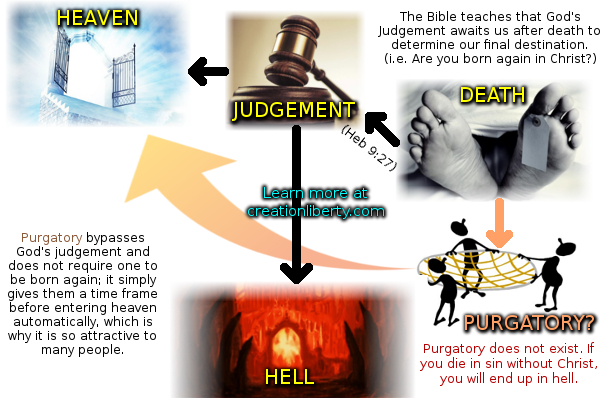
And as it is appointed unto men once to die, but after this the judgment:
-Hebrews 9:27
| Purgatory is an attractive doctrine to many people because it bypasses the Judgment of God. |
Tim Staples of Catholic Answers continues to give more details:
"Scripture is very clear when it says, "But nothing unclean shall enter [heaven]" (Rev. 21:27). Hab. 1:13 says, "You [God]... are of purer eyes than to behold evil and cannot look on wrong..."How many of us will be perfectly sanctified at the time of our deaths? I dare say most of us will be in need of further purification in order to enter the gates of heaven after we die, if, please God, we die in a state of grace."
-Tim Staples, "Is Purgatory in the Bible?" Catholic Answers, Jan 17, 2014, retrieved Nov 23, 2017, [catholic.com/magazine/online-edition/is-purgatory-in-the-bible]
As a side note, the Catholic Church has been corrupting the Word of God for nearly two millennia, and it was from their deceptive works that nearly all of the modern-day corrupt bible versions were created. That is a topic that I will not be able to cover in this book, and I have a separate book here at creationliberty.com where I cover that subject in much more detail.
(Read Why Christians Should Study The King James Bible here at creationliberty.com for more details on the history of bible versions, and how all of the modern versions have a foundation of Catholic corruption.)
There are two general ways the word 'sanctify' is used in Scripture. One meaning is "to purify," and the other meaning is "to set apart for a holy use," which is important to understand so we can clearly point out Staples' heresy:
sanctify (v): 1. in a general sense, to cleanse, purify or make holy
2. to separate, set apart or appoint to a holy, sacred or religious use
(See 'sanctify', American Dictionary of the English Language, Noah Webster, 1828, retrieved Aug 29, 2020, [webstersdictionary1828.com])
But if we walk in the light, as he is in the light, we have fellowship one with another, and
-1 John 1:7
deny (v): to contradict; to gainsay [oppose]; to declare a statement or position not to be true
(See 'deny', American Dictionary of the English Language, Noah Webster, 1828, retrieved June 28, 2023, [webstersdictionary1828.com])
Sanctify them through thy truth: thy word is truth. As thou hast sent me into the world, even so have I also sent them into the world. And for their sakes I sanctify myself, that they also might be sanctified through the truth.
-John 17:17-19
If we confess our sins, he is faithful and just to forgive us our sins, and to cleanse us from all unrighteousness.
-1 John 1:9
Not only does the Bible tell us that God sanctifies us wholly, without the need for an imaginary safety net, the Bible also tells us that Christ sanctified us ONCE through His sacrifice on the cross. This means that, for those of us who have been born again in Jesus Christ, there is no need for purgatory because Christ is our safety net.
By the which will we are sanctified through the offering of the body of Jesus Christ once for all.
-Hebrews 10:10
And the very God of peace sanctify you wholly; and I pray God your whole spirit and soul and body be preserved blameless unto the coming of our Lord Jesus Christ. Faithful is he that calleth you, who also will do it.
-1 Thessalonians 5:23-24
After making his fallacious statements, Staples says:
"In light of this, the truth about Purgatory is almost self-evident to Catholics. "
-Tim Staples, "Is Purgatory in the Bible?" Catholic Answers, Jan 17, 2014, retrieved Nov 23, 2017, [catholic.com/magazine/online-edition/is-purgatory-in-the-bible]
So putting his argument into perspective, Staples first admitted there is no direct evidence for purgatory, Biblical or otherwise, but then argues that Catholics should believe it anyway. Essentially, he is arguing the NEED for Catholics to have purgatory, rather than providing the Scriptural evidence for it, or in other words, Staples is arguing that you must first presuppose purgatory is true, and then it will suddenly make sense to you. That is absurd, and I thank Mr. Staples for helping me prove my point because when he says purgatory is "self-evident," he is offering his readers/listeners an authoritative slap in the face, telling them it needs no explanation, and he will not provide them with one.
self-evident (adj): evident without proof or reasoning
(See 'self-evident', American Dictionary of the English Language, Noah Webster, 1828, retrieved Nov 23, 2017,[webstersdictionary1828.com])
To that, I emphatically respond: "No." I only trust in the Living God who is worthy of trust.
Thus saith the LORD; Cursed be the man that trusteth in man, and maketh flesh his arm, and whose heart departeth from the LORD... Blessed is the man that trusteth in the LORD, and whose hope the LORD is.
-Jeremiah 17:5-7
He refers to the book of Maccabees, which is an "apocryphal" book that is not the Word of God. The word 'apocryphal' comes from the word 'apocrypha':
apocryphal (adj): doubtful authorship or authenticity
(See 'apocryphal', Random House Dictionary, 2018, [dictionary.com]; See also Collins English Dictionary, 10th Edition, William Collins Sons & Co, 2012)
For example, in 2nd Maccabees, it says:
"It is therefore a holy and wholesome thought to pray for the dead, that they may be loosed from sins. "
-2 Maccabees 12:46, Douay-Rheims 1899 American Edition, Bible Gateway, retrieved Nov 23, 2017, [biblegateway.com/passage/?search=2+Maccabees+12%3A46&version=DRA]
Thus, Maccabees teaches that we can be justified to enter the Kingdom of God by the works of others; meaning that someone else does the works of prayer to get you a ticket to heaven. That contradicts the Word of God:
Therefore by the deeds of the law there shall no flesh be justified in his sight: for by the law is the knowledge of sin. But now the righteousness of God without the law is manifested, being witnessed by the law and the prophets; Even the righteousness of God which is by faith of Jesus Christ unto all and upon all them that believe: for there is no difference: For all have sinned, and come short of the glory of God; Being justified freely by his grace through the redemption that is in Christ Jesus:
-Romans 3:20-24
Staples goes on to claim that, because Maccabees says this, therefore, the practice of "praying for the dead" was done commonly in Israel. I would not argue against that point because if you read the Old Testament, most of it is rebuke of the wicked deeds of Israel, how they turned their backs on God and worshipped the gods/goddesses of the pagans, and therefore, they also adopted pagan traditions, just like the Catholic Church has done, so it would make sense if Israel adopted unbiblical practices, such as praying for the dead.
However, Staples does not provide any sources for his claim (i.e. he is just asserting it, as if his word is truth), and furthermore, just because the Jews may have done something foolish, that does not automatically mean God approved of it. Worse still, Staples says, "
Again, the Bible addresses this matter very simply:
And as it is appointed unto men once to die, but after this the judgment:
-Hebrews 9:27
Thus saith the LORD, Learn not the way of the heathen, and be not dismayed at the signs of heaven; for the heathen are dismayed at them.
-Jeremiah 10:2
And he did that which was evil in the sight of the LORD, after the abominations of the heathen, whom the LORD cast out before the children of Israel.
-2 Kings 21:2
Agree with thine adversary quickly, whiles thou art in the way with him; lest at any time the adversary deliver thee to the judge, and the judge deliver thee to the officer, and thou be cast into prison. Verily I say unto thee, Thou shalt by no means come out thence, till thou hast paid the uttermost farthing.
-Matthew 5:25-26
cherry-pick (v): to choose or take the best or most profitable of (a number of things), esp for one's own benefit
(See 'cherry-pick', Random House Dictionary, 2023, [dictionary.com]; See also Collins English Dictionary, 10th Edition, William Collins Sons & Co, 2012)
For Christians, we need to clarify exactly how the Word of God should be studied, and thankfully, the Lord instructed us in the Bible about how to study His Word. God said that He gives knowledge and understanding to those who follow this instruction concerning the Bible:
Whom shall he teach knowledge? and whom shall he make to understand doctrine? them that are weaned from the milk, and drawn from the breasts. For precept must be upon precept, precept upon precept; line upon line, line upon line; here a little, and there a little:
-Isaiah 28:9-10
We should also note a VERY important point that God made in these verses, namely, His explanation of WHY He structured the Bible in this way:
But the word of the LORD was unto them precept upon precept, precept upon precept; line upon line, line upon line; here a little, and there a little; that they might go, and fall backward, and be broken, and snared, and taken.
-Isaiah 28:13
Having a form of godliness, but denying the power [i.e. authority] thereof: from such turn away. For of this sort are they which creep into houses, and lead captive silly women laden with sins, led away with divers lusts, Ever learning, and never able to come to the knowledge of the truth.
-2 Timothy 3:5-7
But the natural man receiveth not the things of the Spirit of God: for they are foolishness unto him: neither can he know them, because they are spiritually discerned.
-1 Corinthians 2:14
For I say unto you, That except your righteousness shall exceed the righteousness of the scribes and Pharisees, ye shall in no case enter into the kingdom of heaven.
-Matthew 5:20
Ye have heard that it was said by them of old time, Thou shalt not kill; and whosoever shall kill shall be in danger of the judgment: But I say unto you, That whosoever is angry with his brother without a cause shall be in danger of the judgment: and whosoever shall say to his brother, Raca, shall be in danger of the council: but whosoever shall say, Thou fool, shall be in danger of hell fire. Therefore if thou bring thy gift to the altar, and there rememberest that thy brother hath ought against thee; Leave there thy gift before the altar, and go thy way; first be reconciled to thy brother, and then come and offer thy gift.
-Matthew 5:21-24
The parts Jesus mentioned about bringing gifts to the altar are talking about the Old Testament traditions of Jewish society, not a secret place Catholics go to work out their sins. In context, Jesus is telling the Jews that if you have done a wrong (committed a crime) against your brother and offended him, then it would be senseless to bring your gift to God until you have righted that wrong, and that when you go to your brother with repentance (i.e. sorrow of your wrongdoing), you need to agree with him on what he says, otherwise, he may choose to call the guards and have the judge send you to prison.
A farthing is money, which means this is referring to a fine that must be paid for however much you must pay for the offense of the crime you did against your brother, to provide for him restitution for his losses. In nearly every governmental system around the world, when it concerns a monetary penalty, there is no forgiveness granted until that fine is paid, and so what Jesus was saying in this instance is that just because you might be saved by the Lord Jesus Christ, does not mean you are relieved of your duties as a citizen under the government of the land.
(Read "Should Christians Submit to Governing Authority?" here at creationliberty.com for more details.)
There is more evidence of this context in the verses that follow, for example, in verses 27-28, Jesus talked about the law of adultery, in verses 31-32, Jesus talked about the law concerning divorce, and in verses 33-34, Jesus talked about the law concerning the swearing of oaths. In all these examples, Jesus pointed out what the Jews heard in the law, and then told them how they should live with charity and humility; thus, the man who brought his gift to the altar was humbling himself before God in repentance, but Jesus is telling him that he should not forget the man he wronged because God will not save him from a prison cell (on this earth, in society, in the flesh, not a "spiritual" prison) if he does not repent to those he has wronged.
So the typical Catholic will use these two verses, cherry-picked out of their context to try and justify their belief in an imaginary spiritual limbo state where you go to work out your sins so you can get into heaven eventually, and to help soften the sufferings of purgatory, they believe that their time of punishment can be cheated if you can get someone else still alive on earth to pray, flog themselves, or in many instances, give the Catholic Church money. (We will discuss more about that in chapter four.) Again, because they do not have their faith in the Lord Jesus Christ, and instead put their faith in their own works, purgatory is their only salvation, but because it does not exist, there is no salvation for Catholics, and thus, millions and billions of Catholics have died, and will die, with their hopes in a false system that will lead them to hell.
But it is not over because Staples goes on to claim there is an even more clear text in Scripture that proves purgatory, and that is in 1 Corinthians 3:
For other foundation can no man lay than that is laid, which is Jesus Christ. Now if any man build upon this foundation gold, silver, precious stones, wood, hay, stubble; Every man's work shall be made manifest: for the day shall declare it, because it shall be revealed by fire; and the fire shall try every man's work of what sort it is. If any man's work abide which he hath built thereupon, he shall receive a reward. If any man's work shall be burned, he shall suffer loss: but he himself shall be saved; yet so as by fire.
-1 Corinthians 3:11-15
For we are labourers together with God: ye are God's husbandry, ye are God's building. According to the grace of God which is given unto me, as a wise masterbuilder, I have laid the foundation, and another buildeth thereon. But let every man take heed how he buildeth thereupon.
-1 Corinthians 3:9-10
So in context, the works we do for the eternal Kingdom of God will be those of high value, metaphorically represented by gold, silver, and precious stones, but the works we do that are worldly are metaphorically represented by low-value substances like wood, hay, and stubble. The high-value substances are metaphorically referenced because they are not destroyed by fire, but the low-value substances are destroyed by fire, and therefore, whatever high-value substances are left over is how God will judge what reward we receive, meaning that those who worked righteousness by putting in the time and effort, being charitable and teaching the truth of His Word, will receive great reward, while those who did little will receive little reward.
However, ONLY those who have laid the foundation in Jesus Christ will be rewarded because there is no other foundation a man can lay but in Christ. That means when a Catholic, who may have done many works (like alms and charity), puts all his works into the fire, there is no foundation to put the works on, and therefore, it is the same as him never having done any good works in his life; therefore he will also fall into the fire. When a man chooses to lay his foundation in purgatory, and teaches others to do so, there will be nothing to try by fire because there was no foundation laid in the first place, and thus, the context of 1 Corinthians 3 rebukes the false doctrine of purgatory.
Rather than giving an answer, Staples ends his article by asking a question to cast doubt:
"If these 'works' do not represent sins and imperfections, why would they need to be eliminated? "
-Tim Staples, "Is Purgatory in the Bible?" Catholic Answers, Jan 17, 2014, retrieved Nov 23, 2017, [catholic.com/magazine/online-edition/is-purgatory-in-the-bible]
Of course, his answer is "purgatory," but that is not a Biblical answer. This is exactly the method Satan used in the Garden of Eden to trick Eve; he simply asked her questions to try and cast doubt. (Gen 3:1) Staples does not want his readers to know there is a Biblical answer in the context itself. He definitely does not want them to know that those verses rebuke purgatory, and it serves as a warning that your works will not be considered at all if you have no foundation laid in the Lord Jesus Christ, meaning, this is a warning to Catholics to flee from an organization that falsely calls itself "Christian," and come to the Lord Jesus Christ directly.
There are other problem verses that Catholic Answers magazine and the Catholic Church do not like to bring up when discussing this topic. For example, Jesus Christ clearly stated:
For if ye forgive men their trespasses, your heavenly Father will also forgive you: But if ye forgive not men their trespasses, neither will your Father forgive your trespasses.
-Matthew 6:14-15
But God commendeth his love toward us, in that, while we were yet sinners, Christ died for us. Much more then, being now justified by his blood, we shall be saved from wrath through him.
-Romans 5:8-9
No man can serve two masters: for either he will hate the one, and love the other; or else he will hold to the one, and despise the other. Ye cannot serve God and mammon.
-Matthew 6:24
And he [i.e. Jesus Christ] is the propitiation for our sins: and not for ours only, but also for the sins of the whole world.
-1 John 2:2
propitiation (n): the atoning sacrifice offered to God to assuage his wrath and gain his favor
(See 'propitiation', American Dictionary of the English Language, Noah Webster, 1828, retrieved Nov 23, 2017,[webstersdictionary1828.com])
The Catholic Church teaches that grace must be earned by works, by the sufferings done in purgatory, but the Bible says that grace must come through faith, and not of our works:
For by grace are ye saved through faith; and that not of yourselves: it is the gift of God: Not of works, lest any man should boast.
-Ephesians 2:8-9
"If any one saith , that, after the grace of Justification has been received, to every penitent sinner the guilt is remitted, and the debt of eternal punishment is blotted out in such wise, thatthere remains not any debt of temporal punishment to be discharged either in this world, or in the next in Purgatory, before the entrance to the kingdom of heaven can be opened (to him); let him be anathema. "
-James Waterworth, Canons and Decrees of the Sacred and Ecumenical Council of Trent, 2003 Reprint, Kessinger Publishing, Canon #30, p. 48, ISBN: 9780766138414; See also Council of Trent, "On Justification," Canon #30, retrieved Aug 31, 2018, [thecounciloftrent.com/ch6.htm]
The common argument from Catholics is that the word "anathema" does not mean damnation to hell, but that is simply their way of sugar-coating the truth of what they believe and teach.
anathema (n): a person detested or loathed; accursed to damnation or destruction
(See 'anathema', Random House Dictionary, 2017, [dictionary.com]; See also Collins English Dictionary, 10th Edition, William Collins Sons & Co, 2012)
Catholics may not like that, but it is a fact of Catholic doctrine, and one that is rarely talked about within Catholic circles. They believe that if you do not believe in purgatory, you are an anathema, and if you are an anathema, you go to hell.
The Catechism (i.e. official rulebook) of the Catholic Church clearly states:
"The teaching of the Church affirms the existence of hell and its eternity.Immediately after death the souls of those who die in a state of mortal sin descend into hell, where they suffer the punishments of hell, 'eternal fire.' The chief punishment of hell is eternal separation from God, in whom alone man can possess the life and happiness for which he was created and for which he longs."
-Catechism of the Catholic Church, Part 1, Section 2, Chapter 3, Article 12, "IV Hell," Canon #1035, retrieved Mar 21, 2018, [http://www.scborromeo.org/ccc/p123a12.htm]; Read "Hell is Real And Many People Are Going There" here at creationliberty.com for more details.)
As we will learn in the next chapter, according to the Catholic Catechism, in order to gain God's grace, you must be a part of the Catholic Church. So, to anathemize a person means they are no longer accepted within the Catholic Church, and therefore, because they are not in God's grace, they would end up in hell for eternity.
The contradiction here is that even though Catholics have no idea if they are in God's grace or not, meaning that they have no idea if they will end up in heaven when they die, they will quickly anathemize people like me (assuming they follow Catholic canon), condemning me to hell for telling people they should follow Jesus Christ in His Word, but then turn around and say that atheists will end up in heaven after they spend enough time in purgatory. If you think that is absurd, then I agree with you, and though some readers may have a hard time accepting that is what Catholicism teaches, we have only just begun to unravel their absurdities.
(Read "Everything You Need To Know About Atheism" here at creationliberty.com for more details.)
Charles Grondin, an ordained Catholic priest who also writes for Catholic Answers, responded to an inquiry, "
"If, however, because of circumstancesa sincere person is prevented from coming to belief in God, then his lack of faith is calledinvincible ignorance , and such a person would not be considered culpable. [deserving of blame]"
-Charles Grondin, "Is Purgatory in the Bible? (Can an Atheist Go To Heaven?)" Catholic Answers, Jan 24, 2017, retrieved Nov 24, 2017, [catholic.com/qa/can-an-atheist-go-to-heaven]
We will continue with Grondin's answer in a moment, but I have paused this quote to point out that the Bible teaches the opposite of what he just said. There is no such thing as "
For the wrath of God is revealed from heaven against all ungodliness and unrighteousness of men, who hold the truth in unrighteousness; Because that which may be known of God is manifest in them; for God hath shewed it unto them. For the invisible things of him from the creation of the world are clearly seen, being understood by the things that are made, even his eternal power and Godhead; so that they are without excuse: Because that, when they knew God, they glorified him not as God, neither were thankful; but became vain in their imaginations, and their foolish heart was darkened. Professing themselves to be wise, they became fools,
-Romans 1:18-22
Knowing this first, that there shall come in the last days scoffers, walking after their own lusts, And saying, Where is the promise of his coming? for since the fathers fell asleep, all things continue as they were from the beginning of the creation. For this they willingly are ignorant of, that by the word of God the heavens were of old, and the earth standing out of the water and in the water:
-2 Peter 3:3-5
For we must all appear before the judgment seat of Christ; that every one may receive the things done in his body, according to that he hath done, whether it be good or bad. Knowing therefore the terror of the Lord, we persuade men; but we are made manifest unto God; and I trust also are made manifest in your consciences.
-2 Corinthians 5:10-11
The Lord is not slack concerning his promise, as some men count slackness; but is longsuffering to us-ward, not willing that any should perish, but that all should come to repentance.
-2 Peter 3:9
"As Pope Pius XI [1922-1939] noted in Quanto conficiamur moerore: 'It is known to us and to you thatthose who are in invincible ignorance of our most holy religion, but who observe carefully the natural law, and the precepts graven by God upon the hearts of all men, and who being disposed to obey Godlead an honest and upright life [i.e. works-based doctrine], may, aided by the light of divine grace, attain to eternal life; for God who sees clearly, searches and knows the heart, the disposition, the thoughts and intentions of each, in his supreme mercy and goodnessby no means permits that anyone suffer eternal punishment, who has not of his own free will fallen into sin.' "
-Charles Grondin, "Is Purgatory in the Bible? (Can an Atheist Go To Heaven?)" Catholic Answers, Jan 24, 2017, retrieved Nov 24, 2017, [catholic.com/qa/can-an-atheist-go-to-heaven]
In short, the Catholic Church believes that atheists go to heaven so long as they do "good works" from a "sincere heart." Notice that there is no mention of the name of the Lord Jesus Christ, and that is because Catholics do not really believe in the Christian God of the Bible; rather, they believe in a different "god," and falsely call him "Jesus."
They believe that by good works, a man can enter heaven by being a righteous person, but the Bible tells us:
As it is written, There is none righteous, no, not one:
-Romans 3:10
For all have sinned, and come short of the glory of God;
-Romans 3:23
He that hath the Son hath life; and he that hath not the Son of God hath not life.
-1 John 5:12
Jesus saith unto him, I am the way, the truth, and the life: no man cometh unto the Father, but by me.
-John 14:6
In hope of eternal life, which God, that cannot lie, promised before the world began;
-Titus 1:2
Blessed are ye, when men shall revile you, and persecute you, and shall say all manner of evil against you falsely, for my sake.
-Matthew 5:11
(Read "The Biblical Understanding of Sanctification" here at creationliberty.com for more details.)
Be ye not unequally yoked together with unbelievers: for what fellowship hath righteousness with unrighteousness? and what communion hath light with darkness? And what concord hath Christ with Belial? or what part hath he that believeth with an infidel? And what agreement hath the temple of God with idols? for ye are the temple of the living God; as God hath said, I will dwell in them, and walk in them; and I will be their God, and they shall be my people. Wherefore come out from among them, and be ye separate, saith the Lord, and touch not the unclean thing; and I will receive you, And will be a Father unto you, and ye shall be my sons and daughters, saith the Lord Almighty.
-2 Corinthians 6:14-18
"Catholics shall not enter into any disputes or conference with non-Catholics, especially public ones, without the permission of the Holy See or in urgent case of the local Ordinary [Catholic bishop]."
-Stanislaus Woywod, The New Canon Law: A Commentary and Summary of the New Code of Canon Law, J.F. Wagner, 1918, p. 272-273, [Ohio State University]; Woywod was a Catholic priest and his preface was written by a professor of Canon Law at a Catholic University in Washington.
Please do not misunderstand, I give thanks to the Lord God if He has led any Catholics out there to read this book, but it is important for Catholics to understand that, just like any religious cult, the Catholic Church holds a tight grip over their members. Nonetheless, I would pray that Catholics continue to read more of this book, considering carefully what it is the Catholic Church really believes, to learn why the Catholic Church is so far from the Word of God.
mass (n): the celebration of the Eucharist
(See 'mass', Random House Dictionary, 2018, [dictionary.com]; See also Collins English Dictionary, 10th Edition, William Collins Sons & Co, 2012)
eucharist (n): the sacrament of Holy Communion; the sacrifice of the Mass
sacrament (n): the consecrated elements of the Eucharist, especially the bread; an outward sign combined with a prescribed form of words and regarded as conferring some specific grace upon those who receive it
consecrate (v): to make or declare sacred or hallowed in service of a deity
(See 'eucharist', 'sacrament' & 'consecrate', Random House Dictionary, 2018, [dictionary.com]; See also Collins English Dictionary, 10th Edition, William Collins Sons & Co, 2012)
transubstantiation (n): the changing of the elements of the bread and wine, when they are consecrated in the Eucharist, into the body and blood of Christ
(See 'transubstantiation', Random House Dictionary, 2018, [dictionary.com]; See also Collins English Dictionary, 10th Edition, William Collins Sons & Co, 2012)
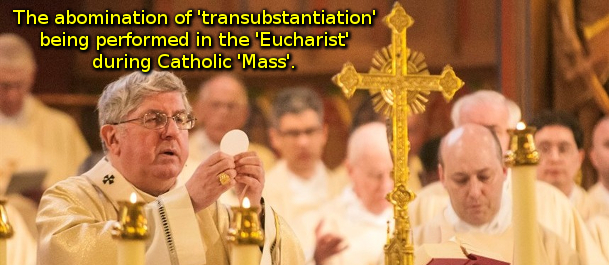
By consuming these things, they believe they receive the grace of God. How much grace did they get by performing these actions? I would be happy to include an official statement on this from the Catholic Church, but there is nothing to include because they have no idea, and furthermore, no priest or bishop has any idea how much "grace" they need to receive to get out of purgatory. However, they believe that if they keep going to mass over and over and over again, eventually, they will rack up enough grace points to enter heaven; very similar to a "rewards card" you might get at a restaurant, but the only difference is that, to get the reward in the Catholic Church, you have to repeat the same action an unspecified amount of times for the rest of your life.

The Catholic Catechism (i.e. the official rulebook of the Catholic Church) set forth by a council appointed and approved by Pope John Paul II in 1992, states:
"At the Last Supper, on the night he was betrayed, our Savior instituted the Eucharistic sacrifice of his Body and Blood. This he did in order to perpetuate the sacrifice of the cross throughout the ages until he should come again,"
-Catechism of the Catholic Church, Crown Publishing Group, 2nd Edition, 2012, ISBN: 9780307953704; See also Catechism of the Catholic Church, Part 2, Section 2, Chapter 1, Article 3, Canon #1323, retrieved Oct 4, 2023, [http://www.scborromeo.org/ccc/p2s2c1a3.htm]
perpetual (adj): continuing forever
(See 'perpetual', Random House Dictionary, 2018, [dictionary.com]; See also Collins English Dictionary, 10th Edition, William Collins Sons & Co, 2012)
And he took bread, and gave thanks, and brake it, and gave unto them, saying, This is my body which is given for you: this do in remembrance of me. Likewise also the cup after supper, saying, This cup is the new testament in my blood, which is shed for you.
-Luke 22:19
This act of consuming bread and wine from the Passover supper (commonly known as the "Last Supper") before Christ went to the cross is often referred to as "communion," based on 1 Corinthians 10:
The cup of blessing which we bless, is it not the communion of the blood of Christ? The bread which we break, is it not the communion of the body of Christ?
-1 Corinthians 10:16
And that he [Jesus] might reconcile both [Jew and Gentile] unto God in one body by the cross, having slain the enmity thereby:
-Ephesians 2:16
For by grace are ye saved through faith; and
that not of yourselves: it is the gift of God:
-Ephesians 2:8
And, having made peace through the blood of his cross, by him to reconcile all things unto himself; by him, I say, whether they be things in earth, or things in heaven.
-Colossians 1:20
Blotting out the handwriting of ordinances that was against us, which was contrary to us, and took it out of the way, nailing it to his cross;
-Colossians 2:14
"He [Jesus Christ]offered up to God the Father His own body and blood under the species of bread and wine; and, under the symbols of those same things , He delivered (His own body and blood) to be received by His apostles,"
-Council of Trent, Session XXII, Chapter I, "On the Institution of the Most Holy Sacrifice of the Mass," retrieved Mar 20, 2018, [thecounciloftrent.com/ch22.htm]
If what the Catholic Church just stated was true, then there was absolutely NO reason for Christ to go to the cross at all. If Christ gave His sacrifice of body and blood at the Passover feast with His disciples, then why did He need to offer His body and blood a second time at the cross? It does not make sense because the Bible tells us that Christ offered up Himself ONCE, but the Catholic Church contradicts the Bible by teaching Christ did this twice.
Who needeth not daily, as those high priests, to offer up sacrifice, first for his own sins, and then for the people's: for this he did once, when he offered up himself.
-Hebrews 7:27
By the which will we are sanctified through the offering of the body of Jesus Christ once for all. And
-Hebrews 10:10-14
"The Eucharist is above all else a sacrifice. It is the sacrifice of the Redemption and also the sacrifice of the New Covenant ,"
-Pope John Paul II, quoted by Steven J. Schloeder, Architecture in Communion: Implementing the Second Vatican Council through Liturgy and Architecture, Ignatius Press, 1998, p. 52, ISBN: 9780898706314
Again, Hebrews 10:11 states very simply that other sacrifices, like those done in the Catholic Mass, "can never take away sins," but the Catholic Church teaches the opposite. The Catholic Catechism declares:
"At the Last Supper , on the night he was betrayed,our Savior instituted the Eucharistic sacrifice of his Body and Blood . This he did in order toperpetuate [continue forever] the sacrifice of the cross throughout the agesuntil he should come again , and so to entrust to his beloved Spouse, the Church, a memorial of his death and resurrection: a sacrament of love, a sign of unity, a bond of charity,a Paschal [Passover] banquet 'in which Christ is consumed, the mind is filled with grace , and a pledge of future glory is given to us."
-Catechism of the Catholic Church, Part 2, Section 2, Chapter 1, Article 3, "The Sacraments of the Eucharist," Canon #1323, retrieved Oct 4, 2023, [http://www.scborromeo.org/ccc/p2s2c1a3.htm]
Earlier, we learned that 'perpetuate' means to "continue forever," so what the Catholic Church believes is that the sacrifice Christ made on the cross continues FOREVER IN THE CATHOLIC EUCHARIST; meaning they are offering new sacrifices continually in their Mass. This is false doctrine. As we just read, the Bible teaches clearly that Christ's sacrifice on the cross was done once, and that is enough; no other works, ceremonies, or sacrifices done by Catholic priests can offer salvation or grace, and by denying that Christ's one-time sacrifice was enough, Catholics deny Christ's sacrifice, or in short, if a Catholic believes and practices what the Catholic Church teaches, he/she will end up in hell without Christ.
In summary, because they believe the wine they drink is the LITERAL blood of Christ, the Catholic Church teaches that you must drink Christ's blood over and over in order to maintain eternal life. If you think about it, that is no different than the demonic concept of a vampire.
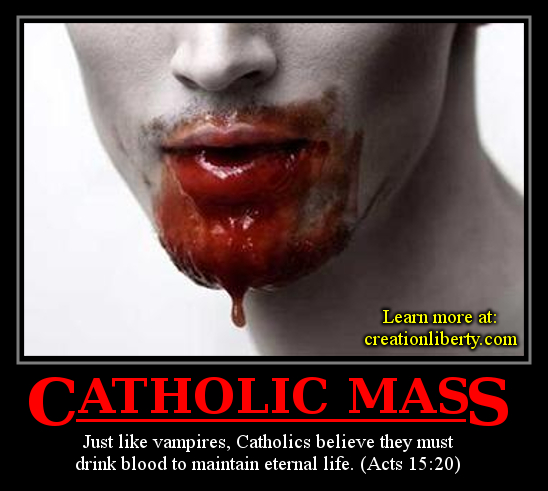
Even if they were drinking literal blood, the early church in the book of Acts established that we, as born-again Christians, were to avoid eating or drinking blood. This is one of the many ways we can know that Christ was speaking metaphorically when He said the fruit juice was His blood:
But that we write unto them, that they abstain from pollutions of idols, and from fornication, and from things strangled, and from blood.
-Acts 15:20
Every moving thing that liveth shall be meat for you; even as the green herb have I given you all things. But flesh with the life thereof, which is the blood thereof, shall ye not eat.
-Genesis 9:3-4
It shall be a perpetual statute for your generations throughout all your dwellings, that ye eat neither fat nor blood.
-Leviticus 3:17
If you find it nonsensical that a religious organization is teaching that you have to drink blood that is not really blood, but is claimed to be blood anyway, you are not alone. As I stated earlier, this is just the beginning of the many absurdities of the Catholic Church.
Let's imagine for a moment that the Lord Jesus Christ performed the miracle of turning water into wine, but He made it appear to be water by sight, taste, and smell; would they have still called it a miracle without the evidence that a miracle had taken place? Would the people have called it a miracle if Peter and John had, through the power of Christ, lifted up the lame man to walk, but under the appearance that he could not walk? No one would ever believe that a miracle had been performed without evidence that a miracle had occurred, and that shows us the extreme absurdity of Catholicism in their willingness to believe in a miracle without evidence.
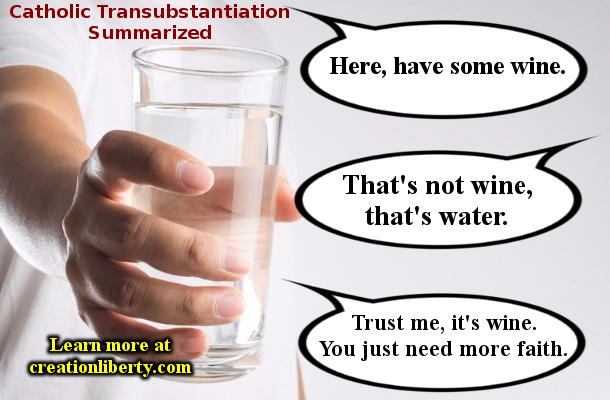
Where I come from, we call that a scam:
scam (n): a confidence game or other fraudulent scheme, especially for making a quick profit; swindle
(See 'scam', Random House Dictionary, 2020, [dictionary.com]; See also Collins English Dictionary, 10th Edition, William Collins Sons & Co, 2012)
Ye cannot drink the cup of the Lord, and the cup of devils: ye cannot be partakers of the Lord's table, and of the table of devils.
-1 Corinthians 10:21
Now the Spirit speaketh expressly, that in the latter times some shall depart from the faith, giving heed to seducing spirits, and doctrines of devils;
-1 Timothy 4:1
When the Lord Jesus Christ tells us that we born-again Christians are His "sheep" (John 10:27), this is meant for us to consider the similar manner in which a shepherd watches over his sheep; He does not mean we are literal sheep that have wool and must be literally herded around a meadow. When Christ said He is the door (John 10:7), are we to believe that He is literally made of wood and has hinges? It would be absurd to believe such things. Likewise, when Christ said the bread and wine were His body and blood, it is a metaphorical reference, not a literal one; it is His shed blood on the cross that is the literal sacrifice.
As we read earlier, the Bible states very clearly that God has reconciled men unto Himself by the CROSS, not by the cup, and I will quote this again for emphasis:
Having abolished in his flesh the enmity, even the law of commandments contained in ordinances; for to make in himself of twain one new man, so making peace; And that he might reconcile both unto God in one body by the cross, having slain the enmity thereby:
-Ephesians 2:15-16
"If any one saith, that, in the sacred and holy sacrament of the Eucharist, the substance of the bread and wine remains conjointly [combined; i.e. as a separate thing that is included together] with the body and blood of our Lord Jesus Christ, anddenieth that wonderful and singular conversion of the whole substance of the bread into the Body, and of the whole substance of the wine into the Blood-the species Only of the bread and wine remaining-which conversion indeed the Catholic Church most aptly calls Transubstantiation; let him be anathema. "
-Council of Trent, "Concerning the Most Holy Sacrament of the Eucharist," First Decree, Canon II, retrieved Mar 22, 2018, [thecounciloftrent.com/ch13.htm]
Simply put, the Council of Trent stated that if you do not believe that the Catholic priest transforms the wafer and wine into the LITERAL body and blood of Christ (without any evidence that a miracle has taken place), you are damned to hell. As we mentioned in the last chapter, an anathema results in death and damnation in hell because once someone is anathemized, then they are no longer part of the Catholic Church, and if they cannot do the sacraments of the Eucharist in the Catholic Church, then they cannot gain God's grace, and therefore, they cannot enter heaven. Even though the wafer and wine have not changed into anything else, if you do not believe that they are transformed into the LITERAL body and blood of Christ, the Catholic Church rejects you, and condemns you to hell.
Thus, Catholics are not trained to put their faith into the Word of God, but rather, they are trained to put their faith into the traditions and doctrines of men set forth by the Catholic decree. Catholics claim with their mouths to believe on Jesus Christ, but in practice, they believe on Catholic priests, and their hearts are far from Christ because they follow after the commandments of men:
This people draweth nigh unto me with their mouth, and honoureth me with their lips; but their heart is far from me. But in vain they do worship me, teaching for doctrines the commandments of men.
-Matthew 15:8
Blessed are ye, when men shall revile you, and persecute you, and shall say all manner of evil against you falsely, for my sake. Rejoice, and be exceeding glad: for great is your reward in heaven: for so persecuted they the prophets which were before you.
-Matthew 5:12
Blessed are ye, when men shall hate you, and when they shall separate you from their company, and shall reproach you, and cast out your name as evil, for the Son of man's sake.
-Luke 6:22
"The sacrifice of Christ and the sacrifice of the Eucharist are one single sacrifice:The victim is one and the same : the same now offers through the ministry of priests,who then offered himself on the cross; only the manner of offering is different . And since in this divine sacrifice which is celebrated in the Mass, the sameChrist who offered himself once in a bloody manner on the altar of the cross is contained andis offered in an unbloody manner ... this sacrifice is truly propitiatory."
-Catechism of the Catholic Church, "The Sacrificial Memorial of Christ and of His Body, The Church," Part 2, Section 2, Chapter 1, Article 3, Canon #1367, retrieved Mar 16, 2018, [scborromeo.org/ccc/p2s2c1a3.htm#1367]; See also Peter M. J. Stravinskas, Our Sunday Visitor's Catholic Encyclopedia, Our Sunday Visitor Publishing, 1998, The Eucharist, p. 390, ISBN: 9780879736699
Though the Catholic Catechism says Christ "
The bottom line is that they deny Christ's blood sacrifice because a man cannot be Biblically sound when he says a blood sacrifice is without blood. (i.e. "
And almost all things are by the law purged with blood; and without shedding of blood is no remission.
-Hebrews 9:22
And if it seem evil unto you to serve the LORD, choose you this day whom ye will serve; whether the gods which your fathers served that were on the other side of the flood, or the gods of the Amorites, in whose land ye dwell: but as for me and my house, we will serve the LORD.
-Joshua 24:15
"The fruits indeed of which oblation [sacrificial offering], ofthat bloody one [Christ on the cross] to wit [namely],are received most plentifully through this unbloody one [Catholic Mass]; so far isthis (latter) from derogating [inferior] in any way from that (former oblation) . Wherefore, not only for the sins, punishments, satisfactions, and other necessities of the faithful who are living, but also for those who are departed in Christ, and who are not as yet fully purified , is it rightly offered, agreebly to a tradition of the apostles."
-Council of Trent, "On The Sacrifice Of The Mass," Doctrine, Chapter II, retrieved Mar 22, 2018, [thecounciloftrent.com/ch22.htm]
The Catholic Church loves making things as complex as possible so the average reader cannot understand it, so to make sure we understand what the Council of Trent just said, allow me to summarize it: They claimed that Christ's blood shed on the cross is received through the Catholic Mass, and that the Mass/Eucharist of the Catholic Church is equivalent to Christ shedding His blood on the cross, but neither of those claims is Biblical. Furthermore, they claim that those who have died and gone to their fabled "purgatory" benefit from performing the ritual of the Catholic Mass/Eucharist, and that it must be done over and over again to pay for the sins of the dead, which means, as I have already stated many times before, they do not believe on the cleansing blood of Jesus Christ.
| The Catholic Eucharist is the religious version of the Social Security scam. Not only do you have to pay for your own, but you also have to pay for the generation who came before you. |
To say that there is another sacrifice required, outside of the blood sacrifice of the Lord Jesus Christ, is to DENY Christ, and therefore the Catholic Church denies Christ. As we read earlier, the Bible tells us very clearly that Jesus offered Himself as a sacrifice ONCE, and that the priests who stand around in the temples (like those in Catholicism) are wasting everyone's time and money, and I will quote it again:
Who needeth not daily, as those high priests, to offer up sacrifice, first for his own sins, and then for the people's: for this he did once, when he offered up himself.
-Hebrews 7:27
"As defined by the Church at the Council of Trent, in the Mass, 'The same Christ who offered himself once in a bloody manner on the altar of the Cross, is present andoffered in an unbloody manner .' Consequently,the Mass is a truly propitiatory [continual]sacrifice, which means that by this oblation [sacrificial offering]'the Lord is appeased, He grants grace and the gift of repentance, and He pardons wrongdoings and sins , even grave ones. For it is one and the same victim. He who now makes the offering through the ministry of priests and he who then offered himself on the Cross.The only difference is the manner of offering' "
-John A. Hardon, Catholic Dictionary: An Abridged and Updated Edition of Modern Catholic Dictionary, Image, 2013, p. 290, ISBN: 9780307886347; Hardon was a Catholic Priest for most of his life and held a Doctorate in Theology from Gregorian University in Rome.
In this statement, the Catholic Church goes so far as to say that the Mass/Eucharist is how a man comes to repentance (i.e. godly sorrow of wrongdoing), and that a man cannot receive the gift of repentance without the Catholic rituals. This is a works-based heresy of the Devil, which prevents men from finding the grace of God, because repentance is another gift of God, not a work, nor is it obtained by works of any kind.
In meekness instructing those that oppose themselves; if God peradventure will give them repentance to the acknowledging of the truth;
-2 Timothy 2:25
Forasmuch as ye know that ye were not redeemed with corruptible things, as silver and gold, from your vain conversation received by tradition from your fathers; But with the precious blood of Christ, as of a lamb without blemish and without spot... Who by him do believe in God, that raised him up from the dead, and gave him glory; that your faith and hope might be in God.
-1 Peter 1:18-21
It is abomination in the sight of God to keep making sacrifices when His Son already finished the work:
When Jesus therefore had received the vinegar, he said, It is finished: and he bowed his head, and gave up the ghost.
-John 19:30
Once we have come to repentance and faith in Christ, the payment for our sins is PAID IN FULL by the grace and blood of Jesus Christ alone, meaning that NO AMOUNT OF WORKS are needed to have full pardon for all sin.
For by grace are ye saved through faith; and that not of yourselves: it is the gift of God: Not of works, lest any man should boast.
-Ephesians 2:8-9
This is the covenant that I will make with them after those days, saith the Lord, I will put my laws into their hearts, and in their minds will I write them; And their sins and iniquities will I remember no more. Now
-Hebrews 10:16-18
And if by grace, then is it no more of works:
-Romans 11:6
Now to him that worketh is the reward not reckoned of grace, but of debt.
-Romans 4:4
Because the Catholic Church teaches very strictly that the Mass is a sacrifice, then they have denied the doctrine of Christ when He said, "this do in REMEMBRANCE of me." Notice that Jesus did NOT say, "this do to get your loved ones out of purgatory." The Mass is viewed by Catholics as a way to get bonus points to keep themselves out of purgatory, but the Catholic Church, in densely populated areas, hold daily masses whereby people can come in and help get their dead friends and relatives out of purgatory.
(See United States Conference of Catholic Bishops, "Chapter VIII: Masses and Prayers for Various Needs and Occasions and Masses for the Dead," retrieved Mar 20, 2018, [http://bit.ly/2IDHVn1])
And he took bread, and gave thanks, and brake it, and gave unto them, saying, This is my body which is given for you: this do in remembrance of me.
-Luke 22:19
And when he had given thanks, he brake it, and said, Take, eat: this is my body, which is broken for you: this do in remembrance of me.
-1 Corinthians 11:24
Please note that if you believe the following verses, the Catholic Church condemns you to hell:
But this man, after he had offered one sacrifice for sins for ever, sat down on the right hand of God; For by one offering he hath perfected for ever them that are sanctified.
-Hebrews 10:12-14
Neither by the blood of goats and calves, but by his own blood he entered in once into the holy place, having obtained eternal redemption for us.
-Hebrews 9:12
So Christ was once offered to bear the sins of many;
-Hebrews 9:28
For Christ also hath once suffered for sins, the just for the unjust, that he might bring us to God, being put to death in the flesh, but quickened by the Spirit:
-1 Peter 3:18
Beloved, when I gave all diligence to write unto you of the common salvation, it was needful for me to write unto you, and exhort you that ye should earnestly contend for the faith which was once delivered unto the saints.
-Jude 1:3
"If any one saith, thatin the mass a true and proper sacrifice is not offered to God ; or, thatto be offered is nothing else but that Christ is given us to eat;let him be anathema ."
-Council of Trent, "On The Sacrifice Of The Mass," Doctrine, Canon I, retrieved Mar 22, 2018, [thecounciloftrent.com/ch22.htm]
We have already read the Scriptures teaching us that it is vain (i.e. useless) for priests to offer daily sacrifices over and over for the sins of the people, and that such practices can never take away sins, but again, the Catholic Church tells us that if you believe what the Bible says on that matter, then you are damned:
"If any one saith, that by those words, Do this for the commemoration of me (Luke xxii. 19),Christ did not institute the apostles priests; or,did not ordain that they, and other priests should offer His own body and blood; let him be anathema ."
-Council of Trent, "On The Sacrifice Of The Mass," Doctrine, Canon II, retrieved Mar 22, 2018, [thecounciloftrent.com/ch22.htm]
In short, the Catholic Church is calling "evil" that which is good, and calling "good" that which is evil:
Woe unto them that call evil good, and good evil; that put darkness for light, and light for darkness; that put bitter for sweet, and sweet for bitter!
-Isaiah 5:20
He that hath the Son hath life; and he that
hath not the Son of God hath not life.
-1 John 5:12
For the preaching of the cross is to them that perish foolishness; but unto us which are saved it is the power of God.
-1 Corinthians 1:18
indulgence: a partial remission of the temporal punishment, esp. purgatorial atonement, that is still due for a sin or sins; a declaration by church authorities that those who say certain prayers or do good deeds will have some of their punishment in purgatory remitted
(See 'indulgence', Random House Dictionary, 2018, [dictionary.com]; See also New Dictionary of Cultural Literacy, 3rd Edition, Houghton Mifflin Company, 2005)
Again, the Word of God teaches us that there is no special recipe of words in prayer, nor are there any magical mantras, that can take away sins because there is no work we can do for the remission (i.e. pardon) of sins:
For by grace are ye saved through faith; and that not of yourselves: it is the gift of God: Not of works, lest any man should boast. For we are his workmanship, created in Christ Jesus unto good works, which God hath before ordained that we should walk in them.
-Ephesians 2:8-10
During the 16th century, the entire Word of God (preserved in pieces, with thousands of documents around the world all correlating perfectly together) was compiled by Christians (apart from the Catholic Church) and put in the common English language because, prior to that time, the Catholic Church did their best to keep the Bible away from the common people by only allowing it to be written in the Latin tongue, which few commoners understood, but once the common people got to read the Bible for themselves, a growing number of people began to leave the Catholic Church.
The common people's new found ability to read the Word of God for themselves, and their departure from the Catholic Church based on what they found in the Bible, is known today as "The Reformation." This is not to say that everyone who was a part of the Reformation was born again in Christ, but there was a large fraction of the population that was tired of the oppression of the Catholic Church in their suppression of knowledge, which is known as "The Dark Ages."
In chapter eight, we will go over the history of what is known as "The Inquisition" in Europe, which was the torture, rape, and murder of countless people, by the Catholic Church. One of the primary contentions that led to these atrocities was the false doctrine of indulgences, which the Christians who read the Bible rejected, and to understand why this was such a great offense against the Gospel of Christ that it was worth dying for, we need to understand that indulgences have been one of the biggest money-making schemes to ever come out of Rome.
In chapter two, I mentioned that purgatory was the biggest of the money-making doctrines for the Catholic Church, being foundational for their profits, but I did not explain HOW it made them so much money. The way they accumulated so much profit was by selling indulgences, and the greedy abuse of the poor and needy was so vile, it is best expressed by the famous saying of Johann Tetzel (a German preacher commissioned by Pope Leo X in the early 16th century):
"As soon as the coin in the coffer rings, the soul from purgatory springs. "
(See Roland Bainton, Here I Stand: Life of Martin Luther, New York: Penguin, 1995; also James Kittelson, Luther The Reformer, Minneapolis: Augsburg Fortress Publishing House, 1986)
Simply put, this phrase is saying, "Give us money, and we will get your dead family members an express ticket to heaven." This is a very clear example of what the Bible talks about concerning "the love of money," in which extortioners abuse the poor and needy to line their pockets with gold.
And having food and raiment let us be therewith content. But they that will be rich fall into temptation and a snare, and into many foolish and hurtful lusts, which drown men in destruction and perdition. For the love of money is the root of all evil: which while some coveted after, they have erred from the faith, and pierced themselves through with many sorrows.
-1 Timothy 6:8-10
Know ye not that the unrighteous shall not inherit the kingdom of God? Be not deceived: neither fornicators, nor idolaters, nor adulterers, nor effeminate, nor abusers of themselves with mankind, Nor thieves, nor covetous, nor drunkards, nor revilers, nor extortioners, shall inherit the kingdom of God.
-1 Corinthians 6:9-10
Beware of the scribes, which desire to walk in long robes, and love greetings in the markets, and the highest seats in the synagogues, and the chief rooms at feasts; Which devour widows' houses, and for a shew make long prayers: the same shall receive greater damnation.
-Luke 20:46-47
extortion (n): the act or practice of wresting any thing from a person by force, duress, menaces, authority, or by any undue exercise of power
(See 'extortion', American Dictionary of the English Language, Noah Webster, 1828, retrieved June 30, 2023, [webstersdictionary1828.com])
"'Why are we bringing it back? ' asked Bishop Nicholas A. DiMarzio of Brooklyn, who has embraced the move. 'Because there is sin in the world. '"
-Paul Vitello, "For Catholics, a Door to Absolution Is Reopened," New York Times, Feb 9, 2009, retrieved Mar 22, 2018, [nytimes.com/2009/02/10/nyregion/10indulgence.html]
The reason the Catholic Church is able to make so much money from indulgences is because, as we learned in chapter two, Catholics have no idea how much "grace" someone needs to enter heaven. (i.e. They foolishly treat the grace of God as if it is quantifiable by a number, weight, or length.) Even the Pope does not know how long he will need to remain in purgatory, and so Catholics are trained to do indulgences endlessly throughout their lives, not only for themselves, but also for the dead.

In simple terms, the indulgence ritual is a practice of "selling salvation" to those who believe that they can work their way into heaven because, for many centuries, the Catholic Church charged a fee to do indulgences. Essentially, the Catholic Church created a fake problem through false doctrine, and then came up with a "solution" by creating a ritual through which they could charge money.
Though some Catholics will argue that the Catholic Church forbade the charging of money for indulgences in 1567, what they will not tell you is that the decree was nothing more than a political reaction to counter the outrage from the public during the Reformation. The 1567 decree only served to retract the REQUIREMENT to charge money, which in no way prevented people from paying for them, nor did it prevent priests from charging for them, nor did it stop priests from promoting them, nor did it prohibit them from offering fake promises to the public that paying for indulgences would earn them and their deceased loved ones special divine benefits.
However, one of the greatest attractions to indulgences was the pay-to-play absolution for criminals. Antonio Gavin, a former Roman Catholic priest in Saragossa, Spain, gave more details about the prices put on the indulgence of sins/crimes:
"According to a book, called The Tax of the Sacred Roman Chancery, in which are contained the exact sums to be levied for the pardon of each particular sin, we find some of the fees to be thus: 'Robbing a church, 2 dollars 25 cents. Simony, 2 dollars 25 cents. Perjury, forgery, and lying, 2 dollars. Robbery, 3 dollars. Burning a house, 2 dollars 75 cents. Eating meat in Lent, 2 dollars 75 cents. Killing a layman, 1 dollar 75 cents. Striking a Priest, 2 dollars 75 cents. Procuring abortion, 1 dollar 50 cents. Dead man excommunicated, 3 dollars. Priest to keep a concubine, 2 dollars 25 cents. Ravishing or deflowering a virgin, 2 dollars. Murder of father, mother, sister, brother or wife, 2 dollars 50 cents. Nun for frequent fornication, in or out of the nunnery, 5 dollars. Marrying on a day forbidden, 10 dollars. All incest, rapes, adultery and fornication committed by a priest, with his relations, nuns, married women, virgins and his concubines, with the joint pardon of all his whores, at the same time, 10 dollars. Absolution of all crimes together 12 dollars. "
-Antonio Gavin, The Great Red Dragon: Or The Master-Key to Popery, Samuel Jones, 1854, p. 263-264, [Harvard University]
We need to keep in mind, the American dollar did not exist at this time, but rather, this is an estimated exchange rate of gold or silver coins in Europe at that time, to the American dollar in the 19th century. The following table is Gavin's explanation so readers can more clearly understand what he is saying:
|
To clarify, the prices listed were the value of a dollar in the mid-1800s, meaning that the value in 2020 would be roughly 40 times higher. For example, theft could be absolved in 2020 values for roughly $120, burning down someone's house for roughly $110, rape for roughly $80, or, if you were a serial criminal, you could get a package discount rate to have all crimes absolved for around $500.
I felt like my head was going to explode when I read that "simony" was on this list, and if you do not understand why, it is because 'simony' is another name for the sin of extortion, specifically when someone tries to take advantage of people through buying or selling pardons. The practice of indulgences in the Catholic Church IS taking advantage of people through the buying or selling of pardons, which means trying to use paid indulgences (which is a form of simony) to absolve someone of simony is like trying to use a blow torch to heal a burn wound.
If you are wondering how people could be so blind not to see such an overt contradiction that is staring them right in the face, then you may not fully understand the great blindness that comes over those who follow the false religious ideologies of the Catholic Church. We Christians need to remember that, without the Holy Spirit to open our eyes, we would still be blind to these things too:
But the natural man receiveth not the things of the Spirit of God: for they are foolishness unto him: neither can he know them, because they are spiritually discerned.
-1 Corinthians 2:14
And even as they did not like to retain God in their knowledge, God gave them over to a reprobate mind, to do those things which are not convenient;
-Romans 1:28
However, the Catholic Church seemed to have developed a system that is FAR different than normal moral standards placed on crimes in typical governments. How does theft ($3.00) have a higher price than murder ($1.75)? How does eating meat during Lent ($2.75) have a higher price than rape ($2.00)? You can even see their low standards concerning abortion, since marrying on a forbidden day costs six times more than killing a baby.
(Read "Abortion: Paganism, Satanism, Sacrifices & Witchcraft" here at creationliberty.com for more details.)
Furthermore, many of these absolutions (i.e. indulgences to make one blameless for sin) do not make any sense and create ridiculous loopholes; for example, if a man pays the Catholic Church to be absolved of robbing a Catholic Church, what money is he paying them with? If the man has not been caught and the stolen goods returned, then does he not pay them with the money he stole? If we suppose that the price to be absolved of robbing a Catholic Church was two gold coins, then all the man would have to do is make sure that he steals at least three gold coins, and he would turn a profit whether he got absolved or not.
I am sure they had ways to shake down these criminals, making sure to get law enforcement to return the stolen goods first, and then force the criminal to pay the Catholic Church for absolution later. However, the point I am making is that the system itself does not make any sense, and was only in place to protect the criminals in league with the priests and bishops of the Catholic Church, who were also committing crimes themselves, and would only seek absolution if they got caught.
A moment ago, we read Johann Tetzel's famous phrase, "
Gavin goes on to explain how this extortion was preached:
"The souls confined in purgatory, for whose redemption indulgences are purchased, as soon as the money tinkles in the chest, instantly escape from that place of torment, and ascend into heaven ...the cross erected by the preachers of indulgences was equally efficacious with the cross of Christ itself. 'Lo,' said they, 'the heavens are open: if you enter not now, when will you enter? For twelve pence you may redeem the soul of your father out of purgatory; are you so ungrateful that you will not rescue the soul of your parent from torment? If you had but one coat, you ought to strip yourself instantly, and sell it, in order to purchase such benefit ,'"
-Antonio Gavin, The Great Red Dragon: Or The Master-Key to Popery, Samuel Jones, 1854, p. 264, [Harvard University]
In summary, the priests would take advantage of the grief of the fatherless, in which case a young man's father had died unexpectedly, and the priest would tell him what a cruel son he was for not being willing to part with his money to get his father out of torment. The priests would also take advantage of the widows in their grief, telling them what horrible women they were for not giving some money to get their departed husbands out of torment. And yet, while they rob the fatherless and widows blind, they would not strip their own coats and sell them to purchase such a thing on behalf of someone else because they would not touch such a burden with one of their fingers, leaving the orphans and widows to their grief, while expecting them to come to the priests who sit in a religious palace and collect their money.
Pure religion and undefiled before God and the Father is this, To visit the fatherless and widows in their affliction, and to keep himself unspotted from the world.
-James 1:27
And he said, Woe unto you also, ye lawyers! [i.e. religious men who were well-versed in God's Word] for ye lade men with burdens grievous to be borne, and ye yourselves touch not the burdens with one of your fingers.
-Luke 11:46
I wrote unto you in an epistle not to company with fornicators: Yet not altogether with the fornicators of this world, or with the covetous, or extortioners, or with idolaters; for then must ye needs go out of the world. But now I have written unto you not to keep company, if any man that is called a brother [i.e. one who claims he is of Christ] be a fornicator, or covetous, or an idolater, or a railer, or a drunkard, or an extortioner; with such an one no not to eat.
-1 Corinthians 5:9-11
(Read "Tithe is Not a Christian Requirement" here at creationliberty.com for more details.)
The Catholic Church was not only extorting the poor and needy, but when they held power and influence over the kingdoms of Europe, they also decreed that those who had paid the indulgence fee to be absolved of criminal activity were called "anointed malefactors," and could NOT be prosecuted by any civil authorities. Up until the 19th century, when the Catholic Church lost much of its political power in Europe, anointed malefactors were a commonplace problem for local governments. In case readers may not fully comprehend this absurd idea, it means that rapists, thieves, and murderers were getting away with their crimes because they had a priest in their pocket to make them immune from prosecution, meaning that even if the criminals were brought into a courtroom, they would have to be released as innocent men because they had been pardoned by a Catholic priest.
(For examples of anointed malefactors, see Notes and Queries, Oxford University Press, 1866, p. 359; See also Henry Worsley, The Dawn of the English Reformation, published Elliot Stock, 1890, p. 8)
For example, in the 18th century, German nobles openly voiced complaints about this problem; that they could not jail/execute criminals who were operating unchecked in their lands. The commoners would come to the Lords over the lands at the time, and there was nothing they could do because the Catholic priests had more power than the local magistrates.
Worse still is that some people would go through the process of becoming a cleric of the Catholic Church because the governments in that day could not prosecute them for their crimes (i.e. Catholic priests could only be tried in private Catholic courts, away from the public eye); meaning that a priest who thought to do evil could (with some restrictions) continue to do evil, so long as they bowed to the Pope and maintained the title of a priest:
"As long as the clerical character [Catholic priesthood] remained, the person of an ecclesiastic [member of Catholic clergy] was, in some degree, sacred [pure according to Catholic tenets]; and, unless he were degraded [demotion of position] from his office, the unhallowed [impure; not consecrated by the Catholic Church] hand of the civil judge durst not touch him. But as the power of degradation [demotion] was lodged in the spiritual courts [Catholic Church], the difficulty and expense of obtaining such a sentence, too often secured absolute impunity [exemption from punishment] to offenders. Many assumed the clerical character for no other reason than that it might screen them from the punishment which their actions deserved . The German nobles complained loudly thattheir ANOINTED malefactors, as they called them, seldom suffered capitally even for the most enormous crimes ; and their independence on the civil magistrate is often mentioned in the remonstrances [protests] of the diets [legislative assemblies in government], as a privilege equally pernicious [harmful/destructive] to society, and to the morals of the clergy."
-William Robertson, The Historical Works of William Robertson, Doig & Stirling, Vol. 5, 1813, p. 262-263, [Complutense University of Madrid]
Anointed malefactors were a plague of their own across Europe, but they were originally given the title by the German people:
"No man, in short, dared touch the sacred hem of the priest's garment. Unless degraded from his office, he was even above the reach of the civil judge. And hence the reason, why priests were very appositely [appropriately] called, by the Germans, 'anointed malefactors ,' and why they came to get into their hands, in that empire, more than one half of the national property."
-Richard J. Sulivan, A View of Nature: In Letters to a Traveller Among the Alps, T. Becket, Vol. 6, 1794, p. 325, [University of Michigan]
In later chapters, we will cover more on the Catholic Church's acquisition of wealth and property, but for now, it should be noted that the anointed malefactors (via payment for indulgences) were one of the ways the Catholic Church and its priests were getting away with crimes against various families, districts, and states. They would absolve themselves for murder and theft, essentially by paying themselves, and they would never have to reconcile with the victims.
When I said they were "paying themselves," this is not something to be taken lightly because in my teaching on the modern false doctrines of storehouse tithing, I pointed out the hypocrisy of pastors who "set the example" to pay tithe in the church buildings by being the first to stand up and put money in their offering plate, but rarely does anyone stop and consider that his paycheck comes from that money, which really means he is paying himself, while putting on a show of charity and obedience by dropping a dollar in the plate. Likewise, the Catholic priests were doing the same thing when it came to crimes within their priesthood, which had a much higher rate of payment than they charged the general public:
"If anyone arraigned [called in on criminal charges]in a secular court for robbery or murder could prove his ability to read or write, he was allowed to claim 'benefit of clergy,' and thus to have his cause transferred from the secular to the spiritual court. The greater leniency of ecclesiastical sentences may be argued to have 'done much to uphold a higher standard of humanity'; buta wide door had been thus thrown open to gross abuses . The Roman Chancery had established a graduated scale of fines, according to which bya money payment 'anointed malefactors' could compound for flagrant transgressions. The vow of chastity might be violated for the modest sum of one hundred livres ['lee-vra' - French currency]. Assassination by a bishop or abbot cost the guilty ecclesiastic three hundred livres. Absolution from murder was assessed to a deacon at twenty crowns. [unit of currency that was used in many European countries]"
-Henry Worsley, The Dawn of the English Reformation: Its Friends and Foes, Elliot Stock, 1890, p. 8, [University of Wisconsin - Madison]
The prices varied based on the country, but the larger sums for crimes against the Catholic clergy from within were NOT because they found crimes committed by the clergy to be of higher offense, but rather, they were trying to prevent infighting and divisions among the clergy, or in other words, the higher prices were political, not moral. However, the bottom line is that when they would pay these fines for their crimes, they were paying with money they were given by the general public, or in other words, they were simply paying themselves to absolve their own crimes, and I would add they only paid the fines IF they got caught, which means the fines were more for show than anything else.
In spite of the public declaration from the Catholic Church to not charge people for indulgences, the practice continued through the anointed malefactors because the criminals who were loyal to the Catholic Church (i.e. including many priests) still needed a way to avoid criminal prosecution. Due to political pressure, the price for indulgences was removed for the general public, but as I stated earlier, priests still preached to the people that they could receive more or better indulgences through donations, so the Catholic Church could still continue to profit off the poor and needy.
The problem is that, since the Catholic Church has slowly rebuilt after it lost a lot of its political and religious influence in the 19th century, the practice of indulgences dropped off. However, as we read earlier in the New York Times article, the Catholic Church is working to bring back indulgences because it is part of the official doctrine of the Catholic Church, as the 2nd Vatican Council stated:
"The faithful who use with devotion an object of piety (crucifix, cross, rosary, scapular, or medal) after it has been duly blessed by any priest,can gain a partial indulgence. But, if this object of piety is blessed by the Pope or any bishop, the faithful who use it with devotioncan also gain a plenary [absolute] indulgence on the feast of the Apostle Peter and Paul, provided they make a confession of faith using any approved formula ."
-Austin Flannery, Vatican Council II: The Conciliar and Post Conciliar Documents, 1988, p. 77-78, ISBN: 9780918344151
The "object of piety" (i.e. a religious object) is actually idolatry, and I would challenge any Catholic to show me where "relics," and blessings over those relics, were used by the New Testament church, or when we were commanded to do such things by Jesus Christ or His apostles, or anywhere they set an example do such things. If you read the Scriptures carefully, you will find nothing but rebuke of such idolatrous practices, and we will cover more on that in chapter six. The doctrine of indulgences is supposed to be standard operating procedure for Catholics, and as a message for those who practice it, you are deceived into thinking your vain repetitious prayers, alongside your money, will get you into heaven, but I assure you, it will not.
But when ye pray, use not vain repetitions, as the heathen do: for they think that they shall be heard for their much speaking.
-Matthew 6:7
(Read "The Biblical Understanding of Prayer" here at creationliberty.com for more details.)
To address the differences in indulgences, what the Vatican Council said is that if you come in to a Catholic temple to get an indulgence from your average, everyday priest, you might get a small span of time knocked off your purgatory punishment equal to what we will call (for the purpose of this example) 1 bonus point (representing whatever amount of time 1 point would be worth in purgatory). If you go to a high priest, who oversees many other priests, you might get the equivalent of 5 bonus points time knocked off your purgatory sentence. If you go to a high priest on a particular celebration that is meaningful to Catholics, you might get around 15 bonus points, but if you can manage to somehow get the Pope's attention, and have him give you an indulgence on one of the high Catholic holidays, you might get 100 bonus points, which is why many Catholics show up to major Catholic celebrations, especially when the Pope comes to town, and desperately seek his attention so they can kiss his ring and get special "divine" benefits.
Of course, there are many Catholic websites out there that do their best to excuse away these things, or worse still, cover them up, because they do not want the public to know what I am teaching in this book. At best, their religious nonsense is foolish, and at worst, they are leading people to the wide gates of hell with this doctrine.
For example, Catholic Online deceives their readers and causes a lot more confusion by telling them that people like myself are teaching error on indulgences:
"If you uncover a holy card or prayer book , you'll notice pious acts or recitation [vain repetition] of prayersmight carry an indication of time, such as '300 days' or 'two years.' Most fundamentalists, and even many Catholics, think such phrases refer to how much 'time off for good behavior' you'd get in purgatory. If you perform a pious act labeled as '300 days' partial indulgence,' then you'd spend 300 fewer days in purgatory. It's easy to see howmisinformed Catholics might scurry around for years, toting [carrying] up indulgences, keeping a little register in which they add up the days . 'Let's see, last year's tally comes to one thousand three hundred twelve years, give or take a week or so, and my lifetime tally is now past the twenty thousand mark. I can cancel out a lot of sinning with this!' Or so some people might think. Well,there are no days or years in purgatory -- or in heaven or hell, for that matter -- andthe indication of days or years attached to partial indulgences never meant you'd get that much time off in purgatory ."
-Catholic Online, "Introduction to Indulgences," retrieved Mar 23, 2018, [catholic.org/prayers/indulgc.php]
If there is no time in purgatory, then purgatory would have to be eternal, or in other words, it would be a fluffier version of hell, just without the fire. Furthermore, how does it make sense to get a "plenary" indulgence that remits part of TEMPORAL (i.e. temporary, having to do with a small increment of time for) punishment in purgatory?
temporal (adj): of or relating to time
(See 'temporal', Random House Dictionary, 2018, [dictionary.com]; See also Collins English Dictionary, 10th Edition, William Collins Sons & Co, 2012)
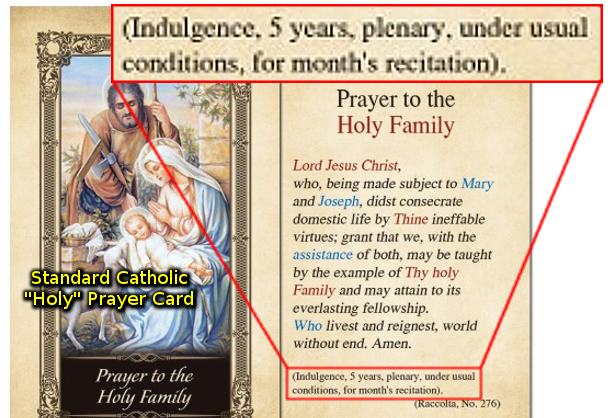
At the bottom, the prayer card says:
"Indulgences, 5 years, plenary , under usual conditions, for month's recitation."
-Shop Catholic Inspirational Gifts, "Holy Family Laminated Prayer Card," KE24-360, retrieved Mar 23, 2018, [https://www.shopcatholic.com/products/prayer-to-the-holy-family-kilgarlin-laminated-prayer-card?_pos=1&_psq=holy-family-laminated-prayer-card&_ss=e&_v=1.0]
They say it is "plenary" (i.e. full) instead of "partial" because, as we read earlier, it would have been "blessed" by a Catholic bishop prior to shipment (assuming they are not lying and claiming that a bishop actually did it), and that is supposed to knock five years off of a Catholic's time in purgatory, whether for the person praying, or for a dead person who is supposedly already in purgatory. However, Catholic Online says this is error because time does not exist in purgatory, and as I just pointed out, if it does not involve time, then it is eternal, and if it is eternal, then it cannot be "temporal," (i.e. temporary) as the Catholic Catechism says:
"An indulgence is partial or plenary according as itremoves either part or all of thetemporal punishment due to sin . Indulgences may be applied to the living or the dead."
-Catechism of the Catholic Church, "X. Indulgences: What is an Indulgence?" Part 2, Section 2, Chapter 2, Article 4, retrieved Oct 4, 2023, [http://www.scborromeo.org/ccc/p2s2c2a4.htm]
So we read the Catholic Church's official decree, which states that indulgences remove time from purgatory, but then we read the Catholic Church's official teaching, which states that indulgences do not remove time from purgatory. Are we supposed to believe the Catholic Church or the Catholic Church? Of course, they will simply blame all this on authors like me, but obviously, one of them is wrong, and it does not take a theology degree to figure out that the party in error is clearly the Catholic Church.
There are many drastic contradictions that exist within Catholic-approved organizations, websites, and temples on just the topic of indulgences alone (let alone all the other topics we will cover later in this book). One way or another, those five years listed on the prayer cards are MEANINGLESS (i.e. vanity) because purgatory does not exist, and Catholics waste their time and money on false doctrine that will not save them from hell.
Sadly, it is very difficult to preach this message to Catholics who participate in indulgences because not only do they refuse to believe they have wasted so much time and money on nonsense, being deceived by a man (i.e. the priest) who they look up to (instead of the Lord Jesus Christ) for religious guidance, they also do not want to believe that their loved ones are in hell, nor do they like the thought that they might end up in the same hell with them. If a Catholic has departed from this world with his hopes and faith in purgatory, I can guarantee that he will never see the Kingdom of God.
Jesus saith unto him, I am the way, the truth, and the life: no man cometh unto the Father, but by me.
-John 14:6
"Following Pope Francis' Twitter feed may be good for your soul — both in this life and the next.The spiritual leader of the Roman Catholic Church plans to grant plenary indulgences by Twitter during the World Youth Day, which will be held July 23-28 in Brazil. Theindulgences, which Catholics believe can reduce the time a soul spends in purgatory, will be available to Francis' nearly 7.5 million Twitter followers in all languages —if they tune in to World Youth Day broadcastsor take other spiritual actions . To get an indulgence, Catholics must have already had their sins absolved by a priest... Even people who can't travel to a major church event or pilgrimagecan still experience that forgiveness... if they take some kind of spiritual action ."
-Bob Smietana, "How You Can Save Your Soul: In 140 Characters or Less," USA Today, July 17, 2013, retrieved June 18, 2015, [usatoday.com/story/news/nation/2013/07/17/twitter-plenary-indulgences-pope/2524213]; See also National Catholic Reporter, July 22, 2013, [https://www.ncronline.org/news/art-media/tweet-your-way-out-purgatory-theres-work-involved]
The recipients of the indulgence must still participate in all the other rites of the Catholic celebration, but if they do all those things, then they can get a Pope-approved indulgence on Twitter to get them a bunch of bonus points for heaven. This is a childishly nonsensical false doctrine of works, which is teaching that in order to get God's forgiveness, you must do a list of deeds at certain places, at certain times, and nearly every false religion around the world utilizes the same corrupt philosophy so they can get their followers to do a lot of work and earn them a lot of money.
Why not just offer the indulgences online for free, without any other conditions? Because they want to expand into the social media realm to gain attention, but they do NOT want people to rely on digital, quick, and easy indulgences that would keep them away from spending their time and money on priests at Catholic temples.
The title of the article we just read is called, "
The Bible teaches that we cannot be justified by the works of the law:
Knowing that a man is not justified by the works of the law, but by the faith of Jesus Christ, even we have believed in Jesus Christ, that we might be justified by the faith of Christ, and not by the works of the law: for by the works of the law shall no flesh be justified.
-Galatians 2:16
The Council of Trent states:
"Whereasthe power of conferring Indulgences was granted by Christ to the Church; and she has, even in the most ancient times, used the said power, delivered unto her of God; the sacred holy Synod [clergy] teaches, and enjoins [instructs/urges], that the use of Indulgences, for the Christian people most salutary [beneficial], and approved of by the authority of sacred Councils,is to be retained in the Church; and It condemns with anathema those who either assert, that they are useless; or who deny that there is in the Church the power of granting them. "
-Austin Flannery, Vatican Council II: The Conciliar and Post Conciliar Documents, 1988, p. 71, ISBN: 9780918344151
I have no problem stating clearly that, by the gift of understanding God has given me in His Word, I know the Catholic Church is a false and dangerous cult, and they have NO spiritual authority to grant a so-called "indulgence." If anyone reading this is a practicing Catholic and you do not follow the doctrine of indulgences, then according to the authorities presiding over the Catholic Church, you are an apostate against the Catholic Church, and they have condemned you to hell.
Rather than running to a priest, bowing before him and trying to touch the hem of his garment, it would be infinitely better and simpler to repent (i.e. have godly sorrow of your wrongdoing) and cry out to the Lord Jesus Christ, putting your total trust in Him to save you. Depart from the devils of Rome, and look to the Lord Jesus Christ.
Though I may repeat many of these verses, I do so for emphasis, and to build up the faith of former Catholics, to remind them that the Bible teaches very clearly you do not need indulgences for forgiveness of sins:
If we confess our sins, he is faithful and just to forgive us our sins, and to cleanse us from all unrighteousness.
-1 John 1:9
So then faith cometh by hearing, and hearing by the word of God.
-Romans 10:17
oxymoron (n): a figure of speech by which a locution [i.e. a word or phrase] produces an incongruous [i.e. out of place], seemingly self-contradictory effect, as in 'cruel kindness' or 'to make haste slowly'
(See 'oxymoron', Random House Dictionary, 2018, [dictionary.com]; See also Collins English Dictionary, 10th Edition, William Collins Sons & Co, 2012)
grace (n): favor, good will, kindness; the free unmerited love and favor of God
(See 'grace', American Dictionary of the English Language, Noah Webster, 1828, retrieved Sept 4, 2018, [webstersdictionary1828.com])
A baby boy does not and cannot do anything to earn grace from his parents, just as mankind does not and cannot do anything to earn grace from God. The Bible tells us the grace of God is a free gift, meaning that it has no cost attached to it:
Therefore as by the offence of one judgment came upon all men to condemnation; even so by the righteousness of one the free gift came upon all men unto justification of life.
-Romans 5:18
And if by grace, then is it no more of works: otherwise grace is no more grace. But if it be of works, then is it no more grace: otherwise work is no more work.
-Romans 11:6
Therefore as by the offence of one judgment came upon all men to condemnation; even so by the righteousness of one the free gift came upon all men unto justification of life.
-Romans 5:18
(Read "There is No Saving Grace Without Repentance" here at creationliberty.com for more details.)
Jesus very directly warned that many would claim to believe on Him, meaning that they would claim to be Christians, but He will reject them unto everlasting punishment in hell:
Not every one that saith unto me, Lord, Lord, shall enter into the kingdom of heaven; but he that doeth the will of my Father which is in heaven.
-Matthew 7:21-23
(Read Why Millions of Believers on Jesus Are Going to Hell here at creationliberty.com for more details.)
Those who will enter the Kingdom of Heaven are those who come to Jesus Christ with a humble heart of godly sorrow, as a little child would do, and everyone else will be rejected.
Verily I say unto you, Whosoever shall not receive the kingdom of God as a little child, he shall not enter therein.
-Mark 10:15
In meekness instructing those that oppose themselves; if God peradventure [i.e. perhaps] will give them repentance to the acknowledging of the truth;
-2 Timothy 2:25
For godly sorrow worketh repentance to salvation not to be repented of: but the sorrow of the world worketh death.
-2 Corinthians 7:10
Thus saith the LORD; Cursed be the man that trusteth in man, and maketh flesh his arm, and whose heart departeth from the LORD.
-Jeremiah 17:5
Catholics refuse to go to Jesus Christ alone, and therefore, because of their lack of faith in Christ, they will not receive His grace, and the wages of their sins will NOT be paid by His blood. The wages of sin cannot be paid by anyone other than Jesus Christ, and if a man turns to any other source for his salvation (e.g. Catholic priest, Mary, etc), then Jesus will not pay for that man's sin.
For the wages of sin is death; but the gift of God is eternal life through Jesus Christ our Lord.
-Romans 6:23
For by grace are ye saved through faith; and that not of yourselves: it is the gift of God: Not of works, lest any man should boast.
-Ephesians 2:8-9
wages (n): hire; reward; that which is paid or stipulated for services
(See 'wages', American Dictionary of the English Language, Noah Webster, 1828, retrieved Oct 3, 2020, [webstersdictionary1828.com])
This is why the very concept of purgatory, the Mass/Eucharist, and indulgences is completely opposed to the Gospel of Jesus Christ and the philosophy of Scripture. If purgatory, masses, or indulgences were the answer, the Bible would tell us that the wages of sin are punishment, rituals, or special prayers, but that is not what the Bible says.
The Bible teaches us that good works grant us reward in heaven (1Co 3:8), but works do NOT grant us saving grace from God. Good works and/or religious rituals are NOT the foundation of saving grace through Christ.
|
Good works and religious rituals do NOT justify men in the eyes of God. |
Grace is a gift of mercy, and the works we Christians do are a result of Christ's saving grace and mercy upon us, as a tree bearing fruit in its time. (Mark 4:8) But again, works are NOT a foundation of saving grace.
Abide in me, and I in you. As the branch cannot bear fruit of itself, except it abide in the vine; no more can ye, except ye abide in me.
-John 15:4
Ye shall know them by their fruits. Do men
gather grapes of thorns, or figs of thistles?
-Matthew 7:16
"[W]e must believe that nothing further is wanting to the justified, to prevent their being accounted to have,by those very works which have been done in God , fully satisfied the divine law according to the state of this life, andto have truly merited [i.e. earned] eternal life , to be obtained also in its (due) time [i.e. they believe you have to go to purgatory to get it],if so be, however, that they depart in grace ,"
-Council of Trent, "On the Fruit of Justification, that is, On the Merit of Good Works, and On the Nature of that Merit," Session VI, Chapter XVI, retrieved Oct 6, 2023, [https://www.ewtn.com/catholicism/library/decree-concerning-justification--decree-concerning-reform-1496]
Please take a moment to read that carefully because the Council of Trent started out by saying that a Catholic must do works to earn eternal life, but then said that Catholics must depart (i.e. die and leave this world) in a state of grace. However, we learned in chapter three that, according to official Catholic canon, to receive God's grace, a Catholic is required to do religious works in official Catholic rituals, so if we combine it all together, Catholicism teaches that you have to do works to gain eternal life, but only if you are in a state of God's grace, and the only way to die in a state of God's grace is to be a member of the Catholic Church and perform rituals (i.e. works) to earn God's grace.
Simply put, here is the Bible's doctrine versus the Catholic Church's doctrine:
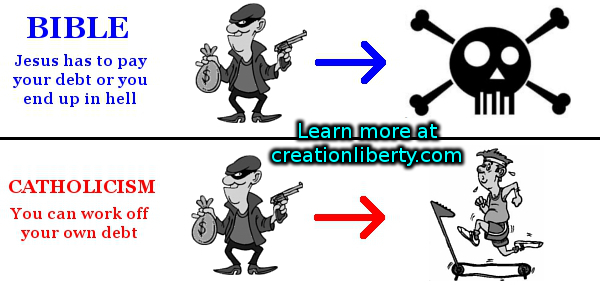
Now I beseech you, brethren, mark them which cause divisions and offences contrary to the doctrine which ye have learned; and avoid them. For they that are such serve not our Lord Jesus Christ, but their own belly; and by good words and fair speeches deceive the hearts of the simple.
-Romans 16:18
Judge not according to the appearance, but judge righteous judgment.
-John 7:24
Yea, they are greedy dogs which can never have enough, and they are shepherds that cannot understand: they all look to their own way, every one for his gain, from his quarter.
-Isaiah 56:11
(Read "Respecting Persons Is Sin" here at creationliberty.com for more details.)
But if ye have respect to persons, ye commit sin, and are convinced of the law as transgressors.
-James 2:9
Therefore by the deeds of the law there shall no flesh be justified in his sight: for by the law is the knowledge of sin.
-Romans 3:20
For all have sinned, and come short of the glory of God; Being justified freely by his grace through the redemption that is in Christ Jesus:
-Romans 3:23-24
As it is written, There is none righteous, no, not one: There is none that understandeth, there is none that seeketh after God. They are all gone out of the way, they are together become unprofitable; there is none that doeth good, no, not one.
-Romans 3:10-12
Therefore we conclude that a man is justified
by faith without the deeds of the law.
-Romans 3:28
But to him that worketh not, but believeth on him that justifieth the ungodly, his faith is counted for righteousness.
-Romans 4:5
Now to him that worketh is the reward not reckoned of grace, but of debt.
-Romans 4:4
The only way to not suffer the punishment of death is to have someone else die in our place, specifically, someone else who does not already owe his own eternal sin debt. This is exactly what Jesus Christ did for us, so we would not have to pay that eternal penalty, and by the grace of God, I have studied the Scripture for myself to understand that no man, priest or otherwise, can pay that price for us—it is Christ or hell, there is no middle ground.
Knowing that a man is not justified by the works of the law, but by the faith of Jesus Christ, even we have believed in Jesus Christ, that we might be justified by the faith of Christ, and not by the works of the law: for by the works of the law shall no flesh be justified.
-Galatians 2:16
For Christ is the end of the law for righteousness to every one that believeth.
-Romans 10:4
But Israel, which followed after the law of righteousness, hath not attained to the law of righteousness. Wherefore? Because they sought it not by faith, but as it were by the works of the law.
-Romans 9:31-32
And be found in him, not having mine own righteousness, which is of the law, but that which is through the faith of Christ, the righteousness which is of God by faith:
-Philippians 3:9
"In fact the apostles themselves urged their disciples to pray thatsinners might be saved . This very ancient practice of the Church has happily lasted, particularlyin the practice of penitents [i.e. Catholics confessing to a Catholic priest] begging the whole community's prayers, and in helping the dead with intercessions [i.e. prayers and indulgences for the dead to get them out of purgatory], especially through the offering of the Eucharistic Sacrifice . From the most ancient times in the Churchgood works were also offered to God for the salvation of sinners , particularly works which human weakness finds hard. Because the sufferings of the martyrs for the faith and for God's law were thought to be very valuable, penitents used toturn to the martyrs to be helped by their merits to obtain a more speedy reconciliation from the bishops. Indeed,the prayers and good works of holy people were regarded as of such great value that it could be asserted that the penitent was washed, cleansed and redeemed with the help of the entire Christian people ."
-Austin Flannery, Vatican Council II: The Conciliar and Postconciliar Documents, Liturgical Press, 2014, Chpt. 3, ISBN: 9780814649299
As I mentioned in chapter two, not only is the Catholic Church teaching that you must work your way into heaven, but worse still, they are teaching that you can rely on the works of other men to get you into heaven. It is impossible for a man who owes an eternal sin debt to pay off another man's eternal sin debt on top of his own, in a similar way that it is ridiculously absurd to believe that a man who is serving life in prison can pay off another man's prison time.
Indeed, the Bible teaches us to pray for the sake of lost sinners to be saved, but there is NO place in Scripture that teaches us to pray for the dead, as we covered in chapter two on purgatory. That so-called "
Thus, we can clearly see that the Catholic Church requires works to be saved, putting justification on your own merits instead of on the Lord Jesus Christ, because they require you to do a lot of praying, for those alive and dead, calling upon priests (not God) in the Catholic Church, and doing the rituals of the Eucharist and Mass in order to gain salvation. That is vile heresy against the doctrines of Christ, and it means that Catholics are heretics against God's Word.
We Christians do not call the Catholic Church an antichrist organization because it has some sort of shock value, but rather, we say it is an antichrist organization because it is against all that Christ taught us. The Pope and his bishops state clearly that they believe it is through the merits of other Catholics within the Church of Rome, not the Lord Jesus Christ, that one obtains the merits of justification/salvation, which means in a nutshell, the Catholic Church has attempted to put a patent or trademark on salvation.
Though we just read in Romans 3 that a man cannot become justified by good works, and that justification comes through faith in Christ alone, the Catholic Church condemns to hell all those who would believe what the Bible says:
"If any one saith, that the good works of one that is justified are in such manner the gifts of God, as thatthey are not also the good merits of him that is justified;or, that the said justified, by the good works which he performs through the grace of God and the merit of Jesus Christ, whose living member he is,does not truly merit increase of grace, eternal life, and the attainment of that eternal life , if so be, however, that he depart in grace, and also an increase of glory;let him be anathema. "
-Council of Trent, "On Justification," Session VI, Canon XVI, retrieved Mar 28, 2018, [http://thecounciloftrent.com/ch6.htm]; See also James Waterworth, Canons and Decrees of the Sacred and Ecumenical Council of Trent, 2003 Reprint, Kessinger Publishing, Canon #32, p. 48-49, ISBN: 9780766138414
Once again, the Catholic Church openly denies Christ by stating that you must perform good works to merit grace and eternal life, which is an oxymoron. Notice that they said you had to earn grace, while first being in the grace of God, but the only way to gain the grace of God is to do works to earn it, which is nothing short of mental gymnastics that is mind-bogglingly absurd.
Worse still, they condemn to hell anyone who refuses to believe in the Catholic Church's blatant, heretical contradiction, namely that you must receive the grace of Jesus, but they do not believe it is enough to have Christ's free grace. They believe you have to work for that grace, and are condemned to hell if you dare to question their lack of Scriptural backing, and lack of logic.
Let's look at another statement from the Council of Trent to verify their heretical doctrine:
"If any one saith, thatjustifying [saving] faith is nothing else but confidence [faith] in the divine mercy which remits [pardons] sins for Christ's sake; or, that this confidence [faith] alone is that whereby we are justified [saved]; let him be anathema. "
-Council of Trent, "On Justification," Session VI, Canon XVI, retrieved Mar 28, 2018, [http://thecounciloftrent.com/ch6.htm]; See also James Waterworth, Canons and Decrees of the Sacred and Ecumenical Council of Trent, 2003 Reprint, Kessinger Publishing, Canon #12, p. 46, ISBN: 9780766138414
|
If you believe that Jesus paid it all, the Catholic Church condemns you to hell. |
The Gospel of the Lord Jesus Christ, which saves the souls of lost sinners, is condemned to hell in the Catholic Church. Once more, let's read from Galatians 2, to emphasize the contradiction:
Knowing that a man is not justified [saved] by the works of the law, but by the faith of Jesus Christ, even we have believed in Jesus Christ, that we might be justified [saved] by the faith of Christ, and not by the works of the law: for by the works of the law shall no flesh be justified [saved].
-Galatians 2:16
"If any one saith, that thejustice [salvation] received is not preserved [maintained] and also increased before God through good works; but that the said works are merely the fruits and signs of Justification obtained [i.e. your works are a result of saving grace], but not a cause of the increase thereof; let him be anathema. "
-Council of Trent, "On Justification," Session VI, Canon XVI, retrieved Mar 28, 2018, [http://thecounciloftrent.com/ch6.htm]; See also James Waterworth, Canons and Decrees of the Sacred and Ecumenical Council of Trent, 2003 Reprint, Kessinger Publishing, Canon #24, p. 47, ISBN: 9780766138414
The Catholic Church just stated, in no uncertain terms, that their parishioners must believe that their good works "cause" the increase of justification for saving grace, or in other words, in the corrupt Catholic worldview, works replace the blood of Jesus Christ. If you are a Catholic, you need to acknowledge that what your religion teaches and believes is directly opposed to what Jesus Christ taught, and in a later chapter, we will read more direct quotes from the Catholic Church in which they say they do not follow Scripture, but rather, they follow tradition, and that is one of the key reasons for their error; they follow the traditions and commandments of men instead of the Christian God of the Bible.
Beware lest any man spoil you through philosophy [way of thinking] and vain deceit [worthless lies], after the tradition of men, after the rudiments [first teachings] of the world, and not after Christ.
-Colossians 2:8
Howbeit in vain do they worship me, teaching
for doctrines the commandments of men.
-Mark 7:7
Catholics will claim that the "Mary" they pray to is the mother of Christ while He was on earth. However, the goddess they worship is not the virgin woman spoken of in Scripture; that is simply the symbol they use to make their goddess appear more acceptable in a so-called "Christian" context.
If you go to the Catholic Church and ask them for a copy of the Ten Commandments to take home with you, they may give you a card that looks something like this:
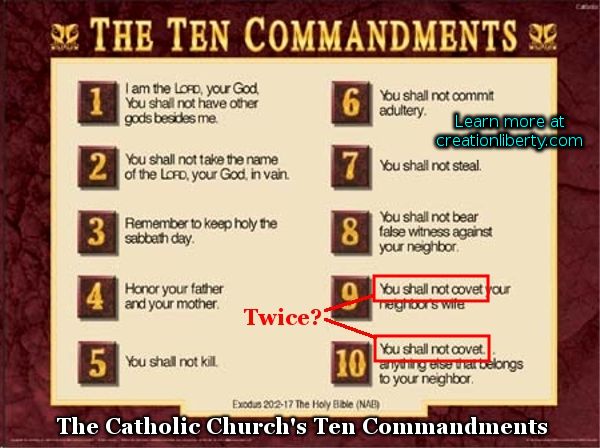
The card says that they took these ten commandments from Exodus 20:2-17. I would simply ask readers to carefully consider verse 4 below, and then try to find it on the Catholic card above:
Thou shalt not make unto thee any graven image, or any likeness of any thing that is in heaven above, or that is in the earth beneath, or that is in the water under the earth:
-Exodus 20:4
The Jews have always had the commandment about "no graven images" (from Exodus 20:4) within the second commandment of the Ten Commandments, and that is what they still teach their children to this day. That leads us to an obvious question: Since the Jews knew this was the proper interpretation of Scripture from the moment it was delivered to them by God through Moses, then why did the Catholic Church remove it entirely?
(See Menachem Posner, "The Ten Commandments," Chabad.org, retrieved Mar 28, 2018, [chabad.org/library/article_cdo/aid/2896/jewish/The-Ten-Commandments.htm]; See also Ronald H. Isaacs, "The Ten Commandments," My Jewish Learning, retrieved Mar 28, 2018, [myjewishlearning.com/article/the-ten-commandments])
In order to remove the second commandment and still have a total of ten (because Scripture clearly states that there are ten commandments, Exd 34:28, Deut 4:13), the Catholic Church had to do some sleight-of-hand deception. They took out the 2nd commandment, shifted the 3rd, 4th, 5th, 6th, 7th, 8th, 9th, and 10th commandments down one slot (for a total of nine commandments), then split the final 10th commandment into two parts to make up the 9th and 10th commandments.
And if any man shall take away from the words of the book of this prophecy, God shall take away his part out of the book of life, and out of the holy city, and from the things which are written in this book.
-Revelation 22:19
It does not take a doctorate in philosophy to figure out that their excuse is NOT the real reason they removed the second commandment. The real reason is that the second commandment was offensive to pagans, and since the Catholic Church shaped itself after pagan religion, they had to remove the second commandment to avoid Scriptural and logical contradiction.
Thus, the Catholic Church removed the graven images clause of the second commandment because the Catholic Church is OVERFLOWING with graven images, idols, and pagan gods, so it would not be profitable for them to hand out cards with commandments from God that condemn the very things they do.
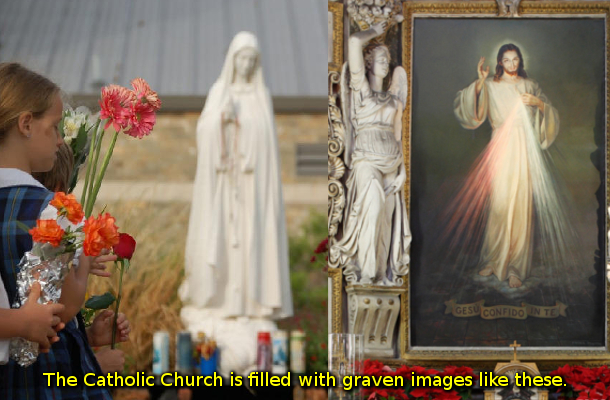
Little children, keep yourselves from idols. Amen.
-1 John 5:21
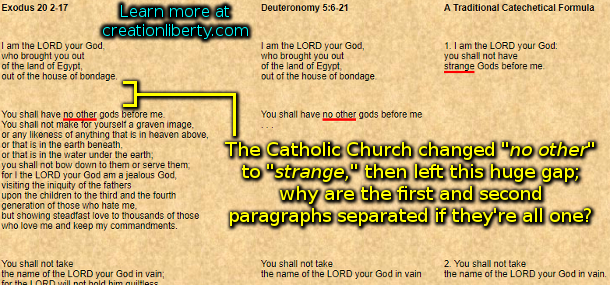
The information listed on the left-hand column is the beginning of the Ten Commandments in Exodus 20, and we need to remember that the Catholic Church claims verses 2-6 are all the same commandment. The gap they left in the middle of it is very strange and is not found in Scripture, and they use that as a justification for how they structured their version of the Ten Commandments, as you can see from the other examples on the right. (i.e. They have no logical or theological reason for excluding the commandment about idolatry.)
Notice that the Vatican uses the phrase "strange gods" in place of the phrase "no other gods," and that is far more significant than most people realize. To put a finer point on this, let's suppose you were in a restroom with stalls, and there was a sign on the door that said "use no other toilet except this one," you would clearly heed the warning that this specific toilet was the only toilet that was to be used; however, if you read a sign that said, "use no strange toilets," then it would be up to your discretion to determine what toilet you would consider "strange."
strange (adj): foreign, belonging to another country; not domestic
(See 'strange', American Dictionary of the English Language, Noah Webster, 1828, retrieved Sept 5, 2018, [webstersdictionary1828.com])
Moreover the workers with familiar spirits, and the wizards, and the images, and the idols, and all the abominations that were spied in the land of Judah and in Jerusalem, did Josiah put away, that he might perform the words of the law which were written in the book that Hilkiah the priest found in the house of the LORD.
-2 Kings 23:24
They shall be turned back, they shall be greatly ashamed, that trust in graven images, that say to the molten images, Ye are our gods.
-Isaiah 42:17
It should be pointed out to those of us born again in Christ that even the cross symbols we see on church buildings, jewelry, and clothing are all idolatry. The Bible tells us that we ought not to think that any such symbols represent the Godhead (i.e. Father, Son, and Holy Spirit), or anything like unto them because to do so is to adopt the ways of the heathen (i.e. pagans and witches).
(Read "Christian Symbols Are Not Christian" here at creationliberty.com for more details.)
Forasmuch then as we are the offspring of God, we ought not to think that the Godhead is like unto gold, or silver, or stone, graven by art and man's device.
-Acts 17:29
"'Catholics worship statues!' People still make thisridiculous claim. Because Catholics have statues in their churches, goes the accusation, they are violating God's commandment : 'You shall not make for yourself a graven image... you shall not bow down to them or serve them' (Ex. 20:4-5);"
-Catholic Answers, "Do Catholics Worship Statues?" retrieved Mar 29, 2018, [catholic.com/tract/do-catholics-worship-statues]
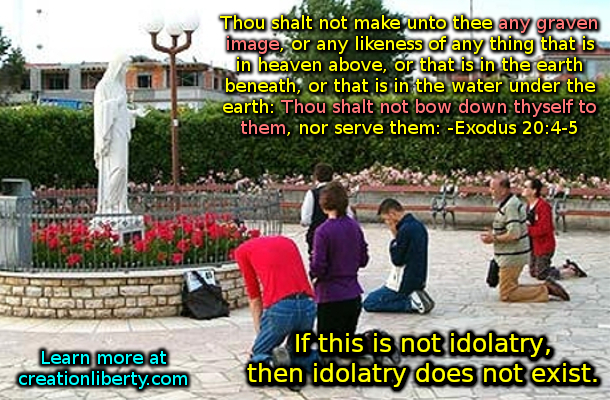
In short, Catholic Answers is satisfied to just call worshiping statues of Mary "ridiculous," which does not answer anything; however, before we go further, this anonymous author has already made a false claim because the argument I am making is NOT that "Catholics are idolaters because they have statues." I also believe that is a ridiculous claim. I do NOT argue that everyone who visits an art museum is an idolater. (They could be, but not in that context.) The accusation I am making is, "Catholics are idolaters because they have graven images which they claim represent divine entities, and they use them for religious worship." Catholic Answers Magazine knows full well that they cannot respond to the argument I am making because the evidence is too overwhelming, so instead, they create what is known as a "Strawman Argument."
A Strawman Argument is a logical fallacy that is named after the idea of a man setting up a man-shaped statue made of straw, attacking it, and claiming he won the fight. Just as a strawman requires less study and is easier to defeat than a real man, so too is a straw argument less sturdy and easier to defeat than a real argument.
Formally, a strawman argument looks like this:
|
|
If you go on to read the Catholic Answers article, their argument is that God had commanded the children of Israel to make statues in certain circumstances, so therefore, they claim that their graven images are acceptable. For example, in Numbers 21:
Therefore the people came to Moses, and said, We have sinned, for we have spoken against the LORD, and against thee; pray unto the LORD, that he take away the serpents from us. And Moses prayed for the people. And the LORD said unto Moses, Make thee a fiery serpent, and set it upon a pole: and it shall come to pass, that every one that is bitten, when he looketh upon it, shall live. And Moses made a serpent of brass, and put it upon a pole, and it came to pass, that if a serpent had bitten any man, when he beheld the serpent of brass, he lived.
-Numbers 21:7-9
1. God directly commanded the Jews to make a statue of a serpent, and thus, there is no violation of the commandments of God when the people are following His direct commandments. Remember that the Jews were also directly commanded to exterminate certain pagan tribes, but that does not give Christians a justification to go around killing anyone they think is bad. This should be obvious to anyone who follows Christ (and to anyone who simply reads the Scriptures), but it is difficult to get Catholics to understand such things when they are too busy worshiping idols.
In addition, not only were such statues not used for religious worship among the Jews, but again, God told them to do these specific things at this specific time for a specific reason. Christians were NEVER instructed by God to create statues for religious purposes, and I would challenge Catholics to find me anywhere in the New Testament where that was practiced.
2. If Moses and the Hebrew population bowed down to this serpent statue in prayer, as you see the Catholics doing in the images I showed earlier, then God would have severely punished them, as he did at Mount Sinai when three thousand of them were found to be worshiping a calf made of gold:
And he said unto them, Thus saith the LORD God of Israel, Put every man his sword by his side, and go in and out from gate to gate throughout the camp, and slay every man his brother, and every man his companion, and every man his neighbour. And the children of Levi did according to the word of Moses: and there fell of the people that day about three thousand men.
-Exodus 32:28
idolatry (n): the worship of idols, images, or any thing made by hands, or which is not God; idolatry is of two kinds; the worship of images, statues, pictures, etc. made by hands; and the worship of the heavenly bodies, the sun, moon and stars, or of demons, angels, men and animals; excessive attachment or veneration for any thing, or that which borders on adoration
(See 'idolatry', American Dictionary of the English Language, Noah Webster, 1828, retrieved Oct 10, 2020, [webstersdictionary1828.com])
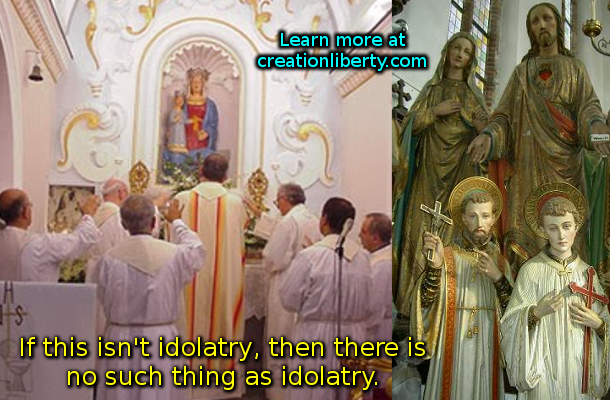
3. Catholic Answers does not claim their argument to be Biblical, or in other words, they do not claim that their beliefs come from Scripture. If you read their article, they claim their argument is "common sense:"
"Common sense tells us that , since God has revealed himself in various images, most especially in the incarnate Jesus Christ,it's not wrong for us to use images of these forms to deepen our knowledge and love of God."
-Catholic Answers, "Do Catholics Worship Statues?" retrieved Mar 29, 2018, [catholic.com/tract/do-catholics-worship-statues]
In case you missed it, Catholic Answers just stated that they believe that Jesus Christ coming to this world in the flesh is an "image" in the same way that they carve graven images for their worship. In other words, they believe that because Jesus came from heaven into this world, therefore, the Catholic Church is entitled to practice idolatry.
Again, they did NOT say, "The Bible teaches us this practice" — they said "Common sense tells us," or in other words, they decided for themselves. This means they are not basing their argument on the Word of God; the Catholic Church is basing their argument on the foundation of their own thoughts and feelings, how they want to see things through their own eyes, claiming to be wise in their own sight.
Be not wise in thine own eyes: fear the LORD, and depart from evil.
-Proverbs 3:7
There is a generation that are pure in their own eyes, and yet is not washed from their filthiness.
-Proverbs 30:12
Woe unto them that are wise in their own eyes, and prudent in their own sight!
-Isaiah 5:21
Their idols are silver and gold, the work of men's hands. They have mouths, but they speak not: eyes have they, but they see not: They have ears, but they hear not: noses have they, but they smell not: They have hands, but they handle not: feet have they, but they walk not: neither speak they through their throat. They that make them are like unto them; so is every one that trusteth in them.
-Psalm 115:4-8
Ye know that ye were Gentiles, carried away unto these dumb idols, even as ye were led.
-1 Corinthians 12:2
(Read "The Biblical Understanding of Idolatry here at creationliberty.com for more details.)
Son of man, these men have set up their idols in their heart, and put the stumblingblock of their iniquity before their face: should I be enquired of at all by them?
-Ezekiel 14:3
"The Church absolutely recognizes and condemns the sin of idolatry.What anti-Catholics [i.e. born again Christians] fail to recognize is the distinction between thinking a piece of stone or plaster is a god and desiring to visually remember Christ and the saints in heaven by making statues in their honor ."
-Catholic Answers, "Do Catholics Worship Statues?" retrieved Mar 29, 2018, [catholic.com/tract/do-catholics-worship-statues]
I was laughing out loud in my office when I first read that paragraph because, not only is it a bald-faced lie, but it is also the word-for-word excuse pagans use to justify their idolatry. The Catholic Church does not recognize idolatry as a grievous sin because if they did, they would have condemned themselves in anathema; however, conveniently, this is one of the very few doctrines for which (as far as I am aware) the Catholic Church does NOT have anathemized condemnations, and that should be no surprise to readers at this point.
The Catholic Catechism states:
"The Christian [i.e. Catholic] veneration [reverence, or high degree of respect] of images is not contrary to the first commandment which proscribes idols. Indeed, 'the honor rendered to an image passes to its prototype [the original from which the image was copied; thus, they are saying that prayers to the image of Mary pass through to Mary],' and 'whoever venerates [greatly respects] an image venerates the person portrayed in it.' Thehonor paid to sacred images is a 'respectful veneration,' not the adoration due to God alone:Religious worship is not directed to images in themselves , considered as mere things, but under their distinctive aspect as images leading us on to God incarnate."
-Catechism of the Catholic Church, "IV. You Shall Not Make For Yourself A Graven Image," Part 3, Section 2, Chapter 1, Article 1, Canon #2132, retrieved Oct 6, 2023, [http://www.scborromeo.org/ccc/p3s2c1a1.htm]
The funny thing about this statement is that they said the worship of images, which they indeed do in the Catholic Church, is "respectful veneration," and not "adoration." The reason that is humorous is because they mean the same thing:
veneration (n): the highest degree of respect and reverence; respect mingled with some degree of awe; a feeling or sentiment excited by the dignity and superiority of a person, or by the sacredness of his character
adoration (n): the act of paying honors to a divine being; homage paid to one in high esteem; profound reverence
(See 'veneration' & 'adoration', American Dictionary of the English Language, Noah Webster, 1828, retrieved Oct 10, 2020, [webstersdictionary1828.com])
I find it fascinating that when you look at what pagans say when they are accused of idolatry, they make exactly the same excuses as the Catholic Church makes in their Catechism, and I will demonstrate that. Lia Rees, a practicing pagan who was formerly a Catholic (i.e. she converted away from Catholicism to paganism, which is an easy philosophical transition), says the same thing when asked if pagans worship statues:
"As one of the few modern followers of the ancient Roman Religion, and educated in the fields of archaeology and theology, I can safely say you're on the right track with this. [i.e. She's referring to the question asked.]No pagan religion ever believed the statues, fetishes, or images were the gods themselves. Much like Catholic ikonography [study of symbols and their meanings], they were reminders and representations of the gods. Also like the ikons [representation of a sacred person], they were made to glorify and praise the god in whose image they were made. "
-Lia Rees, "Did The Pagans Actually Worship Statues?" Quora, Dec 7, 2015, retrieved Mar 29, 2018, [quora.com/Did-the-pagans-actually-worship-statues]
Again, that is exactly what the Catholic Church teaches when it says, "
Should we say that a murderer is not guilty of murder because he does not personally think his killing of another person was murder? Should we say a rapist is not guilty of rape because he did not classify his sexual action to be "rape?" In the 2020s, there are pedophile groomers who think they are not pedophile groomers because they do not "identify" as such, even though they clearly do the deeds out in the open in broad daylight. These are the same kind of logical absurdities held by Catholics to justify idolatry, believing themselves to be innocent of idolatry because they do not classify their actions to be that of an idolater, but according to Scripture, they are guilty nonetheless.
Many pagans and witches do not think they are guilty of idolatry because of this excuse, but something graven that is a representation of a divine entity is still an offense against God because it represents wicked and false things that lead people away from the truth. So what makes Catholics different from pagans and witches? From a Biblical perspective, nothing. It is the same excuse that pagans and witches will sometimes use to justify themselves, and worse still, some witches have used Catholicism as their justification for idolatry:
"Wiccans would certainly have difficulty following all 10 commandments and harmonizing them with their own theological and moral beliefs. However, Christians [i.e. Catholics] have similar problems: most don't worship on Saturday;many have statues of the Virgin Mary and crucifixes. Yet they still consider themselves to be Christian ."
-Jeanne Curran & Susan R. Takata, "Syncretic Religion: Wiccans, Witchcraft, and Christianity," California State University Dominguez Hills, Aug 12, 2002, retrieved Oct 6, 2023, [https://web.archive.org/web/20190207032958/https://www5.csudh.edu/dearhabermas/religion22.htm]
What we just read is a witch looking at the Catholic Church, seeing the striking similarities between witchcraft and Catholicism, and concluding that pagan worship is acceptable since Catholics (who falsely call themselves Christians) do it too. This is no different than a child doing something wrong, and then telling his parents, "But my brother did it too!" Just because one person is guilty of a crime does not justify your committing the same crime. Catholics ought to be ashamed of themselves for trying to use these excuses, but they continue to glory in that for which they should be ashamed.
For many walk, of whom I have told you often, and now tell you even weeping, that they are the enemies of the cross of Christ: Whose end is destruction, whose God is their belly, and whose glory is in their shame, who mind earthly things.
-Philippians 3:18-19
Woe unto them that call evil good, and good evil; that put darkness for light, and light for darkness; that put bitter for sweet, and sweet for bitter!
-Isaiah 5:20
worship (v): to adore, to pay divine honors with reverence and veneration
(See 'worship', American Dictionary of the English Language, Noah Webster, 1828, retrieved Mar 30, 2018,[webstersdictionary1828.com])
To borrow a phrase from Catholic Answers, it would be "common sense" to a ten-year-old that the Catholic Church is practicing idolatry because it is as clear as day, but when a child is bombarded with Catholic lies from the day he is born, he becomes so blinded, he cannot see the forest because the trees are in the way, or in other words, he cannot see the idolatry because all the idols are in the way. So at this point, since the Catholic Church claims they are not guilty of idolatry, I decided to search their Catechism to get a clear definition of what idolatry means according to them, or more specifically, what is it that they believe distinguishes Catholics from witches?
The Catholic Catechism states:
"Idolatry not only refers to false pagan worship. It remains a constant temptation to faith.Idolatry consists in divinizing what is not God. "
-Catechism of the Catholic Church, "Idolatry," Part 3, Section 2, Chapter 1, Article 1, Canon #2113, retrieved Oct 6, 2023, [http://www.scborromeo.org/ccc/p3s2c1a1.htm]
I repeat, the Catholic Church states that idolatry is "
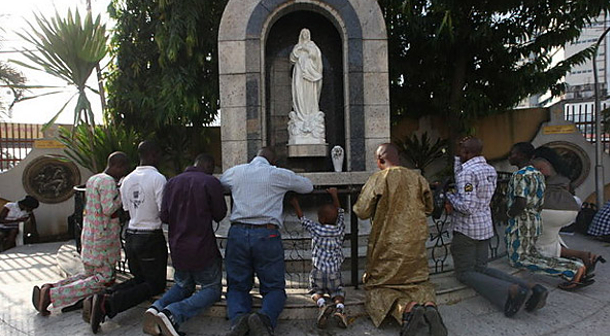
The above image shows Catholics kneeling to worship at the feet of a statue of a figure they call "Mary," giving her divine honors. The Catholic Church will tell you that this is Mary, the virgin who gave birth to Jesus Christ. Because they are giving to Mary that which is reserved for the Lord God alone, that means they are idolaters because they are "
Then saith Jesus unto him, Get thee hence, Satan: for it is written, Thou shalt worship the Lord thy God, and him only shalt thou serve.
-Matthew 4:10
divinize (v): to make divine
divine (adj): of or relating to a god, godlike characteristic of or befitting a deity
(See 'divinize' & 'divine', Random House Dictionary, 2018, [dictionary.com]; See also Collins English Dictionary, 10th Edition, William Collins Sons & Co, 2012)
After the sudden death of his mother, an eight-year-old boy named Carol Voitila developed an intense devotion to the Catholic goddess called "Mary." Later in his life, Voitila would become Pope John Paul II (instituted in 1978), and he formally rededicated himself and his Roman office, not to the Lord Jesus Christ, not to the Word of God, but to Mary. During his tenure as Pope, Voitila often traveled around the world to various Marian shrines (i.e. shrines devoted to Mary) to worship her statue, and he was followed by millions of other Catholics.
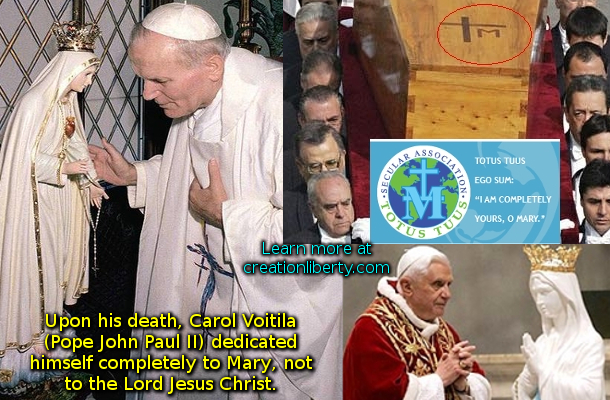
Voitila often used the phrase "Totus tuus ego sum, Maria," which translates, "I am totally yours, Mary." He did not belong to the Lord Jesus Christ; Voitila instead said he belonged to Mary. That is why Voitila's funeral casket had a large letter 'M' burned into the wood; the 'M' stands for "Mary."
Carol Voitila wrote in his last will and testament, which is in the Vatican archives, and it says:
"I do not know when the moment [of my death] will come, but like everything else,I place it too in the hands of the Mother of my Master : Totus Tuus. In the same maternal Hands I leave everything and everyone with whom my life and vocation have linked me.In these Hands I leave, above all, the [Catholic] Church, as well as my Nation and all humanity. "
-Pope John Paul II, "Testament of the Holy Father John Paul II," Mar 6, 1979, retrieved Mar 30, 2018, [vatican.va/gpII/documents/testamento-jp-ii_20050407_en.html]
|
Again, Voitila did not put his faith in Christ, but rather, he put his faith in Mary. Because he left his soul in the hands of Mary, he never saw the Kingdom of Heaven, but despite the fact that he died with his hopes in false doctrines, Catholics still highly revere this pagan man.
Voitila continued to say that when he went to judgment (not purgatory?), he was putting all his faith and hope in Mary: "Today, I would like to add just this: that everyone keep the prospect of death in mind and be ready to go before the Lord and Judge - and at the same time Redeemer and Father. So I keep this continuously in my mind, |
 |
The Bible very simply tells us there is one mediator between God and men, and that is the Lord Jesus Christ. If we are to be reconciled to God, the ONLY way to do so is through Christ.
mediator (n): one that interposes between parties at variance for the purpose of reconciling them
(See 'mediator', American Dictionary of the English Language, Noah Webster, 1828, retrieved Mar 30, 2018,[webstersdictionary1828.com])
For this is good and acceptable in the sight of God our Saviour; Who will have all men to be saved, and to come unto the knowledge of the truth. For
-1 Timothy 2:3-6
For other foundation can no man lay than that is laid, which is Jesus Christ.
-1 Corinthians 3:11
"The history of Christian [i.e. Catholic] piety [fulfillment of religious obligations] teaches thatMary is the way which leads to Christ and that filial devotion [i.e. the devotion a child would give to a parent] to her takes nothing from intimacy with Jesus; indeed, it increases it andleads to the highest levels of perfection ."
-Pope John Paul II, Devotion to Mary is Based on Jesus' Will, EWTN (Global Catholic Network), retrieve Mar 30, 2018, [https://www.ewtn.com/catholicism/library/devotion-to-mary-is-based-on-jesus-will-8070]; See also Bill McCarthy & James Tibbets, Mary in the Church Today: Official Catholic Teaching on the Mother of God Since Vatican II, St Andrews Productions, 2000, p. 374, ISBN: 9781891903229
The first thing to note is that nothing that Pope John Paul said is found in Scripture. He is only referring to Catholic religious tradition, not the Word of God. Furthermore, it is a lie because devotion to Mary most certainly takes away intimacy with Jesus Christ, especially since the Lord God has said He will share His glory with no man, nor will He give His glory to graven images of a false goddess.
I am the LORD: that is my name: and my glory will I not give to another, neither my praise to graven images.
-Isaiah 42:8
Jesus saith unto him, I am the way, the truth, and
the life: no man cometh unto the Father, but by me.
-John 14:6
Come unto me, all ye that labour and are
heavy laden, and I will give you rest.
-Matthew 11:28
John Paul II's Book of Mary is a collection of Voitila's writings on Mary, which is approved for use by the Catholic Church. In the book, the chapters are titled by the names of worship given by the Catholic Church to Mary; some of those include the following (and I will highlight a few that readers will want to note):
 |
|
When Catholics refer to Mary as the "
This is also why they call her the "
At the very least, Voitila helps us understand the vile idolatry that goes on in the Catholic Church:
"Mary shares our human condition but in complete openness to the grace of God.Not having known sin , she is able to have compassion on every kind of weakness. She understands sinful man and loves him with a mother's love."
-John Paul II, quoted by Margaret R. Bunson, John Paul II's Book of Mary, Our Sunday Visitor, 2005, p. 18, ISBN: 9781592761845
This is one of the reasons I highlighted certain titles in Voitila's list, namely, "
immaculate (adj): free from spot or stain; free from moral blemish; pure; free from fault, flaw, or error
(See 'immaculate', Random House Dictionary, 2018, [dictionary.com]; See also Collins English Dictionary, 10th Edition, William Collins Sons & Co, 2012)
"I would like once again to entrust myself entirely to the Lord's grace. He Himself will decide when and how I am to end my earthly life and my pastoral ministry.In life and in death [I am] Totus Tuus [totally yours] through Mary Immaculate ."
-Pope John Paul II, "Testament of the Holy Father John Paul II," Mar 6, 1979, retrieved Mar 30, 2018, [vatican.va/gpII/documents/testamento-jp-ii_20050407_en.html]
Voitila spoke of Jesus Christ and grace through Him, but he believed that grace was only granted by and through Mary in her so-called "sinless perfection." If Mary was without sin, then she did not need a savior, and yet, she called God her savior:
And Mary said, My soul doth magnify the Lord, And
my spirit hath rejoiced in God my Savior.
-Luke 1:46-47
"Not a few Protestants are surprised to discover the Catholic Church actually agrees that Mary was 'saved.'Indeed, Mary needed a savior! "
-Tim Staples, "Hail Mary, Conceived Without Sin," Catholic Answers, Sept 1, 2007, retrieved Mar 30, 2018, [catholic.com/magazine/print-edition/hail-mary-conceived-without-sin]
Of course, it appears at first glance that Staples is in agreement with me, but we will soon learn that is not the case. However, I wanted to pause for a moment to point out how this scam works.
The Catholic Church tells people that they believe what we Christians believe to convince them that there is common ground, but if you read carefully, you will notice that Staples put the word 'saved' in quotations. That was no accident. Now let's continue to read his article, so we can see how he misleads his readers:
"However, Mary was 'saved' from sin in a most sublime [supreme] manner. She was given the grace to be'saved' completely from sin so that she never committed even the slightest transgression ."
-Tim Staples, "Hail Mary, Conceived Without Sin," Catholic Answers, Sept 1, 2007, retrieved Mar 30, 2018, [catholic.com/magazine/print-edition/hail-mary-conceived-without-sin]
You can see how Staples says on one side of his mouth that Mary needed a savior, but then puts the word "saved" in quotations because he is secretly defining the word 'saved' as something other than how the Bible defines it. He changed the definition of the word 'saved' to "
Staples is a liar and deceiver, and after reading some of his articles and listening to him in debate, I believe he knows he is being deceptive because he is of his father, the Devil, and he spends a lot of time learning these deceptive techniques from his Roman bishop teachers.
Ye are of your father the devil, and the lusts of your father ye will do. He was a murderer from the beginning, and abode not in the truth, because there is no truth in him. When he speaketh a lie, he speaketh of his own: for he is a liar, and the father of it.
-John 8:44
If what Staples said was true, then Mary should have said something along the lines of, "
If we confess our sins, he is faithful and just to forgive us our sins, and to cleanse us from all unrighteousness. If we say that we have not sinned, we make him a liar, and his word is not in us.
-1 John 1:9-10
The title "
"INANNA: A Sumerian [from the region of Sumer in Babylon] goddess who presided over fertility, love, and war.Known as 'Queen of Heaven' ... Offerings were traditionally made to her at sunrise. After the sun sank beneath the horizon and darkness veiled the night sky, she transformed into the patroness of the temple prostitutes.She is identified with the Babylonian goddess Ishtar ."
-Gerina Dunwich, Wicca A to Z: A Complete Guide to the Magickal World, Citadel Press, 1997, p. 180, ISBN: 9780806519302; Dunwich is a high priestess of witchcraft and considered a professional astrologer. Ishtar is where we get the pagan celebration of "Easter," read "Easter: Christians Celebrating Abomination" here at creationliberty.com for more details.)
Since Catholics often ignore the Word of God in favor of tradition, they might be surprised to learn that God described the abominations of the Jews when they worshiped the "Queen of Heaven." The Jews provoked the anger of God, and He cursed them for their wickedness:
The children gather wood, and the fathers kindle the fire, and the women knead their dough, to make cakes to the
-Jeremiah 7:18
But since we left off to burn incense to the
-Jeremiah 44:18-22
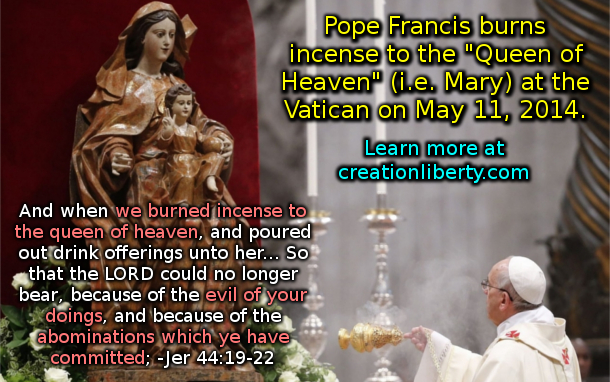
The correlation and similarities between the Catholic Mary and the goddess of pagans and witches are very eye-opening if you take the time to compare them. Witches in covens and druids in pagan circles understand very well the symbolism the Catholic Church uses, but most Catholics do not have a clue what they mean because they think those symbols are just a bunch of artwork, and so they sit in blissful and willful ignorance about those things having any meaning whatsoever.
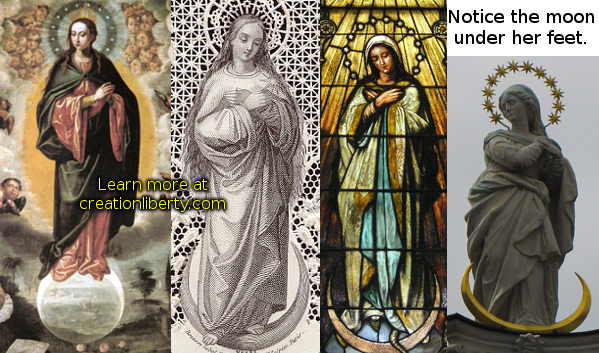
The Catholic Church claims these are simply depictions of Revelation 12:
And there appeared a great wonder in heaven; a woman clothed with the sun, and the moon under her feet, and upon her head a crown of twelve stars:
-Revelation 12:1
"Many mythological traditions identify the moon as a feminine counterpart to the masculine sun. For this reason,a number of Goddesses are associated with the moon , including Artemis or Diana, Selena, and of course, Luna. Even the 'Goddess' of Christianity [i.e. Catholicism],the Virgin Mary, has some associations with the moon under her feet ... So,for Witches, the moon is special because it is a powerful symbol of the Goddess , and therefore of women."
-Gerina Dunwich, Wicca A to Z: A Complete Guide to the Magickal World, Citadel Press, 1997, p. 180, ISBN: 9780806519302; Dunwich is a high priestess of witchcraft and considered a professional astrologer.
What Christians need to understand is that Catholics may claim that these depictions are based on "Mary" in Revelation 12, but in reality, this practice was adopted from pagans in an effort to appease Rome. When the Council of Nicaea formed (in 325 A.D.), their purpose was to submit a foundation of beliefs (i.e. their version of "Christianity") to the Roman government, so they could be approved as a legal religion under Rome's protection, and in order to get that approval, they had to make sure that their beliefs did not denounce or offend the pagan religions that already had legal status in Rome.
This means that they could NOT condemn idols because that would contradict other religions under Rome's leadership, and so it was imperative that the Council of Nicaea reshape Christian doctrine to coincide with the pagan religions of Rome, otherwise, their petition for legal status would be rejected. This is also what allowed the Catholic Church to grow in popularity, since their beliefs not only coincided with the witchcraft and paganism citizens already practiced in various places around the world, but they also attached that pagan belief to Jewish history and the figure of Jesus Christ which was already well known among many cultures. (This is part of the concept behind what the Bible refers to as "Mystery Babylon," and we will go over that later in this book.)
The following author documents the long history of "moon goddess" worship, spanning over thousands of years, starting with Babylon, spreading into Judaism, and later into Roman Catholicism:
"The cult of the Virgin Mary is a phenomenon in Catholic communities throughout the world... the historical development of the concept of aMoon-Mother Goddess, her beginnings in the Near East five thousand years ago—circa 3,000 BCE, and her ultimate absorption into the Catholic Church as the Blessed Virgin Mary ... The examination of the literature related to Goddesses, specifically Moon Goddesses demonstrates thatthe role of Mary, the mother of Jesus was inherited from the Goddess Isis in ancient Egypt and the Goddess Ishtar in Babylon ."
-Safiya Karimah, Moon Goddess, iUniverse, 2003, p. 15, ISBN: 9780595294329
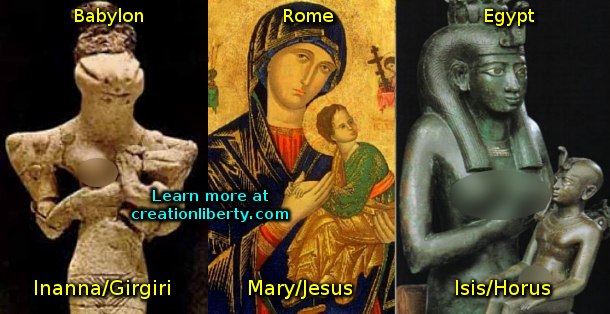
After publishing this book, and a few other articles that covered a similar topic on paganism, I received a few emails from some witches, and all the letters had two similarities:
|
I have also received emails from some Catholics over the years, and sadly, they tend to be less familiar with these things because the Catholic Church does its best to cover up their pagan origins. All of Catholicism's paganism is labeled as "Christian" by priests, so this is all most Catholics have ever known, and most of them are willingly blind to the truth.
So when I explain to them that Catholicism is one of the world's largest pagan cults, they typically express confusion and/or anger, but we Christians need to remember that the Jews would not hear Christ either, and those Jews who claimed they "believed on him" also picked up stones to kill him as soon as He started to preach the truth to them:
Then said Jesus to those Jews which believed on him, If ye continue in my word, then are ye my disciples indeed; And ye shall know the truth, and the truth shall make you free... Why do ye not understand my speech? even because ye cannot hear my word. Ye are of your father the devil, and the lusts of your father ye will do. He was a murderer from the beginning, and abode not in the truth, because there is no truth in him. When he speaketh a lie, he speaketh of his own: for he is a liar, and the father of it. And because I tell you the truth, ye believe me not... Then took they up stones to cast at him: but Jesus hid himself, and went out of the temple, going through the midst of them, and so passed by.
-John 8:31-59
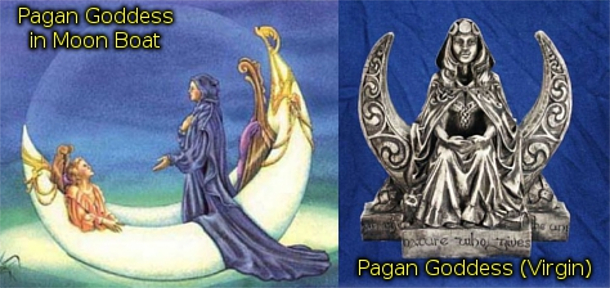
"The 'Crescent Moon Goddess' is an ancient symbol of change in a woman's life, and her life cycles as they parallel the season of the earth. Historically, the goddess is the symbol of feminine energy and nature's power. With her flowing tresses, she represents a classic image of beauty... This image spans many centuries and appears across many cultures. The design of the crescent moon, which represents the moon when it is located 45 to 90 degrees ahead of the sun, evokes a certain mystical feeling. Not surprisingly,the Crescent Moon has been adopted as a symbol by various religions of the world, including Islam and the Wiccan belief system ."
-Patricia L. Cummings, Redwork Renaissance: 49 Designs from an 1893 Coverlet, Quilter's Muse Publications, 2004, ISBN: 9780976976318
Indeed, the crescent moon symbol is no coincidence. The Islamic god Muslims call "Allah" is, in fact, a moon god, which is why the crescent moon symbol is used so frequently by Muslims, even though most Muslims are willingly ignorant of its true origin.
(Read "Islam: Religion of Terror" here at creationliberty.com for more details.)

In short, the crescent moon symbol used in Catholic paintings is the "maiden" symbol in Wicca, part of the "Triple Moon," which represents the three aspects of their goddess (i.e. maiden, mother, and crone). The maiden crescent moon is used to represent the "virgin" aspect:
"Triple Moon - Many Wiccans consider thetriple moon 'the' definitive symbol of the Goddess . The triple moon consists of a left-facingcrescent moon on the left , a full moon in the center, and a right-facing (like a 'C') crescent moon on the right. All three of these are put together in a row to make the triple moon )O(. It represents the three aspects ofmaiden , mother and crone."
-David Salisbury, Teen Spirit Wicca, John Hunt Publishing, 2014, ISBN: 9781782790587; Salisbury is clergy over a witch coven in Washington DC, and is married to a psychic medium who operates in Maryland.
As we can see, pagans believe the "maiden" crescent moon symbol to be the ultimate way to define their goddess overall, which is why it is used so frequently by correlating pagan religions, like Catholicism and Islam. These types of symbols of the goddess of the pagans are not only found in Catholic paintings and stained-glass windows, but the Catholic Church follows the architectural designs of the pagan goddess in many areas around the world:
"The major difference between The Goddess and the Blessed Virgin Mary is that The Goddess is a Creatrix in Her Own Right and a source of Divine Power. In Catholicism, Mary is Blessed, unique among women, sinless, The Mother of God - and it is believed that She ascended bodily into Heaven. However, for Catholics, She is supposed to be merely a channel of Power from God, and not a source of Divine Power, Herself. Of course, this is only the official view of the Catholic Church.Many worshipers understand, and have always understood instinctively, if not consciously, that the Blessed Virgin is a modern version of The Goddess; and many Catholic cathedrals are actually built upon the sites of ancient temples to The Great Goddess. For example, St. Peters Cathedral in the Vatican is built right on top of the old temple of The Goddess, Magna Mater, and some parts of the original temple are presumably still left under the foundations."
-Raven Emrys Aurlineus, "The Catholic Goddess," May 4, 2008, retrieved Nov 20, 2013, [http://ravenemrys.hubpages.com/hub/The-Catholic-Goddess#]; Aurlineus has been a witch for over 30 years and is part of the 501c3 incorporated Welsh Traditionalist Coven in Missouri.
In the first chapter of this book, I talked about the Pantheon, which was dedicated by pagans and witches to six gods and six goddesses, which is twelve gods in total, and that is why the Catholic Mary has twelve stars above her head. That depiction has NOTHING contextually to do with the twelve mentioned in Revelation, and it has EVERYTHING to do with pagan origins. The early Catholic Church noticed a similarity in number, and decided to link an out-of-context numerological meaning between paganism and the Bible, which sums up the entire origin of Catholicism. The Catholic Church did not come onto the scene of pagan sites to preach the law of God which condemns the worship of idols, but rather, they claimed ownership of the temple site of the Pantheon, repaired and cleaned it up, and renamed it "St. Mary and the Martyrs," continuing the worship of the pagan goddess on their own terms.
(See John Bell, Bell's New Pantheon: or Historical Dictionary of the Gods, Demi-Gods, Heroes and Fabulous Personages of Antiquity, self-published, Vol. 1, 1790, p. 226, [New York Public Library]; See also George Weigel, Roman Pilgrimage: The Station Churches, Basic Books, 2013, p. 387, ISBN: 9780465027699)
As a side note, there are some other commonly used phrases in our society that are initially confusing, but once you understand the origins of Catholicism and its heathen teachings, they begin to make sense. For example, the phrase alma mater is often used when one is referring to his or her college or university (e.g. a man might say, "Harvard University is my alma mater"), however, what most people do not understand is that the word alma is Latin for "virgin" and mater is Latin for "mother," which means when someone says "that is my alma mater," they are actually saying, "
Another example is the phrase "Holy Matrimony," used in modern-day marriage ceremonies, which are also pagan in origin, and were mostly established by Catholic tradition. This phrase is rather confusing because the word matri is Latin for "matron" or "motherhood." It makes no sense that a man and woman would enter "holy motherhood" when they get married, unless you interpret the meaning by pagan Catholic doctrine, in which they are having their marriage approved through the pagan moon goddess, transitioning from her "maiden" to "mother" form.
(Read The Biblical Understanding of Weddings & Marriage here at creationliberty.com for more details.)
Pope John Paul II declared that this pagan goddess will lead them to the truth of Christ:
"Precisely with her faith as Spouse and Mother she wishes to act upon all those who entrust themselves to her as her children. And it is well known that the more her children persevere and progress in this attitude, the nearerMary leads them to the 'unsearchable riches of Christ.' "
-Pope John Paul II, Redemptoris Mater #46, retrieved Oct 6, 2023, [https://www.vatican.va/content/john-paul-ii/en/encyclicals/documents/hf_jp-ii_enc_25031987_redemptoris-mater.html]; Also quoted in John Paul II's Book of Mary, 1996, front page under the cover, ISBN: 0-87973-578-3
Again, that is NOT what the Bible teaches us:
Whereof I was made a minister, according to the gift of the grace of God given unto me by the effectual working of his power. Unto me, who am less than the least of all saints, is this grace given, that I should preach among the Gentiles the unsearchable riches of Christ; And to make all men see what is the fellowship of the mystery, which from the beginning of the world hath been hid in God, who created all things by Jesus Christ:
-Ephesians 3:7-9
Now the works of the flesh are manifest, which are these; Adultery, fornication, uncleanness, lasciviousness, Idolatry, witchcraft, hatred, variance, emulations, wrath, strife, seditions, heresies, Envyings, murders, drunkenness, revellings, and such like: of the which I tell you before, as I have also told you in time past, that they which do such things shall not inherit the kingdom of God.
-Galatians 5:19-21
"With special veneration,they are to honor the Virgin Mother of God, the example and protector of all consecrated [holy] life, also through the marian rosary ."
-Vatican Archives, "Chapter VI. The Obligations and Rights of Institutes and Their Members," Code of Canon Law, Cannon #663 §4, retrieved Apr 25, 2018, [https://www.vatican.va/archive/cod-iuris-canonici/eng/documents/cic_lib2-cann607-709_en.html]
According to Marians of the Immaculate Conception (i.e. a conglomerate of Catholic priests dedicated to Mary), performing the marian rosary requires a set of "rosary beads," and the following formula of duties:
"On the 5 decades (sets of 10 beads) of a rosary, we pray and meditate on the corresponding set of 5 Mysteries from the Joyful Mysteries, the Sorrowful Mysteries, the Glorious Mysteries, or the Luminous Mysteries.
1. Make the Sign of the Cross and say the 'Apostles Creed.'
2. Say the 'Our Father.'
3. Say three 'Hail Marys.'
4. Say the 'Glory be to the Father.'
5. Announce the First Mystery; then say the 'Our Father.'
6. Say ten 'Hail Marys,' while meditating on the Mystery.
7. Say the 'Glory be to the Father.' After each decade say the following prayer requested by the Blessed Virgin Mary at Fatima: 'O my Jesus, forgive us our sins, save us from the fires of hell, lead all souls to Heaven, especially those in most need of Thy mercy.'
8. Announce the Second Mystery: then say the 'Our Father.' Repeat 6 and 7 and continue with the Third, Fourth, and Fifth Mysteries in the same manner.
9. Say the 'Hail, Holy Queen ' on the medal after the five decades are completed.
The Mysteries traditionally adhere to certain days of the week. Monday: Joyful, Tuesday: Sorrowful, Wednesday: Glorious, Thursday: Luminous, Friday: Sorrowful, Saturday: Joyful, Sunday: Glorious"
-Marians of the Immaculate Conception, "How to Recite the Rosary," retrieved Apr 25, 2018, [marian.org/mary/rosary/howto.php]; The cross symbol is an offense against God's Word - read "Christian Symbols Are Not Christian" here at creationliberty.com for more details.)
Without getting into too much detail, the "Our Fathers," "Hail Marys," and all the other things they listed out are a group of phrases that are repeated over and over. You can look them up on your own if you want to, but listing them out here would be a waste of time, and the reason for that is because they are what the Bible calls "vain repetitions," and the Lord Jesus Christ made the matter very easy for us to understand.
In chapter four, we learned how the Catholic Church devours widows' houses, and I quoted the Scripture where Jesus pointed that out. In that same verse, Christ also points out the corruption of those who make long, drawn-out prayers for pretense (i.e. for show), and how they will receive damnation:
Woe unto you, scribes and Pharisees, hypocrites! for ye devour widows' houses, and for a pretence make long prayer: therefore ye shall receive the greater damnation.
-Matthew 23:14
Which devour widows' houses, and for a shew make long prayers: the same shall receive greater damnation.
-Luke 20:47
But thou, when thou prayest, enter into thy closet, and when thou hast shut thy door, pray to thy Father which is in secret; and thy Father which seeth in secret shall reward thee openly. But when ye pray,
-Matthew 6:8
(Read "The Biblical Understanding of Prayer here at creationliberty.com for more details.)
In the same manner, the Jews were working wickedness in their pagan traditions and would not come to repentance (i.e. grief and godly sorrow of wrongdoing), the Lord God also told them He would not hear their prayers:
And when ye spread forth your hands, I will hide mine eyes from you: yea, when ye make many prayers, I will not hear: your hands are full of blood. Wash you, make you clean; put away the evil of your doings from before mine eyes; cease to do evil;
-Isaiah 1:15-16
Take thou away from me the noise of thy songs; for I will not hear the melody of thy viols. But let judgment run down as waters, and righteousness as a mighty stream.
-Amos 5:23-24
Howbeit in vain do they worship me, teaching
for doctrines the commandments of men.
-Mark 7:7
"To foster [support] the sanctification [separation for a holy use] of the people of God, the Church commends [charges/instructs] to thespecial and filial [child-to-parent] reverence [fear, respect and esteem] of the Christian faithful the Blessed Mary ever Virgin , Mother of God, whom Christ established asthe mother of all people , and promotes the true and authentic veneration [highest degree of honor] of the other saints whose example instructs the Christian faithful and whose intercession sustains them."
-Canon 1186, quoted by John P. Beal, New Commentary on the Code of Canon Law, Paulist Press, 2000, p. 1413, ISBN: 9780809105021
Notice that it says she is "
Catholics are obsessed with calling Mary blessed for bearing Jesus in the womb and feeding Him from her breast, and so they love to quote Luke 11:27, which says:
And it came to pass, as he spake these things, a certain woman of the company lifted up her voice, and said unto him, Blessed is the womb that bare thee, and the paps which thou hast sucked.
-Luke 11:27
But he said, Yea rather, blessed are they that
hear the word of God, and keep it.
-Luke 11:28
flee (v): to run with rapidity; to hasten away
(See 'flee', American Dictionary of the English Language, Noah Webster, 1828, retrieved Oct 24, 2020, [webstersdictionary1828.com])
Wherefore, my dearly beloved, flee from idolatry.
-1 Corinthians 10:14
"The title pope, once used with far greater latitude, is at present employed solelyto denote the Bishop of Rome, who, in virtue of his position as successor of St. Peter, is the chief pastor of the whole Church, the Vicar of Christ upon earth ."
-Kevin Knight, "The Pope," New Advent, retrieved Apr 27. 2018, [newadvent.org/cathen/12260a.htm]
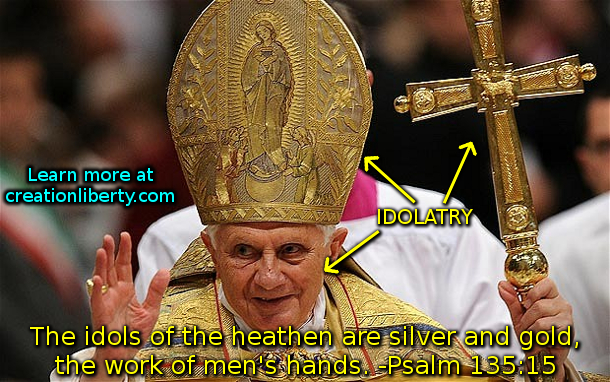
There is only one position of "
(Read "Titles Are Unbiblical in the Church" here at creationliberty.com for more details; the apostles did not use fancy titles like "Saint Peter" or "Pastor Peter" or "Apostle Peter," nor was the church ever commanded to do such things.)
And when the chief Shepherd shall appear, ye shall receive a crown of glory that fadeth not away.
-1 Peter 5:4
A 'vicar' is a person who is authorized to perform the functions and duties of someone else. In the context of the Catholic Church, the Pope is considered to be "Christ on earth," or to have the seat and authority of Christ Himself, and I think Noah Webster worded this quite accurately in his 19th-century dictionary:
vicar (n): In a general sense, a person deputed or authorized to perform the functions of another; a substitute in office. The pope pretends to be vicar of Jesus Christ on earth.
(See 'vicar', American Dictionary of the English Language, Noah Webster, 1828, retrieved Apr 27, 2018,[webstersdictionary1828.com])
For there shall arise false Christs, and false prophets, and shall shew great signs and wonders; insomuch that, if it were possible, they shall deceive the very elect.
-Matthew 24:24
Little children, it is the last time: and as ye have heard that antichrist shall come, even now are there many antichrists; whereby we know that it is the last time.
-1 John 2:18
"But in process of time, by a strange perversion of the original meaning of the word, Vicarius, came to be understood by the adulators of the See of Rome, in the opposite sense of a 'vicegerent' [vice-office] or 'deputy.' And thus,by an ominous fatality [the foreboding of something deadly], the title Vicar of Christ , most unwittingly [i.e. done without understanding], andin disgrace of the boasted infallibility of the Roman Pontiffs, became the exact rendering of the obnoxious [offensive] term [*Greek spelling*]'Antichrist:' "... [The book goes on to break down the Greek composition.]... And thus, by a singular circumstance,Gregory the Great [Pope Gregory I, 590-604] became himself the 'forerunner of Antichrist,' by assuming the inauspicious [ill-omened and unfavorable] title of Vicarius Christi, perverted by his successors into the name of blasphemy ,"
-The Antijacobin Review and Magazine, Vol. 27, Sherwood, Neely, and Jones, Paternoster-Row, 1807, p. 511; See also William Hales & John T. Troy, Letters on the Religious and Political Tenets of the Romanish Hierarchy, Oxford University, 1813, p. 45
A "vicar" of Christ is quite literally an antichrist. Once again, this will enrage Catholics, but the fact of the matter is that such a position is not authorized by the Lord in Scripture, and therefore, the Catholic Church had to invent it to justify their hierarchy.
One might believe this was started over a simple misunderstanding of Scripture, but in truth, it has as little to do with misunderstanding and more to do with purposefully misleading people to believe something unbiblical. However, this is what happens in all false religious cults, and Peter (through the power of the Holy Spirit) warned the church about this:
And account that the longsuffering of our Lord is salvation; even as our beloved brother Paul also according to the wisdom given unto him hath written unto you; As also in all his epistles, speaking in them of these things; in which are some things hard to be understood, which they that are unlearned and unstable wrest [twist, distort], as they do also the other scriptures, unto their own destruction. Ye therefore, beloved, seeing ye know these things before, beware lest ye also, being led away with the error of the wicked, fall from your own stedfastness. But grow in grace, and in the knowledge of our Lord and Saviour Jesus Christ. To him be glory both now and for ever. Amen.
-2 Peter 3:16-18
As New Advent stated in the quote at the beginning of this chapter, Catholics believe that Peter was the first Pope, and that all subsequent popes are his successors. The website continues to say:
"The proof that Christ constituted St. Peter head of His Church is found in the two famous Petrine texts [i.e. texts related to Peter's writings], Matthew 16:17-19, and John 21:15-17. "
-Kevin Knight, "The Pope," New Advent, retrieved Apr 27. 2018, [newadvent.org/cathen/12260a.htm]
And Jesus answered and said unto him, Blessed art thou, Simon Barjona: for flesh and blood hath not revealed it unto thee, but my Father which is in heaven. And I say also unto thee, That thou art Peter, and upon this rock I will build my church; and the gates of hell shall not prevail against it. And I will give unto thee the keys of the kingdom of heaven: and whatsoever thou shalt bind on earth shall be bound in heaven: and whatsoever thou shalt loose on earth shall be loosed in heaven.
-Matthew 16:17-19
(Read "The 'Original Greek' Scam" & Why Christians Should Study The King James Bible here at creationliberty.com for more details.)
We Christians have no need for weak arguments if we simply trust in the Lord and use His Word, as He intended for us to do:
For the word of God is quick, and powerful, and sharper than any twoedged sword, piercing even to the dividing asunder of soul and spirit, and of the joints and marrow, and is a discerner of the thoughts and intents of the heart.
-Hebrews 4:12
When Jesus came into the coasts of Caesarea Philippi, he asked his disciples, saying, Whom do men say that I the Son of man am? And they said, Some say that thou art John the Baptist: some, Elias [Elijah]; and others, Jeremias [Jeremiah], or one of the prophets. He saith unto them, But whom say ye that I am?
-Matthew 16:13-15
And Simon Peter answered and said, Thou art
the Christ, the Son of the living God.
-Matthew 16:16
And Jesus answered and said unto him, Blessed art thou, Simon Barjona: for flesh and blood hath not revealed it unto thee, but my Father which is in heaven.
-Matthew 16:17
And I say also unto thee, That thou art Peter, and upon this rock I will build my church; and the gates of hell shall not prevail against it.
-Matthew 16:18
The context is very clear, and this simple doctrine can be backed up by MANY verses. Please read the following Scripture and then decide if you believe the Bible teaches that the rock is Peter, or if you believe the Bible teaches that the rock is Christ:
For who is God, save the LORD? and who is a rock, save our God?
-2 Samuel 22:32
He shall cry unto me, Thou art my father,
my God, and the rock of my salvation.
-Psalm 89:26
He is the Rock, his work is perfect: for all his ways are judgment: a God of truth and without iniquity, just and right is he.
-Deuteronomy 32:4
But Jeshurun waxed fat, and kicked: thou art waxen fat, thou art grown thick, thou art covered with fatness; then he forsook God which made him, and lightly esteemed the Rock of his salvation.
-Deuteronomy 32:15
Of the Rock that begat thee thou art unmindful,
and hast forgotten God that formed thee.
-Deuteronomy 32:18
To shew that the LORD is upright: he is my rock, and there is no unrighteousness in him.
-Psalm 92:15
There is none holy as the LORD: for there is none beside thee:
neither is there any rock like our God.
-1 Samuel 2:2
And he said, The LORD is my rock, and my fortress, and my deliverer;
-2 Samuel 22:2
The LORD liveth; and blessed be my rock; and exalted
be the God of the rock of my salvation.
-2 Samuel 22:47
The LORD liveth; and blessed be my rock; and let the
God of my salvation be exalted.
-Psalm 18:46
Unto thee will I cry, O LORD my rock; be not silent to me: lest, if thou be silent to me, I become like them that go down into the pit.
-Psalm 28:1
Because thou hast forgotten the God of thy salvation, and hast not been mindful of the rock of thy strength, therefore shalt thou plant pleasant plants, and shalt set it with strange slips:
-Isaiah 17:10
For thou art my rock and my fortress; therefore
for thy name's sake lead me, and guide me.
-Psalm 31:3
I will say unto God my rock, Why hast thou forgotten me? why go I mourning because of the oppression of the enemy?
-Psalm 42:9
He only is my rock and my salvation: he is my defence; I shall not be moved.
-Psalm 62:6
And they remembered that God was their rock,
and the high God their redeemer.
-Psalm 78:35
O come, let us sing unto the LORD: let us make
a joyful noise to the rock of our salvation.
-Psalm 95:1
And he shall be for a sanctuary; but for a stone of stumbling and for a rock of offence to both the houses of Israel, for a gin and for a snare to the inhabitants of Jerusalem.
-Isaiah 8:14
And did all drink the same spiritual drink: for they drank of that spiritual Rock that followed them: and that Rock was Christ.
-1 Corinthians 10:4
That the God of our Lord Jesus Christ, the Father of glory, may give unto you the spirit of wisdom and revelation in the knowledge of him: The eyes of your understanding being enlightened; that ye may know what is the hope of his calling, and what the riches of the glory of his inheritance in the saints, And what is the exceeding greatness of his power to us-ward who believe, according to the working of his mighty power, Which he wrought in Christ, when he raised him from the dead, and set him at his own right hand in the heavenly places, Far above all principality, and power, and might, and dominion, and every name that is named, not only in this world, but also in that which is to come: And hath put all things under his feet, and gave him to be the head over all things to the church, Which is his body, the fulness of him that filleth all in all.
-Ephesians 1:17-23
If Peter is such an important head of the whole church, then why was he not mentioned anywhere in those verses of Ephesians? Did you see anything in those verses about a pope or a priest? If Peter was the head of the church of Jesus Christ, then Paul would surely have acknowledged Peter somewhere in these verses, but there is no mention of him, nor does Peter ever mention himself having such a role in any of the letters he wrote.
Jesus continues to explain His doctrine in Matthew 16:
 |
And I will give unto thee the keys of the kingdom of heaven: and whatsoever thou shalt bind on earth shall be bound in heaven: and whatsoever thou shalt loose on earth shall be loosed in heaven. |
The proper interpretation of this is given two chapters later in Matthew 18:
Moreover if thy brother shall trespass against thee, go and tell him his fault between thee and him alone: if he shall hear thee, thou hast gained thy brother. But if he will not hear thee, then take with thee one or two more, that in the mouth of two or three witnesses every word may be established. And if he shall neglect to hear them, tell it unto the church: but if he neglect to hear the church, let him be unto thee as an heathen man and a publican. Verily I say unto you, Whatsoever ye shall bind on earth shall be bound in heaven: and whatsoever ye shall loose on earth shall be loosed in heaven.
-Matthew 18:15-18
(Read "Respecting Persons is Sin" here at creationliberty.com for more details.)
When a member is accepted into the church, they have been "binded" into the body, but if they are put out of the body, they are "loosed" back into the world. Jesus Christ gave the disciples authority to bind and loose from the church, and whatsoever they bound and loosed, the same would be done in heaven, but even though He gave His disciples special authority, He did not leave it to them alone because the entire local church was to be involved as eye-witnesses, so there was no confusion and the offender was given every opportunity for repentance.
So when Jesus said He would give the keys to the kingdom of heaven to His disciples, what does that mean? At the very least, we know that it does NOT mean Peter is standing at the gates of heaven with a keyring ready to reject anyone on his 'naughty' list. It means the disciples of Jesus had the special authority to "bind" and "loose" from the church, and the same would be done in heaven based on that authority Christ gave to ALL of them (including the whole church), but nowhere in these verses is it even remotely implied that Peter is the head of all Christendom, and that he must pass off his scepter of rulership to other men throughout the ages to be the so-called "holy" Pope.
In the New Testament church, we have local elders and deacons to oversee certain matters, but outside of that, there is no religious hierarchy. In fact, Jesus explicitly stated that it is the world that operates according to such hierarchies, but the church was NOT to do any such thing.
But Jesus called them unto him, and said, Ye know that the princes of the Gentiles exercise dominion over them, and they that are great exercise authority upon them. But it shall not be so among you: but whosoever will be great among you, let him be your minister; And whosoever will be chief among you, let him be your servant: Even as the Son of man came not to be ministered unto, but to minister, and to give his life a ransom for many.
-Matthew 20:25-28
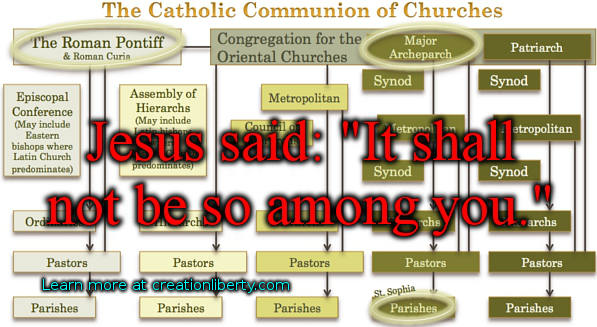
Furthermore, if Peter was supposed to be the first "Vicar" of the church, why is he not mentioned in Paul's list of greetings to the church in Rome? In Romans 16, Paul greets many of those in the Roman church, including other evangelists and apostles, but Peter is NEVER mentioned in that letter.
To clarify what I mean, it would be quite odd and rather insulting if you wrote a letter to the staff in the United States White House, but did not mention the President, who is chief among the staff, and likewise, would be odd and rather insulting that Paul never mentioned Peter, especially since they knew each other. In fact, there is no evidence (Scriptural or otherwise) that Peter ever stepped foot in Rome, let alone visited the church in Rome, but the Catholic Church puts their faith, hope, and structure of everything they say and do on the basis of a made-up doctrine with no supporting evidence.
Even though dedicated Catholics want to believe that it is a "self-evident" fact that Peter was the first "Pope" of the Catholic Church, even Encyclopedia Britannica admits that there is no documented evidence for that belief:
"The identification of this obvious primacy [office] of Peter in the New Testament with the primacy of the church of Rome isnot self-evident . For one thing,the New Testament is almost silent about a connection between Peter and Rome . The reference at the close of the Acts of the Apostles to the arrival of the Apostle Paul in Rome givesno indication that Peter was there as the leader of the Christian community or even as a resident, and the epistle that Paul had addressed somewhat earlier to the church at Rome devotes its entire closing chapter to greetings addressed to many believers in the city but fails to mention Peter's name ."
-Francis C. Oakley & Jaroslav J. Pelikan, "Roman Catholicism - The emergence of Roman Catholicism," Encyclopedia Britannica, retrieved Nov 16, 2017, [britannica.com/topic/Roman-Catholicism]
This is why Catholics like to use the term "self-evident" when asked for evidence for their claims. Essentially, it is a quick, professional-sounding, go-to phrase they can quickly pull out when they are backed into a corner without any evidence to show for what they believe.
There are Catholics that sinfully respect the persons of the Catholic hierarchy, and refuse to believe that they just fabricated unbiblical things to justify the foundations of Catholicism. However, if we carefully read the Catechism of the Catholic Church, it openly states that Catholics do not follow the Bible when it comes to such matters:
"As a resultthe [Catholic] Church , to whom the transmission and interpretation of Revelation is entrusted, 'does not derive her certainty about all revealed truths from the holy Scriptures alone. Both Scripture and Tradition must be accepted and honored with equal sentiments of devotion and reverence.' "
-Catechism of the Catholic Church, "The Transmission of Divine Revelation," Part 1, Section 1, Chapter 2, Article 2, Canon #82, retrieved Apr 27, 2018, [http://www.scborromeo.org/ccc/para/82.htm]
Before we continue, it should be noted that this statement means the Catholic Church believes that their priests are the holders of all divine revelation, meaning that if you want to understand God's Word, you have to go to their private institution to get private interpretation. Once again, the Bible teaches us the opposite:
Knowing this first, that no prophecy of the
scripture is of any private interpretation.
-2 Peter 1:20
These things have I written unto you concerning them that seduce you. But the anointing which ye have received of him abideth in you, and ye need not that any man teach you: but as the same anointing teacheth you of all things, and is truth, and is no lie, and even as it hath taught you, ye shall abide in him.
-1 John 2:26-27
Howbeit in vain do they worship me, teaching
for doctrines the commandments of men.
-Mark 7:7
So when they had dined, Jesus saith to Simon Peter, Simon, son of Jonas, lovest thou me more than these? He saith unto him, Yea, Lord; thou knowest that I love thee. He saith unto him, Feed my lambs. He saith to him again the second time, Simon, son of Jonas, lovest thou me? He saith unto him, Yea, Lord; thou knowest that I love thee. He saith unto him, Feed my sheep. He saith unto him the third time, Simon, son of Jonas, lovest thou me? Peter was grieved because he said unto him the third time, Lovest thou me? And he said unto him, Lord, thou knowest all things; thou knowest that I love thee. Jesus saith unto him, Feed my sheep.
-John 21:15-17
Peter, in his epistle to the church (via the Holy Ghost), told us that we were NOT to be lords over the flock (i.e. as the priests, bishops, and popes of Rome have done) and he told us that we were NOT to seek after filthy lucre (i.e. money), which Catholic priests, bishops, and popes have done for centuries through the false doctrine of purgatory and indulgences, as we covered in earlier chapters of this book:
The elders which are among you I exhort, who am also an elder, and a witness of the sufferings of Christ, and also a partaker of the glory that shall be revealed: Feed the flock of God which is among you, taking the oversight thereof, not by constraint, but willingly; not for filthy lucre [i.e. not to receive a paycheck], but of a ready mind; Neither as being lords over God's heritage, but being ensamples to the flock. And when the chief Shepherd shall appear, ye shall receive a crown of glory that fadeth not away.
-1 Peter 5:1-4
There will likely be some readers who will think it easier to falsely accuse me than to accept that Catholics' beliefs are based on something so absurd and flimsy, but you do not have to take my word for it. Let's continue to read New Advent's article:
"He saith to him, 'Feed my sheep'.Why does He pass over the others and speak of the sheep to Peter?... I should reply thatHe made Peter the teacher not of that see but of the whole world ."
-Kevin Knight, "The Pope," New Advent, retrieved Apr 27. 2018, [newadvent.org/cathen/12260a.htm]
In case you missed it, what New Advent, a Catholic-approved website, stated was that when Jesus told Peter to feed His sheep, they took that to mean that Peter was given global religious authority over all mankind. This is comical at best. What Catholics do not understand is that all Christians were given the authority to teach the whole world the doctrines of Jesus, and when He gave all Christians this commandment, He said that all authority belonged to Himself; not Peter, nor a pope:
And Jesus came and spake unto them, saying, All power is given unto me in heaven and in earth. Go ye therefore, and teach all nations, baptizing them in the name of the Father, and of the Son, and of the Holy Ghost: Teaching them to observe all things whatsoever I have commanded you: and, lo, I am with you alway, even unto the end of the world. Amen.
-Matthew 28:18-20
Peter answered and said unto him, Though all men shall be offended because of thee, yet will I never be offended. Jesus said unto him, Verily I say unto thee, That this night, before the cock crow, thou shalt deny me thrice.
-Matthew 26:33-34
And Peter remembered the word of Jesus, which said unto him, Before the cock crow, thou shalt deny me thrice. And he went out, and wept bitterly.
-Matthew 26:75
I have spoken personally with Catholics who insist that Peter is the "rock" because (as I mentioned earlier) Christ called him 'Peter', which means "rock." However, if we approach Scripture the way that Catholics do, then we would have to conclude that Peter is also Satan because immediately after Christ named Simon "Peter," He called Peter by the name of the Devil:
But he turned, and said unto Peter, Get thee behind me, Satan: thou art an offence unto me: for thou savourest not the things that be of God, but those that be of men.
-Matthew 16:23
A double minded man is unstable in all his ways.
-James 1:8
Study to shew thyself approved unto God, a workman that needeth not to be ashamed, rightly dividing the word of truth.
-2 Timothy 2:15
Ask, and it shall be given you; seek, and ye shall find; knock, and it shall be opened unto you: For every one that asketh receiveth; and he that seeketh findeth; and to him that knocketh it shall be opened.
-Matthew 7:7-8
The heart of the righteous studieth to answer:
but the mouth of the wicked poureth out evil things.
-Proverbs 15:28
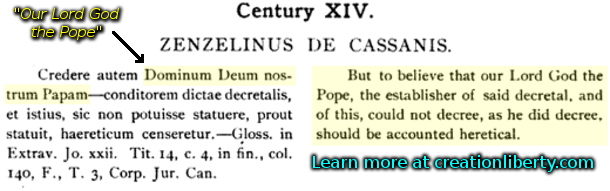
"But to believe thatour Lord God the Pope , the establisher of said decretal, and of this, could not decree, as he did decree, should be accounted heretical."
-John H. Treat, The Catholic Faith, Or, Doctrines of the Church of Rome Contrary to Scripture and the Teaching of the Primitive Church, Bishop Welles Brotherhood, 1888, p. 536, [Harvard University]
When speaking with the public, Catholic priests typically stand on pretense and lie by telling people that the Pope is just a "substitute" for Christ. However, what most people do not know is that the Catholic Church believes and teaches their Pope IS God in the flesh, and past popes have declared it in official decrees.
For those Catholics who still may not believe that an anathema from the Catholic Church is a condemnation to hell, perhaps they will listen to Pope Boniface VIII (8th, 1294-1303), who teaches that you must believe on the Catholic Pope to be saved:"Furthermore, we declare, we proclaim, we define that |
 |
After we have learned about the pagan origins and heathenistic philosophy of the Catholic Church, the Pope's statement should not be surprising, and to make sure readers understand this fully, the Catholic Pope is considered to be Christ on earth, and to have taken His place on the cross. Zenit, a news agency in Rome, documented a statement from Roman Catholic Bishop Patrick Dunn of Auckland when he commented on Pope John Paul II's condition in the final days of his life:
"'It seems thatPope John Paul II now presides over the universal Church from his place upon Christ's cross ,' said Bishop Dunn, who traveled with seven other prelates to Rome."
-Zenit Staff, "Auckland Bishop Says Pope Presides From the Cross," Zenit, Sept 21, 2004, retrieved Apr 27, 2018, [zenit.org/articles/auckland-bishop-says-pope-presides-from-the-cross]
Sadly, because of the deception of the ecumenical (i.e. one-world religious) movement, many Catholics falsely believe that we born-again Christians and practicing Catholics believe mostly the same things, but the truth is that Catholics serve a different "god" than we Christians do, and they serve a different "christ" than Christians. The following is a letter that was received by Friar Septimus Andrews from Venetian priest Don Marino, who translated the words of the letter he received from Cardinal Joseph Sarto, January 10, 1896:
"Dear Don Marino—I have read all the homilies I have made since my coming here in Venice, and only in the sermon for the anniversary of the election of the Holy Father, I said these exact words: 'The Pope represents Jesus Christ Himself, and therefore is a loving Father. '"
-Joseph Sarto, quoted by Marino Tommates, Publications of the Catholic Truth Society, Vol. 29, 1896, p. 11, [New York Public Library]
If the Catholic Pope truly represented Jesus Christ on earth, he would not be highly esteemed with huge parades in his honor, and housed in lavish buildings made of gold and silver. Rather, he would have to be lowly, meek, and humble:
And Jesus saith unto him, The foxes have holes, and the birds of the air have nests; but the Son of man hath not where to lay his head.
-Matthew 8:20
Take my yoke upon you, and learn of me; for I am meek and lowly in heart: and ye shall find rest unto your souls.
-Matthew 11:29
Charge them that are rich in this world, that they be not highminded, nor trust in uncertain riches, but in the living God, who giveth us richly all things to enjoy;
-1 Timothy 6:17
"Side by side with the shameless worship of the Virgin in the Church of Rome is the Divine honour paid to the Pope.He has been adored upon the altar, solemnly proclaimed the Vicar of Christ, Ruler of the World, Lord of Lords, the Almighty Vice-general of God, God upon earth, our Lord God. The Pope's official organ [publication]has asserted, that 'when he thinks it is God that thinks in him, and he is to Christians all that Jesus Christ would be were He now upon earth.' This blasphemous homage was not reproved by Pius IX [9th]; it has never been condemned by Leo XIII [8th]. "
-Lord Halifax, Leamington Country Chronicle, Oct 26, 1895, quoted in Publications of the Catholic Truth Society, Vol. 29, 1896, p. 11, [New York Public Library]
The above author provided a list of names by which the Catholic Pope has been called, and never once have the popes of Rome ever rebuked such lavish titles. Catholic priests attempt to explain away the doctrine of a pope's claim to divinity as just a "representation" of Jesus, but that is no different than Catholics trying to cover up their idolatry by claiming that a statue is just a "representation" of Mary. In short, this is the same idolatry in another form, and Catholics desperately try to plug up the breached dam of obvious blasphemy and heresy that floods the Catholic Church.
If you are wondering how the head of the Catholic Church went from man to godhood, you need to look no further than Rome because the Roman Emperor was also considered to be a god on earth:
"On his death,Julius Caesar was officially recognised as a god, the Divine ('Divus') Julius, by the Roman state. And in 29 BC Caesar's adopted son, the first Roman emperor Augustus, allowed the culturally Greek cities of Asia Minor to set up temples to him. This was really the first manifestation of Roman emperor-worship...Emperor-worship was a unifying factor in the Roman world, practiced not only by army units spread throughout the empire but also by individuals in the provinces , where there were collective imperial cult centres at places such as Lyons (Gaul), Pergamon (Asia) and (probably) Colchester (Britain)."
-Nigel Pollard, "Roman Religion Gallery: The Imperial Cult," BBC History, Feb 17, 2011, retrieved Sept 6, 2018, [bbc.co.uk/history/ancient/romans/roman_religion_gallery_06.shtml]
The worship of the Roman Emperor was a unifying feature, and that is exactly how the Catholic Pope is treated, having people from many different religions and cultures worship together at his feet, lining up just to shake his hand and kiss his ring. If you want a more accurate date for the philosophical beginnings of the Roman Catholic Church, I would say 27 BC would be more precise, since that was the year Augustus was appointed Roman Emperor to handle a national emergency, and after the crisis was over, Augustus and the subsequent emperors never gave their power back to the people, producing five centuries of tyrannical conquest.
(See Donald L. Wasson, "Roman Emperor," Ancient History Encyclopedia, Apr 30, 2018, retrieved Dec 5, 2020, [https://bit.ly/3orE5Bv])
The Catholic Church calls Constantine (the actual first pope) a "god on earth:"
"Pope Nicolas saith: Constat summum Pontificem a pio Principe... Deum appellatum ('It is well-known that the Pope of the godly prince Constantine was called God '). Likewise the Pope was well content to suffer one of his parasites [one who flatters in exchange for hospitality] to say unto him in the late Council of Lateran:Tu es alter Deus in terris ('Thou art another God on earth') . Likewise Cardillus the Spaniard, in defence of the Pope's late chapter at Trident, oftentimes calleth the Pope a Terrenus Deus ('an earthly God ')."
-Publications of the Catholic Truth Society, Vol. 29, 1896, p. 18, [New York Public Library]; Gratiani Decretum, xcvi, can. 7; See also Defence of Apology, Part 5, Chapter 6, Div. 11, p. 583
To give an example of such parasites, Christopher Marcellus gave an address to Pope Julius II during the Fifth Lateran Council in 1512, in which he said:
"Take care that we lose not that salvation, that life and breath which thou [Pope Julius] hast given us, for thou art our shepherd, thou art our physician, thou art our governor, thou art our husbandman, thou art finally another God on earth. "
-Christopher Marcellus, Fifth Lateran Council, 1512, quoted by Edward Hendrie, Antichrist: The Beast Revealed, 2015, p. 215, ISBN: 9780983262787
Robert Bellarmine, Italian Jesuit and Catholic cardinal, who was also canonized to be a "saint" of the Catholic Church in 1930, said:
"All names which in the Scriptures are applied to Christ , by virtue of which it is established that he is over the church,all the same names are applied to the Pope ."
-Robert Bellarmine, Bellarmine on the Authority of the Councils, Vol. 1, Book 2, Ch. 17, 1628, p. 266, quoted in The Protestant Magazine, Vol 7, 1915, p. 86
Again, no Catholic Popes throughout the centuries have ever renounced or rebuked these glorious titles used to describe themselves. Some Catholics might complain that the sources I am providing for these quotes come from "anti-Catholic" documents, and although that is not an argument that detracts from the validity of the quotes, let's appease Catholics for a moment and look at some papal decrees.
Pope Pius X (10th, Guiseppe Sarto, 1903-1914) was quoted in an 1895 edition of the Catholic National magazine, in which he said:
 |
" |
Please take a moment to consider that Pope Pius was saying that his spirit is actually the Holy Spirit of the Godhead, meaning that if one claims to be Jesus Christ, one would also have to claim that he is God the Father come to earth. Therefore, those Catholics who try to claim that the Pope is just a "representative of Jesus Christ" not only have no clue what they are talking about, but they are also in direct doctrinal contradiction against their god, the Pope.
Pius X's predecessor, Pope Leo XIII (8th, Vincenzo Pecci, 1878-1903), also decreed that the Pope was like unto God the Father:" -Pope Leo XIII, Sapientiae Christianae, 1890, retrieved May 1, 2018, [papalencyclicals.net/Leo13/l13sapie.htm] |
 |
The popes of the Catholic Church believe they are God Himself, and they also expect everyone else to see them as God because they are lifted up in the pride of their hearts, just as the King of Babylon lifted up himself in the pride of his heart, to think he is like God:
How art thou fallen from heaven, O Lucifer [the King of Babylon], son of the morning! how art thou cut down to the ground, which didst weaken the nations! For thou hast said in thine heart, I will ascend into heaven, I will exalt my throne above the stars of God: I will sit also upon the mount of the congregation, in the sides of the north: I will ascend above the heights of the clouds; I will be like the most High. Yet thou shalt be brought down to hell, to the sides of the pit.
-Isaiah 14:12-15
 |
"Have no fear when people call me the 'Vicar of Christ,' -Pope John Paul II, Crossing the Threshold of Hope, Knopf Doubleday Publishing Group, 1995, p. 6, ISNB: 9780679765615 |
To his very small credit, John Paul II was correct in that it seems contradictory to call a priest or pope "Holy Father." The reason this seems contradictory is because it IS plainly contradictory to anyone who reads the Gospel of Christ because Jesus stated very clearly that to give a man the title of "Father" in the religious sense (not in a blood lineage sense, from son to father) is a violation of Christ's commandment:
But be not ye called Rabbi [the title of a religious lord or master]: for one is your Master, even Christ; and all ye are brethren. And call no man your father upon the earth: for one is your Father, which is in heaven. Neither be ye called masters: for one is your Master, even Christ. But he that is greatest among you shall be your servant.
-Matthew 23:8-9
But in vain they do worship me, teaching for
doctrines the commandments of men.
-Matthew 15:9
Beware lest any man spoil you through philosophy [way of thinking] and vain deceit, after the tradition of men, after the rudiments [first teachings] of the world, and not after Christ.
-Colossians 2:8
And why call ye me, Lord, Lord, and do not the things which I say?
-Luke 6:46
The fear of the LORD is the beginning of knowledge:
but fools despise wisdom and instruction.
-Proverbs 1:7
For that they hated knowledge, and did not choose the fear of the LORD:
-Proverbs 1:29
So that we may boldly say, The Lord is my helper,
and I will not fear what man shall do unto me.
-Hebrews 13:6
And he said unto them, Ye are they which justify yourselves before men; but God knoweth your hearts: for that which is highly esteemed among men is abomination in the sight of God.
-Luke 16:15
The heart is deceitful above all things, and
desperately wicked: who can know it?
-Jeremiah 17:9
He that trusteth in his own heart is a fool:
but whoso walketh wisely, he shall be delivered.
-Proverbs 28:26
"[W]e readily understand the devotion ofSaint Francis of Assisi for 'the Lord Pope' , the daughterly outspokenness of Saint Catherine of Siena towardsthe one whom she called 'sweet Christ on earth' ,"
-Pope John Paul II, Vita Consecrata, Vatican Archives, Mar 25, 1996, retrieved May 1, 2018, [https://bit.ly/1Ql5nTO]
I have watched various video interviews with Catholic parishioners, priests, and nuns, who all call their Pope "The Good Shepherd," which is a title reserved for Christ alone since there is none good but God. (Mark 10:18) They also said that being with him is like standing in the presence of God, which is not only laughable from a Scriptural standpoint (i.e. no man could stand for a brief moment in a small portion of the presence of God and live), but it is absurd to think that man could arise to such a divine state by being voted into office by men.
Again, the power over heaven and earth belongs to Jesus Christ alone, and it is heresy to believe or teach that any man should usurp His throne in any capacity:
And Jesus came and spake unto them, saying, All power is given unto me in heaven and in earth.
-Matthew 28:18
I am the LORD: that is my name: and my glory will I not give to another, neither my praise to graven images.
-Isaiah 42:8
"I recently wrote to the bishops of Asia: 'Althoughthe [Catholic] Church gladly acknowledges whatever is true and holy in the religious traditions of Buddhism, Hinduism and Islam as a reflection of that truth which enlightens all people , this does not lessen her [the Catholic Church's] duty and resolve to proclaim without fail Jesus Christ who is 'the way, and the truth and the life.'...The fact that the followers of other religions can receive God's grace and be saved by Christ apart from the ordinary means which he [Jesus] has established does not thereby cancel the call to faith and baptism which God wills for all people.'"
-Pope John Paul II, Redemptoris Missio, Vatican Archives, Dec 7, 1990, retrieved May 1, 2018, [https://bit.ly/1QXMWUO]
In case it was unclear what John Paul II said, he taught that people of other religions, who contradict Christ in their doctrine and practices, can receive God's saving grace by another method apart from the method Jesus Christ established for us. How does one receive the grace of salvation apart from the method that God declared, namely, repentance and faith in the shed blood of Christ? God has told us of no other method in His Word, and so in order to believe what the Catholic Church teaches, Catholics are forced to put all their faith and hope into a fallible pope, and they do so to their own destruction.
Thus saith the LORD; Cursed be the man that trusteth in man, and maketh flesh his arm, and whose heart departeth from the LORD.
-Jeremiah 17:5
Jesus saith unto him, I am the way, the truth, and the life:
-John 14:6
"The universality of salvation means thatit is granted not only to those who explicitly believe in Christ and have entered the [Catholic] Church ."
-Pope John Paul II, Redemptoris Missio, Vatican Archives, Dec 7, 1990, retrieved May 1, 2018, [https://bit.ly/1QXMWUO]
Even though Christ just told us that no one can come unto the Father except through Him, the Pope says there are other ways apart from Christ, but the Catholic Church still requires people to bow to the Pope (who they believe to be Christ) in order to be saved because John Paul II also contradicts Boniface VIII, whose words we read earlier when he said that "
Just as politicians, Catholic authorities often contradict themselves and flip-flop on their positions based on who they are talking to, and who they want to convince of a particular idea, so that they may gain more power and wealth, and in the next chapter, we will learn what happens when the Catholic Church attains the supreme power they so fervently desire. The goal of Rome was to conquer the world, and so the spirit of Rome lives on within the Roman Pontiffs, who now seek a one-world religion under the Pope's authority, in which they are willing to accept any religious belief, so long as they accept the Catholic Pope as a revered religious authority over the world.
For example, in Pope John Paul II's book, Crossing the Threshold of Hope, he makes many statements that indicate that almost any religious belief will lead to heaven:
|
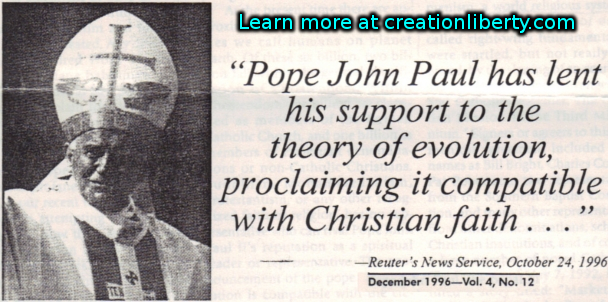
(Read "Evolutionism: Another New-Age Religion" here at creationliberty.com for more details.)
John Paul II rejected God's account of Genesis and gave ideological credibility to heretics:
"The Church's magisterium is directly concerned with the question ofevolution , for itinvolves the conception of man. "
-Pope John Paul II, Address to the Pontifical Academy of Sciences, Oct 22, 1996, retrieved May 8, 2018, [catholicculture.org/culture/library/view.cfm?id=80]
The Lord God, through His prophet Moses, stated clearly in Exodus 20 that the creation week was a typical seven-day work week, just as we experience today, and the Lord Jesus Christ also said if you do not believe what Moses wrote, then you do not believe Christ either:
Six days shalt thou labour, and do all thy work: But the seventh day is the sabbath of the LORD thy God: in it thou shalt not do any work, thou, nor thy son, nor thy daughter, thy manservant, nor thy maidservant, nor thy cattle, nor thy stranger that is within thy gates: For in six days the LORD made heaven and earth, the sea, and all that in them is, and rested the seventh day: wherefore the LORD blessed the sabbath day, and hallowed it.
-Exodus 20:9-11
For had ye believed Moses, ye would have believed me: for he wrote of me. But if ye believe not his writings, how shall ye believe my words?
-John 5:47
(Read "The Earth's Age Affects Salvation Doctrine" here at creationliberty.com for more details.)
"The Catholic Church certainly does not endorse creationism. This is clearly attested by reference to the concluding statement of the historic conference of paleontologists, geneticists, and molecular biologists which met from May 24th to May 27th, 1982, at thePontifical Academy of Sciences in the Vatican Gardens . After working together under the direction of Carlos Chagas, Brazilian neurophysiologist andscientific advisor to Pope John Paul II , the group concluded that: 'We freely acknowledge thatthere is room for differences of opinion on such problems as species formation and the mechanisms of evolutionary change . Nevertheless,we are convinced that masses of evidence render the application of the concept of evolution to man and other primates beyond serious dispute .'"
-Nation Center for Science Education, "Letters to the Editor," Vol. 4, No. 4, 1984, p. 44-49, retrieved May 8, 2018, [http://ncse.com/cej/4/4/letters-to-editor]
In short, the Catholic Pope's science advisor stated that although there is some room for debate in the Catholic Church about how evolution took place, there is NO room for debate about whether or not evolution took place because the Catholic Church believes in evolutionism. More recently, Pope Francis made the following statement to the Pontifical Academy of Sciences in support of evolutionism's many heresies:
"When we read about creation in Genesis,we run the risk of imagining God was a magician, with a magic wand able to do everything. But that is not so ...He created human beings and let them develop according to the internal laws that he gave to each one so they would reach their fulfillment."
-Pope Francis, quoted by Ishaan Tharoor, "Pope Francis Says Evolution is Real and God is No Wizard," The Washington Post, Oct 28, 2014, retrieved May 23, 2015, [washingtonpost.com/blogs/worldviews/wp/2014/10/28/pope-francis-backs-theory-of-evolution-says-god-is-no-wizard]
There are two major problems with this, the first being that Pope Francis does not believe God is all-powerful, and the second problem is that Pope Francis is claiming that those who believe that God is all-powerful, and that God did the things He said He did in His Word, are fools that believe in a magician's witchcraft. This is a very dark, twisted heresy, and so it should be no surprise for readers to learn that Pope Francis also promotes Karl Marx's communism:
"REPORTER: "You told me some time ago that the precept, 'Love your neighbour as thyself' had to change, given the dark times that we are going through, and become 'more than thyself.'So you yearn for a society where equality dominates. This, as you know, is the programme of Marxist socialism and then of communism. Are you therefore thinking of a Marxist type of society?
POPE FRANCIS:It has been said many times and my response has always been that, if anything, it is the communists who think like Christians. Christ spoke of a society where the poor, the weak and the marginalized have the right to decide. Not demagogues, not Barabbas, but the people, the poor, whether they have faith in a transcendent God or not. It is they who must help to achieve equality and freedom. "
-Eugenio Scalfari, "Pope Francis: 'Trump? I do not judge. I care only if he makes the poor suffer'," la Repubblica, Nov 13, 2016, retrieved Dec 12, 2020, [repubblica.it/vaticano/2016/11/11/news/pope_francis_trump-151810120]; These comments were made after Donald Trump's election into office, and were part of the leftist media's socialist agenda.
It should be noted that Karl Marx dedicated his communist book, Das Kapital, to Charles Darwin because Marx was a sincere admirer of Darwin:
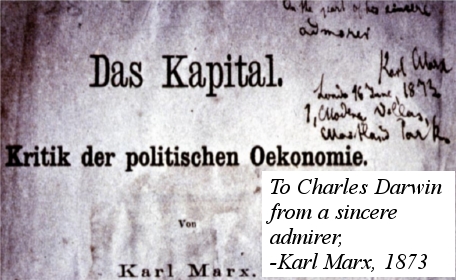
It is clear that neither the reporter nor Francis understood what it means to "love thy neighbor as thyself," and I say that because I believe they know full well what Marxism, socialism, and communism are, but they twist the words of Jesus Christ to promote their own foolish and insane ideology.
As also in all his epistles, speaking in them of these things; in which are some things hard to be understood, which they that are unlearned and unstable wrest, as they do also the other scriptures, unto their own destruction.
-2 Peter 3:16
Now the Lord is that Spirit: and where the Spirit of the Lord is, there is liberty.
-2 Corinthians 3:17
Greater love hath no man than this, that a man lay down his life for his friends.
-John 15:13
But if any provide not for his own, and specially for those of his own house, he hath denied the faith, and is worse than an infidel.
-1 Timothy 5:8
For even when we were with you, this we commanded you, that if any would not work, neither should he eat.
-2 Thessalonians 3:10
And a certain ruler asked him, saying, Good Master, what shall I do to inherit eternal life? And Jesus said unto him, Why callest thou me good? none is good, save one, that is, God. Thou knowest the commandments, Do not commit adultery, Do not kill, Do not steal, Do not bear false witness, Honour thy father and thy mother. And he said, All these have I kept from my youth up. Now when Jesus heard these things, he said unto him, Yet lackest thou one thing: sell all that thou hast, and distribute unto the poor, and thou shalt have treasure in heaven: and come, follow me. And when he heard this, he was very sorrowful: for he was very rich.
-Luke 18:18-23
The Catholic Church and its heretical leadership are those who promise their laity liberty, but they are the servants of corruption. The true wicked heart of Pope Francis could not care less about the poor and the needy, so long as they bow to his authority.
As free, and not using your liberty for a cloke of maliciousness, but as the servants of God.
-1 Peter 2:16
While they promise them liberty, they themselves are the servants of corruption: for of whom a man is overcome, of the same is he brought in bondage.
-2 Peter 2:19
This people draweth nigh unto me with their mouth, and honoureth me with their lips; but their heart is far from me.
-Matthew 15:8
The Catholic Church's ecumenical push towards a one-world religion is the purpose for them accepting all religions, including evolutionism (which is a religion) into one unified corporation, lying to everyone by telling them that they will all go to heaven. This forced ecumenical movement cannot exist in a society of liberty, which is why Catholicism needs communism. It is also for this reason that Pope Francis declared that proselytizing/evangelism (i.e. preaching of the Gospel to win souls - Pro 11:30) was too controversial, and that evangelism does not grow the Kingdom of God:" |
 |
proselyte (n): new convert to some religion; thus a Gentile converted to Judaism is a proselyte; a pagan converted to christianity is a proselyte
evangelism (n): the public declaration of the gospel
(See 'proselyte' & 'evangelism', American Dictionary of the English Language, Noah Webster, 1828, retrieved May 8, 2018, [webstersdictionary1828.com])
Repent ye therefore, and be converted, that your sins may be blotted out, when the times of refreshing shall come from the presence of the Lord;
-Acts 3:19
"[E]vangelism is not proselytizing.The [Catholic] Church grows not through proselytizing but through attraction ... one young man asked me this question: 'What should I say to a university classmate, a friend, a good person, but who is atheist? What should I tell him in order to change him, to convert him?' This was the response: 'The last thing you should do is to say something.' "
-Pope Francis, "On the return flight from Dhaka," L'Osservatore Romano, Vatican City, No. 51-52, Dec 22-29, 2017, retrieved May 8, 2018, [osservatoreromano.va/vaticanresources/pdf/ING_2017_049_0812.pdf]; See also "Press Conference on the Return Flight From Bangladesh," 2017, retrieved Oct 10, 2023, [https://www.vatican.va/content/francesco/en/speeches/2017/december/documents/papa-francesco_20171202_viaggioapostolico-bangladesh-voloritorno.html]
I have to agree with Pope Francis to a degree because of his belief that the Catholic Church is grown through attraction rather than evangelizing. The true church of Jesus Christ is not grown through attraction, but the Catholic Church most certainly is grown through such worldly means because they are of the world, and they bring people into their corrupt fold through worldly methods that contradict what Christ taught us.
Love not the world, neither the things that are in the world. If any man love the world, the love of the Father is not in him.
-1 John 2:15
(Read Christian Music: For The Love of Money & "Revivalism: The Devil's Design" here at creationliberty.com for more details.)
Francis's statement also contradicts Christ's most basic commandments, and it goes against the entire example that was set for us in the New Testament, which I have already quoted in this chapter, but I will quote it again:
Go ye therefore, and teach all nations, baptizing them in the name of the Father, and of the Son, and of the Holy Ghost: Teaching them to observe all things whatsoever I have commanded you: and, lo, I am with you alway, even unto the end of the world. Amen.
-Matthew 28:19-20
preach (v): to pronounce a public discourse on a religious subject, or from a subject, or from a text of Scripture; to discourse on the gospel way of salvation and exhort to repentance
(See 'preach', American Dictionary of the English Language, Noah Webster, 1828, retrieved May 8, 2018, [webstersdictionary1828.com])
Preach the word; be instant in season, out of season; reprove, rebuke, exhort with all longsuffering and doctrine.
-2 Timothy 4:2
Blessed are ye, when men shall hate you, and when they shall separate you from their company, and shall reproach you, and cast out your name as evil, for the Son of man's sake. Rejoice ye in that day, and leap for joy: for, behold, your reward is great in heaven: for in the like manner did their fathers unto the prophets.
-Luke 6:23
Yea, and all that will live godly in Christ Jesus shall suffer persecution.
-2 Timothy 3:12
As many as desire to make a fair shew in the flesh, they constrain you to be circumcised; only lest they should suffer persecution for the cross of Christ.
-Galatians 6:12
"As a result the Church, to whom the transmission and interpretation of Revelation is entrusted, 'does not derive her certainty about all revealed truths from the holy Scriptures alone. Both Scripture and Tradition must be accepted and honored with equal sentiments of devotion and reverence.' "
-Catechism of the Catholic Church, "The Transmission of Divine Revelation," Part 1, Section 1, Chapter 2, Article 2, Canon #82, retrieved Apr 27, 2018, [http://www.scborromeo.org/ccc/para/82.htm]
What I want readers to understand is that I declare that Catholic priests are heretics, and in return, they call me a heretic, but there is a very important difference between the two parties. My accusation of heresy against them is based on the Word of the Living God, whereas their accusation of heresy against me is based on their traditions created by their corrupt popes, so in short, they accuse me of being a heretic against their traditions (of which, I say, "praise God"), but I accuse them of being heretics against the Holy Scriptures (of which, they are guilty), and therefore, Catholics need to decide if they are going to follow Scripture or tradition because you cannot serve both.
And if it seem evil unto you to serve the LORD, choose you this day whom ye will serve; whether the gods which your fathers served that were on the other side of the flood, or the gods of the Amorites, in whose land ye dwell: but as for me and my house, we will serve the LORD.
-Joshua 24:15
"A baptized Christian, whocalls himself a Christian, yet obstinately [stubbornly] denies or calls into doubt any of the truths [i.e. traditions] to be believed by Divine and Catholic faith, is a heretic ; if he abandons the Christian faith altogether he is called an apostate; if, finally, herefuses to be subject to the Supreme Pontiff [i.e. The Pope], or to have communication with the members of the Church subject to the Roman Pontiff, he is a schismatic. "
-Stanislaus Woywod (Catholic Priest), The New Canon Law: A Commentary and Summary of the New Code of Canon Law, J.F. Wagner, 1918, p. 272, [University of Toronto]
It is Jesus Christ who first came to bring division; to separate the truth from the lies:
Suppose ye that I am come to give peace on earth?
I tell you, Nay; but rather division:
-Luke 12:51
(Read "The Biblical Understanding of Sanctification" here at creationliberty.com for more details.)
Be ye not unequally yoked together with unbelievers: for what fellowship hath righteousness with unrighteousness? and what communion hath light with darkness? And what concord hath Christ with Belial? or what part hath he that believeth with an infidel? And what agreement hath the temple of God with idols? for ye are the temple of the living God; as God hath said, I will dwell in them, and walk in them; and I will be their God, and they shall be my people. Wherefore come out from among them, and be ye separate, saith the Lord, and touch not the unclean thing; and I will receive you, And will be a Father unto you, and ye shall be my sons and daughters, saith the Lord Almighty.
-2 Corinthians 6:14-18
"The Reformation produced indeed an exaggerated individualism, which by declaring every man equally competent to find out the doctrines of the Saviour fromhis own private reading of the Scriptures, has led millions to the utter denial of Christ and His doctrines of faith and morality ."
-Bertrand L. Conway (Catholic Priest), The Question-box Answers: Replies to Questions Received on Missions to Non-Catholics, The Catholic Book Exchange, 1903, p. 131, [New York Public Library]
I would encourage readers to look over that statement carefully because the priest just stated that if you read the doctrines of Christ yourself, the Bible will lead you to deny Jesus Christ. That is absurd. That makes no sense at all. Rather, the problem is that the Catholic Church believes that their wicked popes are Jesus Christ Himself; therefore, they believe that if you read Scripture for yourself, you will deny their false christ, the Pope, and to that I say, "Amen," because your faith in the truth of Jesus Christ is established by the study of His Word.
So then faith cometh by hearing, and hearing by the word of God.
-Romans 10:17
Study to shew thyself approved unto God, a workman that needeth not to be ashamed, rightly dividing the word of truth.
-2 Timothy 2:15
Knowing this first, that no prophecy of the scripture is of any private interpretation.
-2 Peter 1:20
But God hath revealed them unto us by his Spirit: for the Spirit searcheth all things, yea, the deep things of God.
-1 Corinthians 2:10
These things have I written unto you concerning them that seduce you. But the anointing which ye have received of him abideth in you, and ye need not that any man teach you: but as the same anointing teacheth you of all things, and is truth, and is no lie, and even as it hath taught you, ye shall abide in him.
-1 John 2:26-27
Which things also we speak, not in the words which man's wisdom teacheth, but which the Holy Ghost teacheth; comparing spiritual things with spiritual. But the natural man receiveth not the things of the Spirit of God: for they are foolishness unto him: neither can he know them, because they are spiritually discerned.
-1 Corinthians 2:13-14
"Deny the [Catholic] Church's infallible witness [i.e. The Pope, who they believe is infallible], and lo!the Bible is reduced to the level of mere Oriental literature, full of errors and utterly devoid of divine inspiration ... so that St. Augustine could rightly say in the fifth century: 'I would not believe the gospel unless moved thereto by the authority of the [Catholic] Church. ' ...There is nowhere in the New Testament a clear, methodical statement of the teachings of Christ ."
-Bertrand L. Conway (Catholic Priest), The Question-box Answers: Replies to Questions Received on Missions to Non-Catholics, The Catholic Book Exchange, 1903, p. 66, [New York Public Library]
If you look up the reference and read this priest's statements for yourself, he continues on the next page to say that the Bible is NOT a safe book to read. The Catholic Church wants Catholics to stay away from the Bible because the truth in the Word of God will lead Catholics AWAY from Rome and her Pontiff.
Certainly, many cultists have drawn misinterpretations from Scripture and started corrupt religious entities by doing so. In fact, the Catholic Church is one example of that, and many false religious cults branched off from Catholicism.
(Read "Denominations Are Unbiblical" here at creationliberty.com for more details.)
Karl Keating, founder of Catholic Answers Magazine, took part in a live debate in which he never quoted Scripture, while his opponent quoted it often. During the discussion Keating attempted to defend the inspiration of Scripture, and during Q&A, a young man stood up and asked Keating why he was not quoting from the Bible during the debate, and he responded:
"You know, people have different ways of speaking...I don't believe in giving chapter and verse because, first, it's a waste of time ... and second, I didn't bring my Bible because I don't like to flip through pages and read from it out to the audience whenI try to read from my notes ."
-Karl Keating, "Catholic Debate Peter Ruckman Karl Keating Full Video," uploaded by stereomann83, retrieved Dec 12, 2020, [https://youtu.be/W2HrCTGjGAo?t=7700]
In summary, Keating is saying that his personal notes are more important than the Word of God, which means Keating actually worships himself, and in reality, he is more afraid that quoting the Word of God alongside his comments would reveal his ignorance of Scripture if someone were to look up the context of the passages he is referencing. Again, this should be no surprise after we have learned that the Catholic Church holds the traditions of men in higher authority than the Bible, and how Catholic priests do not lay a foundation in the study of Scripture (as we learned in the introduction to this book), and in chapter nine, we will also learn that nuns also do not end up studying Scripture either.
The following Catholic priest (in a Catholic-approved publication) says:
"Historically,we are certain that the Bible has never been the way to find out Christ ...it has ever been practically impossible for men, generally, to find out Christ from the Bible only ."
-Bertrand L. Conway (Catholic Priest), The Question-box Answers: Replies to Questions Received on Missions to Non-Catholics, The Catholic Book Exchange, 1903, p. 70, [New York Public Library]
The Lord God has NEVER told us that tradition is a lamp unto our feet, and that priests are a light unto our path.
How sweet are thy words unto my taste! yea, sweeter than honey to my mouth! Through thy precepts I get understanding: therefore I hate every false way. Thy word is a lamp unto my feet, and a light unto my path.
-Psalm 119:103-105
For the word of God is quick, and powerful, and sharper than any twoedged sword, piercing even to the dividing asunder of soul and spirit, and of the joints and marrow, and is a discerner of the thoughts and intents of the heart.
-Hebrews 4:12
Then said Jesus to those Jews which believed on him, If ye continue in my word, then are ye my disciples indeed; And ye shall know the truth, and the truth shall make you free.
-John 8:31-32
Of these things put them in remembrance, charging them before the Lord that they strive not about words to no profit, but to the subverting of the hearers. [i.e. to tear down the foundations of worldly philosophies] Study to shew thyself approved unto God, a workman that needeth not to be ashamed, rightly dividing the word of truth. But shun profane and vain babblings: for they will increase unto more ungodliness.
-2 Timothy 2:14-16
Making the word of God of none effect through your tradition, which ye have delivered: and many such like things do ye.
-Mark 7:13
But he answered and said unto them, Why do ye also transgress the commandment of God by your tradition?
-Matthew 15:3
|
"Pope [John Paul II] is currently leading the greatest ecumenical movement in history, in order to unite all religions under Rome's leadership. In 1986, Pope John Paul II gathered in Assisi, Italy the leaders of the world's major religions to pray for peace. |
All famous Catholic icons have believed and taught these same ecumenical (i.e. one-world) religious principles, and all of them have been guilty of idolatry without any repentance of their sins. For example, very few people today know that Mother Teresa prayed at pagan altars and bowed before Buddhist statues as she traveled around the world.
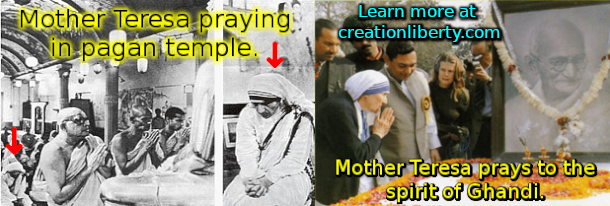
For when they shall say, Peace and safety; then sudden destruction cometh upon them, as travail upon a woman with child; and they shall not escape.
-1 Thessalonians 5:3
This worshiping of popes as gods is nothing new, and it can easily be seen by how the people act when a pope comes to town. According to the following news article, Catholic worshipers are willing to poop their pants just to see their Catholic god, and I assure readers that this is not a joke or satire; this is real:

"When Pope Francis visits the Philippines next week, traffic enforcers won't let the capital's streets get gridlocked if they have to answer the call of nature. About 2,000 traffic enforcers who will be on duty during the 15-19 January papal visit will berequired to wear adult diapers , the Metropolitan Manila Development Authority chairman, Francis Tolentino, said.Tolentino also encouraged people who will wait for hours to see the pope to also wear diapers. The prospect of wearing diapers while on duty was 'well received' by his men , he said on Wednesday."
-Associated Press in Manila, "Philippine Traffic Officers To Wear Adult Diapers During Papal Visit," The Guardian, Jan 7, 2015, retrieved May 8, 2018, [theguardian.com/world/2015/jan/07/philippines-pope-francis]
Please understand that diapers on babies are only to keep feces contained for a short time until the diaper can be changed because, if left unchanged, it can cause rashes and/or septic infections that can be dangerous. Even during this event in which thousands of adults would be walking around in their own filth, idolatry was at the forefront of the celebration:
"The Black Nazarene procession [Mexican worship of a statue depicting a black-skinned 'Jesus'] attracts hundreds of thousands of barefoot, mostly male,Filipino Roman Catholics, who parade a centuries-old black statue of Jesus Christ which devotees believe possess mystical powers that could cure ailments and answer wishes of good health and fortune. [i.e. idolatry] Tolentino says there won't be enough portable toilets for the millions of people expected to see Pope Francis hold an open-air mass at the seaside Rizal Park on 18 January. 'If you attend an event that will last for 24 hours, you cannot go around looking for a [portable toilet],' Tolentino said.Priests, nuns, seminarians, and the elderly also should consider wearing diapers , he said. Asked if he will also wear one, Tolentino said, 'I will try, but in my case, I have less hydration.'"
-Associated Press in Manila, "Philippine Traffic Officers To Wear Adult Diapers During Papal Visit," The Guardian, Jan 7, 2015, retrieved May 8, 2018, [theguardian.com/world/2015/jan/07/philippines-pope-francis]
Of course, the chairman of the Metropolitan Manila Development Authority would not subject himself to that which he recommends to everyone else. It should be noted that he never suggested that the pope should wear a diaper too.
I find it amazing how many times I have heard Catholics tell me that they are not idolaters, and yet, the Catholic Church holds national and international celebrations to worship a statue, and even when the Catholic Pope shows up, he encourages them to continue in idolatry, and never once rebukes it. These idolaters line the streets in their sin, hoping to get a special, worthless indulgence from their Catholic god, and are so desperate to touch the hem of his garment, they will inconveniently defecate in their own trousers just to breathe the same air as such a wicked man.
And even as they did not like to retain God in their knowledge, God gave them over to a reprobate mind, to do those things which are not convenient;
-Romans 1:28
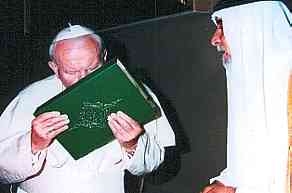 |
The reason the Catholic popes do not rebuke idolatry is because they want all to bow to the Catholic throne of antichrist. You will not find any Biblical justification for anyone who claims to be of Christ to worship in an Islamic mosque, tell the Muslims they are worshiping the same 'god', and kiss the corrupt Qur'an for the media, but the antichrist popes have certainly done these things because they do not know Jesus Christ, and they do not care to know Him. |
I have received letters from angry Catholics telling me how I am just a worthless layman who has no special education or worldly honors, so I have no right to even question their so-called "holy" Roman Pontiff. In response, I tell them that the next time Jorge (i.e. Pope Francis) is in my area, they should have him stop by and I will be more than happy to set him straight on the doctrines of Christ because the Lord Jesus Christ has already instructed us that such vile men of high and lofty stature, with grand, self-serving titles, are not chosen by God to preach His Word, but rather, the Holy God has chosen the lowly and base to preach His Word, so that no flesh should glory in His presence:
For ye see your calling, brethren, how that not many wise men after the flesh, not many mighty, not many noble, are called: But God hath chosen the foolish things of the world to confound the wise; and God hath chosen the weak things of the world to confound the things which are mighty; And base [worthless] things of the world, and things which are despised, hath God chosen, yea, and things which are not, to bring to nought things that are: That no flesh should glory in his presence.
-1 Corinthians 1:26-29
"The cross shows us a different way of measuring success. Ours is to plant the seeds. God sees to the fruits of our labors. And if at timesour efforts and works seem to fail and not produce fruit, we need to remember that we are followers ofJesus Christ and his life, humanly speaking, ended in failure, the failure of the cross ."
-Pope Francis, quoted by Emily Shapiro, "Read What Pope Francis Said at New York's St. Patrick's Cathedral," ABC News, Sept 24, 2015, retrieved May 8, 2018, [abcnews.go.com/US/read-pope-francis-yorks-st-patricks-cathedral/story?id=34023376]
Christ never failed. He fulfilled everything that was foretold of Him thousands of years before His arrival. He did everything He said He would do. The Bible tells us that Christ's sacrifice on the cross brought us victory, not failure.
But thanks be to God, which giveth us the
victory through our Lord Jesus Christ.
-1 Corinthians 15:57
"Another danger -- another danger emerges when we become jealous of our free time,when we think that surrounding ourselves with worldly comforts help [sic] us to serve better. The problem with this way of reasoning is that it can blunt the power of god's daily call to conversion, to encounter with him ."
-Pope Francis, quoted by Emily Shapiro, "Read What Pope Francis Said at New York's St. Patrick's Cathedral," ABC News, Sept 24, 2015, retrieved May 8, 2018, [abcnews.go.com/US/read-pope-francis-yorks-st-patricks-cathedral/story?id=34023376]
When I read Francis's words, my first thought was: "Is he joking?" A Catholic Pope dares to question others about having too many "worldly comforts?" Is the world so blind that they cannot see the overwhelming behemoth of hypocrisy, roaring at ear-deafening volume in the middle of the room?
The following image is the inside of St. Peter's Basilica, which houses the papal enclave in Vatican City. The entire structure is substantially larger than the Capitol Building on Capitol Hill in Washington DC, and is lined with silver and gold. Please look at it closely and ask yourself if it is possible that the Catholic Church might be guilty of "
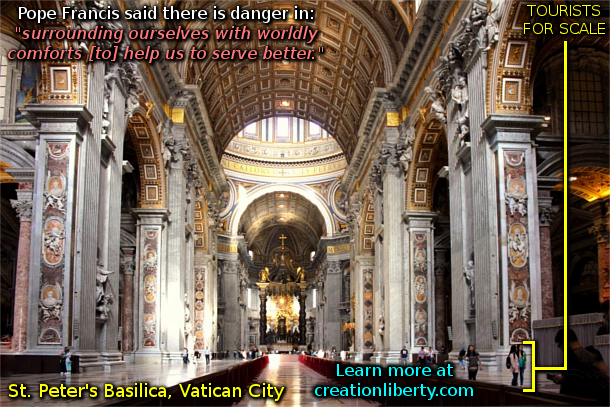
There has never lived a Catholic Pope who has not surrounded himself with lavish comforts, while hypocritically preaching to the public about charity, tithing (which is unbiblical in the New Testament), and living meekly. The following image was John Paul II's private bed for his private bed chambers in his private jet, and it is considered a "relic" that sits in a museum in Kansas:
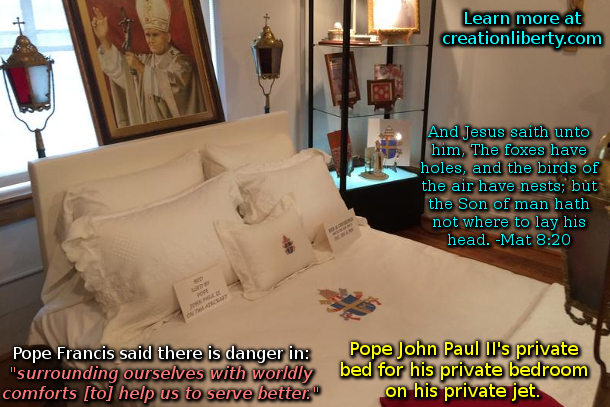
And Jesus saith unto him, The foxes have holes, and the birds of the air have nests; but the Son of man hath not where to lay his head.
-Matthew 8:20
Go your ways: behold, I send you forth as lambs among wolves. Carry neither purse, nor scrip [sack to carry goods, or money], nor shoes: and salute no man by the way.
-Luke 10:3-4
And many shall follow their pernicious [destructive] ways; by reason of whom the way of truth shall be evil spoken of. And through covetousness shall they with feigned words make merchandise of you: whose judgment now of a long time lingereth not, and their damnation slumbereth not.
-2 Peter 2:2-3
For many walk, of whom I have told you often, and now tell you even weeping, that they are the enemies of the cross of Christ: Whose end is destruction, whose God is their belly, and whose glory is in their shame, who mind earthly things.
-Philippians 3:18-19
(See Nicole Winfield, "Pope pays hotel bill: Pope Francis sheds luxuries of previous popes," Christian Science Monitor, Mar 14, 2013, retrieved Dec 19, 2020, [http://bit.ly/2J46Mp0])
Someday, I am waiting for a news headline to read, "Pope Wipes Own Rear End, No Longer Needs Fellows From The Royal College of Surgeons For Assistance" because that is the level of absurdity we are witnessing. However, we need to remember that the Catholic Church believes that their Pope is Christ on earth, and so therefore, they consider him to be divine, and thus, his doing something so unbelievably simple, which everyone else does daily, like paying a hotel bill, is foolishly perceived to be, and treated like, divine intervention.
The hypocrisy gets worse because in March of 2013, Pope Francis gave a speech, and because he used complex Catholic terms, most people did not understand the impact of what he said:
"I thank the Lord that I can celebrate this Holy Mass for the inauguration ofmy Petrine ministry ,"
-Pope Francis, "Mass, Imposition of the Pallium and Bestowal of the Fisherman's Ring for the Beginning of the Petrine Ministry of the Bishop of Rome," Vatican Archives, Mar 19, 2013, retrieved June 8, 2018, [https://bit.ly/2y29Fk6]
The word "Petrine" means in relation to Peter, the apostle of Christ, and thus, Francis declared HIS "Petrine" ministry, as a spiritual descendant of Peter, which is defined in the Catholic Catechism as supreme, universal rule over all:
"The Pope, Bishop of Rome and Peter's successor, is the perpetual and visible source and foundation of the unity both of the bishops and of the whole company of the faithful. Forthe Roman Pontiff, by reason of his office as Vicar of Christ, and as pastor of the entire Church has full, supreme, and universal power over the whole Church, a power which he can always exercise unhindered. The college or body of bishops has no authority unless united with the Roman Pontiff ,"
-Catechism of the Catholic Church, "The Episcopal College and Its Head, The Pope," Vatican Archives, Part 1, Section 2, Chapter 3, Article 9, Paragraph 882-883, retrieved June 8, 2018, [http://www.scborromeo.org/ccc/p123a9p4.htm]
So after giving grand speeches telling everyone that they need to humble themselves, Francis is declaring himself to be Christ on earth, with absolute ruling authority, and expects all to bow to his every word and action because he believes he is divine. It is no coincidence that many governing tyrants and dictators have believed and taught the same thing, and knowing this, it should be no surprise why the Catholic popes have hated the Constitutional Republic of the United States that promotes liberty, and have instead supported Darwinism, Marxism, and communism.
In the same speech, Francis says that it is the job of the entire world to protect things, and he lists out what things he is referring to:
"To protect Jesus with Mary , to protect the whole of creation, to protect each person, especially the poorest, to protect ourselves: this is a service that the Bishop of Rome is called to carry out, yet one to which all of us are called, so that the star of hope will shine brightly."
-Pope Francis, "Mass, Imposition of the Pallium and Bestowal of the Fisherman's Ring for the Beginning of the Petrine Ministry of the Bishop of Rome," Vatican Archives, Mar 19, 2013, retrieved June 8, 2018, [https://bit.ly/2y29Fk6]
First of all, why does "Mary" need protection? If she is in heaven with the Lord Jesus Christ, as are all the saints of God, then why does she need protection from men? Of course, they are not referring to the Mary of Scripture, but rather, they are referring to their false pagan goddess of the heathen; their idolatrous statues and pagan heresies.
Furthermore, in what manner does Jesus, who is God, need protection? When did He call on Christians to be His personal bodyguards? The Lord Jesus Christ needs no protection, and such a thought is incomprehensibly absurd. It is Jesus Christ who protects us, not the other way around, but again, because Pope Francis is considered to be Jesus Christ on earth, therefore, he is calling for the WORLD's protection, not just Catholics, and later in his speech, he called for politicians, economists, and many others to come to his aid and protect him as Jesus Christ on earth, which essentially destroys any hope of that so-called "humble" persona he hypocritically preaches.
A Catholic dare not say that Pope Francis misspoke either. The Catholic Church declares that when popes speak ex cathedra (with full authority), they are "infallible," meaning that they are not capable of making a mistake.
infallibility (adj): not fallible; not capable of erring; entirely exempt from liability to mistake
(See 'infallibility', American Dictionary of the English Language, Noah Webster, 1828, retrieved June 1, 2018, [webstersdictionary1828.com])
"[W]e teach and define as a divinely revealed dogma thatwhen the Roman Pontiff speaks EX CATHEDRA , that is, when, in the exercise of his office as shepherd and teacher of all Christians, in virtue of his supreme apostolic authority, he defines a doctrine concerning faith or morals to be held by the whole Church, he possesses, by the divine assistance promised to him in blessed Peter [i.e. not in Jesus Christ],that infallibility which the divine Redeemer willed his Church to enjoy in defining doctrine concerning faith or morals. Therefore, such definitions of the Roman Pontiff are of themselves, and not by the consent of the Church, irreformable. "
-First Vatican Council, "On the infallible teaching authority of the Roman Pontiff," Global Catholic Network, retrieved June 1, 2018, [https://www.ewtn.com/catholicism/library/first-vatican-council-1505]
Notice that they claimed that Jesus Christ gave the Pope divine authority to determine all doctrine for the church as a whole. Notice also that they did not provide any Scripture on that, but claimed that authority came through Peter, and as we have already learned, there is no Biblical backing for that.
Most Catholics are very aware that their priests teach that the Pope is infallible, but in order to counter Christian teachers like me (who expose them for the deceivers they are), they tell Catholics it is ONLY when he is speaking ex cathedra. (i.e. They claim the Pope can be wrong if he is not speaking ex cathedra.) However, that is a convenient lie because that has never been the official teaching of the Catholic Church, and we can learn more details by looking at the Catechism:
"Bishops who teach in communion with the Roman Pontiff are to be revered by all as witnesses of divine and Catholic truth; the faithful, for their part, are obliged [required] to submit to their bishops' decision , made in the name of Christ, in matters of faith and morals, and to adhere to it with a ready and respectful allegiance of mind.This loyal submission of the will and intellect must be given, in a special way, to the authentic teaching authority of the Roman Pontiff, even when he does not speak ex cathedra in such wise, indeed, that his supreme teaching authority be acknowledged with respect, and that one sincerely adhere to decisions made by him ,"
-"Saint" Ignatius, The Companion to The Catechism of the Catholic Church: A Compendium of Texts Referred to in The Catechism of the Catholic Church, 1993, p. 381, ISBN: 9780898704518
Catholics will commonly tell you that their Pope is not completely infallible, and many priests might say the same thing, but again, that has NEVER been the official doctrine of the Catholic Church. That is only an insurance policy, meaning that they can pull out a convenient excuse whenever someone points out an obvious contradiction, either from the same pope or between different popes. However, their statement has philosophical implications that the men who wrote this did not consider it very carefully before writing it down, because it forces Catholics into a contradiction one way or another.
For example, when Pope Francis and the former Pope Benedict contradict one another on the source of the problem with sexual abuse in the Catholic Church, who is right? Which one is infallible?
(See Chico Harlan & Stefano Pitrelli, "Ex-Pope Benedict contradicts Pope Francis in unusual intervention on sexual abuse," Washington Post, Apr 11, 2019, retrieved Dec 26, 2020, [http://wapo.st/3aKYVZ8])
When Clement V and the Second Lateran Council declared that lending money was wrong, but Pius VIII and Pius XII said it was acceptable (and now the Vatican runs their own bank collecting interest on loans), who is infallible? When Gregory I and Urban II said that owning slaves was good (and the Catholic Church practiced it until 1866), but Leo XIII said it was wrong, who is infallible? In fact, the Second Vatican Council has stated that religious liberty should be allowed to people in direct violation of the papal decrees of the 18th and 19th centuries to punish "heretics," so why are they directly ruling against previous Catholic popes who spoke ex cathedra?
(See John Zmirak, "What Do We Do When the Pope Gets It Wrong?" Stream, June 24, 2015, retrieved Dec 26, 2020, [stream.org/what-do-we-do-when-the-pope-gets-it-wrong])
When two supposedly infallible statements contradict each other, it means that one of the statements is a lie because there can be only one truth. Therefore, either Catholics have to completely ignore the evidence of lies in their Catholic hierarchy, or they have to accept an illogical absurdity that lies can sometimes be true.
God is not a man, that he should lie; neither the son of man, that he should repent: hath he said, and shall he not do it? or hath he spoken, and shall he not make it good?
-Numbers 23:19
In hope of eternal life, which God, that cannot
lie, promised before the world began;
-Titus 1:2
It should also be noted that there is no method by which any Catholic can determine if the Pope is speaking ex cathedra or not. In other words, if he is right, the priests claim he was speaking ex cathedra, but if he is wrong and contradicts himself, the priests claim he was not speaking ex cathedra. In short, ex cathedra and papal infallibility are façades; a convenient excuse to keep Catholics in line, and convince them to never question a pope, bishop, or priest under any circumstance because if you can never question them, then you will never find the truth, and this is how all religious cults operate.
In 1302, Pope Boniface VIII issued an official decree, which would typically be taken to be speaking ex cathedra, that required everyone to follow his commandments, or in other words, he used his "supreme authority" to give himself supreme authority. He titled his decree Unam Sanctam, meaning "the One Holy" in context of the Catholic Church being united in the following doctrine:
"Furthermore,we declare, we proclaim, we define that it is absolutely necessary for salvation that every human creature be subject to the Roman Pontiff ."
-Pope Boniface VIII, "Unam Sanctam," New Advent, Nov 18, 1302, retrieved June 1, 2018, [newadvent.org/library/docs_bo08us.htm]; Transcribed by Bob VanCleef, Department of Philosophy at the Catholic University of America, 1927.
The popes, bishops and priests of the Catholic Church do not openly teach that today because they know how exclusive it sounds, and since they have evolved into the ecumenical (one-world) movement, it would not help their cause; however, they still believe it secretly. As we have already seen, they teach that Muslims, Buddhists, and all other pagan religions around the world have salvation and are praying to the same god. Thus, the Catholic Church teaches that their popes are both infallible and fallible at the same time, contradicting one another repeatedly, while requiring all Catholics to follow each new pope without question.
On the other hand, even though the Catholic popes, bishops, and priests have an ecumenical agenda, the official teaching of Boniface VII in an official Catholic decree, taught the same thing that the First Vatican Council taught, namely, if you do not accept the Catholic Pope as supreme ruler, then you are damned to destruction:
"So, then,if anyone says that the Roman Pontiff has merely an office of supervision and guidance, andnot the full and supreme power of jurisdiction over the whole Church , and this not only in matters of faith and morals, but also in those which concern the discipline and government of the Church dispersed throughout the whole world;or that he has only the principal part, butnot the absolute fullness, of this supreme power; or that this power of his is not ordinary and immediate both over all and each of the Churches and over all and each of the pastors and faithful: let him be anathema ."
-First Vatican Council, "On the power and character of the primacy of the Roman Pontiff," Global Catholic Network, retrieved June 1, 2018, [https://www.ewtn.com/catholicism/library/first-vatican-council-1505]
Again, anathema from the Catholic Church means that you cannot be saved because, as we covered in earlier chapters, being kicked out of the Catholic Church means that you cannot partake in the Eucharist. If you cannot partake in the Eucharist, then according to their doctrines, you cannot receive God's grace, and if you do not die in God's grace, according to their teaching, you cannot get into purgatory to work your way into heaven.
 |
Charles Spurgeon, a 19th-century preacher wrote the following, which I think is well-stated:"Of all the dreams that ever deluded men, and probably |
In another well-worded teaching, Spurgeon said:
"These people who received honour [i.e. popes, bishops, and priests of Rome] had a further difficulty, namely, that, always receiving this undeserved honour, they deceived themselves into believing that they deserved it. A man who deludes other people, by degrees comes to delude himself. The deluder first makes dupes [i.e. a person who is easily deceived] of others and then becomes a dupe to himself.I should not wonder but what the Pope really believes that he is infallible, and that he ought to be saluted as 'his holiness.' It must have taken him a good time to arrive at that eminence of self-deception, but he has got to that, I dare say, by now, and everyone who kisses his toe confirms him in his insane idea. When everybody else believes a flattering falsehood concerning you, you come at last to believe it yourself, or at least to think that it may be so. These Pharisees, being continually called 'the learned rabbi,' 'the holy scribe,' 'the devout and pious doctor,' 'the sanctified teacher,' almost believed the flattering compliments. They used very grand phrases in those days, and doctors [i.e. a teacher, or a title given to those claimed to be skilled in a profession] of divinity were very common, almost as common as they are now; andthe crowd of doctors and rabbis helped to keep each other in countenance [i.e. having a pleased facial expression because they are lifted up in their pride] by repeating one another's fine names till they believed they meant something. Dear friends, it is very difficult to receive honour and to expect it, and yet to keep your eyesight; for men's eyes gradually grow dull through the smoke of the incense which is burned before them ;"
-Charles Spurgeon, quoted in The Metropolitan Tabernacle Pulpit, Sermons Preached by Spurgeon in 1875, p. 413; Read "Respecting Persons is Sin" & "Titles Are Unbiblical in the Church" here at creationliberty.com for more details.
Praise God that He has made me an anathema out of the wicked Catholic Church, and that He has taught me to sanctify (i.e. divide) myself away from the lies and confusion of the world's largest religious cult. They teach one thing, then turn around later and teach the exact opposite, which I pointed out earlier is what the Bible calls "double-minded," and because double-minded men are unstable in all their ways, they will end up leaving a trail of bodies in their path.
A double minded man is unstable in all his ways.
-James 1:8
Blessed are they that do his commandments, that they may have right to the tree of life, and may enter in through the gates into the city. For without are dogs, and sorcerers, and whoremongers, and murderers, and idolaters, and whosoever loveth and maketh a lie.
-Revelation 22:14-15
inquisition (n): inquiry; examination; a searching; in some Catholic countries, a court or tribunal established for the examination and punishment of heretics; this court was established in the twelfth century via Pope Innocent III
(See "inquisition," American Dictionary of the English Language, Noah Webster, 1828, retrieved June 6, 2018, [webstersdictionary1828.com])
For there is no remembrance of the wise more than of the fool for ever; seeing that which now is in the days to come shall all be forgotten. And how dieth the wise man? as the fool.
-Ecclesiastes 2:16
In the early 13th century, groups of Christians in southern France and northern Italy began to study the Bible and sanctify themselves from the Catholic Church. There were various groups given many names (e.g. Waldensians, Albigensians, etc) and they rejected many of the foundational doctrines of the Catholic Church; for example, they rejected the corrupt sacraments of the Catholic Eucharist, and the lavish wealth and lifestyles of the Catholic clergy, declaring publicly (and truthfully) that these things opposed the doctrines of Christ.
These Christian groups began to grow in number, which also meant that Catholic numbers began to decrease in those regions, and of course, the Catholic Church labeled them "heretics," but there was no standard, universal way of dealing with those who the Catholic Church labeled as heretics. Prior to this time, the situation was left up to the discretion of individual bishops in the region (which is known in the Catholic Church as a "diocese" [die-oh-sis]) where the so-called "heresy" took place. It was at this time that certain men in the Catholic Church were given authority to imprison, torture, and execute all those who opposed the Catholic Church, and they would later be known as the "Inquisitors."
Though many people of various cultures and beliefs were tortured and executed by the Catholic Church through the office of Inquisition, it all began as persecution against the New Testament Church in the 13th century, and this is history that the Catholic Church does not readily teach nor discuss:
"When the reformed religion began to diffuse [spread] the Gospel light throughout Europe,Pope Innocent III entertained great fear for the Romish Church. He accordingly instituted a number of inquisitors, or persons who were to make inquiry after, apprehend, and punish, heretics, as the reformed were called by the papists . At the head of these inquisitors was one Dominic, who had been canonized by the pope, in order to render his authority the more respectable. Dominic, and the other inquisitors, spread themselves into various Roman Catholic countries, andtreated the Protestants with the utmost severity . In process of time, the pope, not finding these roving inquisitors so useful as he had imagined, resolved upon the establishment of fixed and regular courts of Inquisition. After the order for these regular courts, the first office of Inquisition was established in the city of Toulouse, and Dominic became the first regular inquisitor, as he had before been the first roving [wandering] inquisitor."
-John Foxe, Foxe's Book of Martyrs, Hendrickson Publishing, 2004, p. 77, ISBN: 9781565637818
Pope Innocent III's predecessors built a Catholic army of Crusaders (trained soldiers designed to war against the Muslim armies) to command and dispose of at his will (which violates the commandments of the New Testament, 2Co 10:3-5), and so he used their might to help enforce the will of the Inquisitors. As we learned in the previous chapter, the Catholic Church taught false doctrine that the popes of Rome were never to be questioned, and that their existence was somehow necessary for salvation, but never did one of those popes ever speak a word of rebuke against the torture and murder coming out of the Office of Inquisition; rather, each pope after Innocent III assisted and added to the atrocities of the Inquisition:
"The record of the Inquisition would be embarrassing for any organization; for the Catholic Church, it is devastating. Today, it prides itself, and with much justification [i.e. excuses], on being the defender of natural law and the rights of man. The papacy in particular likes to see itself as the champion of morality. What history shows is that for more than six centuries without a break, the papacy was the sworn enemy of elementary justice. Of eighty popes in a line from the 13th century on, not one of them disapproved of the theology and apparatus of the Inquisition. On the contrary, one after another added his own cruel touches to the workings of this deadly machine. "
-Peter De Rosa, Vicars of Christ: The Dark Side of the Papacy, Poolbeg Press, 2000, ISBN: 9781842230008
It is important to understand that the author I just quoted was not a born-again Christian, although some readers may have thought that, but rather, De Rosa is a Roman Catholic historian; meaning that this is coming from historians within the Catholic Church's own ranks. The following come from the documentation of another Roman Catholic historian from the 19th century, who was extremely dedicated to the Catholic religion, even saying that he did not have the "slightest shadow of doubt about any dogma of the Catholic Church," and he wrote the following about the Inquisition:
"The Inquisition is peculiarly the weapon and peculiarly the work of the popes. It stands out from all those things in which they co-operated, followed or assented as the distinctive feature of papal Rome.It was set up, renewed and perfected by a long series of acts emanating from the supreme authority in the [Catholic] Church. No other institution, no doctrine, no ceremony is so distinctly the individual creation of the papacy, except the dispensing power. [i.e. As we learned earlier, the popes would use their supreme authority to give themselves supreme authority.] It [the Inquisition] is the principal thing with which the papacy is identified, and by which it must be judged. The principle of the Inquisition is the Pope's sovereign power over life and death. Whosoever disobeys him should be tried and tortured and burnt. If that cannot be done, formalities may be dispensed with, and the culprit may be killed like an outlaw. That is to say, the principle of the Inquisition is murderous, and a man's opinion of the papacy is regulated and determined by his opinion of religious assassination. If he honestly looks on it as an abomination, he can only accept the Primacy with a drawback, with precaution, suspicion, and aversion for its acts. If he accepts the Primacy [office of the Catholic Church and Inquisition] with confidence, admiration, unconditional obedience, he must have made terms with murder. "
-Lord Acton, quoted in The Nineteenth Century and After, Leonard Scott Publishing Company, Vol. 55, 1904, p. 772, [Princeton University]; See also The Messenger, 1906, p. 536
Many of the people who were tortured and executed by the Catholic Inquisitors were killed over the matter of the Eucharist; meaning that they refused to believe that the bread and wine were the literal body and blood of Christ, which we learned about in chapter three. The Catholic Eucharist is an overt heresy to the Gospel of Christ, and it is this idolatry that is so contradictory to our faith in Christ that we Christians are (through the power of the Holy Spirit in us) willing to suffer and die at the hands of our persecutors for that belief in the Word of God, specifically, that others would be led to Jesus Christ, but you will be very hard pressed to find any Catholic willing to suffer and die to lead people to their Eucharist.
These are a few examples of the Christians tortured at the hands of the Catholic Church, and this was documented by a man who spent many years of his life traveling to many countries and interviewing people who personally witnessed these horrible executions:
|
"As touching the terrible manner and fashion of the burning of this blessed martyr, here is to be noted, that of all others who have been burned and offered up at Smithfield,there was yet none so cruelly and piteously handled as he. For, after that his legs were consumed and burned up to the stumps, and that the wretched tormentors and enemies of God had withdrawn the fire from him, so that but a small fire and coals were left under him, then two that stood on each side of him, with their halberts pitched him upon their pikes, as far as the chain would reach, after the manner and form that is described in the picture adjoined. Then he, lifting up such hands as he had, and his fingers' ends flaming with fire, cried unto the people in these words, 'None but Christ, none but Christ;' and so, being let down again from their halberts, fell into fire, and there ended his life. "
-John Foxe, Foxe's Book of Martyrs: The Acts and Monuments of the Church, G. Virture, Vol. 2, 1844, p. 473
For there is one God, and one mediator between
God and men, the man Christ Jesus;
-1 Timothy 2:5
Half-way through Lambert's burning, still alive and skin smoldering, when his legs had been burned to his thighs, they stopped the fire, impaled his stumped legs with spears, and lifted him up as high as the chains which bound him to the stack would allow. They did this that he might address the crowd, to give him another chance to confess the Catholic heresy and plead for the Pope's mercy, but instead he boldly shouted, with every ounce of strength he had left in his disintegrating bones, "None but Christ!"
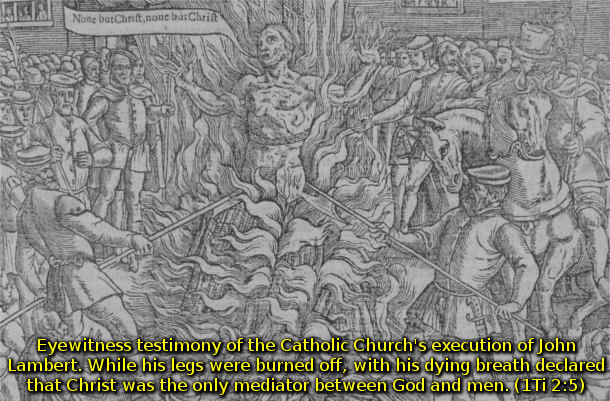
Whereas those of us born again in Christ are willing to suffer and die for the Lord Jesus Christ, the Catholic Church is not willing to do the same. They are only willing to torture and kill for the false god they serve.
It was not just the Christians who stood firmly on the foundation of the Word of God who suffered the wrath of the Catholic Church, but anyone could have been vaguely accused of heresy and been found guilty by an Inquisitor. This is why Inquisitors (and their lackeys) were so feared among the people, and their power was such that they were also feared by some European kings. The Inquisitors of the Catholic Church could torture and execute someone on simply a rumor, or make up one themselves, without any evidence whatsoever, and there was no governing power to keep them in check.
"Courts of Inquisition were now erected in several countries; but the Spanish Inquisition became the most powerful, and the most dreaded of any.Even the kings of Spain themselves , though arbitrary in all other respects,were taught to dread the power of the lords of the Inquisition; and the horrid cruelties they exercised compelled multitudes, who differed in opinion from the Roman Catholics, carefully to conceal their sentiments ... The most zealous of all the popish monks, and those who most implicitly obeyed the Church of Rome, were the Dominicans and Franciscans: these, therefore,the pope thought proper to invest with an exclusive right of presiding over the different courts of Inquisition, andgave them the most unlimited powers, as judges delegated by him, and immediately representing his person: they were permitted to excommunicate, or sentence to death whom they thought proper, upon the most slight information of heresy. They were allowed to publish crusades against all whom they deemed heretics, and enter into leagues with sovereign princes, to join their crusades with their forces. "
-John Foxe, Foxe's Book of Martyrs, Claxton, 1881, p. 77-78, [University of Virginia]
This is disgustingly hypocritical of a worldwide religious entity that claims to uphold the doctrines of Jesus Christ. Where is any justification for these acts listed in the New Testament? As we have already established in earlier chapters, it is not based on the Bible because, first and foremost, the Catholic Church follows popes and their deceptive traditions.
For though we walk in the flesh, we do not war after the flesh: (For the weapons of our warfare are not carnal, but mighty through God to the pulling down of strong holds;) Casting down imaginations, and every high thing that exalteth itself against the knowledge of God, and bringing into captivity every thought to the obedience of Christ;
-2 Corinthians 10:3-5
For we wrestle not against flesh and blood, but against principalities, against powers, against the rulers of the darkness of this world, against spiritual wickedness in high places.
-Ephesians 6:12
And even as they did not like to retain God in their knowledge, God gave them over to a reprobate [sinful] mind, to do those things which are not convenient; Being filled with all unrighteousness, fornication, wickedness, covetousness, maliciousness; full of envy, murder, debate, deceit, malignity [destructive tendencies]; whisperers, Backbiters, haters of God, despiteful, proud, boasters,
-Romans 1:28-32
One of the devices used by sadistic Inquisitors was "The Judas Chair," which was a seat designed with a pyramid shape. Prisoners, male or female, would be taken to a room, stripped naked, and lifted by ropes above this pyramid, then slowly lowered down onto the top and made to sit upon it with the top corner of the pyramid inserted into their orifices (anus or vagina, depending on male or female), slowly stretching and ripping the skin, which would cause an immense amount of pain, while the Inquisitor sat comfortably in his office chair and waited for the so-called "heretic" to confess his/her allegiance to the Roman Pontiff.
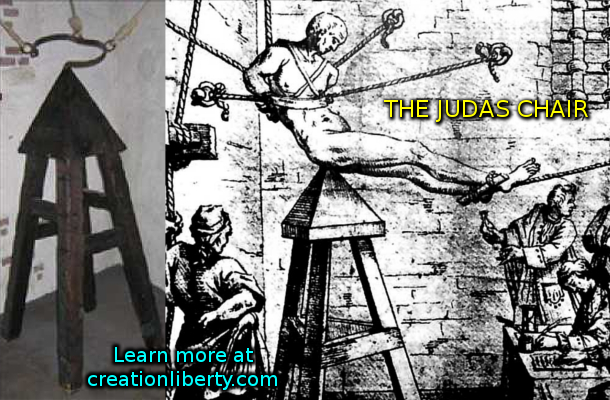
In the previous chapter, we read a quote from a Catholic pope, in which he said evangelizing was not an effective method in gaining new converts. Now we can see the method they think is more effective.
Another device called "The Rack" was designed to slowly stretch out a man or woman's arms and legs to the point that his/her joints would dislocate at the hips and shoulders, which is pain most of us cannot imagine. Again, the Catholic Inquisitor would stand beside the device, watching their pain and listening to their screams while calmly waiting to hear a confession of their dedication to the Catholic Church.
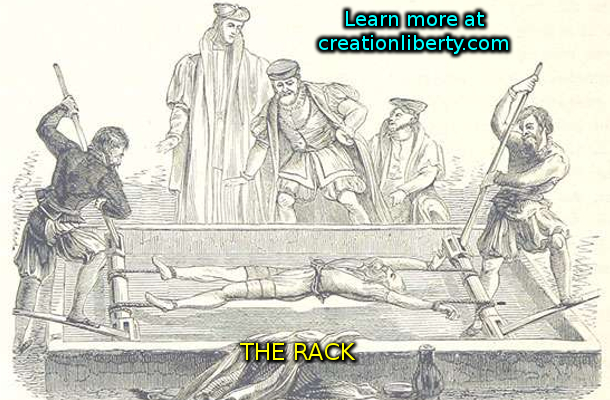
The device called "The Skull Crusher" is relatively self-explanatory; the victim's chin was put over the metal bar at the bottom, while the skull cap was placed on top, and a winch was turned so that the skull was slowly crushed by the vice. This is one of the more excruciating devices because the Christian put in this device would have his/her teeth shatter and eyes pop out of their sockets long before their skull shatters enough to cause a loss of consciousness.

Inquisitors also loved to use "The Hand Crusher," which delivered an extraordinary amount of pain without risk of killing their prisoner. As you can see below, the knuckles of the hands were placed under each vice and were slowly crushed, while the victim was forced to stare at a gothic version of the pagan cross symbol of the Catholic Church.
(Read "Christian Symbols Are Not Christian" here at creationliberty.com for more details.)
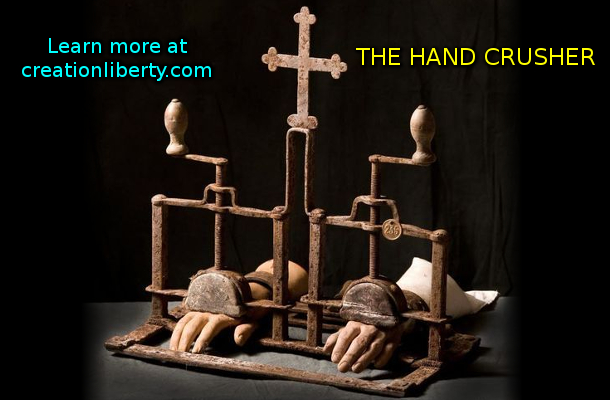
For those of us born again in Christ, we need not fear these things because we cannot withstand this torture on our own, but during trials of tribulation and persecution, the Holy Spirit of God will rain down upon us and give us strength to endure. If you read Foxe's Book of Martyrs, you will find that eyewitnesses reported odd and miraculous things happening upon the torture and execution of Christians, even some instances in which pain was not felt nor would fire burn, and that we should always remember that, though we are undeserving of the least of His mercies, the Lord Jesus Christ will NEVER forsake us because He promised He would be with us.
In God have I put my trust: I will not be afraid what man can do unto me.
-Psalm 56:11
Let your conversation be without covetousness; and be content with such things as ye have: for he hath said, I will never leave thee, nor forsake thee. So that we may boldly say, The Lord is my helper, and I will not fear what man shall do unto me.
-Hebrews 13:5-6
Blessed are they which are persecuted for righteousness' sake: for theirs is the kingdom of heaven. Blessed are ye, when men shall revile you, and persecute you, and shall say all manner of evil against you falsely, for my sake. Rejoice, and be exceeding glad: for great is your reward in heaven: for so persecuted they the prophets which were before you.
-Matthew 5:10-12
Behold, I send you forth as sheep in the midst of wolves: be ye therefore wise as serpents, and harmless as doves. But beware of men: for they will deliver you up to the councils, and they will scourge you in their synagogues; And ye shall be brought before governors and kings for my sake, for a testimony against them and the Gentiles. But when they deliver you up, take no thought how or what ye shall speak: for it shall be given you in that same hour what ye shall speak. For it is not ye that speak, but the Spirit of your Father which speaketh in you.
-Matthew 10:16-20
Sadly, the typical Catholic buys into the media hype of a pathetic, useless, propaganda so-called "apology" made by Pope John Paul II in March of 2000. He did this because in 1998, he decided to open up the secret documents stored in the Vatican library concerning the Inquisition, and I will point out the deception of this in a moment, but first, let's read his public relations garbage:
"Let us forgive and ask forgiveness! While we praise God who, in his merciful love, has produced in the [Catholic] Church a wonderful harvest of holiness, missionary zeal, total dedication to Christ and neighbour,we cannot fail to recognize the infidelities to the Gospel committed by some of our brethren , especially during the second millennium.Let us ask pardon for the divisions which have occurred among Christians, for the violence some have used in the service of the truth and for the distrustful and hostile attitudes sometimes taken towards the followers of other religions ."
-Pope John Paul II, "Day of Pardon," Vatican Archives, Mar 12, 2000, retrieved June 7, 2018, [https://bit.ly/1ZXnGCk]
Notice that he said he wanted to ask pardon for "
What this deceitful viper (i.e. Pope John Paul) did was shift the blame; it is NOT "
(Read "Is Repentance Part of Salvation?" here at creationliberty.com for more details.)
Granted, John Paul II himself did not do the torturing and murder (at least, as far as we know). However, his predecessors DID order these things to be done, and the lineage of popes who John Paul II recognizes as "Vicars of Christ" ordered and blessed these vile crimes!
For with the heart man believeth unto righteousness; and with the mouth confession is made unto salvation.
-Romans 10:10
Now I rejoice, not that ye were made sorry, but that ye sorrowed to repentance: for ye were made sorry after a godly manner, that ye might receive damage by us in nothing. For godly sorrow worketh repentance to salvation not to be repented of: but the sorrow of the world worketh death.
-2 Corinthians 7:9-10
Of course, the typical Catholic I have had conversations with will tell me that I am unmerciful or unforgiving, but Christ told us that we only need to forgive when a man repents in grief and sorrow of his wrongdoing. I would be glad to give my mercy and forgiveness to the popes of Rome if they would come to repentance, but they will not do so because they continue to arrogantly sit on the throne of antichrist.
Take heed to yourselves: If thy brother trespass against thee,
rebuke him; and if he repent, forgive him.
-Luke 17:3
Suppose ye that I am come to give peace on earth?
I tell you, Nay; but rather division:
-Luke 12:51
After the Italian Revolution, governments would not allow the Catholic Church to continue their torture and executions openly; if they were done, they had to be done in secret, and we will see some evidence of that when we get to the next chapter. The Second Vatican Council renamed the Office of Inquisition to "
"By the nineteenth century, most of the gruesome practices had ceased. However,the Office of the Inquisition remained until 1965 when it was reshaped into the Office of the Congregation for the Doctrine of the Faith during the Second Vatican Council ."
-Michael Jerryson, The Oxford Handbook of Religion and Violence, Oxford University Press, 2015, p. 430, ISBN: 9780190270094; See also Charles Kimball, When Religion Becomes Lethal, John Wiley & Sons, 2011, ISBN: 9781118030561
In fact, Joseph Ratzinger, who would later become Pope Benedict XVI, was appointed the "Grand Inquisitor" (by John Paul II) for the newly reshaped Office of Inquisition:" -Shadia B. Drury, Aquinas and Modernity, Rowman & Littlefield, 2008, p. 36, ISBN: 9780742522589 |
 |
The website Catholic Hierarchy is an independent organization of Catholics "dedicated to our Holy Father, Pope Francis." Under the section "Congregation for the Doctrine of the Faith," they have it listed as being formed in July of 1542 under the Latin name Romanae et Universalis Inquisitionis, which is the Roman Universal Office of Inquisition, and another independent Catholic website "GCatholic" has the same listing.
(See Catholic Hierarchy, "Congregation for the Doctrine of the Faith," retrieved Jan 2, 2021, [https://www.catholic-hierarchy.org/diocese/dxcdf.html]; GCatholic.org, "Congregation for the Doctrine of the Faith," retrieved Jan 2, 2021, [http://www.gcatholic.org/dioceses/romancuria/d03.htm])
When it concerns the wicked hearts of mankind, the Bible tells us that they will continue the same things they have always done, which is where the phrase "there is nothing new under the sun" comes from, specifically in Ecclesiastes:
The sun also ariseth, and the sun goeth down, and hasteth to his place where he arose. The wind goeth toward the south, and turneth about unto the north; it whirleth about continually, and the wind returneth again according to his circuits. All the rivers run into the sea; yet the sea is not full; unto the place from whence the rivers come, thither they return again... The thing that hath been, it is that which shall be; and that which is done is that which shall be done: and there is no new thing under the sun.
-Ecclesiastes 1:5-9
In the final days of this world, the Christians will come under persecution and tribulation again, and depending on which country they are in, some are already experiencing it today. I am convicted to express my grief and disgust with the typical church buildings around just about every corner of America, because they cannot sanctify themselves from the most simple things in times of peace, and when they have a free choice, they cannot deny themselves the most basic of comforts for the sake of Christ, but they also proclaim in hypocrisy that when the days come where the devilish throne of antichrist will torture and murder believers, they will allegedly "stand with Christ."
(Read "501c3: The Devil's Church" here at creationliberty.com for more details on greedy, lukewarm ministries and pastors who have no backbone.)
He that is faithful in that which is least is faithful also in much: and he that is unjust in the least is unjust also in much.
-Luke 16:10
But he that received the seed into stony places, the same is he that heareth the word, and anon with joy receiveth it; Yet hath he not root in himself, but dureth for a while: for when tribulation or persecution ariseth because of the word, by and by he is offended.
-Matthew 13:20-21
I know thy works, that thou art neither cold nor hot: I would thou wert cold or hot. So then because thou art lukewarm, and neither cold nor hot, I will spue thee out of my mouth. Because thou sayest, I am rich, and increased with goods, and have need of nothing; and knowest not that thou art wretched, and miserable, and poor, and blind, and naked:
-Revelation 3:15-17
(Read "Hell Is Real And Many People Are Going There" here at creationliberty.com for more details.)
Enter ye in at the strait gate: for
-Matthew 7:13-14
The heart is deceitful above all things, and
desperately wicked: who can know it?
-Jeremiah 17:9
He that trusteth in his own heart is a fool:
but whoso walketh wisely, he shall be delivered.
-Proverbs 28:26
"We here are of the conviction thatthe papacy is the seat of the true and real Antichrist ... personally I declare thatI owe the Pope no other obedience than that to Antichrist ."
-Martin Luther, Aug 18, 1520, quoted by LeRoy E. Froom, The Prophetic Faith of Our Fathers, Review and Herald, Vol. 2, 1950, p. 121
 |
"I am persuaded that -Martin Luther, quoted in The Table Talk of Martin Luther, William Hazlitt, Vol. 127, p. 234, [New York Public Library] |
This is not to say that I believe that Martin Luther was a preacher of Christ because I have my doubts about that since he said and did many things during his time as a preacher that indicated that he did not have a humble heart of repentance. Many Reformation and Protestant leaders claimed to depart from Catholicism while hypocritically upholding Catholic principles and traditions, and I would encourage readers to look at my teaching, "Denominations Are Unbiblical", here at creationliberty.com to get a better understanding of that.
At the end of this chapter, I will quote from many such leaders of the Reformation who I am very cautious of when it concerns their doctrines. However, I wanted to include these testimonies so we can get an idea of the disposition and perspective of the Reformers during the dark days of the Catholic Inquisitors in Europe.
As I mentioned in chapter four, there was a period of hundreds of years in Europe that is known as "The Dark Ages," which was a time of grief, suffering, disease, and death. What historians typically do not care to understand is that the Dark Ages in Europe was caused by the Catholic Church, specifically due to their efforts to prevent the common people from reading the Word of God for themselves.
Many people do not know that, at one point, the Catholic Inquisitors BANNED the Bible, meaning it was forbidden to own a copy or study it on pain of death. (They would say "pain of excommunication," but that was a façade for execution.) This information was discovered not by Christians, but by Catholic librarians and historians after Pope John Paul II began his investigation into the Inquisition's secret files back in 1998:

"The Vatican permitted scrutiny [detailed analysis and criticism] of one of the most notorious periods in Roman Catholic Church history yesterday when itopened the archives of the department once known as the Inquisition ... Opened on Thursday alongsidethe Inquisition archives was the infamous Index of Forbidden Books, which Roman Catholics were forbidden to read or possess on pain of excommunication. [i.e. pain of death after being branded a "heretic"] They showed that even the Bible was once on the blacklist. Translations of the Holy Book ended up on the bonfires along with other 'heretical' works because the Church, whose official language was Latin, was suspicious of allowing the faithful access to sacred texts without ecclesiastical [Catholic] guidance. "
-Stabroek News, "Vatican Archives Reveal Bible Was Once Banned Book," Jan 23, 1998, p. 10
Of course, only allowing the study of Scripture through the guidance of a priest or bishop, in the same manner as any other religious cult, correlates with everything else we have learned about deceptive Catholic practices. The banning and burning of Bibles by the Catholic Church was done very quickly after the formation of the Office of Inquisition, as early as 1244, which was just a few years after it was established, and not only did they ban Bibles, but there was strict punishment for anyone who even dared to read the Bible in English:
"In 1244, their power was farther increased by the emperor Frederic the Second, who declared himself the protector and friend of all the inquisitors, and published the cruel edicts, viz.1. That all heretics who continued obstinate, should be burnt. 2. That all heretics who repented, should be imprisoned for life ... The principal accusation against those who are subject to this tribunal is heresy, which comprises all that is spoken, or written, against any of the articles of the creed, or the traditions of the Roman church.The inquisition likewise takes cognizance [notice] of such as are accused of being magicians, and of suchwho read the bible in the common language ,"
-John Foxe, Foxe's Book of Martyrs, Claxton, 1881, p. 78, [University of Virginia]
Just to clarify, the Catholic Church believed (and still believes) that those who would study the Bible for themselves are sinners on the same level as witches. This is the extent to which they hate the doctrines of Jesus Christ, and to which they manipulate the people, so they cannot learn what Jesus actually said.
As a side note, we should pause and consider why this historical information is not taught to us in public school classrooms across America, especially since many who fled Europe to come to the Americas (i.e. those who established the first American colonies) were fleeing from the heavy persecution of the Catholic Church. As we have already established, the Catholic Church has long discouraged people from studying the Word of God, and it has caused countless problems over many centuries.
In fact, Mary Tudor, Queen of England (1553-1558), who was a dedicated follower of the Catholic Church, earned the nickname "Bloody Mary" because of her vicious persecution of Christians. As soon as she took the throne and established the Pope's ruling authority in England, she prohibited the printing of the Bible by law and all Bibles were removed from church buildings across the country.
(See Christopher Haigh, English Reformations: Religion, Politics, and Society Under the Tudors, Clarendon Press, 1993, ISBN: 9780198221623; Read Why Christians Should Study The King James Bible here at creationliberty.com for more details.)
It is good that we Christians ignore any government law that prevents us from studying the Word of God because we are commanded by God to do so:
Study to shew thyself approved unto God, a workman that needeth not to be ashamed, rightly dividing the word of truth.
-2 Timothy 2:15
The heart of the righteous studieth to answer: but the mouth of the wicked poureth out evil things.
-Proverbs 15:28
(Read "Should Christians Submit to Governing Authority?" here at creationliberty.com for more details.)
John Calvin wrote:
"Some persons think us too severe and censorious when -John Calvin, Institutes of the Christian Religion, H. Howe, 1816, Vol. 3, p. 149 |
 |
Let no man deceive you by any means: for that day shall not come, except there come a falling away first, and that man of sin be revealed, the son of perdition; Who opposeth and exalteth himself above all that is called God, or that is worshipped; so that he as God sitteth in the temple of God, shewing himself that he is God.
-2 Thessalonians 2:3-4
 |
John Knox said the same thing about the papacy when he wrote about "that tyranny which the pope himself has for so many ages exercised over the church." He was firmly convinced that the Pope of Rome is " (See John Knox, quoted by John Hunter & Hastings Robinson, The Zurich Letters, University Press, 1842, p. 199) |
Little children, it is the last time: and as ye have heard that antichrist shall come, even now are there many antichrists; whereby we know that it is the last time.
-1 John 2:18
(Read "The Beginner's Guide to Christian Rapture" here at creationliberty.com for more details on the fact that Paul rebuked pre-tribulation rapture false prophecy.)
Thomas Cranmer wrote:"Whereof it followeth -Thomas Cranmer & John Edmund Cox, The Works of Thomas Cranmer, University Press, 1846, Vol. 16, p. 63 |
 |
At the time of the Reformation, the doctrine that the Pope's seat was the throne of antichrist began to spread far and wide, and since the Catholic Church was no longer able to stop it, the Jesuit Priest Manel De Lacuna, with the help of some of his Jesuit brethren, wrote La Venida Del Mes'as en Gloria y Magestad (i.e. The Coming of the Messiah in Glory and Majesty) in the 18th century, under the pseudonym (fake name) "Rabbi" Juan Josafat Ben-Ezra to give a false appearance of Jewish heritage to add some perceived credibility to the book. The book's purpose was to change some of the prophecies and timelines of Revelation, so that the Jesuits could protect the Roman Pontiff from being seen as antichrist, and in the 19th century, Edward Irving translated Lacunza's book into English, taking his doctrines and applying them to the Charismatic movement, and that is where the "Pre-Tribulation" false prophecy was born. (This is why, outside of some vague theories in a few obscure cults, you do not see "Pre-Trib" doctrine taught in any place in history before the 19th century.) In summary, the false pre-trib doctrine we see in church buildings all over the world today was a Jesuit farce that was created to counter the mass exodus of the Reformation.
(Read "The Beginner's Guide to Christian Rapture" here at creationliberty.com for more details on the history and deception of the pre-tribulation rapture movement.)
There is more to be said on this topic, especially from the Bible, but we will go over those details later in chapter eleven. For now, let's switch gears and take a closer look at nuns; the poor souls of women who are, in this author's opinion, more used and abused than anyone else in the devilish Catholic system.
 |
There are many people, especially Catholics, who will be offended by the title of this chapter, but keep in mind that this is not something I write or say lightly. Though nuns are typically called the "brides of Christ" by the Catholic Church, they are actually marrying themselves to the Devil and his doctrines.
nun (n): a woman member of a religious order, especially one bound by vows of poverty, chastity, and obedience |
It is important for readers to understand that nuns and convents are not Biblical in any sense. There is no place in Scripture where Jesus commanded women to be a part of a "religious order," to bind themselves by "vows of poverty, chastity, and obedience," and though we have elders and deacons in the church (positions which women are not called to, 1Ti 3:2-5), those men are to be servants, not lords over everyone else, and therefore, there is no Biblical mandate that any of these people should be bound to a religious community under a religious superior who rules over them.
But Jesus called them unto him, and said, Ye know that the princes of the Gentiles exercise dominion over them, and they that are great exercise authority upon them. But it shall not be so among you: but whosoever will be great among you, let him be your minister; And whosoever will be chief among you, let him be your servant: Even as the Son of man came not to be ministered unto, but to minister, and to give his life a ransom for many.
-Matthew 20:25-28
Feed the flock of God which is among you, taking the oversight thereof, not by constraint, but willingly; not for filthy lucre, but of a ready mind; Neither as being lords over God's heritage, but being ensamples to the flock.
-1 Peter 5:2-3

In Scripture, the bride of Christ is the church, that is, the collection of born-again Christians throughout the world. These verses are NOT contextually referring to individual women.
Husbands, love your wives, even as Christ also
loved the church, and gave himself for it;
-Ephesians 5:25
For as the body is one, and hath many members, and all the members of that one body, being many, are one body: so also is Christ.
-1 Corinthians 12:12
So we, being many, are one body in Christ,
and every one members one of another.
-Romans 12:5
Wherefore, my brethren, ye also are become dead to the law by the body of Christ; that ye should be married to another, even to him who is raised from the dead, that we should bring forth fruit unto God.
-Romans 7:4
In the New Testament, there are three institutions the Lord God established for Christ's church specifically: One is the government (i.e. the state, for the punishment of evildoers), one is marriage, and the other is the church itself, which is the body of believers (i.e. not a physical building - 1Co 6:19). You will find no Scripture whatsoever in the Bible where God instituted "nuns" or "convents."
Those who have grown up in the Catholic Church will understand that the general doctrine taught in Catholicism (according to their own Catechism) is that "grace" is only a help to introduce one "
(See Catechism of the Catholic Church, Part 3, Section 1, Chapter 3, Article 2, "Grace and Justification," Canon #1997, retrieved Oct 21, 2023, [http://www.scborromeo.org/ccc/p3s1c3a2.htm])
Because the Catholic Church has spent many centuries building a reputation for nuns, I am often branded as an evil man for daring to expose the Catholic convents, but the fact is that nothing they are doing is of Christ, and just like most of those in the Catholic Church, nuns will have their part in the lake of fire if they do not come to repentance and faith in Christ alone. Therefore, I say these things for their sakes as much as for everyone else reading this. If those of you who are skeptical would be willing to read this chapter, you will learn the truth of what goes on behind closed doors in these convents, and what many women have had to suffer under the guise of being "a bride of Christ."
In chapter two, we looked closely at the pagan concept of Purgatory, which I pointed out is the bread-and-butter (i.e. the primary money-maker) of the Catholic Church, but without the nuns, the false doctrine of Purgatory would not make the Catholic Church near as much money. The nuns are, for the most part, the backbone of the Catholic Church because without nuns, the world would not be so willing to believe the lie that the Catholic Church is "good."
Hospitals, orphanages, nursing homes, soup kitchens—you will not often see Catholic priests, bishops, and popes doing this work; it is the nuns who break their backs to do charitable works, and the nuns are the ones who do all the outreach and advertising for the papacy. Sadly, though some may have what they perceive to be "good" intentions, none of those charitable works glorify the Lord Jesus Christ, but rather, the entire institution is designed to give the Catholic Church a good name so they can continue to deceive the masses with lies that will lead countless people to the wide gates of destruction.
Enter ye in at the strait gate: for
-Matthew 7:13-14
(See Robert P. Lockwood, "Convent Horror Stories," Catholic Answers, Mar 1, 2008, retrieved July 7, 2018, [catholic.com/magazine/print-edition/convent-horror-stories])
Let's start with former nun Lolly Harding, who was a medical nun working in a Catholic mission for thirteen years, helping Muslim women. Muslim women often cannot get medical treatment because according to the ridiculous tenets of their pagan religion, a man is not allowed to touch any woman that is not his wife, even if her life is on the line.
(Read "Islam: Religion of Terror" here at creationliberty.com for more details.)

Harding testified that she eventually left the mission and the nuns due to the terrible conditions and lack of love among nuns in general. As I have already stated, it is common for people to view nuns as the most merciful and kindest people in the world, but the truth is far less fanciful. Please do not misunderstand; I am not saying that there are not kind or merciful nuns in the world, but there is an inward corruption beneath the sanctimonious appearance within all institutions of the Catholic Church.
Judge not according to the appearance, but judge righteous judgment.
-John 7:24
Thou blind Pharisee, cleanse first that which is within the cup and platter, that the outside of them may be clean also.
-Matthew 23:26
(See Lolly Harding, quoted by Richard Bennett, The Truth Set Us Free: Twenty Former Nuns Tell Their Stories, WinePress Publishing, 1997, p. 16, ISBN: 1-57921-067-8)
I have read and listened to numerous testimonies from women who were former nuns, and it needs to be noted that psychotropic drugs are quite commonly used among nuns in general. Due to the propaganda arm of the Catholic Church, this fact is hidden from the public. Many former nuns have testified that nuns were commonly taking psychotropic drugs that affect the mind, emotions, and other basic behaviors.
Often, these women testified that nuns were taking Valium or Xanax to calm their anxiety because of the harsh, unbiblical living conditions and workload they suffered daily. Taking these drugs makes people feel drunk, have lack of coordination (which is dangerous in some situations, like those in the medical field), and they can cause extreme irritation, dry mouth, fever, difficulty breathing, heart palpitations, slurred speech, stomach cramps, delayed reflexes, depression, nausea, seizures, bladder control problems, blurred vision, dementia, and worst of all, addiction.
(See Patrick Condron, "The Effects of Valium Use," DrugAbuse.com, retrieved July 26, 2018, [drugabuse.com/library/the-effects-of-valium-use])
Obviously, these drugs can kill people, and have killed many people that are often overlooked, but the Catholic Church allows these women to destroy themselves on these drugs, so long as they continue to put their faith into their "holy" mother church. I have a free-to-read book here at creationliberty.com called Psychology: Hoodwinked by the Devil where you can learn more details about the fraudulent psychological industry and their dangerous psychiatric medication, which the Bible calls "sorcery."
Harding could no longer tolerate that kind of lifestyle, and although she tried to go back to cloistered life in Kokomo, Indiana, she eventually requested to be released from her vows as a nun and joined the military as a nurse. Although she generally stuck to her Catholic roots, as most people who are starved of any pleasure and were under a bond of chains for much of their lives, Harding turned to drunkenness, fornication, and covetousness, and she easily became addicted to those things, looking for any kind of worldly solace during the Vietnam War.
According to Harding's testimony, her brother showed up to a family reunion after he had been saved by Jesus Christ. With his King James Bible in hand, he told his family they "
(Read Why Christians Should Study The King James Bible here at creationliberty.com for more details.)
For this is good and acceptable in the sight of God our Saviour; Who will have all men to be saved, and to come unto the knowledge of the truth. For there is one God, and one mediator between God and men, the man Christ Jesus;
-1 Timothy 2:3-5
"I beg you to do as I did.Come to Jesus Christ as a lost soul and trust His blood atonement at Calvary to pay for your sins . He took your place on the Cross to pay for the sins of the whole world. Receive this gift of eternal life from Him by your acceptance of His complete payment of your sin by His death, burial and resurrection.The Catholic Church has deprived you of the simple plan of salvation and has substituted a tortuous plan of works. There is no need for the pagan sacrifice you make at Mass or the futile confessing of sins to a priest. Jesus Christ awaits you ,"
-Lolly Harding, quoted by Richard Bennett, The Truth Set Us Free: Twenty Former Nuns Tell Their Stories, WinePress Publishing, 1997, p. 19, ISBN: 1-57921-067-8
I also listened to a live interview with Lolly Harding, in which she testified that the young women who enter these convents are brainwashed into the belief that the sister superior (i.e. the nun who rules over the convent) is equivalent to the Word/Will of God:
"She [the sister superior] represents God's will... they have to accept you into the order, and you are thoroughly brainwashed into the idea that you are doing God's will, and thatthe superior represents the will of God for you ... during that whole period of time [initiate training] there is a very strict regimentation of—they have strict rules and regulations that go back into the 14th/15th century ."
-Lolly Harding, "Lolly Harding a Former Catholic Medical Nun," Berean Beacon, Dec 2, 2017, retrieved Oct 21, 2023, [https://youtu.be/cF5ralecEmk?t=260]
Part of those rules are those of penance, in which nuns (and priests) are trained to physically beat and whip themselves (i.e. torture and abuse) for those who are suffering in purgatory:
"We thought that we had to do penance to save the world. We were mistaken. We did not have the truth—we did not have the truth as it is in the King James Bible. We had this idea that we had to save the world by our penitential life, and by living this strict life, isolating yourself, pray—get up at 5:30 in the morning, and I remember flagellating [whipping].I remember this mother superior, and she really flagellated herself; I could hear her whipping herself. They were very devout, misinformed, ignorant, beautiful creatures... and this is the tragedy of this whole thing.We thought we were doing something right for the world, and we were going to help sinners get to heaven by our life of penance. "
-Lolly Harding, "Lolly Harding a Former Catholic Medical Nun," Berean Beacon, Dec 2, 2017, retrieved Oct 21, 2023, [https://youtu.be/cF5ralecEmk?t=766]
Again, this is not based on Biblical instruction or ordainment; all of the nun regulations and rules are based on the made-up traditions of the Catholic Church in respect to their doctrine of purgatory, which has no Scriptural or factual basis whatsoever. Some of these rules about beating and whipping oneself were changed a few decades ago in the United States (as we will see in another testimony later), but this has been normal operating procedure for the Catholic convents and parishes for many centuries, and there are many countries who still practice the Catholic self-flagellating ordinance.
 |
Rita Riel entered a Catholic boarding school in Massachusetts; specifically a section divided for "juvenists," which were girls who were training to be nuns. After being there a mere two weeks, she knew she wanted to leave and return to her father's home because it was a secluded life of being little seen, never heard, and living in constant fear. Riel wrote home to her parents to let them know she no longer wanted to attend, but three days later, the headmistress walked in with her letter, unsealed, in hand, pressuring this young girl to stay, and later, even threatened her by saying that if she left and did not become a nun, God would curse her and punish all her children if she ever got married. (See Rita Riel, quoted by Richard Bennett, The Truth Set Us Free: Twenty Former Nuns Tell Their Stories, WinePress Publishing, 1997, p. 36, ISBN: 1-57921-067-8) |
Riel stayed in the convent and became a nun in fear of the threat the mistress had made to her, fearing that God would curse her children if she did not stay at the convent. She wanted to become a teacher, and studied to be able to do so, but the convent deceived her because they had her become a nun instead of finishing high school, so she was not allowed to be a teacher. (i.e. This is one of the ways they keep up their number of nuns; they must trick young girls into doing it.)
(See Rita Riel, quoted by Richard Bennett, The Truth Set Us Free: Twenty Former Nuns Tell Their Stories, WinePress Publishing, 1997, p. 37-38, ISBN: 1-57921-067-8)
Through a series of circumstances, all guided by the Lord God, she was later given the opportunity to replace a nun teacher who had fallen ill with cancer, and she started out being given a classroom of 47 second-graders. From there, she not only was able to go on to attend universities to learn more about teaching, but more importantly, she began to study the Bible for herself, learning that all have sinned and come short of the glory of God (Rom 3:23), that she needed to repent (i.e. to have godly sorrow of her sins, Luke 24:47), and believe on the Lord Jesus Christ alone (John 20:31), in His grace alone, for her salvation; eventually, she was able to understand enough about the Bible to know that she did not need to be a nun to please the Lord.
(Read "The Cure For Cancer" here at creationliberty.com for more details.)
Mary Hertel grew up in a highly strict Catholic family that was completely dedicated to the daily rituals of the Catholic Church. The Eucharist, Mass, rosaries, novenas (a series of special prayers for nine days), "
(See Mary Hertel, quoted by Richard Bennett, The Truth Set Us Free: Twenty Former Nuns Tell Their Stories, WinePress Publishing, 1997, p. 47-48, ISBN: 1-57921-067-8)
Hertel said:
"This decision to become a religious [nun] was supported especially by my mother. It was a matter of pride and honor for the family. At the time I entered in 1963,the rule was that I would never return home . As a postulant [nunnery candidate], communication with family was monitored (letters written home and received from home were read) and strict rules were in place for the years of training. After the first year, a bridal ceremony followed by the cutting of my hair and dressing in full restrictive habit [nun garment] ushered me into the Novitiate [house for nun novices].I was now Sister Mary Dolora. "
-Mary Hertel, quoted by Richard Bennett, The Truth Set Us Free: Twenty Former Nuns Tell Their Stories, WinePress Publishing, 1997, p. 48, ISBN: 1-57921-067-8
Hertel testified that she was required to fall on her knees and do penance (i.e. voluntary self-punishment for sin) for ridiculous things; for example, she was required to do penance for simply speaking with an elderly nun while she cared for the old woman during infirmary duty because the Catholic Church imposed absolute silence on the girls in the convents at all times. Thankfully, the year before she was required to do self-flagellation (i.e. whipping oneself), changes were made in the Catholic Church to discontinue that practice in the convents (which was a political move, not a religious one, as I will explain in a moment), and the ban on visiting home was lifted; however, many elder nuns and priests attempted to keep some of the more strict rules, even denying Hertel the permission to help certain injured and lame people on the basis of keeping the nuns in line.
Hertel also testifies that her convent was given a task to design a less-restrictive habit (i.e. garment) for the nuns to wear. Why they had them do this was also never explained to them, and she was quite surprised because such things had been done for many centuries in the Catholic Church. (The elder nuns and priests did not like this change either.)
(See Mary Hertel, "The Grace of God Brought a Nun to the True Jesus Christ," Berean Beacon, Dec 5, 2017, retrieved Oct 21, 2023, [https://youtu.be/sQtrpob-_Fs?t=515])
It should be noted there is no logical, official explanation given by the Catholic Church as to why they eased up on the rules (Hertel also testified that no explanation was ever given to or made by any superiors), but it leaves us curious for a reason because those rules had been established by popes and bishops (which are supposed to be absolute, unchangeable divine laws), and were practiced for centuries, so why the sudden change? Hertel even confesses that the nuns and priests in her convent were very confused by all these changes, but I believe I can offer a reasonable explanation for it.
The fact is that this was all taking place in the 1960s, during a time of rebellion and social change in the United States, and so this was a political move specifically for American convents to keep people from exposing the Catholic Church, or in other words, if the Catholic Church had not relaxed their grip, the massive exodus of those leaving the convents and parishes that took place in the 1970s would have been much more severe, especially with the growing feminist movement. To maintain the harsh conditions in these convents may have led to prosecution against the Catholic Church in courts of law, which is bad publicity they desperately wanted to avoid. This is not to say that the feminist movement was good in any sense, but that there was growing investigation into anything having to do with women in the United States. As we have already established, the Catholic Church does not make decisions based on the moral foundations of the doctrine of charity taught by the Lord Jesus Christ, but like every other corrupt religious cult in existence, they make decisions based on the winds of political change.
(Read "Feminism: Castrating America" here at creationliberty.com for more details.)
That we henceforth be no more children, tossed to and fro, and carried about with every wind of doctrine, by the sleight of men, and cunning craftiness, whereby they lie in wait to deceive;
-Ephesians 4:14
"When you're dealing with chastity in a false system that has been set up and made by man, the infractions [violation of rules] are going to come in. In my own experience, as being a nun, my first assignment, which I left after that assignment, but in that assignmentthere were parties that were given by the priest. The priests had freedom, and they had money, and they had parties where there was drinking and there was dancing and there was inappropriate interaction between the nuns and the priests. So that was my personal experience in the convent that really disturbed me because it certainly was against the rules, but it was also something that was kind of known that was going on here and there. But then when I got out of the convent in my job that I took in Chicago, I was teaching with another woman, a lay woman, who, after a period of time, had a very long stretch of depression. She locked herself in her apartment, and wasn't answering phone calls or her door, and I found outshe had been having a very lengthy affair with a priest; the same priest that was coming into our classrooms and teaching religion to our elementary students. She was devastated. This was just cut off. It's as if there was no consequences on the side of the priest that had been involved with her ; at least, we didn't see them externally, but for my friend, there were devastating consequences."
-Mary Hertel, "The Grace of God Brought a Nun to the True Jesus Christ," Berean Beacon, Dec 5, 2017, retrieved Oct 21, 2023, [https://youtu.be/sQtrpob-_Fs?t=2564]
This should be no surprise since this was always a common practice among priests in the Catholic Church. This is standard operating procedure for most of them. For many hundreds of years, priests were allowed to keep concubines (i.e. whores), to use and throw away at will, and walked around with them in open, unashamed fornication, and we will address that subject much more in the next chapter.
Hertel left the convent after six years of being a nun, and remained a Catholic for another 18 years before she was born again in the Lord Jesus Christ. During a series of major life changes, including job changes, children, and family deaths, the Catholic Church made a vital mistake: They gave Hertel and her husband (Bernie) a Bible. Granted, it was a Catholic version (i.e. NASV) that has many flaws in it, but there is enough of the Gospel still in that version, it eventually led the couple to seek out born-again Christians and the King James Bible, which they began to study on a regular basis. By 1990, Hertel and her husband came to repentance and had been born again in the Lord Jesus Christ, departing forever from convents, parishes, and the corrupt, pagan, and restraining rituals of the Catholic Church.
I repeat, there is NO Biblical mandate that commands or allows the institution of a convent or a nunnery. All the traditions they practice within those places are based solely on the Catholic traditions of men; they are not based on the Word of the Living God.
Stand fast therefore in the liberty wherewith Christ hath made us free, and be not entangled again with the yoke of bondage.
-Galatians 5:1
"Rather than searching the Scriptures for truth to find out if Catholic teaching was in line with God's Word, I blindly accepted everything the priest told me during my instructions to become a Catholic, except for one request. He asked me to bring my King James version of the Bible to the rectory. He said it had to be burned because it was not the official Catholic version. Instead, I gave it to my mother."
-Mary Pakiz, quoted by Richard Bennett, The Truth Set Us Free: Twenty Former Nuns Tell Their Stories, WinePress Publishing, 1997, p. 62, ISBN: 1-57921-067-8
During Pakiz's training to be a nun, she was not instructed or guided into study of the doctrines of Christ:
"During the five-year preparation period for our final vows, we studied the Rule of Saint Benedict, canon law, church history, a bit about Jesuit causistry (the end justifies the means), and the lives of the saints. "
-Mary Pakiz, quoted by Richard Bennett, The Truth Set Us Free: Twenty Former Nuns Tell Their Stories, WinePress Publishing, 1997, p. 64, ISBN: 1-57921-067-8
The "end justifies the means" is an unbiblical doctrine that teaches that it does not matter what you do, so long as you do it for reasons that you perceive to be "right" in your own eyes. In other words, as long as the ending is acceptable, it does not matter what wicked thing you did to get there. The Jesuits have certainly practiced that dogma, through deception and murder, all in the name of the Catholic Church and the Pope of Rome.
Ye shall not do after all the things that we do here this day, every man whatsoever is right in his own eyes.
-Deuteronomy 12:8
Every way of a man is right in his own eyes:
but the LORD pondereth the hearts.
-Proverbs 21:2
There is an important common factor I keep seeing in these wonderful testimonies from former nuns: They had to come to repentance (i.e. grief and godly sorrow) of their sins. The Catholic Church taught them in the convents that they were the "holy" brides of Christ, who were to suffer for their own sins and the sins of the world, and that leaves them with the dangerous false impression that nuns are inwardly "good," and that they have no sin. (i.e. If you remember from chapter six, the Catholic Church teaches the false doctrine that Mary, the virgin who gave birth to Jesus, had no sin, and the nuns are intended to follow in those impossible footsteps.)
As it is written, There is none righteous, no, not one: There is none that understandeth, there is none that seeketh after God. They are all gone out of the way, they are together become unprofitable; there is none that doeth good, no, not one.
-Romans 3:10-12
|
The Bible does not say there is a nun righteous. The Bible says there is NONE righteous. |
Another common factor in all these testimonies is that these women thought they would be found righteous before God through their works as a nun; meaning they thought being a nun would help them and their families gain entrance to heaven through their works, and the Catholic Church has used and abused them without remorse. In essence, these women are taught to put a nunnery in the place of Jesus Christ for their salvation.
For example, Jo Kaminski was baptized into the Catholic Church at age 19, and sought to become a nun:"Because of all these things, -Jo Kaminski, quoted by Richard Bennett, The Truth Set Us Free: Twenty Former Nuns Tell Their Stories, WinePress Publishing, 1997, p. 70, ISBN: 1-57921-067-8 |
 |
The Lord God slowly convicted her to come out of the Catholic Church and trust in Him alone, and Kaminski finally decided to back away from the Catholic Church, for which the Catholic Church labeled her an excommunicated heretic. Four years later, she was personally convicted to start studying the Bible, and was invited to a Bible study group by a Christian friend, and she finally learned the truth about Christ through the Word of God, that Jesus is the Rock upon which the church is built, not Peter, and she believed on Christ's grace alone for her salvation.
As we have already learned in previous chapters, the priests and bishops of the Catholic Church discourage studying the Bible because they know that understanding the doctrines of Christ ends up leading people away from the Catholic Church. This is because the Word of God sets them free from the chains of works-based doctrines and traditions:
Then said Jesus to those Jews which believed on him, If ye continue in my word, then are ye my disciples indeed; And ye shall know the truth, and the truth shall make you free.
-John 8:31-32
For the oppression of the poor, for the sighing of the needy, now will I arise, saith the LORD; I will set him in safety from him that puffeth at him. The words of the LORD are pure words: as silver tried in a furnace of earth, purified seven times. Thou shalt keep them, O LORD, thou shalt preserve them from this generation for ever.
-Psalm 12:5-7
As aforementioned former medical nun Lolly Harding put it:
"As a Catholic [nun],you are not allowed to read anything contrary to the Catholic history, or Catholic doctrine , and you are not allowed to openly criticize anything you see that's obviously bad... we were thoroughly—THOROUGHLY imbued with this idea they have all the truth, and you are submitted to them in thisblind obedience, and it's a sin if you listen to anything else ."
-Lolly Harding, "Testimony: Lolly Harding a Former Catholic Medical Nun," Berean Beacon, Dec 2, 2017, retrieved Oct 23, 2023, [https://youtu.be/cF5ralecEmk?t=829]
The aforementioned former nun Mary Hertel said:
"A lot of people find this hard to believe, butI never saw a Bible in the convent. I never read the Bible . There were Scriptures that are incorporated in the mass, of course, and in prayers and prayer books that we used, butI never studied the Bible, and I didn't even know where the books of the Bible were . They were announced as the readings were done, but I really did not know the Word of God."
-Mary Hertel, "The Grace of God Brought a Nun to the True Jesus Christ," Berean Beacon, Dec 5, 2017, retrieved Oct 21, 2023, [https://youtu.be/sQtrpob-_Fs?t=619]
Again, to quote former 23-year-veteran Catholic priest Richard Bennett, whom I quoted in the introduction to this book:
"I also had bought, before I went into the monastery, a Bible. I thought we were going to study the Bible. I spent three pounds sterling buying a Bible, and I thought this is where we were really going to spend our time. I found that the first year was all rituals, devotions...we did all these religious exercises, but we didn't study Scripture . And then, we did start to study intently every day in the second year, but it was the philosophy of Aristotle, a pagan 300 years before Christ. To this day, priests are still trained in the philosophy of Greece. And then, we studied all the philosophies of the world. Then we started, after that, four years of theology of the famous Thomas Aquinas. We did study the introduction to some of the books of the Bible, but always under the authority of the [Catholic] Church. Soit was not anything to do with the Word; it was to do with Catholicism ."
-Richard Bennett, "Ex-Catholic Priest (23 Yrs) Richard Bennett," Creation Liberty Evangelism Official YouTube Channel, Nov 15, 2017, [youtube.com/watch?v=f8eylzmDp04]
Try and remember this if any of you who are born again in Christ meet some nuns (or even priests for that matter); do not let their outward appearance intimidate you because these people do not understand the Word of God. Commit verses like Romans 3:10-12 and First Timothy 2:5 to memory, and even in passing, even if they will not hear you initially, quote these verses to them because one day, many years from now, the Lord God may have those men and women recall those verses and seek the truth, so that they too would be saved by Christ on the day of God's Judgment.
Doreen Eberhardt, a nun who was eventually led by the Lord God out of the convent and into the truth of Christ, testified of the truth behind the closed doors of the convent:
 |
" |
I should note that the concept of praying to "saints" or other such people is taken directly from witches and mystics. Without going into great detail, they teach that you should visualize a particular person in your mind and pray to them, which is ultimately praying unto devils because these men and women hear no prayers.
(Read "The Biblical Understanding of Prayer" here at creationliberty.com for more details.)
Then Paul stood in the midst of Mars' hill, and said, Ye men of Athens, I perceive that in all things ye are too superstitious.
-Acts 17:22
"There is much superstition found in the convent. For example,they would place a statue of St. Joseph on the window ledge so that it would not rain, but it still rained. They kept a statue of Mary on the dishwasher so that it would continue to work, but it still broke down ... In January of 1972, I began to come to an awakening of the truth... God showed me that I should leave [the convent]... When I told my superior of my decision, I was told that I was emotionally upset and not to make such a serious decision for at least another three or four months.I was told that my parents would no longer love me if I left, and that I would not command respect if I did not wear the habit [outfit] of the sisters. "
-Doreen Eberhardt, quoted by Richard Bennett, The Truth Set Us Free: Twenty Former Nuns Tell Their Stories, WinePress Publishing, 1997, p. 134, ISBN: 1-57921-067-8
Imagine for a moment a Catholic man visited a neighbor's home to buy a car, and the neighbor never did any repair or upkeep on the car (e.g. oil changes, new tires, etc), but rather, he put Mary and Joseph bobblehead figurines on the dashboard, and hung some rosary beads from the rearview mirror. Would that Catholic man buy the car in shabby condition on faith that it was "blessed?" It is a matter of amazing willful blindness that, although a Catholic would not do something so simple as buy a car under those circumstances, a Catholic would bet his eternal soul on the same flimsy foundation.
The Catholic Church lies to nuns to keep them from leaving because, as soon as one leaves, the bell of freedom rings in the minds of the others, making it very difficult to keep other nuns from leaving too. Thus, they lie not only to those who leave, but it stands to reason that they lie to the others about why she left. (e.g. "She departed from the faith," "she sinned," etc, and I can personally relate to that since I have had pastors do the same thing to me.) They also stressed to Eberhardt the sin of respecting persons, meaning that they wanted her to desire to have her person respected because of what she was wearing.
(Read "God Does Not Justify Lies" & "Respecting Persons is Sin" here at creationliberty.com for more details.)
For other nuns, the situation is more extreme. Eileen Doran had experienced sexual advances from priests during her tenure as a nun, which is much more common than most people understand:
"At one point, I was asked by a priest stationed at the high school to team-teach a drug curriculum with him. We became friendly, but I was totally unprepared for his leading into a more than friendship status. After dinner together in a restaurant one evening,he took me to his rectory room [his room in the house for clergy] and locked the door. It became clear he wanted something more than friendship. [Doran does not indicate if the priest went through with the act.] I sought a transfer to another school, but he continued to be in touch. After his proposal of marriage [which Catholic nuns and priests are not supposed to do] during my first year in the new position, I began to entertain thoughts of leaving the convent. A short time later, he received permission for further study andchanged his proposal to a desire for a special relationship within the confines of the religious lifestyle . [i.e. fornication, or as the world calls it, 'friends with benefits'] Soon after that experience, I was working as director of a retreat.I encountered more than friendly remarks from another priest who was doing the preaching at the retreat. "
-Eileen Doran, quoted by Richard Bennett, The Truth Set Us Free: Twenty Former Nuns Tell Their Stories, WinePress Publishing, 1997, p. 142, ISBN: 1-57921-067-8
I am in no way justifying fornication by saying this, but I want us to consider the perspective for a moment and ask, what do you expect these men and women to do? They are being forbidden to marry, which is the only Biblical way that God has established to fulfill the burning desire of the flesh to have intimate relations with a mate. The unbiblical pressure the Catholic Church puts on priests and nuns, forbidding them to marry, is what drives them into sin, and unsurprisingly, the Roman Pontiffs ignore the very clear rebuke in Scripture on this matter:
Now the Spirit speaketh expressly, that in the latter times some shall depart from the faith, giving heed to seducing spirits, and doctrines of devils; Speaking lies in hypocrisy; having their conscience seared with a hot iron; Forbidding to marry, and commanding to abstain from meats [e.g. the Catholic doctrine of no meat on Fridays], which God hath created to be received with thanksgiving of them which believe and know the truth.
-1 Timothy 4:1-3
For example, a national survey conducted by researchers at St. Louis University in 1996, that was partially paid for by active orders of nuns in the Catholic Church (sadly, they had to have help from outside sources since they did not have much money), showed that in the United States alone, approximately 40% of nuns suffered some form of sexual trauma. Obviously, the Catholic Church will not pay for this research because it makes them look bad, and they do not want the public to know the truth of how much sexual deviancy is really going on in the convents and parishes. A group of nuns, alongside other charitable Americans, paid for the study because they wanted to know the truth after seeing so many nuns suffering anger, shame, depression, and fear to the point that a growing number of them have attempted or committed suicide.
(See Bill Smith, "Nuns As Sexual Victims Get Little Notice," St. Louis Post-Dispatch, Jan 4, 2003, retrieved July 19, 2018, [snapnetwork.org/female_victims/nuns_as_victims.htm]; See also Beliefnet, "Nuns As Sexual Victims Get Little Notice, " retrieved July 19, 2018, [beliefnet.com/news/2003/01/nuns-as-sexual-victims-get-little-notice.aspx])
According to the St. Louis-Dispatch article:
|
"Findings of the study were published in two religious research journals in the spring and winter of 1998 but have never been reported by the mainstream press. "
-Bill Smith, "Nuns As Sexual Victims Get Little Notice," St. Louis Post-Dispatch, Jan 4, 2003, retrieved July 19, 2018, [snapnetwork.org/female_victims/nuns_as_victims.htm]
At first, individual reporters from Catholic News and ABC News published these findings in articles, but they were soon removed, and I was unable to find them. However, I did go to Internet Archive's "Wayback Machine," which documents old internet sites, even if they get taken down, and indeed these sources did report on these things, even Courier-Mail and the Seattle Times published the findings, but again, they were later removed.
(See Catholic News, "Nuns As Sexual Victims Get Little Notice," Internet Archives Wayback Machine, retrieved July 20, 2018, [web.archive.org/web/20030120055743/http://www.cathnews.com/news/301/20.php])
The aforementioned former nun Mary Pakiz goes on to testify that when she was in the convent, there was a warning by the headmistress about the potential sexual abuse that could take place if any of the women were alone with a priest:
"There was a warning, and I'm very thankful that our novice mistress was honest enough to tell us thatwe had to be very careful . [During the year] when we were more or less cloistered, she told us that pretty soon we would be exchanging our white veil for the black veil, and we would be going out into the community, and she said, 'There's one thing I want all of you to remember. And that thing is:You must travel in pairs, and you must never go to a priest's rectory [house for priests] by yourself. If you do, he going to ask you to—or, he is going to take you to bed with him .' I was very thankful that she had told us that, and she also mentioned the two parishes [place where a priest has administrative authority] where we had to be very careful, and I was familiar with those two parishes, and I just couldn't comprehend how these older men would be preying upon young women who were aspiring to be nuns. I feel very strongly about this. I feel that those priests took away something that they had no right to take away.They took away the virginity of young women. Now these women, who were espousing to be mystically united with Christ, were also supposed to be virgins; that they gave up their—you might say marriage rights—to serve Christ.The priest then, in taking them to bed with him, violated their virginity. He had absolutely no right to do that. To think that someone from the [Catholic] church would violate these young women. Now some of these young women did not stay in the convent; they moved on and left the convent and got married, and the husband got damaged merchandise,merchandise that had been damaged by a priest, maybe even the priest that married the two . I feel that this is something which has to be addressed.I think we've touched only the tip of the iceberg in regard to the sexual abuse which is in the convent. A lot of the sexual abuse committed by priests has come out, but there still is much more to come out. I think that even though the novice mistress told us to be careful about these certain priests she knew that this existed. My question is: Why then? If the [Catholic] church knew these men were doing this, why did they allow these young women to be put into harm's way?"
-Mary Pakiz, "Former Roman Catholic 'Bride of Christ' Nun Testifies of Abnormal Life in the Convent," CAnswersTV, Oct 22, 2011, retrieved July 19, 2018, [youtu.be/ZDAT_BgtnBc?t=20m20s]
Of course, we Christians (and most of our American society) would automatically believe that it was wrong for a priest to forcefully take the virginity of a nun, as it is wrong for a man to rape a woman. We take this to be common knowledge. The reason she so adamantly emphasized the point that "
Pakiz goes on to testify that when the headmistress warned these young ladies of what the priests may attempt to do to them sexually, cautioning them that they could be raped, the girls just giggled because "
Let's continue to read Pakiz's testimony because even though she heeded the warning of her superior and put up a wall of protection to guard herself against the men, she was NOT warned and prepared to guard herself against sexual abuse from the other women:
"I even experienced a lesbian sister trying to seduce me, which I found to be extremely repulsive. It was such that she was a sister superior, and she was built like a gorilla, so there wasn't too much chance to escape her clutches , but it turned out that one day she had me in her office, and she was trying to seduce me through her conversation, and I resisted her, and then finally, someone knocked at the door and I was able to escape down the hall. Then, shortly after that,she decided to take away the keys to our rooms . There were four of us young sisters, and she took away the keys,so we could not lock our rooms at night. I remember waking up one night, and finding this figure clad in a white nightgown on the end of my bed talking to me, and using seductive language. I froze. I really had difficulty—I just didn't know what was going to happen, but nothing did happen. But then she returned, night after night, hoping to be able to seduce me through conversation. Consequently, becauseshe would not return my key, I began to develop chest pains, and I'm sure they were a result of anxiety. This anxiety was mimicking a heart attack, so I had to go to the hospital , and the convent doctor was very knowledgeable, and he recognized that there was something really troubling me. When I told him about this, I said that I had asked the sister superior if I could go to the Mother House, I wanted to talk to the Reverend Mother.I wanted to leave the convent, and the sister superior, the one who would come into the bedroom at night, refused. She said, 'No, you may not go and see the Reverend Mother, I forbid it.' So I mentioned this to the doctor, and the doctor said, 'Don't worry, I'm going to find a way for you to escape. I'm going to find friends who are going to supply the getaway car. I'm also going to provide you with a very small suitcase; pack just a few things that would take care of you maybe for an overnight stay at a villa.' I don't know how exactly the escape plan was done. All I know is one day, somehow, the sister superior was not at the convent, and someone came to tell me that there was somebody waiting outside of the convent for me, and I went, and I was able to get to the Mother House."
-Mary Pakiz, "Former Roman Catholic 'Bride of Christ' Nun Testifies of Abnormal Life in the Convent," CAnswersTV, Oct 22, 2011, retrieved July 19, 2018, [youtu.be/ZDAT_BgtnBc?t=25m30s]
There may be some readers who were not prepared to read these things because they might have believed that women do not, or cannot, commit rape. In fact, women are statistically guilty of sexual abuse in MORE cases than men, but men are treated far worse for the same crimes, and if you want to learn more about that, I recommend my book, Feminism: Castrating America, which is free-to-read here at creationliberty.com.
Over the course of time, Pakiz managed to get away from the nunnery altogether, but soon after leaving the convent, she told this story to a local priest, who in turn went to her convent and contacted the Reverend Mother about it. The Reverend Mother then contacted Pakiz and threatened her, saying, "
Though it is great to see that some nuns have been encouraged to come forward, this is only chipping at the surface of a much deeper and darker iceberg of sexual corruption that goes mostly unseen. When a bunch of false convert women are forced into the same institution, while at the same time, being convinced they are "holy" women, it is a recipe for disaster, and we can see an example of how bad it gets in the case of St. Joseph's Orphanage in Burlington, Vermont, which was one of many orphanages to be investigated for charges of child abuse.
In 1940, two-year-old Sally Dale came to St. Joseph's, and she lived there for the next 21 years, but some of her memories were repressed about her time there. (i.e. Memory repression is how some people, especially young children, handle extreme trauma, attempting to erase the memory instead of being forced to deal with something they cannot rationalize.) It was not until the 1990s that Dale was able to testify under oath (which means that, if she was caught lying, she could go to prison and suffer heavy fines) that she witnessed the murder of at least two children during her time living at St. Joseph's.
"Dale said that around 1944, when she was about six, she was in the courtyard of the orphanage when she heard a crash of breaking glass, andsaw a young boy sailing out of a window, with a nun leaning out and her arms outstretched. 'And he kind of hit and - I guess you'd call it, it was a bounce,' Dale recalled. 'And then he laid still.' She recalled that the nun she was walking with simply grabbed her ear and led her away, warning her that she'd just imagined what she'd seen. On another occasion, Dale says she saw a nun throw a boy into the nearby lake from a rowboat - a method many other former residents recalled being used to teach them to swim. When the boy disappeared beneath the waves, Dale asked a nun if he had died. 'She said, "Oh don't worry, he's gone home for good",' Dale recalled in the deposition. Dale, who is now dead, was one of about100 former residents of St. Joseph's who filed suits against the Church in the 1990s, several years before the Boston Globe's landmark investigation cracked the veil of secrecy surrounding child abuse in the institution. "
-Keith Griffith, "'We saw nuns kill children': Horror claims about torture, sexual abuse and MURDER in Catholic orphanage in Vermont surface decades on," DailyMail, Aug 27, 2018, retrieved Feb 5, 2021, [https://www.dailymail.co.uk/news/article-6104697/Horror-claims-surface-torture-sexual-abuse-MURDER-Catholic-orphanage-Vermont.html]
Of course, the Catholic Church does what it does best: They do everything they can to cover it up and claim it never happened, despite the fact that about 100 people who grew up there testified of seeing the same horrific things. These people testified under oath that they witnessed the torture and murder of children, and even suffocating new-born babies:
"In the course of the litigation, another chilling allegation of child murder came from former St. Joseph's resident Sherry Huestis. Huestis recalled that sometimes, in the middle of the night, a kindly seamstress who worked at the orphanage, Eva, would pull her out of bed to keep her company as she made rounds checking the doors. One night, said Huestis, they heard terrible screams, and rushed toward the source, where theyfound two nuns hovering over another nun lying on the bed with her legs spread, and a black baby emerging from between them . The following day, the baby was in the nursery, where Huestis helped take care of younger children, whena nun came in, picked up a satin pillow, and put it over the baby's face, she said. The baby flailed and then went limp. After Huestis told the orphanage's social worker what she had seen, the nursery nun slapped her across the face . Joseph Eskra, who spent time at St. Joseph's in the 1950s and early 1960s, recalled anotherboy who failed to turn up at dinner one night. A search party set out with flashlights to look for him, and found him near the swing set, tied to a tree, frozen to death. Other stories included horrible beatings, cruel punishments including being locked inside small compartments and burned with matches, and sexual abuse by nuns. "
-Keith Griffith, "'We saw nuns kill children': Horror claims about torture, sexual abuse and MURDER in Catholic orphanage in Vermont surface decades on," DailyMail, Aug 27, 2018, retrieved Feb 5, 2021, [https://www.dailymail.co.uk/news/article-6104697/Horror-claims-surface-torture-sexual-abuse-MURDER-Catholic-orphanage-Vermont.html]
In fairness, we should not assume that every Catholic-run institution operates in this manner, but there have been an overwhelming number of them being exposed over the past 30 years (i.e. since the 1990s). Worse still, many of the witnesses accepted settlements from the Catholic Church for as little as $5,000 because it happened so long ago, and they did not believe that anyone would take their testimonies seriously in court.
In a more recent lawsuit, German nuns were prosecuted for selling children for sex:
"A jarring report outlining decades of rampant child sex abuse at the hands of greedy nuns and perverted priests paints a troubling picture of systematic abuse in the German church. The report is the byproduct of a lawsuit alleging thatorphaned boys living in the boarding houses of the Order of the Sisters of the Divine Redeemerwere sold or loaned for weeks at a time to predatory priests and businessmen in a sick rape trade . The men involved in the lawsuit say asboys they were denied being adopted out or sent to foster families because selling them for rape lined the sisters' coffers for their 'convent of horrors.' Some of the boys were then groomed to be sex slaves to perverts , the report claims."
-Barbie L. Nadeau, "German Nuns Sold Orphaned Children to Sexual Predators," Daily Beast, Feb 2, 2021, retrieved Feb 18, 2021, [http://bit.ly/3au1dLo]
The "Order of the Sisters of Divine Redeemer" made a lot of money selling sex from 175 children (80% boys, 20% girls), ages 8 to 14, refusing to put them up for adoption so they could be used as underage prostitutes:
"According to the men involved in the lawsuit,as boys, they were not put for adoption or sent to foster care because selling them to sick rape trade filled the sisters' coffers with their 'convent of horrors.' The report claims that 175 people majority of whom were boys from the ages of 8 to 14, were abused for more than two decades. Still, itfailed to blame the nuns directly , instead of says [sic] it was 'systematic' management errors and 'leniency' enabling the abuse to continue. The report also finds that someboys were even groomed to be sex slaves to perverts. The lawsuit also surveyed religious orders and found that 1,412 people who lived in or frequented convents, parishes, and monasteries as children, teenagers, and ward [sic] were also abused by at least 654 monks and nuns and other members of the orders. Around 80 per cent of the victims were male, and 20 per cent female. The survey also found that 80 per cent of the abusers are now dead, and 37 had left the priesthood or religious order."
-Shayaree Chanda, "Report Exposes Decades of Sexual Trade Carried Out by German Nuns," Headlines of Today, Feb 3, 2021, retrieved Feb 18, 2021, [http://bit.ly/3u3RCmi]
I find it laughable that they "
At the time I was researching this story (in February of 2021), the lawsuit was ongoing, which means that journalists who wanted to see the report had to sign confidentiality contracts, agreeing not to publish the contents of the report, and therefore, as you read this book, there may be more information currently available on the case, but you will have to look that up for yourself. One of the plaintiffs called it "scandalous," knowing that the order to keep journalists quiet was to protect the Catholic Church from blowback.
However, journalists were allowed to publish general statements about the report. Many details could be given about their findings, but to demonstrate the depth of the criminal activity, one of the men involved in the lawsuit stated that, after leaving the convent, the nuns would often visit his college dorm, drug him, and deliver him to the apartment of one their customers who favored him.
"The young boys faced worst [sic] abuse where they wereforced into participating in gang bangs and orgies then after returning to the convent the nuns would punish them for wrinkling their clothes or for getting covered in semen all over . The archdiocese now led by bishop Karl-Heinz Wiesmann said thatthe investigation report was 'so gory' that it would be too shocking to make it public . Wiesemann told the Catholic News Agency KNA that he had to take a month's sabbatical to recover after reading it. The report's primary abusers are now dead. Many of the victims have settled for financial compensation from the church, so they did not join the lawsuit. In March, the archdiocese is planning to publish a new revised, undoubtedly heavily redacted edition of the report."
-Shayaree Chanda, "Report Exposes Decades of Sexual Trade Carried Out by German Nuns," Headlines of Today, Feb 3, 2021, retrieved Feb 18, 2021, [http://bit.ly/3u3RCmi]
Again, if any readers are curious, you can look up details on the report to see if anything new has been released. The reason victims do not fully go after the Catholic Church is because it takes a lot of time and money to do so, not to mention that they have to suffer a lot of embarrassing and shameful information that must be released for the public to see, so the Catholic Church knows they can throw a few pennies at their victims and slip by without being held fully responsible.
And have no fellowship with the unfruitful works of darkness, but rather reprove them. For it is a shame even to speak of those things which are done of them in secret. But all things that are reproved are made manifest by the light: for whatsoever doth make manifest is light. Wherefore he saith, Awake thou that sleepest, and arise from the dead, and Christ shall give thee light.
-Ephesians 5:11-14
If you want to understand why these horrific acts continue in the Catholic Church, what did the Catholic bishop do after he read the testimony of vile sexual crimes of torture against children? He took a month-long vacation. That should tell you everything you need to know about the Catholic Church.
So far, we have heard about open convents, where nuns and visitors are somewhat connected to the outside world, but Charlotte Eckler's testimony goes much deeper because she entered into a CLOSED convent, otherwise known as a "cloister," and miraculously escaped. As a young girl growing up in Kansas, Charlotte was convinced she would be doing God's will by becoming a nun and joining a convent. Little did she and her family know the horrors that would await her once she signed her life over to the Catholic Church.
(NOTE: Numerous websites say her last name is "Keckler," but the book of her testimony says her last name was "Eckler." It appears that both spellings are German in origin, which means they both may be correct. I am unable to determine which is most accurate, so I will use the spelling that she used in her testimony.)
Charlotte traveled with her parents to a boarding school in which nuns are trained in particular skills. Charlotte chose to become a nurse, and while she attended the school, she was convinced to join a "Cloister," which is a private, closed institution of nuns, in which they have no contact with the outside world, nor do they receive any visitors; she was convinced by a priest that nurses were needed in the Cloisters.
This is an excerpt from Charlotte's testimony:
"After finishing my nurse's training and my schooling,I decided to take my Black Veil and become a Cloistered Nun ... Indeed,I attended my own funeral. A crude casket made of rough boards, by the hands of the little Nuns, was placed at the altar in the chapel. During the ceremony, I stepped into the open faced casket and was covered with a heavy drape mortel. [i.e. a black pall/cloth spread over caskets at funerals]For nine hours I lay in that casket for the purpose of dying out to the world, affections and lusts — trying to forget mother, father, brothers, sisters, home and its memories... At the end of the ceremony, I stepped out of the casket, walked to the rear of the altar into a small room. There before the priests — the Bishop and the Mother Superior of the Convent — I took my final vows of Poverty, Chastity [refraining from sexual intercourse] and Obedience.I signed them in blood taken from the lobe of my ear. "
-Charlotte Eckler, From Convent to Pentecost: My Escape From The Cloistered Convent, Rose of Sharon Books, 1999, p. 9-10, ISBN: 0-9684692-0-5
We can already see the unbiblical practices of this wicked convent because Jesus told us not to swear such religious oaths or vows:
Again, ye have heard that it hath been said by them of old time, Thou shalt not forswear [falsely swear] thyself, but shalt perform unto the Lord thine oaths: But I say unto you, Swear not at all; neither by heaven; for it is God's throne: Nor by the earth; for it is his footstool: neither by Jerusalem; for it is the city of the great King. Neither shalt thou swear by thy head, because thou canst not make one hair white or black. But let your communication be, Yea, yea; Nay, nay: for whatsoever is more than these cometh of evil.
-Matthew 5:33-37
(Read "God Does Not Justify Lies" here at creationliberty.com for more details.)
Baptism is the ceremony we use to show that we were dead, but now we are washed clean by the regenerating blood of the Lord Jesus Christ. These other ceremonies of lying in a coffin for many hours in bridal gowns are all from the corrupt religious traditions of men, and there is nothing close to any such commandment in Scripture.
(Read "The Biblical Understanding of Baptism" here at creationliberty.com for more details.)
Furthermore, this shows us that the Catholic Church is taking the reference of the bride of Christ, which is meant for the church as a whole, and turning it into a sexual matter. In Catholic convents, it is only women who go through this process to become a "bride of Christ," and they use the phrase quite literally, which means they are turning what is meant as a metaphor for how the church should act and operate into a sexual matter meant only for females, thereby perverting the Gospel.
In addition to this, Charlotte testified that she was made to swear complete slavery to the Catholic bishop and "Reverend Mother" who oversaw the convent. This means she was to be seen and not heard. She was to see nothing, hear nothing, and speak nothing; her entire existence would now be that of a robot, to only do as she was commanded no matter what it was, and sadly, knowing what we already know about the sadistic nature of the Catholic Church, some readers may already discern what is coming next.
(You may have noticed that I have referred to a "Reverend Mother" as the "headmistress" because writing out the title of "Reverend" for men or women makes me sick to my stomach, since "reverend" is reserved only for God in Scripture - Psa 111:9; Read "Titles Are Unbiblical in the Church" here at creationliberty.com for more details.)
Charlotte continues in her testimony that the headmistress told her that she would have to suffer ALL the sufferings of Christ. Charlotte lists out everything she was told she was going to have to endure:
|
Of course, none of this makes sense, for example, how is salvation set apart from conversion? Those two things cannot be separated, meaning that you cannot have one without the other, and so it makes no sense to say that there is a plea for salvation, and then also for conversion.
Furthermore, women do not have beards, so how is she supposed to have her beard pulled? Also, if Christ supposedly suffered all these wounds, why does it say that He was only in agony 19 times? Again, none of this makes sense, but more importantly, none of it is found in Scripture, and so if you are wondering where Catholics are getting these numbers from, it is simply the sadistic traditions of Catholicism—nothing more.
Charlotte continues:
"The next morning I received my first penance. [self-punishment] Mother Superior took me to the penance chamber. It was rather barren, with the exception of some devices of torture. ThenMother Superior, with the aid of two Nuns, stripped me to the waist and draped me over a huge wooden cross. Then as Mother Superior watched, the two Nuns whipped me with the flagellation whip, which consisted of six large leather straps with a sharp piece of metal attached to each end, protruding from the base of a round stick approximately eighteen inches long. I was not washed or medically treated after this penance. The blood soaked into my clothes and dried in the wounds, making the wounds all the more painful as I continued work until evening. I was in such a bloody mess when I entered my cell to sleep that I could not remove the inner garments. "
-Charlotte Eckler, From Convent to Pentecost: My Escape From The Cloistered Convent, Rose of Sharon Books, 1999, p. 12, ISBN: 0-9684692-0-5
Although this will anger and upset most readers, we have to keep in mind that this is rather mild so far compared to what is coming, and it is also rather mild compared to the torture that was done openly during the Inquisition, which we covered in chapter eight. If you have read the entirety of this book up to this point, then all I can say is: This is what the Catholic Church looks like when you strip away the pretense and ceremonies.
For this next part of Charlotte's testimony, we need to keep in mind that the priests of the Catholic Church also hold the title of "vicar," like when the Pope is called the "Vicar of Christ." If you remember earlier in this chapter, I mentioned that Mary Pakiz emphasized the fact that the priests "
Immediately after finishing all her vows, Charlotte testified of the following:
"Then a priest walked over to my side, locked his arm through mine, and told me that we were going to the Bridal Chamber. In horror I broke the hold and unhesitatingly told him, 'Never!'... At that moment the Mother Superior came in and reminded me of my obligation as the Bride of Christ. I was told that the Priest represented Christ and that his body was sanctified and holy, therefore, whatever he did was not sin ... Ask any priest why so many cloistered convents have either the high stone wall with broken glass and spikes cemented at the top and a huge gate that's always locked, or a high fence with barbed wire slanting in at the top like prisons. He will no doubt answer, 'To keep the world out.' But I'll give you another answer.'It's not to keep the world out, but to keep the Nuns in.' "
-Charlotte Eckler, From Convent to Pentecost: My Escape From The Cloistered Convent, Rose of Sharon Books, 1999, p. 15-16, ISBN: 0-9684692-0-5
As we have already seen, even in the open convents, sexual abuse and exploitation are not uncommon. These extortioners take advantage of their positions over these young girls, and rape them.
Charlotte's diet, along with all the other nuns, was only a piece of bread and a small cup of black coffee in the morning, and in the evening, they would have a few cooked vegetables in water (which they called "soup"). These young girls were tortured, and then afterwards, put to work from dawn until dusk, cleaning every inch of the cloister on a less-than-sufficient diet, and much of their duties included cooking for the priests (while the little nuns were starving), and doing the priests' laundry, occasionally requiring the little nuns to do penance while doing that laundry, which consisted of licking the soapy, dirty laundry water with their tongues in the shape of a cross.
The nun's outfit is rather difficult to put on, but according to Charlotte's testimony, these girls had five minutes to dress and be lined up in the main hall. One day, Charlotte did not have time to put on one of her shoes, and as punishment, she was locked in a solitary confinement cell, dark and small with a dirt floor, for three days and nights without food.
All the young nuns were not to be friends with one another because of the constant threat of intense torture, meaning that they were trained very early on to lie against and/or tattle on one another if any nun put one toe out of line. This was not done out of any hope of gaining favor with the superiors, but rather, they did it to protect themselves from being punished.
There are no friends in these cloisters. There are no allies. The nuns did not look out for one another. Charlotte learned quickly to trust no one because if she did, she might be killed, or worse.
"We were brought there to be the Brides of Christ, but we found ourselves turned into fornicators with the priests, thieves for stealing food, murderers for having hearts filled with hatred and vengeance, liars and tattlers. Every Nun spied on the other. You dared not trust one soul in the convent. The Nun's only hope was Hell here, and Hell hereafter. "
-Charlotte Eckler, From Convent to Pentecost: My Escape From The Cloistered Convent, Rose of Sharon Books, 1999, p. 19, ISBN: 0-9684692-0-5
Eckler died in 1983, working as an evangelist to Catholics, and especially nuns, for which she had a heart of great compassion. Her escape was quite miraculous, and very painful, being that she was on the run for two days, as a starving young girl, with nowhere to go in a strange place, no food or water, a compound fracture in her arm, and hiding constantly out of fear that the Catholic Church might find her and take her back. Eckler requested that her documented story not be released in book form until after she died, so no one would ever say that she was using her testimony as a way to make money; she wanted all these little nuns to be born again in the faith of Christ and released from their prisons.
After reading all this, it may confuse some people how the Catholic Church can get so many people on board with the convents and nuns, and how they can convince so many people that it is good. It is through lies of religious tradition and prestige that they are able to manipulate people with their use of the word 'mystical', and I believe the aforementioned Mary Pakiz said it best:
"I found that the term 'mystical' has been something that the Catholic Church employs each time they want to get the people to believe something without understanding it. They will tell the people that you really and truly don't have to understand this, it just is accepted. So 'mystical' covers a great deal of deceit. "
-Mary Pakiz, "Former Roman Catholic 'Bride of Christ' Nun Testifies of Abnormal Life in the Convent," CAnswersTV, Oct 22, 2011, retrieved July 19, 2018, [https://youtu.be/ZDAT_BgtnBc?t=920]
How does torture help people in purgatory? The Catholic tells you not to think about that, and just accept it as a "mystery." Why are nuns pressured or required to have sex with priests? The Catholic Church does not want you to dwell on it because it is "mystical." Why does the Catholic Church cling to these nonsensical traditions that are not found anywhere in Scripture? Apparently, only a Catholic priest can understand something that complicated, so the ignorant Catholic laity should not consider such things.
The Catholic Church has many excuses, and few answers. As I have already stated many times in this book, Catholicism is a pagan mystic religion like any other, and the only difference is that, through lust and political intrigue, they have a lot more money and power, and with that money and power, their leaders abuse women and children without fear of reprisal.
In the last chapter, I quoted 1 Timothy 4 to emphasize the unbiblical mandate the Catholic Church puts on their priests, namely that they are forbidden to marry a woman. Let's read it one more time:
Now the Spirit speaketh expressly, that in the latter times some shall depart from the faith, giving heed to seducing spirits, and doctrines of devils; Speaking lies in hypocrisy; having their conscience seared with a hot iron; Forbidding to marry, and commanding to abstain from meats, which God hath created to be received with thanksgiving of them which believe and know the truth.
-1 Timothy 4:1-3
Gerald Fitzgerald, a bishop of the Catholic Church, and founder of the Servants of the Paraclete (a Catholic order with the specific purpose of treating pedophile priests), wrote a letter in 1957 to bishops with a warning about sex offenders in Catholic leadership:
"We are amazed to find how often a man, who would be behind bars if he were not a priest, is entrusted with the cura animarum [care of souls]. "
-Gerald Fitzgerald, quoted by Alan Cooperman, "One Diocese's Early Warning On Sex Abuse," Washington Post, Apr 22, 2003, retrieved Aug 7, 2018, [https://wapo.st/2AVkoOm]; See also Laurie Goodstein, "Early Alarm for Church on Abusers in the Clergy," New York Times, Apr 2, 2009, retrieved Aug 7, 2018, [nytimes.com/2009/04/03/us/03church.html]
|
In other words, the Catholic Church protects sexual predators. |
Of course, not all Catholic priests conduct themselves in that same offensive manner, and so we should not assume that all priests are sexual predators, however, we need to acknowledge that there is a large amount of such criminal activity that has taken place in the Catholic Church, and the Catholic clergy have spent unfathomable amounts of money to cover it up. As we will learn in this chapter, this fact is indisputable. What we are going to focus on in this chapter is not only how much is going on, but how much the Papacy of the Catholic Church knows about it, how little they have done to stop it, how much effort they put into protecting the criminals who abuse children, and how much money they have paid out to settle lawsuits for sexual abuse.
First, let's look at a few examples to get a better idea of the overall situation. In 2016, the Canadian Superior Court approved a $30 million settlement for 150 sexual abuse victims in a school for the deaf operated by the Catholic Church; $20 million was to be paid by the Clerics of St. Viateur, who operate under the Roman Catholic Church in Montreal, and there were a total of 28 Catholic priests convicted of sexual assault.
-CTV News Montreal, "$30M settlement approved for survivors of abuse at school for the deaf," Feb 17, 2016, retrieved July 31, 2018, [https://bit.ly/2Ozv4VE]
In another case:
"The Archdiocese of St. Paul and Minneapolis says it has agreed topay a $210 million settlement to 450 victims of clergy sexual abuse, one of the largest payouts to date in the U.S. over the Catholic church's priest abuse scandal ."
-Aamer Madhani, "Archdiocese paying $210 million to 450 priest sex abuse victims: Catholic 'church let you down'," USA Today, May 31, 2018, retrieved July 31, 2018, [https://usat.ly/2LStK1C]
Typically, there would be a statute of limitations on such cases, in which a priest could not be prosecuted after a certain amount of time, but Minnesota Legislature approved a three-year window to lift the statute of limitations, so that all prior sexual abuse victims could come forward to prosecute the Catholic Church for the sexual crimes of their priests. Soon after the statute of limitations was lifted, hundreds of claims were filed against the Catholic Church, to the point that the archdiocese (district for the Catholic Church under one archbishop) filed for bankruptcy, and according to the article, as of May of 2018, 18 dioceses have filed for bankruptcy in Minnesota alone.
As I was doing research for this chapter in August of 2018, I decided to look up local news to see what I could find, and sure enough, the Shelby County News, the county where I live in Indiana, reported a police investigation into child sex abuse by a local priest:
"The Archdiocese of Indianapolis released information about apriest that has been suspended amid charges of child sex abuse . The priest, at one time, served in Shelbyville. Fr. John Maung, a priest for the Archdiocese of Indianapolis, has been suspended after an individual made a report to the Archdiocese that they were abused as a child several decades ago by Fr. Maung...The St. Joseph Catholic Church website says Fr. Maung was in Shelbyville from 1986-1998. "
-J. McCrory, "Former Shelbyville Priest Investigated for Child Sex Abuse Charges; Fr. Maung Denies Claim," Shelby County News, Aug 30, 2018, [https://bit.ly/2wNmGtC]; Link has since been taken down; See also Andy Koval, "Priest suspended by Indianapolis Archdiocese following report of child sex abuse," FOX 59, Aug 30, 2018, retrieved Oct 23, 2023, [https://fox59.com/news/priest-suspended-by-indianapolis-archdiocese-following-report-of-child-sex-abuse/]
Now the works of the flesh are manifest, which are these; Adultery, fornication, uncleanness, lasciviousness [i.e. unable to control sexual lusts], Idolatry, witchcraft, hatred, variance, emulations, wrath, strife, seditions, heresies, Envyings, murders, drunkenness, revellings, and such like: of the which I tell you before, as I have also told you in time past, that they which do such things shall not inherit the kingdom of God.
-Galatians 5:19-21
"The Rev. Paul R. Shanley, who is accused ofmolesting at least 26 boys while he was a priest in the Boston Archdiocese , was arrested today in San Diego and charged with three counts of child rape... Since the clergy sexual abuse scandal erupted in Boston in January, prosecutors here and around the country have beenfrustrated that many of the accusations against priests could not be prosecuted because the acts happened too long ago, many of them in the 1960s or 1970s, and fell outside statutes of limitations ."
-Pam Belluck, "SCANDALS IN THE CHURCH: THE SHANLEY CASE; Boston Priest Is Arrested On Charges of Child Rape," New York Times, May 3, 2002, retrieved Aug 7, 2018, [https://nyti.ms/2AQaCgN]
The article said there was a "scandal in Boston in January" of 2002, and the following article covers more detail on that:
"Yesterday, the Globe reported that Cardinal Bernard F. Law, during his first year in Boston in 1984,assigned [Rev. John J.] Geoghan to St. Julia's in Weston even though Geoghan had been removed from his two prior parishes for molesting children. In one of those cases, in 1980, Geoghan asserted that his repeated abuse of seven boys in one family, which was discovered that year, was not a 'serious' problem. That is according to a church timeline of Geoghan's career - six parish assignments in 34 years with accusations that he molested more than 130 children. "
-Sacha Pfeiffer, "Geoghan preferred preying on poorer children," Boston Globe, Jan 7, 2002, retrieved Aug 7, 2018, [archive.boston.com/globe/spotlight/abuse/print/010702_geoghan.htm]
After seeing so many cases, and not knowing exactly what to pick and choose to put in this chapter, I decided to type in "catholic priest sex abuse" into a news search engine just to give readers an idea of how much of this is going on. There is so much activity on the topic of Catholic priest sexual abuse every week, it is not possible that any one person is going to be able to document all of it.
The following are just a few of the titles of the news articles I found by doing a quick search. All the news articles in the following image were published within a three-week period, and these were only a fraction of what I found because the scandals are pouring out of newspapers and magazines constantly, all around the world, on a daily basis:
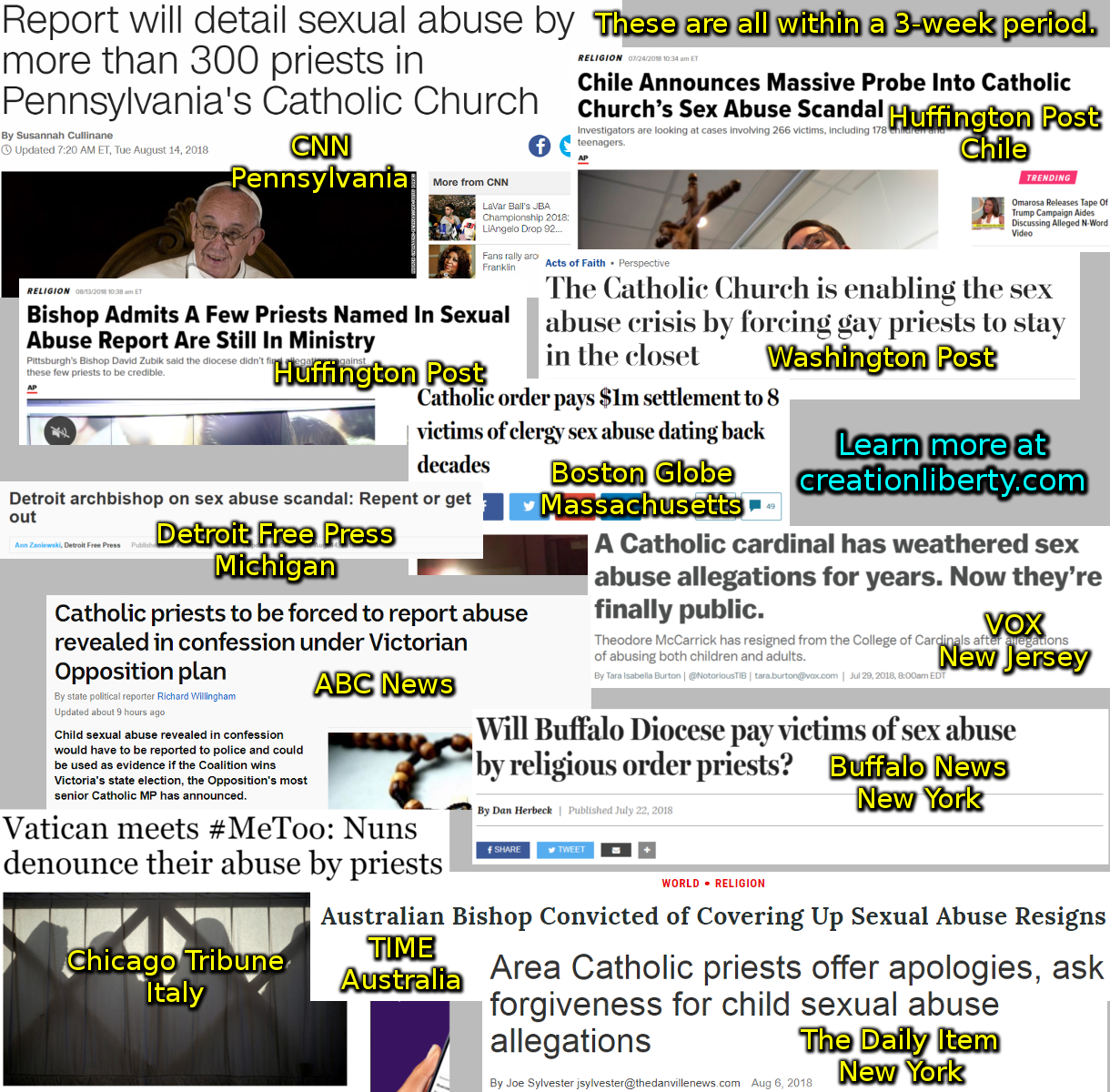
According to the National Catholic Reporter, the Catholic Church (as of November of 2015) had paid out almost $4 billion (i.e. 4,000 million dollars) in costs related to sexual abuse by priests. They also reported that these numbers are only based on those settlements that are part of public record, as many of the dioceses who are members of the U.S. Bishops' Conference did NOT make their financial reports public, even though they are required to do so by law (via 501c3 contract, but no one is enforcing it), and on top of that, this number does not include those settlements which were reached with nondisclosure or confidentiality restrictions. (i.e. The number of $4 billion is probably quite low, especially considering that this was back in 2015.)
(See Jack & Diane Ruhl, "NCR research: Costs of sex abuse crisis to US church underestimated," National Catholic Reporter, Nov 2, 2015, retrieved July 31, 2018, [https://bit.ly/2b6lM3G]; Read "501c3: The Devil's Church" here at creationliberty.com for more details.)
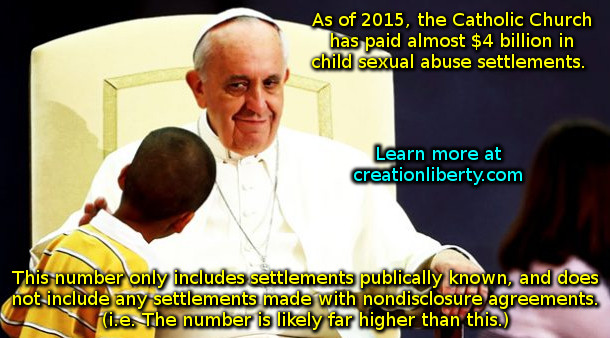
Many of these sexual abuse cases require the state to temporarily lift the statute of limitations for special reasons, namely because children do not have the cognitive reasoning or understanding to know what is happening to them at the time of the incidents, and thus, they have no choice but to press charges years later when they are adults. (This is especially important for orphans, who have no parents to protect them, and no one else to turn to.) The Catholic Church has taken great pains to try and convince their parishioners that these are isolated incidents or just media exaggeration.
In fact, according to interviews with news correspondents to Rome and the Vatican, the bishops and cardinals of the Catholic Church attempted to give the impression that sexual abuse was only taking place in the U.S. and Canada. They tried to shift the blame to a region far from the Vatican to cover up the worldwide religious problems, and to protect the Vatican from being accused of ignoring child abuse (among many other things).
Robert Mickens, a reporter for a Catholic newspaper said:
"One of the things Vatican officials have tried to do is portray this an 'American thing' or, at best, an 'Anglo-Saxon' thing. [i.e. Germanic inhabitants of England]"
-Robert Mickens, Rome Correspondent for the Tablet-Catholic Weekly, interviewed in Mea Maxima Culpa: Silence in the House of God, Home Box Office, retrieved Aug 7, 2018, [youtu.be/ckmZahKS-Zo?t=46m5s]
A Vatican Correspondent for the Daily Fact, an Italian newspaper, said:
"[He imitates what the bishops and cardinals say:]'Oh, the sex abuse scandals, they happen only in the United States, in Canada.' And suddenly, in the year 2010, the great scandal explodes in Europe. It explodes in Ireland, in Germany, in Austria, in Switzerland, in France, in Belgium. "
-Marco Politi, Vatican Correspondent for Il Fatto Quotidiano, interviewed in Mea Maxima Culpa: Silence in the House of God, Home Box Office, retrieved Aug 7, 2018, [youtu.be/ckmZahKS-Zo?t=46m16s]
Obviously, such allegations are embarrassing, and I am sure no one will argue against that fact, but these "region-specific" excuses are being used to cover up the massive offenses in these religious institutions because, today, it is being exposed in every major country around the world. However, one of the most absurd excuses used by the leadership in the Vatican is the tale that they "did not know" about the sexual abuse of children; in fact, the popes of the Catholic Church have known more about the sexual abuse than anyone else, and worse still, they sat on the information and did nothing because they were protecting themselves and their criminal colleagues.
In 2016, a German investigation led to the prosecution of priests who had sexually abused young boys in a famous Catholic boys' choir in Bavaria. There were fifty cases of sexual abuse, and they further discovered that many more cases (beyond those fifty) involved physical abuse, everything "
(See Alexander Stille, "What Pope Benedict Knew About Abuse in the Catholic Church," The New Yorker, Jan 14, 2016, retrieved Aug 7, 2018, [https://bit.ly/2vNS1vI])
This is where the investigation got very interesting:
"The news received widespread attention not only because of its disturbing content but because the director of the Regensburg boys' choir from 1964 to 1994 wasGeorg Ratzinger, the older brother of Joseph Ratzinger, who became Benedict XVI. Joseph Ratzinger was the Archbishop of Munich from 1977 until 1981, when he went to head up the powerful Congregation for the Doctrine of the Faith [i.e. The Office of Inquisition], which establishes theological orthodoxy and was also one of the branches of the Church that dealt with priestly sexual abuse. "
-Alexander Stille, "What Pope Benedict Knew About Abuse in the Catholic Church," The New Yorker, Jan 14, 2016, retrieved Aug 7, 2018, [https://bit.ly/2vNS1vI]
In chapter eight, we covered the Inquisition, and I provided documentation to show that the Office of Inquisition was reopened under the name, "Congregation for the Doctrine of the Faith." We also just read that this Office of Inquisition was in charge of sexual abuse cases in the Catholic Church. I hope some readers are starting to connect the dots. The head office that handled child sexual abuse cases was overseen by the leader (i.e. Grand Inquisitor) of the newly reopened Office of Inquisition, which had, for hundreds of years, tortured, raped, and murdered countless men, women, and children, and that same man later became the Pope.
While heading up the Congregation for the Doctrine of the Faith, Ratzinger (Benedict XVI) had all sexual abuse cases within the Catholic Church worldwide brought to his desk. He had all the data in their secret archives. He knew about the cases, and it was very likely he knew about his own brother's abuse of children in Germany, and just from that case alone, the conflict of interest is so glaringly obvious, one would have to be willingly blind not to see it, but the general public seems to be completely lost in blissful ignorance. At the very least, it certainly brings into question how Ratzinger became the Pope, and it does not take a criminal law degree and years of training to figure out what is happening here, namely, that Ratzinger was elected because of his work covering up the sins of his fellow priests, bishops, and cardinals who voted for him.
In countries like Ireland, many Catholics began to leave the Catholic Church, and would not come to Mass anymore because they were tired of the lies and contradictions in the numerous sex abuse lawsuits that were being brought against priests. There has been a lot of anger due to the cover-up and lack of effort by priests and bishops to contact local police in response to child sexual abuse at the hands of their fellow priests and bishops, but if you are wondering why they are not reporting these offenses, there is an interesting reason for that.
Ratzinger, as Pope Benedict XVI, with all the knowledge he had about child sex abuse in Catholic parishes around the world, decided to publish the "Pastoral Letter of the Holy Father Pope Benedict XVI to the Catholics of Ireland," which addresses the Irish bishops:
"It cannot be denied thatsome of you and your predecessors failed , at times grievously,to apply the long-established norms of canon law to the crime of child abuse . Serious mistakes were made in responding to allegations. I recognize how difficult it was to grasp the extent and complexity of the problem, to obtain reliable information and to make the right decisions in the light of conflicting expert advice. Nevertheless, it must be admitted that grave errors of judgment were made and failures of leadership occurred. All this has seriously undermined your credibility and effectiveness. I appreciate the efforts you have made to remedy past mistakes and to guarantee that they do not happen again. Besidesfully implementing the norms of canon law in addressing cases of child abuse, continue to cooperate with the civil authorities in their area of competence. Clearly, religious superiors should do likewise. "
-Pope Benedict XVI, "Pastoral Letter of the Holy Father Pope Benedict XVI to the Catholics of Ireland," Vatican Archives, retrieved Aug 7, 2018, [w2.vatican.va/content/benedict-xvi/en/letters/2010/documents/hf_ben-xvi_let_20100319_church-ireland.html]
On the surface, it appears that Ratzinger identified the problem and addressed it, namely, that priests and bishops were not doing their job, and that they should follow "
After the release of Ratzinger's publication, an anonymous source (obviously within Catholic clergy) released a confidential document from a Catholic Apostolic Nuncio (i.e. a diplomatic representative of the Holy See) to the media. Of course, these letters are not for the public to see, but it was released by an angry priest to show that bishops were instructed NOT to report child sexual abuse cases to the police, and that doing so would violate canon law:
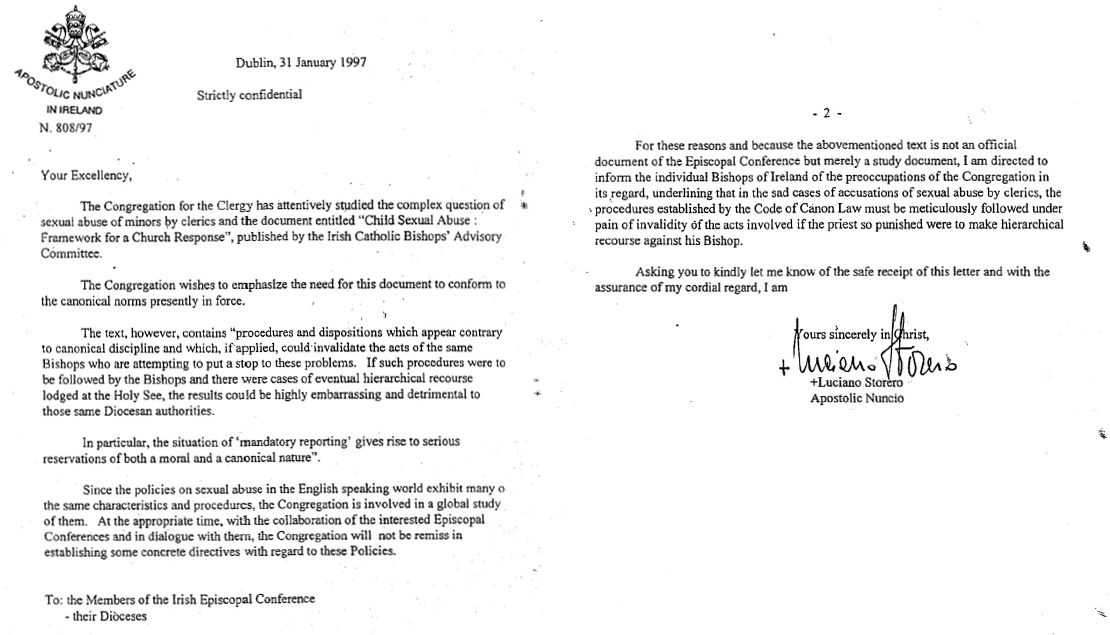
(Click image for larger view.)
"The Congregation for the Clergy hasattentively studied the complex question of sexual abuse of minors by clerics and the document entitled 'Child Sexual Abuse: Framework for a Church Response', published by the Irish Catholic Bishops' Advisory Committee.The Congregation wishes to emphasize the need for this document to conform to the canonical norms [Vatican rules] presently in force. The text, however, contains 'procedures and dispositions which appear contrary to canonical discipline and which, if applied, could invalidate the acts of the same Bishops who are attempting to put a stop to these problems.'If such procedures were to be followed [e.g. reporting an incident of rape or molestation to the police]by Bishops and there were cases of eventual hierarchical recourse lodged at the Holy See [i.e. a priest/bishop got caught in a sexual act and was hidden away by the Vatican], the results could be highly embarrassing and detrimental to those same Diocesan authorities. [i.e. They need to protect the pedophiles that make up the Vatican from embarrassing accusations.] In particular, the situation of 'mandatory reporting' gives rise to serious reservations of both a moral and a canonical nature [i.e. They do not believe that turning in pedophile priests to governing authorities is the right thing to do.]...
For these reasons and because the abovementioned text [Child Sexual Abuse: Framework for a Church Response] isnot an official document of the Episcopal Conference butmerely a study document , I am directed to inform the individual Bishops of Ireland of the preoccupations of the Congregation in its regard, underlining thatin the sad cases of accusations of sexual abuse by clerics, the procedures established by the Code of Canon Law must be meticulously followed under pain of invalidity of the acts involved if the priest so punished were to make hierarchical recourse against his Bishop. "
-Luciano Storero, "Apostolic Nunciature in Ireland N. 808/97," Jan 31, 1997; See above image to read the document.
That was a lot of long sentences and complex phrases, so in case some readers did not understand, in short, the Catholic diplomat is afraid of embarrassing the Catholic Church, and also afraid that people would lose respect for priests. The letter said "
Therefore, the recommendations to contact local authorities in matters of child sexual abuse in the "Framework for a Church Response" document were said to be only labeled as "study material" and NOT instruction, which was stated to dissuade bishops and priests from contacting the police. Furthermore, the author told Irish bishops that they ought not to ever report these "sad cases" because not only would it break Catholic Canon Law, but the priests would also have their positions and wealth threatened by others in cases of wrongful accusation, which makes no sense because, if a priest did nothing wrong, then he has nothing to worry about; rather, they are worried about being exposed for their crimes.
|
Ultimately, Vatican authorities care more about tradition and their own well-being than they care about abused children. |
Then said he unto the disciples, It is impossible but that offences will come: but woe unto him, through whom they come! It were better for him that a millstone were hanged about his neck, and he cast into the sea, than that he should offend one of these little ones.
-Luke 17:1-2
And I saw the dead, small and great, stand before God; and the books were opened: and another book was opened, which is the book of life: and the dead were judged out of those things which were written in the books, according to their works. And the sea gave up the dead which were in it; and death and hell delivered up the dead which were in them: and they were judged every man according to their works. And death and hell were cast into the lake of fire. This is the second death. And whosoever was not found written in the book of life was cast into the lake of fire.
-Revelation 20:12-15
The Lord is not slack concerning his promise, as some men count slackness; but is longsuffering to us-ward, not willing that any should perish, but that all should come to repentance.
-2 Peter 3:9
"The commission's research uncovered between 2,900 and 3,200 paedophile priests or other members of the church, said Jean-Marc Sauve, adding that it was 'a minimum estimate' . The commission's report is due to be released on Tuesday after two and a half years of research based on church, court and police archives, as well as interviews with witnesses. Sauve, senior French civil servant, said the report, which runs to2,500 pages , had attempted to quantify both the number of offenders and the number of victims."
-France24, "Thousands of paedophiles active in French Catholic Church since 1950, commission finds," Oct 3, 2021, retrieved Oct 4, 2021, [https://www.france24.com/en/france/20211003-thousands-of-paedophiles-operated-in-french-catholic-church-since-1950-commission-finds]
The commission concluded its investigation with a staggering 216,000 victims of sexual abuse in the Catholic Church since the 1950s, and they were all children, mostly boys. Keep in mind, this is ONLY in France, and these are ONLY those who they had reports on:
"Some 216,000 children - mostly boys - have been sexually abused by clergy in the French Catholic Church since 1950, a damning new inquiry has found... The inquiry found the number of children abused in France could rise to 330,000, when taking into account abuses committed by lay members of the Church, such as teachers at Catholic schools. "
-BBC News, "French Church abuse: 216,000 children were victims of clergy - inquiry," Oct 5, 2021, retrieved Oct 5, 2021, [https://www.bbc.com/news/world-europe-58801183]
After everything we have covered in this book so far, if someone is going to tell me that Catholicism is a "Christian" institution, then I would say that person is nothing short of willingly blind. And yet, I have seen and heard Catholics try to justify these vile things, clinging with hope to their senseless false doctrines that result in the sexual abuse of children.
These are not isolated incidents within France or Ireland (as the Popes often like to imply), but rather, this is a worldwide problem with the Catholic Church, and the hierarchy specifically, including the Papacy, that ignores and covers up sexual abuse allegations to save face. To understand this in more detail, let's take a closer look at Marcial (mar-see-al) Maciel (mah-see-el) Degollado, a famous (or infamous) Mexican Catholic priest and pedophile who was praised many times by Pope John Paul II for his well-known work in fund-raising for the Catholic Church.
In 1941, Maciel founded The Legion of Christ (sometimes called the Legionaries of Christ) and the Regnum Christi Movement (i.e. Kingdom of Christ Movement), which were zealous groups of fund-raisers for the Catholic Church. In the course of their existence, they have raised enormous amounts of money for the Catholic Church, and have started Catholic seminary colleges all around the world.
 |
"After founding the Legion of Christ in Mexico in 1941, Maciel built a vast network of schools, colleges, seminaries and lucrative real estate holdings. At its peak the Legion had an -Jason Berry, "Father Maciel Is Our Father, Say Two Mexican Men, And He Molested Us," ABC News, Mar 5, 2010, retrieved Aug 8, 2018, [https://abcn.ws/2M0x3oq] |
The Spanish phrase "Millionarios de Cristo" means "Millionaires of Christ," which was a nickname given to them for their extraordinary wealth.
It is easier for a camel to go through the eye of a needle, than for a rich man to enter into the kingdom of God.
-Mark 10:25
But they that will be rich fall into temptation and a snare, and into many foolish and hurtful lusts, which drown men in destruction and perdition. For the love of money is the root of all evil: which while some coveted after, they have erred from the faith, and pierced themselves through with many sorrows.
-1 Timothy 6:9-10
Maciel was able to become friends with many famous and wealthy people, who supported the Legion of Christ:
"Politically, he was closely linked with the far right in the US, mixing withJeb Bush, brother of George W Bush, Rick Santorum, a former US senator [also U.S. presidential candidate], and Thomas Monaghan, the Domino's Pizza magnate [a wealthy and influential person - also the founder of Ave Maria University in Florida] who paid for the new cathedral in Nicaragua's capital, Managua, which replaced the one that was destroyed in the 1972 earthquake."
-Hugh O'Shaughnessy, "Pope acts against incest priest's group," The Independent, Aug 8, 2010, retrieved Aug 8, 2018, [https://ind.pn/2nnbDDt]
Maciel also had ties and received funding from Steve McEveety, producer of Mel Gibson's The Passion of the Christ, Spanish opera singer Placido Domingo, and former CIA director William Casey. He was praised by Mary Ann Glendon, former U.S. ambassador to the Vatican, claiming that he had a "radiant holiness" and that he was key in "advancing the New Evangelization." Author George Weigel, Founding President of the James Madison Foundation, said, "
(See Jason Berry, "Money paved way for Maciel's influence in the Vatican," National Catholic Reporter, Apr 6, 2010, retrieved Aug 8, 2018, [https://www.ncronline.org/money-paved-way-maciels-influence-vatican])
Woe unto you, when all men shall speak well of you! for so did their fathers to the false prophets.
-Luke 6:26
(See Jason Berry, "Legion of Christ's deception, unearthed in new documents, indicates wider cover-up," National Catholic Reporter, Feb 28, 2013, retrieved Aug 8, 2018, [https://bit.ly/2KD5ImP])
Pope John Paul II praised Maciel and his fund-raising army:
"During a 1993 speech in St. Peter's Square,John Paul said, 'You are all sons and daughters of Father Maciel!' In 1994, he called Maciel'an efficacious [effective] guide to youth.' John Paul continued to praise him after the allegations were filed against Maciel at the Vatican's Congregation for the Doctrine of the Faith — where they gathered dust for six years."
-Jason Berry, "Confidant cardinal tells new tales about Pope John Paul's role in scandal," Public Radio International, Nov 8, 2013, retrieved Aug 8, 2018, [https://bit.ly/2M1L9G4]
They just love to flatter each other's fine names with lavish compliments.
Help, LORD; for the godly man ceaseth; for the faithful fail from among the children of men. They speak vanity every one with his neighbour: with flattering lips and with a double heart do they speak.
-Psalm 12:1-2
"With special affectionI greet your beloved founder, Fr [Father] Marcial Maciel, and extend to him my heartfelt congratulations on this important event, cordially thanking him for the words he addressed to me on everyone's behalf. "
-John Paul II, "Address of John Paul II to the Legionaries of Christ and the Members of the Regnum Christi Movement," Vatican Archives, Jan 4, 2001, retrieved Aug 8, 2018, [https://bit.ly/2LZYdMl]
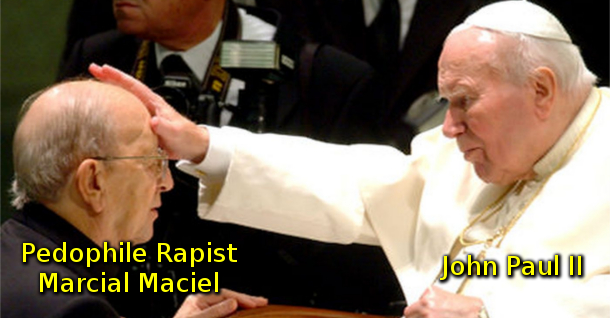
(See Jason Berry, "Money paved way for Maciel's influence in the Vatican," National Catholic Reporter, Apr 6, 2010, retrieved Aug 8, 2018, [https://www.ncronline.org/money-paved-way-maciels-influence-vatican])
Sadly, it does not end there because Maciel also began to target very wealthy Mexican widows, sexually abused their children, and then had more children with them. Blanca Bonilla was one of the women targeted, who Maciel gave a fake identity, calling himself "Raul Rivas," claiming he was an international detective for oil companies, and although they did not marry, he elected to become the adoptive father of her 3-year-old son, and when he was 7, Maciel attempted to rape him. There are many such examples of Maciel taking the children of his mistresses on trips to Europe, and molesting them during their travels.
-Christopher Simon, "Maciel Raped His Own Children Too," The Atlantic, Apr 13, 2010, retrieved Aug 8, 2018, [https://bit.ly/2ATJBJn]; See also Michael Sheridan, "Father Marcial Maciel, was my dad, and he sexually abused me, Raul Gonzalez claims in lawsuit," New York Daily News, Jun 22, 2018, retrieved Aug 14, 2018, [https://nydn.us/2OBuCFM]
Reporters started to gather information and publish these facts in 1997, and they attempted to contact the Vatican to get a response. There was no response.
Of course, dedicated Catholics will argue that perhaps John Paul II never received this information, which is beyond absurd because Maciel was the most highly revered fund-raiser for the Catholic Church at the time, and the Pope was giving speeches complimenting Maciel for his work, and for this information to have not reached the Pope, who is surrounded by those who, without any doubt, had the information, is ridiculous. What is more ridiculous is any Catholic who would make that excuse for the Papacy, because, assuming that the Catholic Church slipped on a banana peel and just happened to accidentally hire and cover up pedophiles in their highest levels of religious leadership, a Catholic would have to presuppose that the Catholic Church, likely the most wealthy and powerful institution in the known world, is blind, stupid, disorganized, and completely unconcerned about the welfare of children, and if that is the case, I would ask them: Why do you blindly follow, and give money to, such an incompetent organization?
This gets stranger as it goes because after John Paul II's death in 2005, Ratzinger had the prosecutor general of the Congregation for the Doctrine of the Faith (i.e. the Office of Inquisition) go to New York to retrieve all the investigative documentation on the sexual charges against Maciel, and the prosecutor returned the following week with more than enough information to have Maciel charged with a lot of criminal activity. Keep in mind that this information on Maciel was known to the Vatican in the early 90s, and possibly sooner than that, so the Vatican sat on this information for, at minimum, over a decade while Maciel continued to rape children.
Ratzinger, even though he had the information, did nothing to prosecute Maciel. After Ratzinger took the office of the Pope as Benedict XVI, he was asked the following by a priest named Lombardi:
"LOMBARDI: It is known and recent polls have shown that the sexual abuse scandals have shaken the trust of the faithful in the [Catholic] Church.How do you intend to act so as to re-establish this trust?
BENEDICT XVI: Above all I must say that these revelations were a shock for me. They are agreat sadness , and it is hard to understandhow this perversion of the priestly ministry was possible ."
-Joseph Ratzinger, "Interview of the Holy Father Benedict XVI with the Journalists During the Flight to the United Kingdom," Vatican Archives, Sept 16, 2010, retrieved Aug 8, 2018, [https://bit.ly/2MbsGWN]
Ratzinger addressed the victims much later in his response, but I want readers to notice that his first response was NOT to address the horror of what was done to these children. The children were an afterthought. Ratzinger's first thought was, "Oh, the horrors of the tarnished name of the precious Catholic priesthood!" This is standard operating procedure in any cult, namely, the tradition and religious system are protected first and foremost so they can give a fake appearance of being "holy" unto men, while they are full of corruption, lust, hypocrisy, and many other sins, and then, IF time, money, and circumstance allow, and IF enough people object, and IF it does not dirty the name of the Catholic Church and its hierarchy, the victims might get some help in the form a few scraps thrown at them, so long as they keep their mouths shut about it.
Woe unto you, scribes and Pharisees, hypocrites! for ye are like unto whited sepulchres, which indeed appear beautiful outward, but are within full of dead men's bones, and of all uncleanness. Even so ye also outwardly appear righteous unto men, but within ye are full of hypocrisy and iniquity.
-Matthew 23:27
(See Andy McSmith, "The priest who abused deaf boys for 24 years," The Independent, Mar 27, 2010, retrieved Aug 8, 2018, [https://ind.pn/2Mrtzrd])
Years later, many of the young boys, now grown men, tried to bring up charges against Murphy, but as previously mentioned, the statute of limitations would not allow them to do so. Also, some of the boys had been tricked into signing confidentiality clauses against their will.
In criminal law, this scam is known as "fraudulent inducement," in which a person is told they are signing something that is for their benefit, but the forger of the contract takes advantage of an ignorant person who they know cannot understand what is in the contract, ultimately getting them to sign away their rights and property. In this instance, these young men spent most of their time learning a different type of language that makes up for their disability, which means that they may not be able to read and write English as well as others (especially in that time period where not as much emphasis was placed on the education of the disabled), and so they were manipulated into signing documents they were told were to start the process of filing lawsuits against the Catholic Church and priests to get justice for their abuse, but the documents turned out to be nondisclosure agreements that gave Murphy a free pass because the contracts included clauses that stated the boys were at fault for their abuse.
|
Murphy did not arrange this scam to save himself. The Catholic Church arranged this scam for him. |
Although Murphy was never prosecuted until his death in 1998, Murphy did go through a psychiatric evaluation with a therapist a few years before he died. I have another book in which I expose the foundational corruption and fraud that makes up psychology and psychiatry (i.e. they are not real sciences, nor are they real medical practices), but for the sake of the information, I want to document the findings.
(Read Psychology: Hoodwinked by the Devil here at creationliberty.com for more details.)
The notes of the therapist not only document that Murphy had confessed to sexually molesting about 200 children, but the notes also record his excuses for why he committed the crimes:
|
"Traditional corruption is defined as the use of one's official position for personal gain. The personal gain can be economic or otherwise, such as sexual favors. As a profession, we have long understood this type of abuse of power and, when discovered and investigated, those involved are arrested. A less obvious but perhaps even more threatening type of misconduct in law enforcement is Noble Cause Corruption...Noble Cause Corruption is a mindset or sub-culture which fosters a belief that the ends justify the means. In other words, law enforcement is engaged in a mission to make our streets and communities safe, and if that requires suspending the constitution or violating laws ourselves in order to accomplish our mission, then for the greater good of society, so be it.The officers who adopt this philosophy lose their moral compass. "
-Steve Rothlein, "Noble Cause Corruption," Public Agency Training Council, retrieved Aug 7, 2018, [patc.com/weeklyarticles/noble-cause-corruption.shtml]
Though the main focus of the Public Agency Training Council article was on police officers who do evil in the name of good, Catholic priests who try to justify their sexual abuse do the exact same thing; believing their sin is a "holy act" in the name of God. This is a form of blasphemy, which is to attribute that which is of the Devil to the Christian God of the Bible.
Ye are of your father the devil, and the lusts of your father ye will do. He was a murderer from the beginning, and abode not in the truth, because there is no truth in him. When he speaketh a lie, he speaketh of his own: for he is a liar, and the father of it. And because I tell you the truth, ye believe me not. Which of you convinceth me of sin? And if I say the truth, why do ye not believe me? He that is of God heareth God's words: ye therefore hear them not, because ye are not of God.
-John 8:44-47
| Parents would wage war against anyone who would harm their children in such a way, but overlook it when done by a Catholic priest. |
Beware lest any man spoil you through philosophy [a way of thinking] and vain deceit [useless lies], after the tradition of men, after the rudiments [first teachings] of the world, and not after Christ.
-Colossians 2:8
Making the word of God of none effect through your tradition, which ye have delivered: and many such like things do ye.
-Mark 7:13
(See Andrea Lee, "Elderly Ontario priest convicted of abuse dies in jail," CBC News, Jan 23, 2007, retrieved Aug 9, 2018, [https://bit.ly/2noVOfi])
But at the time the abuse occurred, many of the girls thought they had done wrong. The feeling of what Sylvestre did to them, or made them do to him, was a bad feeling, but the girls thought that they must have done something wrong to make him do these things to them (which is a result of the corrupt teachings of the Catholic Church and reinforcement of those corrupt teachings by parents and family), so they ended up blaming themselves and not talking to anyone about what happened because, after all, he was a Catholic priest, and their brainwashed perception was that there was no way a Catholic priest could do anything wrong.
The following video documentary is from a short-lived, hard-to-find TV show called Unforgivable Crimes; this episode covered the story of "Father Sylvestre" and his crimes against young girls:
|
CAROLYN JEWELL: "The first time I met Father Sylvestre was when he was brought into the class, introduced as a visiting priest. |
In Carolyn Jewell's testimony, we can see the cultic brainwashed mentality in her thought process which was ingrained into her mind as a child, but she never once gives a logical reason WHY she had to honor the priests. In the minds of Catholics, the priest becomes the channel between the laity and the heavenly things of God, which is not true in the slightest, but because they believe it, they continue to automatically assume that the man who wears a priest's garbs is a "safe" person.
This is how Catholic children are raised. Their parents teach them to never question a Catholic priest, and because of that philosophy, Carolyn Jewell became one of Sylvestre's first victims.
|
CAROLYN JEWELL: "We used to play hide-and-go-seek with him. He took us swimming; he used to make milkshakes for us... We were special. We were the youngest kids in the whole school to begin with, and so we felt—I think we probably flaunted it whenever we saw the high school kids. Like, 'We're the little kids and |
Part of the "special" feeling was that these girls were hand-picked by Sylvestre to volunteer at the Catholic Church. It seemed to give the girls some sense of purpose and value, which they were obviously lacking at home, otherwise, they would have no need for it, but they clung to that, even though the priest had ulterior motives for choosing them.
|
IRENE DESCHENES: "I just remember feeling so ecstatic, like one of the chosen ones. All the children loved him. JOANNE MORRISON: "I felt that probably God had something to do with it; that God was happy with me. So |
It was not just the children who had this philosophy, but also the parents. These women would later testify that Sylvestre would sometimes sexually fondle them in public, where other people could see, even during Catholic services when the families of the girls were present, but no one paid any attention because, again, he was a priest, so in the Catholic brainwashed mindset, there is no way a priest could be malicious, so his actions right in front of the parents were ignored and counted as "innocent" for the sake of religious pretense.
To put it another way, if this man were not wearing the outfit of a Catholic priest, the parents of these children would be much more on guard against predators, and alarmed if the slightest detail seemed suspicious. However, when the man puts on the garb of a priest, their brainwashed philosophy causes them to view him as a "good person," and suddenly, they are blinded, leaving them incapable of judging righteous judgment.
Judge not according to the appearance, but judge righteous judgment.
-John 7:24
And the Lord said unto him, Now do ye Pharisees make clean the outside of the cup and the platter; but your inward part is full of ravening [like a ferocious animal hungry for prey] and wickedness [sin].
-Luke 11:39
Beware of false prophets, which come to you in sheep's clothing, but inwardly they are ravening wolves... Even so every good tree bringeth forth good fruit; but a corrupt tree bringeth forth evil fruit.
-Matthew 7:15-17
(Read "Respecting Persons is Sin" here at creationliberty.com for more details.)
But if ye have respect to persons, ye commit sin, and are convinced of the law as transgressors.
-James 2:9
|
JOANNE MORRISON: " IRENE DESCHENES: "He would present us with the candy or pop or whatever, but first he would do this [taps finger on cheek], and that meant kiss on the cheek. And that wasn't uncomfortable at the time because, you know, I kissed my uncles on the cheek, things like that. Then, as time went on, CAROLYN JEWELL: "The first time that Father Sylvestre had touched me, we were playing hide-and-go-seek at the grotto. |
As the video goes on, the victims testified that he would do his worst when he got them alone. He would catch them in a hallway by themselves, or assault them during confessional sessions. Sylvestre told Jewell that if she ever told anyone, she would go to hell, her parents and sister would go to hell, but as long as she did not say anything to anyone about the sexual abuse, he would do what he could to prevent her and her family from ending up in hell, ultimately manipulating the girl by using her love for her family against her.
The truth is that only those who do not come to the humility of repentance (i.e. grief and godly sorrow) of their sin and put their faith in the Lord Jesus Christ will end up in hell. ALL Catholics, not just Sylvestre, are in danger of hellfire because they do not come to Christ and rely on His grace alone.
(See Why Millions of Believers on Jesus Are Going to Hell & There is No Saving Grace Without Repentance here at creationliberty.com for more details.)
As a side note, Irene Deschenes went on to start an organization called SNAP (Survivors Network of those Abused by Priests). This was the first organization specifically started as a help and support group for men, women, and children who are abused by those in positions of religious authority in the Catholic Church. However, that being said, it should also be noted that with money comes greed, and the organization took a turn for the worse in 2017, when founders of SNAP departed because lawyers and board members were making decisions that were exploiting abuse victims for cash from settlements.
(See David Gibson, "SNAP founder quits in second major loss for abuse advocacy group following lawsuit," National Catholic Reporter, Feb 5, 2017, retrieved Aug 15, 2018, [https://bit.ly/2MOLnwT])
Noble Cause Corruption does not only affect girls. I have listened to the testimony of many men who were raped by priests when they were boys.
Just like the young girls, the young boys did not understand sex, and they did not understand the priest was doing something evil. Like the girls, the boys were also embarrassed by the situation, but most importantly, they did not think anyone would believe them even if they told an adult, and oftentimes, they were not believed because, once again, he is a priest, and the Noble Cause Corruption mentality that a "man of the cloth" could do no wrong is a foundation in their Catholic minds, so in a situation where it is their word against his, children find the odds against them, fearing their parents erupting in anger at such an accusation against a supposed "holy man of God."
Some readers may be upset that I would say that this Catholic philosophy is more destructive and does more damage than the acts of child molestation and sexual abuse, but it is true. The reason child sexual abuse gets ignored in such institutions, even when it happens in broad daylight, sometimes in the plain view of the parents, without any retaliation to protect the children, is because of the facade of presumed morality in Catholic priests. I cannot emphasize enough that this fallacious, corrupt philosophy is the very reason why millions of Catholic parents remain willingly blind, why massive amounts of sexual abuse continues to come out of parishes around the world, and why children are still being assaulted in Catholicism today.
This matter is not an issue of the Catholic Church's negligence, because that would mean the bishops and popes would just be ignoring the matter; rather, this is an issue of deception and cover-up. To further demonstrate that point, let's take a closer look at St. John's Abbey in Collegeville, Minnesota, which has recently uncovered criminal activity that could not be described in any other way but accessory to commit serial rape against minors and harboring sex criminals.
After getting small pieces of documentation here and there during the investigation on St. John's Abbey, in 2016, the monastery finally released more than 15,000 pages of documents related to the 18 priests that were sexual offenders:
"The disclosure comes as the latest chapter in the jagged history for the Benedictine community in Collegeville, Minn., on the issue of clergy sexual abuse, one that at times has seen it attempt to lead in understanding the epidemic but at others fall ill to the plague of its horrors. Like many others before them,the disclosed documents provide a recounting of what the abbey knew when regarding each monk — nearly half of whom have died — and often the attempts to shuttle them from place to place to avoid possible lawsuits and scandal. "
-Brian Roewe, "Sexual abuse at St. John's Abbey revealed in 15,000-page disclosure," National Catholic Reporter, Jan 22, 2016, retrieved Aug 14, 2018, [https://bit.ly/2KSCsIE]
The shuttling of criminals outside of law enforcement jurisdiction is not only a common practice in Catholicism, but it happens in many other false religious institutions. In the case of the Catholic Church, if a priest is caught sexually molesting children in one parish, he is simply moved to another parish, not to protect the children, but to prevent a potentially embarrassing investigation, and depending on how much knowledge may be available to the public and state officials, the priest will sometimes be moved out of the country in order to prevent him from being prosecuted by any lawful authority.
Continuing from the same report:
"The thousands of pages from the monks' files — detailing everything from sacramental records and ministerial reviews to medical histories and psychological exams to personal letters and emails — contain many now-common themes from the church's sexual abuse crisis, where [Catholic] officials do not always act on warning signs, sometimes on the back of expert opinions, or fail to heed recommendations from counselors and psychologists. In some cases, priests with known allegations of sexual abuse, whether with minors or college students at St. John's University, were able to continue traveling to the abbey's monasteries abroad, including in Japan and the Bahamas. "
-Brian Roewe, "Sexual abuse at St. John's Abbey revealed in 15,000-page disclosure," National Catholic Reporter, Jan 22, 2016, retrieved Aug 14, 2018, [https://bit.ly/2KSCsIE]
Of course, the convicted priests had some duties to perform in these glamorous monasteries, but that being said, the fact is that the Catholic Church sends their sex abusers on vacation to exotic islands. This statement is far more literal than most people realize, and to understand that more clearly, let's take a look at the testimony of Patrick Wall, a former student and monk from St. John's Abbey:
"Patrick Wall, a former monk at the abbey who now works with Anderson's law firm, told NCR the files represent for him and his fellow St. John's graduates 'a confirmation and an affirmation, first of all, that we weren't crazy, and that yes, there were that many perpetrators on campus. '"
-Brian Roewe, "Sexual abuse at St. John's Abbey revealed in 15,000-page disclosure," National Catholic Reporter, Jan 22, 2016, retrieved Aug 14, 2018, [https://bit.ly/2KSCsIE]
Catholics, and others who revere the Catholic Church, would often call Wall crazy for telling people that St. John's Abbey had numerous sex offenders on staff at the school, but again, in an effort to defend their religious ideology, most Catholics are willingly ignorant of what goes on behind closed doors. Wall graduated from St. John's Abbey and went on to be a monk who was a "fixer," meaning that it was his job to travel around and put out fires for the Catholic Church by handing out non-disclosure contracts and settlement money, and he gave the following testimony in a documentary interview:
"There are treatment centers—before ordination [the act of ordaining],I had no idea that we had treatment centers around the world for priests to go to when they sexually molested, raped, and sodomized kids! I didn't know that. My parents didn't know that.I didn't know that we had 55 molesters in my monastery. I didn't know there were more than 70 molesters operating in the archdiocese. [Catholic district in the region] That wasn't public knowledge...I thought I was going there to uncover the crime, to heal the wounds; I thought it was pastoral care. You know, comfort the afflicted, what we're ordained for, but the people sending me in obviously had ulterior motives. You know, they would give you authorization up to $250,000 to settle a case, if you could get a confidentiality order. [i.e. the victim cannot talk about it after the document is signed; money for silence] And in 1995, we had a budget of seven million dollars to handle the various problems of childhood sexual abuse. And most people don't want to have anything go public; I mean, in the Catholic mindset, you don't sue the church. They want to know that it's going to stop."
-Patrick J. Wall, former Benedictine monk at St. John's Abbey, interviewed in Mea Maxima Culpa: Silence in the House of God, Home Box Office, retrieved Aug 15, 2018, [youtu.be/ckmZahKS-Zo?t=23m53s]
Wall is correct on this point because it is a common philosophy in any religious cult that you should never sue the religious leaders of the organization, and likewise, Catholics believe they should not sue their "Mother Church" because they believe it is sinful to demand restitution from something that is allegedly "holy." The sad part is that the Catholic Church has no interest in helping any of its victims unless they get sued, so ignoring the abused children, which the papacy has always done, has been the most convenient and lucrative (i.e. financially beneficial) option for them.
During his time in his office, which was responsible for covering up the crimes of the Catholic clergy, Wall discovered that the settlements paid were only a facade, and that the sexual abuse of children was allowed to continue within the parishes, monasteries, and schools. It would not be hard to figure this out after he had to return to the same locations for different victims of the same people.
The money that Catholic parishioners may have donated for the relief of the poor and needy was instead being used by the Catholic Church to pay for the silence of victims so the rapists could continue to assault children. In other words, Catholics are being financially used to cover up the crimes of the Catholic Church, and Wall left the Catholic priesthood because he was so disgusted by it.
During the interview, the film crew asked Wall if the Catholic Church had a policy to contact the police in these cases. Wall said, "
(See Patrick J. Wall, former Benedictine monk at St. John's Abbey, interviewed in Mea Maxima Culpa: Silence in the House of God, Home Box Office, retrieved Aug 15, 2018, [youtu.be/ckmZahKS-Zo?t=25m49s])
If you go back to the beginning of this chapter, I quoted a man named Gerald Fitzgerald, a Catholic priest from Boston, who said that he was amazed at how many men would be in prison if they did not have the title of a priest. In 1947, after receiving many reports of child sex abuse, Fitzgerald formed an organization in the Catholic Church called the Congregation of the Servants of the Paraclete (paraclete meaning "advocate" or "counselor"), which still exists today, and the order's purpose was to rehabilitate pedophile priests.
(See Servants of the Paraclete, retrieved Aug 15, 2018, [theservants.org])
I am in no way saying that a pedophile cannot be rehabilitated because I know Jesus Christ saves sinners and changes them for the better, but the Catholic Church is a false religion that is not of God, and so there is no healing that will come from the Spirit of God through their wicked religion. Even though Fitzgerald may have had the right idea that these men should have sorrow for their wrongdoing and turn from it, trying to force these men to repentance is insanity (i.e. repentance can NEVER be achieved by works, meaning that one cannot squeeze out tears of godly sorrow on their own because repentance is a gift from God), and it is certainly no punishment to send these men off to lakeside monasteries at a beautiful mountain retreat; that would only reinforce the idea in their minds that there are no real consequences for their offenses against the children.
(Read There is No Saving Grace Without Repentance here at creationliberty.com for more details.)
In meekness instructing those that oppose themselves; if God peradventure will give them repentance to the acknowledging of the truth;
-2 Timothy 2:25
Now I rejoice, not that ye were made sorry, but that ye sorrowed to repentance: for ye were made sorry after a godly manner, that ye might receive damage by us in nothing. For godly sorrow worketh repentance to salvation not to be repented of: but the sorrow of the world worketh death. For behold this selfsame thing, that ye sorrowed after a godly sort, what carefulness it wrought in you, yea, what clearing of yourselves, yea, what indignation, yea, what fear, yea, what vehement desire, yea, what zeal, yea, what revenge! In all things ye have approved yourselves to be clear in this matter.
-2 Corinthians 7:9-11
(See Gerald Fitzgerald, "Oasi Eucaristica: Servi Del S. Paraclito," August 27, 1963, [creationliberty.com/downloads/CATHOLICfitzgerald.pdf])
"So he [Fitzgerald] thought,'Let's get an island. You can't stop them, but you can contain them. Let's get an island in the Caribbean.' He sent a priest out. He was looking in Barbados, he was looking in various islands, andthey went ahead and they actually did begin the process to buy an island ."
-Patrick J. Wall, former Benedictine monk at St. John's Abbey, interviewed in Mea Maxima Culpa: Silence in the House of God, Home Box Office, retrieved Aug 15, 2018, [youtu.be/ckmZahKS-Zo?t=39m00s]

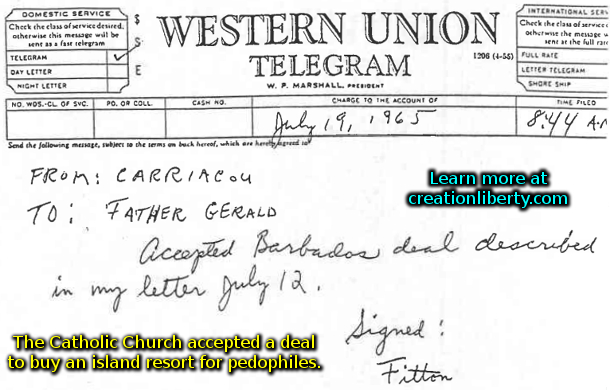
However, some of the higher-ups in the chain of command did not like this idea, so they ordered Fitzgerald to sell the portion of the island they had just purchased because, in the end, the Catholic Church decided that hiding them away was not a good idea. If I had to guess based on everything I have studied about the Catholic Church, it was a financial objection more than anything, meaning that it would be very expensive to have a resort there, the island would not turn a profit for the Catholic Church, and if it got out to the public, it could be damaging to their reputation. Furthermore, the higher-ups could not use it since, if it was discovered to be a resort for pedophiles, and they stayed at that resort, they could be branded as pedophiles as well (whether they were or not). So instead, they decided to attempt rehabilitating the sex offenders in a more simple and speedy process, and recirculate them back into parishes. From the 1950s to 1990s, the Servants of the Paraclete spent 80 million dollars, treating over 2,000 priests in centers located in Europe, Africa, South America, North America, and the Philippines.
(See Mea Maxima Culpa: Silence in the House of God, Home Box Office, retrieved Aug 15, 2018, [youtu.be/ckmZahKS-Zo?t=39m50s])
I want readers to understand that the entire purpose of all the almost unbelievable amount of time and money spent by the Catholic Church on these matters is to cover up the sexual abuse committed by their priests. Because the Catholic Church is tradition-driven, worshiping their traditions and their popes as gods, they have willing participants in whitewashing a false religious institution that is a beacon for rapists and pedophiles.
|
You might be curious about what happened to the Catholic pedophiles put through the Paraclete rehabilitation experiment, and to see those hidden results, we need to take a closer look at Tony Walsh, a Catholic priest who would end up causing a lot of turmoil in Ireland. In 1979, Walsh was appointed to Ballyfermot, a suburb of Dublin, and became well-known among Catholics as a very talented Elvis Presley impersonator. As soon as Walsh showed up at "Our Lady of the Assumption Church," he was put in charge of the altar boys. Within two days, the Catholic Church received its first complaint against Walsh by a young boy's parents. |
 |
"Walsh was born in 1954, and ordained in 1978. He had been a seminarian in Clonliffe College during which, it emerged years later, he abused children there and at the home of another abuser priest Fr Noel Reynolds, to whose house he had a key.Two days after Walsh took up his first appointment as a priest in July 1978, as curate in Ballyfermot, a complaint was received in Archbishop's House that he had sexually abused an eight-year-old boy. That was alleged to have taken place in June 1978 at Fr Reynolds's house.The next complaint was in 1979 when a mother went to the parish priest of Ballyfermot, the late Canon Val Rogers. Another priest in the parish, Fr Michael Cleary, was dispatched to educate the woman's son on male sexuality.In 1985, Canon Rogers admitted this case had been 'hushed up'. "
-Patsy McGarry, "Tony Walsh: More jail time for a 'most notorious' child abuser," Irish Times, July 19, 2016, retrieved Aug 15, 2018, [https://bit.ly/2w7e692]
Though the Catholic Church was aware of the sexual abuse complaints against Walsh, they continued to cover up his crimes for the next 15 years. Worse still, the Catholic Church never informed parents, let alone the police, and their children were put at risk as he continued to visit home after home in Dublin.
(See Genevieve Carbery, "He was in loads of houses in Ballyfermot and nobody knew," Irish Times, Dec 18, 2010, retrieved Aug 15, 2018, [https://bit.ly/2MP46It])
Archbishop Connell, presiding over Dublin, held a secret trial, privately done within the confines of the Catholic priesthood, and declared in 1993 that Walsh should be defrocked (i.e. removed from his position as a priest). Walsh pleaded not guilty, even though the evidence was overwhelming and he admitted to over 100 accounts of child sex abuse, and appealed his case to the Vatican; while the Vatican sat on the information, over the course of the next 8 months, Walsh sexually assaulted another child at the funeral of the boy's grandfather.
(See Patsy McGarry, "Tony Walsh: More jail time for a 'most notorious' child abuser," Irish Times, July 19, 2016, retrieved Aug 15, 2018, [https://bit.ly/2w7e692])
The Vatican just wanted to throw this guy into a closed monastery instead of dismissing him from the priesthood, but after numerous letters from other priests and bishops pleading with John Paul II to kick Walsh out (likely because their reputations were being tarnished by his uncontrolled behavior), finally, the Vatican approved his dismissal. (For Catholics who might be reading this, do you not find it amazing that, for such a well-structured and well-funded organization, it only took them 20 years to get rid of him?) After losing his precious Catholic protections and exemptions in 1996, Walsh was finally prosecuted in a state court in 1997.
"In December 1997,Walsh was sentenced to consecutive terms of six years and four years for assaults on six boys. On appeal this became six years. He was in prison until 2001. In December 2010, Walsh's abuse of one boy from 1978 to 1983 was deemed so extreme he wassentenced to a total of 123 years having been found guilty on 13 separate charges . The most lengthy sentence was for 16 years on a single charge. These were concurrent sentences andfour years were suspended as a psychologist's report said it was unlikely Walsh would offend again. In 2013, he pleaded guilty to two more cases and in 2015 was convicted by a jury in relation to the sexual abuse of a girl. On Tuesday, he was jailed for seven and half years for raping a boy three times, once with a crucifix. He is now due for release in June 2023. "
-Patsy McGarry, "Tony Walsh: More jail time for a 'most notorious' child abuser," Irish Times, July 19, 2016, retrieved Aug 15, 2018, [https://bit.ly/2w7e692]
If you find it absurd that a pedophile rapist like Walsh would receive a lesser sentence because a psychologist thought he would not do it again, I agree with you. It is absurd. This is one of the many reasons I expose the deceptions of psychology in my book, Psychology: Hoodwinked by the Devil (free-to-read at creationliberty.com), not only demonstrating how it is used to keep criminals from suffering the consequences of their unlawful actions, but that psychology itself is a concept that was designed by a cocaine-addict to quantify sin as "illness" under false pretenses, and now fraudulently parades itself as "science."
O Timothy, keep that which is committed to thy trust, avoiding profane and vain babblings, and oppositions of science falsely so called:
-1 Timothy 6:20
Ultimately, it is not the fleeting attempt at rehabilitation that is the problem, but rather, it is the Catholic Church, the Vatican, and Papacy's lackadaisical, uncaring attitude towards child molesters. It all boils down to a corrupt religious system of unbiblical traditions, crafted by men, in a false religious institution that creates and harbors sex predators (among many other crimes).
For example, formerly defrocked pedophile priests have continued to be reinstituted into the Catholic Church to this day:
"On 2 January, the Vatican published a letter from Pope Francis to the world's bishops in which he reminded them thatthey must show 'zero tolerance' towards child abuse . The next day, the American Week magazine published an article that told the story of 'Don Mercedes' — Fr Mauro Inzoli, an Italian priest with a passion for expensive cars and underage boys.In 2012, Pope Benedict stripped Inzoli of his priestly faculties, effectively defrocking him. In 2014, however, they were restored to him — by Pope Francis, who warned him to stay away from minors. Then, finally, the Italian civil authorities caught up with this serial groper of teenagers in the confessional. Last summer Inzoli was sentenced to four years and nine months in jail for paedophile offences. The Vatican, under 'zero-tolerance' Francis, refused to supply evidence that prosecutors wanted. "
-Damian Thompson, "Why more and more priests can't stand Pope Francis," The Spectator, Jan 14, 2017, retrieved Aug 16, 2018, [https://www.spectator.co.uk/article/why-more-and-more-priests-can-t-stand-pope-francis/]
In case you did not understand, this is a man who is put into a position of religious leadership, deceiving the people while he rapes their children. Once he is caught, they pull him aside, give him a bit of a "time-out" and a stern warning, and then put him right back into his position once again.
To summarize, Inzoli was a man who had a history of touching underage boys, and so Pope Francis told him, "Look, we know you have a lengthy history of molesting underage boys, so if you promise us you will not molest anymore underage boys, we will put you in charge of a bunch of underage boys." I am not exaggerating by any means because that is PRECISELY what happened. If a man were truly repentant towards the Lord Jesus Christ, he would know his weaknesses, and he would (at the very least) remove himself from such positions to avoid sin, but Inzoli was more than happy to take up this authority he was so graciously granted by Pope Francis because it would give him many more sexual opportunities with young male victims.
The Catholic Church has almost no concern for the victims and the children, and their so-called "zero tolerance" is feigned words that deceive the hearts of those who blindly trust in them.
For they that are such serve not our Lord Jesus Christ, but their own belly; and by good words and fair speeches deceive the hearts of the simple.
-Romans 16:18
Thus saith the LORD; Cursed be the man that trusteth in man, and maketh flesh his arm, and whose heart departeth from the LORD.
-Jeremiah 17:5
Nothing has changed in the Catholic Church, and to this day, as I write this sentence, the covering of pedophiles is still happening:
"The Archbishop of Hamburg offered to step down on Thursday aftera report named him among several senior officials in Germany's Catholic Church to have breached their duty in handling sexual abuse cases over decades. In an 800-page report into the handling of abuse cases in the archdiocese of Cologne between 1975 and 2018, criminal lawyer Bjoern Gercke said he had found more than 200 abusers and more than 300 victims, mostly under the age of 14. The team of lawyers who carried out the report said there were 75 cases in which church officials had failed to carry out their duty although it cleared the Archbishop of Cologne who had commissioned the investigation. Among those named in the report was the Archbishop of Hamburg Stefan Hesse, who responded bysaying he had never taken part in a cover-up but acknowledged he had made mistakes. 'To avert damage to the office of Archbishop and to the Archdiocese of Hamburg, I offer Pope Francis my resignation and ask him to relieve me of my duties immediately,' he said ."
-Madeline Chambers, "German archbishop offers to resign after Church abuse cover-up report," Reuters, Mar 18, 2021, retrieved Mar 27, 2021, [https://reut.rs/31myt1J]
The ridiculous part about this is that Pope Francis has been assisting pedophiles for a long time. So in short, a man who was covering for pedophiles, claimed to the media that he was not covering for pedophiles (i.e. he just slipped on the same proverbial banana peel many times), then resigned to protect the reputation of the Archdiocese, which already had a bad reputation, which we can clearly see from an 800-page report filled with hundreds of criminals and victims. Please keep in mind that these are ONLY the ones who got caught!
Even fake president (because he cheated to "win" the 2020 election) Joe Biden's priest, Kevin O'Brien, the man who presided over the mass for Biden's fraudulent inauguration on Jan 20th, 2021, was placed on administrative leave (as of March, 2021) due to his "inappropriate behavior." Though what was labeled as "inappropriate" and "adult" misconduct is not being shared publicly, a number of witnesses have come forward with sexual abuse allegations against O'Brien, the man who Biden described as an "American treasure" back in 2016. (Knowing Biden's tendency to sniff little girls, it should be no surprise that he is good friends with a pedophile priest.)
(See Gabriel Keane, "Biden's Inaugural Priest Is Under Investigation For 'Adult' Misconduct, Has Been Placed on Administrative Leave," National File, Mar 19, 2021, retrieved Mar 27, 2021, [https://bit.ly/3daRGcv])
The victimization of these children does not stop with the priests because, after the abuse, there is a lot of suffering, not only in life and marriages afterwards, but also because the risk of suicide heavily increases for the victims. Four Corners, an Australian company that makes documentaries, published details on child sexual abuse in the Catholic Church around Victoria and New South Wales, and they documented a meeting of men in Ballarat who call themselves "The Survivors," which consists mostly of victims of child sex abuse at the hands of Catholic priests.
The documentary is unique in that it covers the large number of suicides, or attempted suicides, that have taken place by men who, when they were boys, were victims of sexual abuse in the Catholic Church. Sadly, those suicides do not get added to the criminal tally of the Catholic Church. (Thankfully, the Lord God in heaven is taking account of all these things, and He will hold them all accountable.) Worse still is that their grief over the cover-up of crimes of the pedophile priests in the Catholic Church, and in some cases, even the uncaring attitude of police and the courts, are what led to these men attempting or committing suicide.
"Police are now investigating a possible link between child sexual abuse by Catholic clergy, and at least 40 suicides in Victoria. "
-Four Corners, "Unholy Silence," ABC, June 28, 2012, retrieved Aug 16, 2018, [abc.net.au/4corners/unholy-silence/4112724]
 |
The documentary goes on to focus on Damian Jurd, a man who killed himself in 2001 out of grief over the repeated sexual assault he endured as a young boy from a Catholic priest. The media was only legally allowed to call the priest "Father F," but I do not have the same restrictions, so after some investigation, I can tell you his name is John J. Farrell. Jurd's parents testified that they did not know Farrell was raping their son; Damian suddenly went from being a well-behaved child to a mean boy getting into trouble, and eventually ran away from home and got himself involved in crime. |
As a side note, Damian Jurd did what many other young boys will do when they do not have a father in the home who listens to him and protects him. This is why gangs exist in many high-crime cities because, when boys realize that no one will protect them, they come to each other to form their own protection, often funding their efforts through criminal activity.
The part I want to highlight about this particular case is the way the court treated the matter. In 1987, Farrell was arrested for five counts of indecent assault and six counts of sexual intercourse without consent, but the court saw Jurd as a "wayward youth," meaning that he now had a criminal record, and they saw Farrell as an upstanding priest, which means this ended up becoming a trial by appearance, rather than a trial by facts.
Again, Jesus said:
Judge not according to the appearance, but judge righteous judgment.
-John 7:24
How long will ye judge unjustly, and accept the persons of the wicked? Defend the poor and fatherless: do justice to the afflicted and needy. Deliver the poor and needy: rid them out of the hand of the wicked.
-Psalm 82:2-4
"REPORTER:Church authorities did not approach other altar boys they knew could have supported Damian's case. Instead, no expense was spared defending the accused priest... Damian Jurd, now age 15, and with a criminal record, offered his testimony alone.
JURD: 'I said "stop it" and he asked "why?" He kept doing it... He started groaning and he rolled onto his side and he started touching himself... I just buried my head in the pillow, buried my face in the pillow and cried.'
REPORTER:A jury would never hear Damian's evidence. The magistrate decided it would be rejected when set against the word of Father F.
JUDGE:'He has no previous convictions and he is a Catholic priest... and obviously Damian must come out second best there.' "
-Four Corners, "Unholy Silence," ABC, June 28, 2012, retrieved Aug 16, 2018, [abc.net.au/4corners/unholy-silence/4112724]
Justice is not blind when it comes to protecting the Catholic Church. Again, this is respecting persons:
My brethren, have not the faith of our Lord Jesus Christ, the Lord of glory, with respect of persons. For if there come unto your assembly a man with a gold ring, in goodly apparel, and there come in also a poor man in vile raiment; And ye have respect to him that weareth the gay clothing, and say unto him, Sit thou here in a good place; and say to the poor, Stand thou there, or sit here under my footstool: Are ye not then partial in yourselves, and are become judges of evil thoughts?
-James 2:1-4
As far as I am aware, John Farrell has never faced justice for his crimes. Damian Jurd was not the only victim; several other men have come forward to testify that he raped them too, and another one of Farrell's victims, Daniel Powell, also killed himself.
I want to remind readers that this is just the tip of the iceberg when it concerns the criminal activity of the Catholic Church. It would take an entire library to contain all the information on the hidden crimes of the Catholic Church, but I hope this chapter is enough to prove the point, and help readers do their own research into these matters.
.
And there came one of the seven angels which had the seven vials, and talked with me, saying unto me, Come hither; I will shew unto thee the judgment of the great whore that sitteth upon many waters: With whom the kings of the earth have committed fornication, and the inhabitants of the earth have been made drunk with the wine of her fornication.
-Revelation 17:1-2
|
So he carried me away in the spirit into the wilderness: and I saw a woman sit upon a scarlet coloured beast, full of names of blasphemy, having seven heads and ten horns. |
 |
The woman riding this beast would be someone who is in control of the beast. She sits comfortably on top, as would any rider who was on friendly terms with a beast. We are going to look at four basic descriptions in Revelation 17 that will help us clearly identify the Roman Catholic Church as this woman.
| 1. The Great Whore is a City on Seven Hills |
Revelation tells us that the woman is a city:
And the woman which thou sawest is that great city, which reigneth over the kings of the earth.
-Revelation 17:18
The seven heads are seven mountains, on which the woman sitteth.
-Revelation 17:9

Rome, and the Vatican City (which was part of Rome until 1929 when the Catholic Church took over, but it still resides within Rome today), are all part of the "Seven Hills" tour that visitors take every year. It is not hard to find this information; just go to any basic search engine, type in "seven hills tour," and many results will appear for Rome and the Vatican.
The book of Daniel predicted all the global empires of the world, and gave specific details about them. These appeared, just as God foretold, in this order:
|
"It is within the city of Rome, called the city of seven hills, that the entire area of Vatican State proper is now confined. "
-The Catholic Encyclopedia, Thomas Nelson, 1976, s.v. "Rome."; See also Rory Roybal, Miracles or Magic?, Xulon Press, 2005, p. 30, ISBN: 9781597812504
However, one piece of evidence is not enough. Before jumping to conclusions, let's continue to look at more evidence in Scripture to identify the Great Whore.
| 2. The Great Whore Dresses in Purple & Scarlet with a Golden Cup in Hand |
And the woman was arrayed in purple and scarlet colour, and decked with gold and precious stones and pearls, having a golden cup in her hand full of abominations and filthiness of her fornication:
-Revelation 17:4
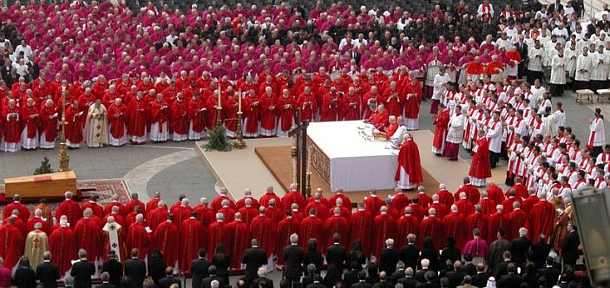
Of the 80+ cities that sit on seven hills, only one is known for adornment in purple and scarlet (red), and it is a marvelous blindness that one could be in the Catholic Church and not see this. However, considering that Catholics are dissuaded from studying Scripture, and also considering that they are continually bombarded with propaganda from priests and nuns, as well as mainstream media (and other various corrupt sources) to believe that there is no way that the Catholic Church could be evil, it makes more sense why almost no one in the Catholic Church can see what Revelation 17 is saying.
The golden cup of abomination is also clear to see:
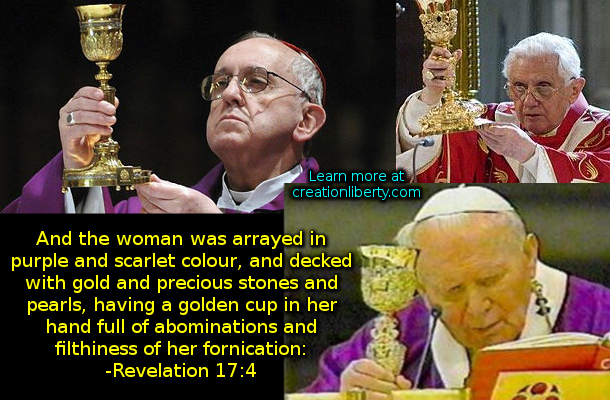
abomination (n): defilement, pollution, evil doctrines and practices which are moral defilements, idols and idolatry
(See 'abomination', American Dictionary of the English Language, Noah Webster, 1828, retrieved Aug 23, 2018, [webstersdictionary1828.com])
Let's look at the context of 1st Corinthians 10 to get a better understanding, and we will start in verse four:
Moreover, brethren, I would not that ye should be ignorant, how that all our fathers were under the cloud, and all passed through the sea; And were all baptized unto Moses in the cloud and in the sea; And did all eat the same spiritual meat; And did all drink the same spiritual drink: for they drank of that spiritual Rock that followed them: and that Rock was Christ.
-1 Corinthians 10:4
But with many of them God was not well pleased: for they were overthrown in the wilderness. Now these things were our examples, to the intent we should not lust after evil things, as they also lusted. Neither be ye idolaters, as were some of them; as it is written, The people sat down to eat and drink, and rose up to play. Neither let us commit fornication, as some of them committed, and fell in one day three and twenty thousand. Neither let us tempt Christ, as some of them also tempted, and were destroyed of serpents. Neither murmur ye, as some of them also murmured, and were destroyed of the destroyer. Now all these things happened unto them for ensamples: and they are written for our admonition [reproof], upon whom the ends of the world are come.
-1 Corinthians 10:5-11
Wherefore, my dearly beloved, flee from idolatry. I speak as to wise men; judge ye what I say. The cup of blessing which we bless, is it not the communion of the blood of Christ? The bread which we break, is it not the communion of the body of Christ? For we being many are one bread, and one body: for we are all partakers of that one bread.
-1 Corinthians 10:14-17
Behold Israel after the flesh: are not they which eat of the sacrifices partakers of the altar? What say I then? that the idol is any thing, or that which is offered in sacrifice to idols is any thing? But I say, that the things which the Gentiles sacrifice, they sacrifice to devils, and not to God: and I would not that ye should have fellowship with devils. Ye cannot drink the cup of the Lord, and the cup of devils: ye cannot be partakers of the Lord's table, and of the table of devils.
-1 Corinthians 10:18-21
| The golden cup of the Catholic Mass is the cup of devils, and abomination of the Great Whore. |
Revelation also tells us the Great Whore is decked (i.e. covered) with pearls and precious stones, which is not a concept foreign to the popes of Rome. As a priest climbs the ladder of hierarchy in the Catholic Church, his decorations become more elaborate, fancy, and expensive.
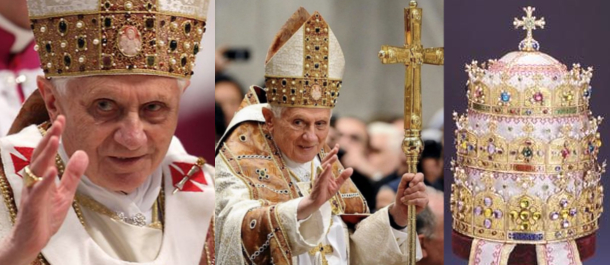
Labour not to be rich: cease from thine own wisdom.
-Proverbs 23:4
| 3. The Great Whore is a Harlot Who Fornicates with Kings |
And upon her forehead was a name written, MYSTERY, BABYLON THE GREAT, THE MOTHER OF HARLOTS AND ABOMINATIONS OF THE EARTH.
-Revelation 17:5
As we learned in the first chapter, Rome and the Catholic Church have had a long-standing history of merging pagan traditions and religious institutions under one umbrella. This is the act of spiritual harlotry, which is someone who sells the sexual pleasures of their body to turn a profit:
harlot (n): a woman who prostitutes her body for hire; in Scripture, one who forsakes the true God and worships idols
(See 'harlot', American Dictionary of the English Language, Noah Webster, 1828, retrieved Aug 17, 2018, [webstersdictionary1828.com])
Lest thou make a covenant with the inhabitants of the land, and they go a whoring after their gods, and do sacrifice unto their gods, and one call thee, and thou eat of his sacrifice;
-Exodus 34:15
Thou hast also committed fornication with the Egyptians thy neighbours, great of flesh; and hast increased thy whoredoms, to provoke me to anger.
-Ezekiel 16:26
If you have read all the previous chapters, it should not be difficult for you to see the harlotry and abominations committed by the Roman Catholic Church, both literal and spiritual. When a city is said to commit fornication, it is speaking generally in the spiritual sense, and leads us to conclude that the Great Whore is a city that is well-known for its religious institutions, which perfectly matches the descriptions of the Roman Catholic Church in the Vatican.
| For example, Jerusalem is recognized worldwide as a spiritual city, which is often called "The Holy City," and that is because, in the Old Covenant, the Jews were chosen by God to represent Him and His Word in their nation, and in this city. However, the Jews committed spiritual fornication with other gods, and became like harlots (Isa 1:21), and yet, this is NOT the city talked about in Revelation 17 because it is not built on seven hills. In the same manner, Mecca is a so-called "holy city" according to Muslims, but it does not rest on seven hills either. |  |
A Catholic would argue that the Vatican sits slightly off the central seven hills location, across the river to the east; however, that is only because the Pope and priests were kicked out during the Italian Revolution in the 19th century. The Vatican was gifted to the Roman Catholic Church by Italy in the 20th century (as we will soon learn), and with their massive wealth, the Catholic Church is slowly buying up property throughout all of Italy, including Rome.
Many churchgoers are willingly blind to the Catholic Church's strong push to unify all religions under Rome's leadership. I document some of the more recent efforts in a teaching I have here at creationliberty.com called, "Pope Francis's Deceptive John 17 Movement," and I would encourage readers to check out the article and videos with it to get all the information. Thus, the Catholic Church is not only committing spiritual fornication, but is also keeping alive the spirit of the Roman Empire, bringing all people under their authority.
The following video is a news report from 2008:
|
REPORTER: "The International Prayer for Peace in Cyprus... began with a Eucharistic celebration in the Holy Cross Catholic Church in Nicosia [capital city of Cyprus], presided over by Cardinal Leonardo Sandri, prefect [chief officer] of the Congregation of the Oriental Churches. The meeting is entitled, 'A Civilization of Peace: Faiths and Cultures in Dialogue,' and will conclude on Tuesday, November 18th. Representatives of Christian [i.e. Catholic and Catholic-supporting] churches and ecclesial communities attended the Eucharistic celebration. In his homily [sermon], Cardinal Sandri underlined that hospitality, patience, and hope are the sure ways of cultivating the true talent of religions, and recalled that |
This is the Catholic Church's continued effort to bring all religious leaders under the Roman Pontiff, calling all wicked, pagan religious cults around the world "
The only "eternal vocation" for all those who follow Catholicism will be hell and the lake of fire:
But the fearful, and unbelieving, and the abominable, and murderers, and whoremongers, and sorcerers, and idolaters, and all liars, shall have their part in the lake which burneth with fire and brimstone: which is the second death.
-Revelation 21:8
(Read "Hell Is Real And Many People Are Going There" here at creationliberty.com for more details.)
|
REPORTER: "Mario Marazziti, spokesperson of the Community of Sant'egidio [Catholic Church that focuses on world peace] that organizes one of the most significant world encounters between religions, explains the value of religion in a world in crisis from the Mediterranean island of Cyprus." MARAZZITI: " REPORTER: " |
When Marazziti said that "
Please do not misunderstand because I am not saying it is a sin to seek justice for wrongdoings, but true religion is to be sanctified (i.e. set apart) from the world, and to help the poor and needy.
Pure religion and undefiled before God and the Father is this, To visit the fatherless and widows in their affliction, and to keep himself unspotted from the world.
-James 1:27
(Read "The Biblical Understanding of Sanctification" here at creationliberty.com for more details.)
For yourselves know perfectly that the day of the Lord so cometh as a thief in the night. For when they shall say, Peace and safety; then sudden destruction cometh upon them, as travail upon a woman with child; and they shall not escape. But ye, brethren, are not in darkness, that that day should overtake you as a thief.
-1 Thessalonians 5:2-4
Suppose ye that I am come to give peace on earth?
I tell you, Nay [No]; but rather division:
-Luke 12:51
Your glorying is not good. Know ye not that a
little leaven leaveneth the whole lump?
-1 Corinthians 5:6
leaven (n): something which corrupts or depraves that with which it is mixed
(See 'leaven', American Dictionary of the English Language, Noah Webster, 1828, retrieved Apr 10, 2021, [webstersdictionary1828.com])
yoke (n): a chain; a link; a bond of connection
(See 'yoke', American Dictionary of the English Language, Noah Webster, 1828, retrieved Apr 10, 2021, [webstersdictionary1828.com])
Be ye not unequally yoked together with unbelievers: for what fellowship hath righteousness with unrighteousness? and what communion hath light with darkness? And what concord hath Christ with Belial? or what part hath he that believeth with an infidel? [i.e. one who does not believe Scripture] And what agreement hath the temple of God with idols? for ye are the temple of the living God; as God hath said, I will dwell in them, and walk in them; and I will be their God, and they shall be my people. Wherefore come out from among them, and be ye separate, saith the Lord, and touch not the unclean thing; and I will receive you, And will be a Father unto you, and ye shall be my sons and daughters, saith the Lord Almighty.
-2 Corinthians 6:14-18
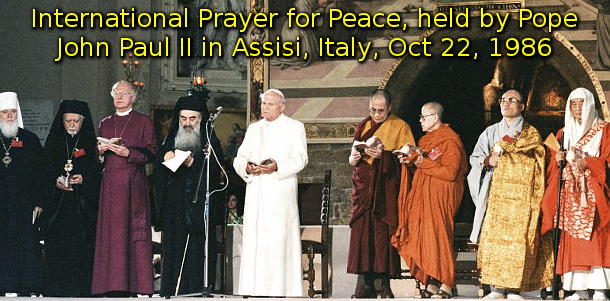
Love not the world, neither the things that are in the world. If any man love the world, the love of the Father is not in him. For all that is in the world, the lust of the flesh, and the lust of the eyes, and the pride of life, is not of the Father, but is of the world. And the world passeth away, and the lust thereof: but he that doeth the will of God abideth for ever.
-1 John 2:15-17
And the woman which thou sawest is that great city, which reigneth over the kings of the earth.
-Revelation 17:18
Jesus answered, My kingdom is not of this world: if my kingdom were of this world, then would my servants fight, that I should not be delivered to the Jews: but now is my kingdom not from hence.
-John 18:36
For the weapons of our warfare are not carnal, but mighty through God to the pulling down of strong holds; Casting down imaginations, and every high thing that exalteth itself against the knowledge of God, and bringing into captivity every thought to the obedience of Christ;
-2 Corinthians 10:4-5
For example, Pope Gregory VII (1073-1085) published an official outline (Dictatus Papae) of the powers of the Papacy. The following is a list of some of the powers Pope Gregory declared that his office of the papacy has, and I want to remind readers that these are direct quotes from that document:
|
If any Catholic may still be reading this book, you need to understand that, no matter how many songs they sing or rituals they perform, the Catholic Church does NOT worship Jesus Christ; they worship their Pope as a god. Of course, many Catholics who have been conditioned to fear the priests and popes will be very uncomfortable with such a statement, but there will come a day when you will have to choose who you will serve, and you cannot serve Christ and Catholicism at the same time.
And if it seem evil unto you to serve the LORD, choose you this day whom ye will serve; whether the gods which your fathers served that were on the other side of the flood, or the gods of the Amorites, in whose land ye dwell: but as for me and my house, we will serve the LORD.
-Joshua 24:15
When Pope Gregory VII wrote, "
The following list is a few examples of popes who have kicked kings off their thrones:
|
(** = Navarre was also in the territory known today as Spain, a small kingdom next to Aragon.)
By now, I hope readers are beginning to see that the Roman Catholic Church, or rather, Rome itself is a great city "which reigneth over the kings of the earth." There is no other spiritual/religious entity that has done such things and held such power. For many centuries, the rulers of Europe and many other countries around the world, knew not to question or oppose the Roman Pontiff in any way, else they would lose their crown.
In 1229, Pope Gregory IX created a papal bull (i.e. formal document) called In Coena Domini (in the Lord's supper) to be read at Catholic Masses at different times throughout the year. By 1372, the Papacy, through this document, had declared papal authority over the entire world, and excommunicated all those who would not obey the popes and pay them taxes. (Just to clarify, you did not misread that; the Roman Catholic Church collected taxes.) Pope Julius II gave In Coena Domini the reinforcement of law, and it was heavily applied during the reign of Pope Pius V in 1568 (almost 200 years later), forbidding rulers to "
(See William J. Bouwsma, Venice and the Defense of Republican Liberty: Renaissance Values in the Age of the Counter Reformation, University of California Press, 1968, p. 237-238, ISBN: 9780520052215; 1229 A.D. is the earlier known document to exist for In Coena Domini.)
In fact, this argument about papal ruling authority was the primary reason why the Anglican Church, or the Church of England, was formed. Please do not misunderstand because Anglicans are EXACTLY the same as the Catholic Church and do all the same abominations; the only difference between them is political, meaning that the Anglicans do not recognize the Roman Pontiff as the highest authority. Do not let Anglicans fool you into thinking they are sanctified and serving Jesus Christ because they still participate in the antichrist abominations of the Eucharist. It is well-documented that Henry VIII started the Anglicans in the 16th century, and declared himself leader over the Anglican Church (very similar to how Constantine started the Roman Catholics), all because the Pope would not let him get a divorce from his wife.
(See Cathy Caridi, "If the Church Has Never Permitted Divorce, Why Did Henry VIII Expect the Pope to Give Him One?" Canon Law Made Easy, June 23, 2016, retrieved Aug 24, 2018, [canonlawmadeeasy.com/2016/06/23/church-never-permitted-divorce-henry-viii])
Because of the legacy media (in combination with the willful ignorance of their viewers), most people think the Catholic Church has no real power or influence in governing or political matters. They like to think that these papal bulls were all long ago, and far away, like some whimsical fairy tale, because the Catholic Church lost a lot of its political power during the 19th-century Italian revolution, which drove out the papacy and seized their assets, but few people understand that the popes of Rome have continued to expand their authority over the nations to this day.
For example, the Catholic papacy allied with Italian Prime Minister (and fascist dictator) Benito Mussolini in 1929. Even though Italy experienced decades of war against the Catholic Church, not only did Mussolini give the Catholic Church the Vatican (which is currently the smallest nation in the world at 109 acres sitting in the midst of Rome), but he also gave them a huge cash payout to gain their favor.
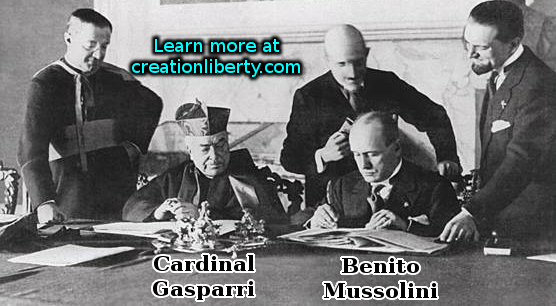
The concordat (i.e. pact or agreement) between the Pope of Rome and King of Italy stated that not only did the Catholic Church obtain the Vatican as their own country, but they were also paid the better part of a billion lire (Italian fiat currency):
"Article 1. Italy, on the exchange of ratifications [agreements] of the Treaty, shall pay to the Holy See the sum of Italian lire750,000,000 (seven hundred and fifty million) and at the same time consign Italian 5 percent bonds (with coupons [certificates], June 30) of the nominal value of Italian lire1,000,000 .
Article 2.The Holy See declares that it accepts the above as a definite systemization of the financial relations with Italy in consequence of the events of 1870.
Article 3. All the acts necessary for the execution of the Treaty with regard to the present Convention and of the Concordat shall beexempt from every form of taxation ."
-The Financial Convention Annexed to the Treaty, Pietro Cardinal Gasparri & Benito Mussolini, quoted by International Business Publications, Vatican City Business Law Handbook: Strategic Information and Laws, 2013, p. 69-70, ISBN: 9781438771366
In case you may not have understood, the Italian government agreed to pay the Catholic Church 750 million lire in cash, and another million in bonds, which they accepted as restitution for damages to their property during the Italian Revolution. Remember the pridefulness of the Papacy, in which men have declared themselves to be gods, and knowing this, there is NO recourse in which the Catholic Church would have ever agreed to peace with the Italian government unless the government first bent the knee to bow before the throne of the Roman Pontiff, and offer him gifts of apology to gain his favor.
A wicked man taketh a gift out of the
bosom to pervert the ways of judgment.
-Proverbs 17:23
Four years later, the Catholic Church signed a similar concordat with Adolf Hitler called the Reichskonkordat, receiving special privileges, titles, and cash handouts. However, this deal came with other stipulations, and in the concordat, Article 16 states the following:
"Before bishops take possession of their dioceses [office of administration] they are to take an oath of fealty either to the Reich representative of the state concerned, or to the President of the Reich, according to the following formula:
Before God and on the Holy Gospels I swear and promise, as becomes a bishop, loyalty to the German Reich and to the State of... I swear and promise to honor the legally constituted government and to cause the clergy of my diocese to honor it. In the performance of my spiritual office and in my solicitude for the welfare and the interests of the German Reich, I will endeavor to avoid all detrimental acts which might endanger it. "
(See Frank J. Coppa, Controversial Concordats: The Vatican's Relations with Napoleon, Mussolini, and Hitler, CUA Press, 1999, The Concordat of 1933, Article #16, p. 209, ISBN: 9780813209203; See also Roderick Stackelberg & Sally A. Winkle, The Nazi Germany Sourcebook: An Anthology of Texts, Psychology Press, 2002, p. 158, ISBN: 9780415222143)
To clarify, the Catholic Church accepted money, titles, and benefits in exchange for their priests and bishops swearing allegiance to the German Nazis. The Roman Pontiff agreed to this, and the Catholic clergy swore their oaths to Nazism.
Investigative reporter John Cornwell was published in Vanity Fair for his research on the truth behind a long-held accusation against Pope Pius XII (Eugenio Pacelli) that he had helped Hitler and the Nazis achieve their goal because Nazism was in line with Catholic ideology. (And, if you study these things carefully, Nazism and Catholicism still hold compatible religious philosophy to this day.) Cornwell's original plan was to prove that Pius XII did not support the Nazis, and that Pius was not guilty of what he had been accused of, but after being granted access to hidden files in the Vatican's archives in the late 90s, spending weeks in study, he discovered that not only was Pius XII anti-Jew, he also worked together with the Nazis to quell all resistance against the Catholic Church:
"By the middle of 1997, I was in a state of moral shock... The evidence was explosive. It showed for the first time thatPacelli [Pius XII] was patently [clearly, without doubt], and by the proof of his own words, anti-Jewish. It revealed thathe had helped Hitler to power and at the same time undermined potential Catholic resistance in Germany . It showed that he had implicitlydenied and trivialized the Holocaust [i.e. he made the holocaust seem like an unimportant matter], despite having reliable knowledge of its true extent . And, worse, that he was a hypocrite, forafter the war he had retrospectively taken undue credit for speaking out boldly against the Nazis' persecution of the Jews . [i.e. Pius lied about it to make himself look good after the Nazis lost the war.]"
-John Cornwell, "Hitler's Pope: Pope Pius XII helped Hitler destroy German Catholic political opposition," Vanity Fair, October, 1999, retrieved Aug 17, 2018, [vanityfair.com/style/1999/10/pope-pius-xii-199910]
Not only did the Pope help the Nazi war machine to succeed in Europe, but after the Nazis were defeated, he tried to claim that he was one of the few voices to speak out against the Nazis. The hypocrisy is overwhelming, especially after we consider the oath they took to never speak a bad word about the Nazi regime, but the popes will say and do whatever is necessary to benefit themselves, operating according to the corrupt Jesuit philosophy of "the end justifies the means."
The United States has also allied with the Roman Pontiff, as demonstrated by Ronald Reagan and the Central Intelligence Agency (CIA). Secretary of State Alexander Haig commented on the Vatican's help in official investigations, saying, "
(See Congressional Record--House, Vol. 151, Pt. 4, Government Printing Office, April 6, 2005, p. 5752; See also Time Magazine, 1992, Vol. 139, p. 327)
The Vatican liaison to the White House, Archbishop Pio Laghi, a Vatican diplomat (i.e. "Apostolic Nuncio"), told American intelligence officials:
"Listen to the Holy Father.We have 2000 years experience of this ."
-Seymour M. Hersh, "On the Nuclear Edge," New Yorker, March 29, 1993, quoted by Christopher Andrew, For the President's Eyes Only: Secret Intelligence and the American Presidency from Washington to Bush, HarperCollins, 1996, p. 469, ISBN: 9780060921781
Many Americans are unaware that our U.S. Central Intelligence Agency (CIA) was developed to spy on the American people; not for national defense. However, that being said, both the Vatican and the U.S. federal agencies agreed that the Pope's internal intelligence forces were better, quicker, and more efficient than anyone else's, including the CIA's.
The Catholic Church has had almost 1700 years of experience in political espionage (i.e. spying), overthrowing governments and deposing kings. This is not something that should be worn as a badge of honor, but rather, it is very condemning for those who claim to be "servants of Christ." Based on everything we have learned so far, it is no great surprise that intelligence agencies look to the Catholic Church as a shining example of political intrigue (i.e. secret planning) and espionage, especially when they have powerful political influence over many leaders all over the world.

United Nations Assistant Secretary-General Robert Muller said:
"I really wish that someday a book containing theU.N. speeches of the 2 Popes ... might be published for worldwide distribution. The result would be a kind ofBible for modern times ...The Holy See has become so close to the U.N. When I read documents emanating from the Holy See... I sometimes have the impression that I'm reading U.N. documents. "
-Robert Muller, U.N. Assistant Secretary-General, New Genesis: Shaping a Global Spirituality, published by Doubleday, 1982, p. 192, ISBN: 9780385181235
Is there another city that is on seven hills, that is known for the colors of purple and scarlet, that is also known for a golden cup of abomination, that has committed spiritual fornication and ruled over the kings of the earth to a greater degree than the Roman Catholic Church? Nothing else comes even remotely close, and though the evidence for Catholicism being the Great Whore who is "reigning over the kings of the earth" is overwhelming, the next point will drive the final nail in the coffin.
| 4. The Great Whore is Drunk with the Blood of the Saints |
And I saw the woman drunken with the blood of the saints, and with the blood of the martyrs of Jesus: and when I saw her, I wondered with great admiration.
-Revelation 17:6
As we covered in chapter eight on the subject of the Inquisition, the Catholic Church is well-known for being drunk with the blood of the born-again saints of God. Just because the Catholic Church has somewhat eased up on its oppressive rule after it lost some of its power in the 19th century, that does not mean the "Mother Church" is not thirsty to drain more blood from the children of God.
In chapter eight, I briefly mentioned Mary Tudor, Queen of England (r. 1553 to 1558), who was a dedicated disciple of the Catholic Church. This was a time of great persecution against the born-again Christians at the hand of the Catholic Inquisitors, and Mary followed the lead of the wicked popes of Rome by executing born-again Christians, earning herself the nickname "Bloody Mary."
For example, in 1555, John Hooper was imprisoned by Bloody Mary because he owed her money, even though he did not owe her anything; it was just an excuse she made up to imprison him. (i.e. Governing leaders have to give the public an excuse for what they do, otherwise, the masses rise up against their wicked leaders.) The real reason she had Hooper arrested was because he refused to preach the sacraments of the Eucharist in the Catholic mass, so her guards threw him into a sewer dungeon, filled with an almost unimaginable foul-smelling sewage, and due to his filthy prison cell, he contracted many septic-related illnesses over the next five months.
Hooper was called before a council of Catholic bishops:
"The bishop of Winchester urged Hooper to forsake the 'evil and corrupt doctrine,' as he called it... andto return to the unity of the Catholic Church and acknowledge the pope as head of that church... If Hooper would bow to the pope's holiness, Winchester assured him that he would receive the pope's blessing, and the Queen's mercy... Hooper answered that inasmuch as the pope taught doctrine that was altogether contrary to the doctrine of Christ, he was not worthy to be head of the church, and so he would in no way give in to any such illegal authority. Further, he said, the Roman Catholic Church is not the true Church at all. The true Church only hears the voice of her spouse and flees from the voice of strangers. 'However,' he said, 'if there is any point that I don't know about in which I have offended the queen's majesty, I will most humbly submit myself to her mercy,'... The bishop answered that the queen would show no mercy to the Pope's enemies. "
-John Foxe, The New Foxe's Book of Martyrs, Bridge Logos Foundation, 2001, p. 152, ISBN: 9780882708751
Bloody Mary ordered Hooper's execution because he would not bow to the Pope of Rome. Based on the eye-witness reports, here are his last moments while being burned alive:
"Hooper prayed in a somewhat loud voice, 'Lord Jesus, have mercy upon me. Lord Jesus, have mercy upon me. Lord Jesus, receive my spirit.' These were the last words he was heard to speak.But even when his mouth was black and his tongue swollen, his lips could still be seen moving in prayer until they shrunk back into his gums. During these moments, Hooper struck repeatedly at his chest, or heart, with his hands until one of his arms fell off, and then continued striking his chest with the other hand while fat, water, and blood spurted out his fingertips. When the flames suddenly flared up in great power, Hooper struck his chest only once more as his strength gave out and his hand stuck to the iron band around his chest. At the same moment, his body fell forward against the band and he gave up his spirit."
-John Foxe, The New Foxe's Book of Martyrs, Bridge Logos Foundation, 2001, p. 162, ISBN: 9780882708751
Never in history has a vile, antichrist pope ever given up himself for the sake of Christ like Hooper did. Never did those lofty bishops sacrifice themselves for the sake of the people as Christ did because they are far too busy commanding their minions to polish their finely crafted crowns.
Another example is John Rogers, who, for a time, was a servant of William Tyndale, one of the translators who preceded the King James Bible translators. After growing in knowledge of God's Word in English, Rogers sanctified himself from the Pope of Rome, knowing that popish throne to be that of an antichrist. Rogers was permitted to preach the truth of God's Word after King Edward the VI (1547-1553) kicked the Pope out of England, but once Bloody Mary took the throne, the wicked bishops of Rome started hunting Christians in England again, and Rogers was one of their victims.
(See The Great Apostacy; Or, the Church of Rome Proved to be Not the Church of Christ, Hamilton, Adams & Company, 1839, p. 465-466, [The British Library])
After being called to preach in a building where there were many Catholic bishops, teaching that the people should abstain from all that had to do with the wicked Roman Pontiff, the bishops addressed Rogers during his preaching, but his answer with the Scripture embarrassed them in front of a viewing audience. As soon as Bloody Mary issued a decree to stop all Biblical preaching, Rogers was arrested, and thrown in a prison reserved for murderers and thieves.
(Read "Should Christians Submit to Governing Authority?" here at creationliberty.com for more details.)
Rogers was sentenced to execution, and the following transcript is the conversation between Rogers and the bishop under whose authority he was held captive:
"ROGERS RESPONDING TO HIS CHARGES: Well, my lord, here I stand before God and you, and all this honourable audience, I take him to witness, that I never wittingly [with full knowledge; deliberately] or willingly taught any false doctrine; and therefore have I a good conscience before God and all good men. I am sure that you and I shall come before a judge that is righteous, before whom I shall be as good a man as you: and I nothing doubt but I shall be found there a true member of the true catholic church of Christ [lower case 'c' catholic church means "whole" or "universal," which is separate from the capital 'C' Catholic Church, which is a corporate entity of Rome], and everlastingly saved. And as for your false church, you need not to excommunicate me from it. I have not been in it these twenty years, the Lord be thanked therefor. But now you have done what you can, my lord, I pray you yet grant me one thing.
BISHOP: What is that?
ROGERS:That my poor wife, being a stranger [foreign to the area], may come and speak with me so long as I live. For she hath ten children that are hers and mine, and I would somewhat counsel her, what were best for her to do.
BISHOP:No, she is not thy wife.
ROGERS:Yes, my lord, and has been these eighteen years.
BISHOP: Should I grant her to be thy wife?
ROGERS: Choose you whether you will or not, she shall be so nevertheless.
BISHOP:She shall not come at thee.
ROGERS: Then I have tried out all your charity.You make yourself highly displeased with the matrimony of priests [i.e. the Catholic Church prevents priests from marrying], but you maintain open concubinage [not a wife; a mistress living with a man in fornication]: as in Wales, where every priest has his concubine openly dwelling with him, even as your holy father [the Pope] suffers all the priests in Holland and in France to do the like. "
(See The Great Apostacy; Or, the Church of Rome Proved to be Not the Church of Christ, Hamilton, Adams & Company, 1839, p. 467, [The British Library])
In short, the Catholic Bishop refused to acknowledge the marriage between Rogers and his wife, but lived in hypocrisy by openly keeping whores in his home, living in fornication. Sadly, that evil spirit of Rome has seeped its way into typical church buildings, where marriages are not recognized unless approved by a "pastor" (quite a few of whom commit adultery), even though Scripture gives no such commandment or implication.
(Read "The Biblical Understanding of Weddings & Marriage" here at creationliberty.com for more details.)
After being imprisoned a lengthy time, Rogers was taken before a priest named Bonner, and he made one request to Bonner:
"And Bonner asking him what that should be, 'Nothing,' said he, 'but that he might talk a few words with his wife before his burning.' Butthat could not be obtained of him! [i.e. the Catholic priest refused] Now when the time came, that he, having been delivered to the sheriffs, was brought out of Newgate to Smithfield, the place of his execution, Master Woodroofe, one of the sheriffs, calling Master [i.e. the word is used in the sense of a teacher] Rogers to him, asked him if he would revoke his abominable doctrine, and his evil opinion of the sacrament of the altar. Master Rogers answered and said, 'That which I have preached I will seal with my blood.' 'Then,' said Master Woodroofe, 'thou art an heretic.' 'That shall be known,' replied Rogers, 'at the day of judgment.' 'Well,' said Master Woodroofe,'I will never pray for thee.' 'But I will pray for you,' rejoined Rogers."
(See The Great Apostacy; Or, the Church of Rome Proved to be Not the Church of Christ, Hamilton, Adams & Company, 1839, p. 468, [The British Library])
As he was held prisoner, riding in a carriage on the way to his execution, Rogers passed by his wife and ten children. He saw them, and they saw him. I am sure you can imagine the reaction of his family upon seeing him carried away to his death. However, their faces did not dissuade him from his dedication to the Lord Jesus Christ (i.e. Rogers trusted in the Living God to care for his family), and even though papers were brought for him to sign, which would be a confession of allegiance to the Pope of Rome in exchange for his life, Rogers stood firm on the Word of God, and was executed by the Great Whore who bathes in the blood of the saints of God.
He that loveth father or mother more than me is not worthy of me: and he that loveth son or daughter more than me is not worthy of me.
-Matthew 10:37
Yea, and all that will live godly in Christ Jesus shall suffer persecution.
-2 Timothy 3:12
To summarize, the Great Whore riding atop the beast has the following four descriptions:
|
1. She is a City on Seven Hills 2. She Dresses in Purple & Scarlet with a Golden Cup in Hand 3. She is a Harlot Who Fornicates with Kings and Reigns Over Them 4. She is Drunk with the Blood of the Saints |
There is no other entity in this world that better and more accurately fits all these descriptions than the Catholic Church. This is not to say that the final antichrist, the son of perdition, will be Catholic, but that son of perdition will claim the ecumenical seat of Rome in one way or another, and it is this Great Whore who will control the beast in the final days; therefore, I urge all Christians not to worry, or be troubled, but to be watchful, and to preach the truth of God's Word on a strong foundation of Christ until the Day of Judgment.
I charge thee therefore before God, and the Lord Jesus Christ, who shall judge the quick and the dead at his appearing and his kingdom; Preach the word; be instant in season, out of season; reprove, rebuke, exhort with all longsuffering and doctrine. For the time will come when they will not endure sound doctrine; but after their own lusts shall they heap to themselves teachers, having itching ears; And they shall turn away their ears from the truth, and shall be turned unto fables. But watch thou in all things, endure afflictions, do the work of an evangelist, make full proof of thy ministry.
-2 Timothy 4:1-5
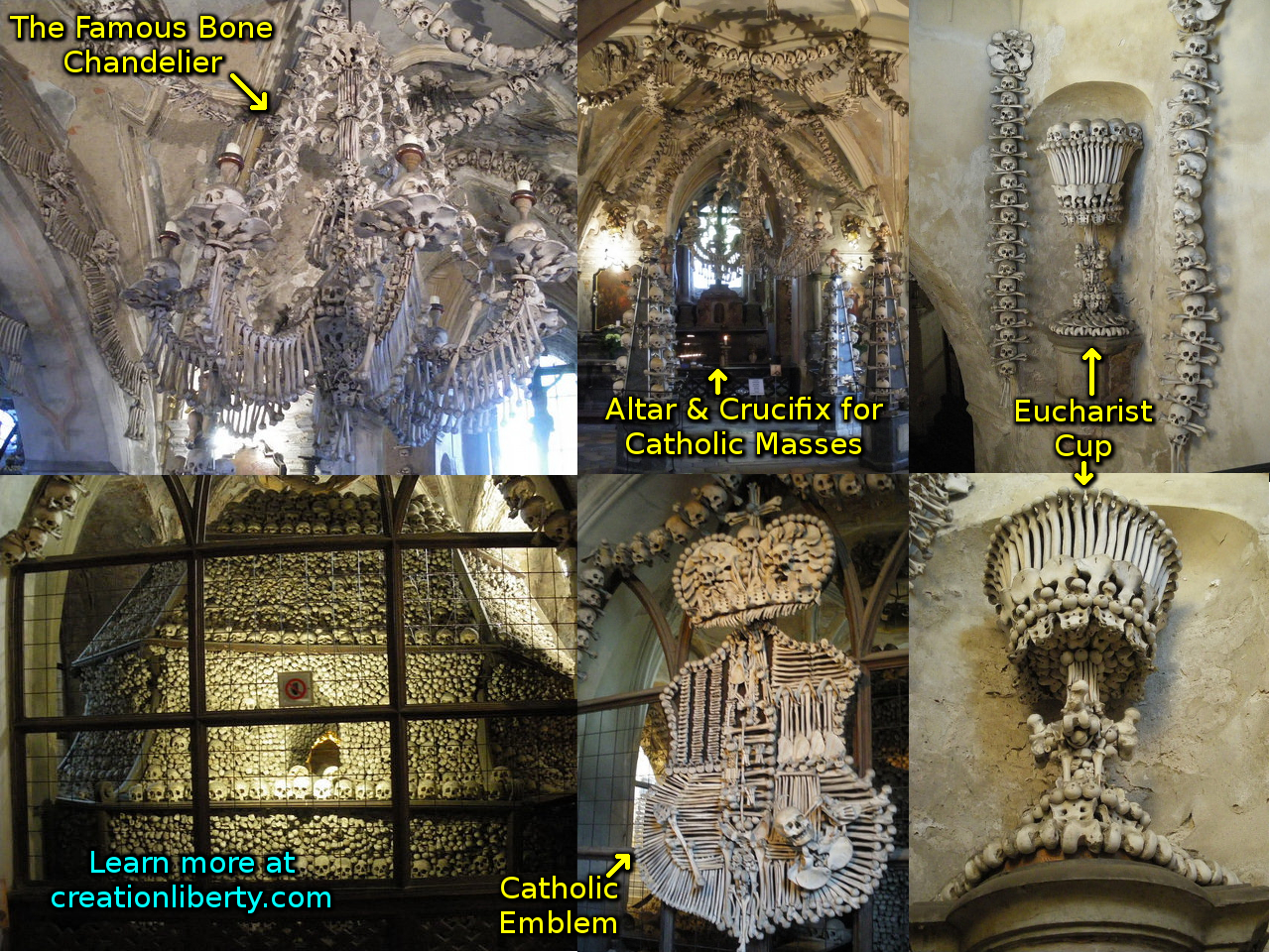
(See Sedlec Ossuary, "Photo Gallery," retrieved Sept 11, 2018, [sedlecossuary.com/sedlec-ossuary-pictures])
Do people honestly believe that this is representative of the doctrine of Jesus Christ? Sadly, many Catholics, eager and desperate to justify themselves, would say 'yes', but the Living God has told us that those who would do such things hate Him:
But he that sinneth against me wrongeth his own soul:
all they that hate me love death.
-Proverbs 8:36
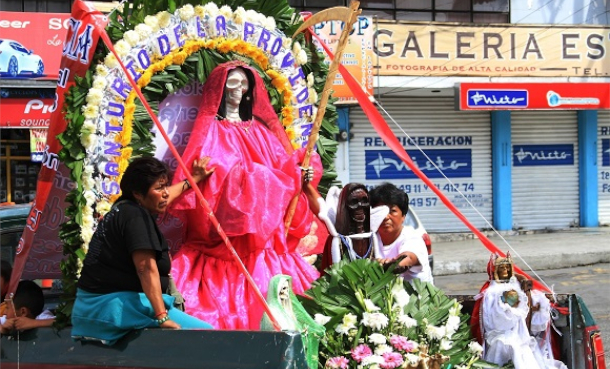
These people are Catholics, and the events are promoted and supported by the Catholic Church. If this were truly of God, then why do they love and worship death?
The following image is the official audience hall of the Catholic Pope, and you will notice that it has been purposefully designed to look like a serpent. This is not trick photography or a wide-angle lens; this is exactly how it was built:
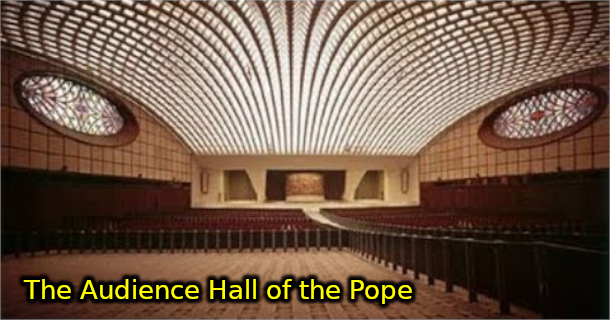
Now the serpent was more subtil than any beast of the field which the LORD God had made. And he said unto the woman, Yea, hath God said, Ye shall not eat of every tree of the garden?
-Genesis 3:1
And he laid hold on the dragon, that old serpent, which is the Devil, and Satan, and bound him a thousand years,
-Revelation 20:2
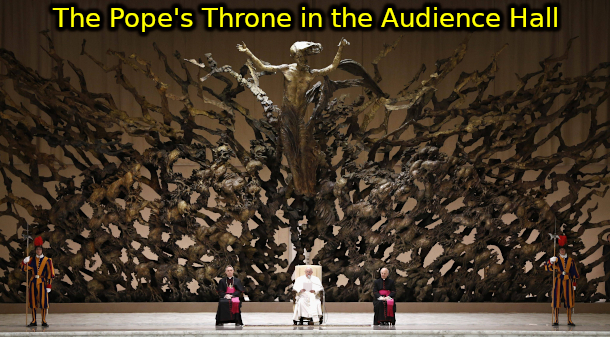
The Catholic Church claims this backdrop is Jesus rising from an olive tree in a "nuclear explosion," and I am quoting the original artist when I say that. Artist Pericle Fazzini, who created this sculpture, said:
"Suddenly there came to me the idea of Christ preaching peace for 2,000 years and the place where he prayed for the last time: the olive grove of Gethsemane.I had the idea of depicting Christ as if he were rising again from the explosion of this large olive grove, peaceful site of his last prayers. Christ rises from this crater torn open by a nuclear bomb; an atrocious explosion, a vortex of violence and energy. "
-Pericle Fazzini, quoted by Stafannel B. Morris, "What is the Vatican Throne?" Pope2Your.net, May 29, 2019, retrieved Apr 24, 2021, [https://www.pope2you.net/what-is-the-vatican-throne]
However, that is not what it looks like to the rest of us. To us, it looks like a man who is rising up in control over the tortured souls of the dead, and it looks that way on purpose because this design began in 1965, and just the initial design took TEN YEARS to finish before it was constructed.
In fact, there is evidence to say that this person in the middle of the backdrop is Satan, not Christ. If you look carefully at the head of the person, you will notice that a serpent is seen from almost every angle, and again, the artists who worked on this project did this on purpose because, as an artist will tell you, these things do NOT happen by accident, and must be meticulously designed that way:

The reason I am showing you this is because there is a HUGE amount of pagan and demonic symbolism in the Catholic Church. We Christians were instructed not to use such symbolism. (Acts 17:29) That symbolism shows you who the real leader of the Catholic Church is, and it is certainly NOT Jesus Christ!
(Read "Christian Symbols Are Not Christian" here at creationliberty.com for more details.)
Over the years, I have often been accused of being "anti-Catholic," which is a quick, one-liner response Catholics are taught to use against anyone who objects to anything the Catholic Church says or does. Despite the lies spoken against me, I am not anti-Catholic, I am pro-truth, specifically the spiritual truth in the doctrine and philosophy (i.e. way of thinking) of Christ in God's Word, and I am anti-error and anti-lies.
If Catholics would confess their errors and lies, having godly sorrow (i.e. repentance) of all their wicked deeds and traditions, like transubstantiation, the Eucharist, the false authority of popes, works-based doctrines, purgatory, indulgences, fornication, adultery, rape, pedophilia, murder, torture, covetousness, idolatry, and every other sin and crime that has bred out of Catholicism over the past 1700 years of their abominations, then I would have no problem with the Catholic Church, but it was founded with a corrupt root, and according to the doctrine of Christ, they cannot become good; rather, it will only get worse with time.
And now also the axe is laid unto the root of the trees: therefore every tree which bringeth not forth good fruit is hewn down, and cast into the fire.
-Matthew 3:10
Beware of false prophets, which come to you in sheep's clothing, but inwardly they are ravening wolves. Ye shall know them by their fruits. Do men gather grapes of thorns, or figs of thistles? Even so every good tree bringeth forth good fruit; but a corrupt tree bringeth forth evil fruit. A good tree cannot bring forth evil fruit, neither can a corrupt tree bring forth good fruit. Every tree that bringeth not forth good fruit is hewn down, and cast into the fire. Wherefore by their fruits ye shall know them.
-Matthew 7:15-20
(Read There is No Saving Grace Without Repentance here at creationliberty.com for more details.)
In meekness instructing those that oppose themselves; if God peradventure will give them repentance to the acknowledging of the truth; And that they may recover themselves out of the snare of the devil, who are taken captive by him at his will.
-2 Timothy 2:25-26
And with all deceivableness of unrighteousness in them that perish; because they received not the love of the truth [i.e. the Bible], that they might be saved.
-2 Thessalonians 2:10
Sanctify them [i.e. divide them apart to a holy use]
through thy truth: thy word [i.e the Bible] is truth.
-John 17:17
But when ye pray, use not vain repetitions, as the heathen do: for they think that they shall be heard for their much speaking.
-Matthew 6:7
Jesus saith unto him, I am the way, the truth, and the life: no man cometh unto the Father, but by me.
-John 14:6
For there is one God, and one mediator between
God and men, the man Christ Jesus;
-1 Timothy 2:5
|
ASK YOURSELF: "Am I following the Word of God, or the traditions of men?" |
The Bible tells us that the traditions of men nullify the effect of God's Word on the hearers, and that many men will seek to turn you rotten through their traditions.
Thus have ye made the commandment of God of none effect by your tradition.
-Matthew 15:6
Beware lest any man spoil you through philosophy and vain deceit, after the tradition of men, after the rudiments of the world, and not after Christ.
-Colossians 2:8
|
ASK YOURSELF: "If I follow the Word of God, have I proved it?" |
A Catholic is taught that the traditions of the Catholic Church come from the Word of God, but that is not the truth. Did you go to the Word of God and prove the Scripture by studying it for yourself?
Prove all things; hold fast that which is good.
-1 Thessalonians 5:21
And the brethren immediately sent away Paul and Silas by night unto Berea: who coming thither went into the synagogue of the Jews. These were more noble [virtuous, excellent] than those in Thessalonica, in that they received the word with all readiness of mind, and searched the scriptures daily, whether those things were so.
-Acts 17:10-11
|
ASK YOURSELF: "Do I trust in God the Father, or a priest I call 'father'?" |
The Lord Jesus Christ gave His followers specific instructions to not call men "father" in the spiritual sense, which is what the Catholic Church teaches. God also taught us that, concerning His Word, those who put their trust in men have departed from God.
And call no man your father upon the earth:
for one is your Father, which is in heaven.
-Matthew 23:9
Thus saith the LORD; Cursed be the man that trusteth in man, and maketh flesh his arm, and whose heart departeth from the LORD.
-Jeremiah 17:5
After this manner therefore pray ye: Our Father
which art in heaven, Hallowed be thy name.
-Matthew 6:9
|
ASK YOURSELF: "Do I believe I can earn my way to heaven through works/suffering?" |
The Bible makes it clear that no man can enter heaven by their own efforts. One can only enter the Kingdom of God through the free gift of the grace of the Lord Jesus Christ, and Jesus only offers that gift of grace to those who repent (i.e. have grief and godly sorrow) in humility of their sin and believe on His one-time blood sacrifice payment for their sins forever.
That in the ages to come he might shew the exceeding riches of his grace in his kindness toward us through Christ Jesus. For by grace are ye saved through faith; and that not of yourselves: it is the gift of God: Not of works, lest any man should boast. For we are his workmanship, created in Christ Jesus unto good works, which God hath before ordained that we should walk in them.
-Ephesians 2:7-10
And every priest standeth daily ministering and offering oftentimes the same sacrifices, which can never take away sins: But this man [i.e. Jesus Christ], after he had offered one sacrifice for sins for ever, sat down on the right hand of God; From henceforth expecting till his enemies be made his footstool. For by one offering he hath perfected for ever them that are sanctified.
-Hebrews 10:11-14
|
ASK YOURSELF: "Am I unwilling or nervous to question the Catholic Church?" |
If there is unwillingness, then there is the sin of pride, and if there is a nervousness, that is a fear of man that is not of God, which brings a snare.
The fear of man bringeth a snare: but whoso
putteth his trust in the LORD shall be safe.
-Proverbs 29:25
Examine yourselves, whether ye be in the faith; prove your own selves. Know ye not your own selves, how that Jesus Christ is in you, except ye be reprobates?
-2 Corinthians 13:5
For if we would judge ourselves, we should not be judged.
-1 Corinthians 11:31
"The Church's universal mission is born of faith in Jesus Christ, as is stated in our Trinitarian profession of faith: 'I believe in one Lord, Jesus Christ, the only Son of God, eternally begotten of the Father... For us men and for our salvation he came down from heaven: by the power of the Holy spirit he became incarnate from the Virgin Mary, and was made man.'The redemption event brings salvation to all, 'for each one is included in the mystery of the redemption and with each one Christ has united himself forever through this mystery .' It is only in faith that the Church's mission can be understood and only in faith that it finds its basis... Newness of life in him is the 'Good News' for men and women of every age:all are called to it and destined for it. Indeed, all people are searching for it , albeit at times in a confused way, and have a right to know the value of this gift and to approach it freely."
-John Paul II, Redemptoris Missio: On the permanent validity of the Church's missionary mandate, Vatican Archives, retrieved Aug 28, 2018, [https://bit.ly/1QXMWUO]
The Bible tells us that all people are NOT searching for God and Christ; in fact, the Bible tells us NO ONE searches for Him. The Lord God has to come to us in our helpless state and give us understanding, and He does that only with those who are humble of heart:
As it is written, There is none righteous, no, not one: There is none that understandeth, there is none that seeketh after God. They are all gone out of the way, they are together become unprofitable; there is none that doeth good, no, not one.
-Romans 3:10-12
But he giveth more grace. Wherefore he saith, God resisteth the proud, but giveth grace unto the humble.
-James 4:6
Not every one that saith unto me, Lord, Lord, shall enter into the kingdom of heaven; but he that doeth the will of my Father which is in heaven.
-Matthew 7:21
Many will say to me in that day, Lord, Lord, have we not prophesied in thy name? and in thy name have cast out devils? and in thy name done many wonderful works? And then will I profess unto them, I never knew you: depart from me, ye that work iniquity.
-Matthew 7:22-23
On the day of God's final judgment, many people (including Catholics) will claim to know Christ, and call Him "Lord," but their names are not written in the book of life, and they will be cast into the lake of fire which burns for all eternity, never to escape, not because they did not do enough work, but because they were never humbled to repentance (i.e. godly sorrow of their sins), and they did not trust in Jesus Christ alone for their justification.
And whosoever was not found written in the
book of life was cast into the lake of fire.
-Revelation 20:15
And if thy hand offend thee, cut it off: it is better for thee to enter into life maimed, than having two hands to go into hell, into the fire that never shall be quenched: Where their worm dieth not, and the fire is not quenched.
-Mark 9:43-44
(Read "Hell is Real And Many People Are Going There" here at creationliberty.com for more details.)
"Do I have a particular assurance of salvation or damnation or what?The answer a Catholic would have to give is: No. And the Catholic position is that an assurance of salvation is not possible. "
-Catholic Layman Karl Keating, founder of Catholic Answers, Debate between Peter Ruckman and Karl Keating, Bayview Baptist Church, retrieved Aug 28, 2018, [youtu.be/6yWc1C-fxw0?t=8m]
I agree with his statement that Catholic assurance of salvation is impossible, and that is because they base it on their own works, or rather, their imaginary "inner goodness." Under a system where you have to earn your way to heaven, no one knows how much work has to be done to get there, and thus, stating that Catholics have no assurance is, at the very least, an honest answer from the Catholic perspective; however, we who are true Christians, the born-again children of God, know that we have eternal life, and have a definite assurance of it because of Christ's promises to us:
These things have I written unto you that believe on the name of the Son of God; that
-1 John 5:13
For I am persuaded, that neither death, nor life, nor angels, nor principalities, nor powers, nor things present, nor things to come, Nor height, nor depth, nor any other creature, shall be able to separate us from the love of God, which is in Christ Jesus our Lord.
-Romans 8:38-39
But woe unto you, scribes and Pharisees, hypocrites! for ye shut up the kingdom of heaven against men: for ye neither go in yourselves, neither suffer ye them that are entering to go in. Woe unto you, scribes and Pharisees, hypocrites! for ye devour widows' houses, and for a pretence [for show] make long prayer: therefore ye shall receive the greater damnation. Woe unto you, scribes and Pharisees, hypocrites! for ye compass [travel] sea and land to make one proselyte [convert to a religion], and when he is made, ye make him twofold more the child of hell than yourselves.
-Matthew 23:13-15
Ye are of your father the devil, and the lusts of your father ye will do. He was a murderer from the beginning, and abode not in the truth, because there is no truth in him. When he speaketh a lie, he speaketh of his own: for he is a liar, and the father of it. And because I tell you the truth, ye believe me not.
-John 8:44-45
Then said Jesus to those Jews which believed on him, If ye continue in my word, then are ye my disciples indeed; And ye shall know the truth, and the truth shall make you free.
-John 8:31-32
A few Catholics may be willing to question certain aspects of their religion, and maybe even seek out the truth of the matter in Scripture, but they still fear men, specifically their friends and family. Since most Catholics grow up around other Catholics, anyone who departs from the Catholic Church to follow the Word of God is generally shunned, and I have heard many sad testimonies from born-again Christians of it happening in their families.
However, Jesus told us we were to love Him more than anyone or anything:
And thou shalt love the Lord thy God with all thy heart, and with all thy soul, and with all thy mind, and with all thy strength: this is the first commandment.
-Mark 12:30
For I am come to set a man at variance against his father, and the daughter against her mother, and the daughter in law against her mother in law. And a man's foes shall be they of his own household. He that loveth father or mother more than me is not worthy of me: and he that loveth son or daughter more than me is not worthy of me.
-Matthew 10:35-37
And the great dragon was cast out, that old serpent, called the Devil, and Satan, which deceiveth the whole world:
-Revelation 12:9
Enter ye in at the strait gate: for
-Matthew 7:13-15
But there were false prophets also among the people, even as there shall be false teachers among you, who privily shall bring in damnable heresies, even denying the Lord that bought them, and bring upon themselves swift destruction.
-2 Peter 2:1
Woe unto you, scribes and Pharisees, hypocrites! for ye are like unto whited sepulchres [tombs], which indeed appear beautiful outward, but are within full of dead men's bones, and of all uncleanness.
-Matthew 23:27
Because thou sayest, I am rich, and increased with goods, and have need of nothing; and knowest not that thou art wretched, and miserable, and poor, and blind, and naked... As many as I love, I rebuke and chasten: be zealous therefore, and repent.
-Revelation 3:17-19
The fruit of the righteous is a tree of life; and he that winneth souls is wise.
-Proverbs 11:30
Traitors, heady, highminded, lovers of pleasures more than lovers of God; Having a form of godliness, but denying the power thereof: from such turn away. For of this sort are they which creep into houses, and lead captive silly women laden with sins, led away with divers lusts, Ever learning, and never able to come to the knowledge of the truth.
-2 Timothy 3:4-7
But the natural man receiveth not the things of the Spirit of God: for they are foolishness unto him: neither can he know them, because they are spiritually discerned.
-1 Corinthians 2:14
This people draweth nigh unto me with their mouth, and honoureth me with their lips; but their heart is far from me.
-Matthew 15:8
And he spake a parable unto them, Can the blind lead the blind? shall they not both fall into the ditch?
-Luke 6:39
It is my prayer that by my efforts to write this book, at least one Catholic might read it, and be led to repentance and true faith in the Lord Jesus Christ. If any of you who are born again in Christ were helped by this book, then please share it with others that, God willing, one more lost soul in the Catholic Church might come to repentance and faith in the pure blood of the Son of God.
Come now, and let us reason together, saith the LORD: though your sins be as scarlet, they shall be as white as snow; though they be red like crimson, they shall be as wool.
-Isaiah 1:18
The Lord is not slack concerning his promise, as some men count slackness; but is longsuffering to us-ward, not willing that any should perish, but that all should come to repentance.
-2 Peter 3:9
Now I rejoice, not that ye were made sorry, but that ye sorrowed to repentance: for ye were made sorry after a godly manner, that ye might receive damage by us in nothing.
-2 Corinthians 7:9
And when he putteth forth his own sheep, he goeth before them, and the sheep follow him: for they know his voice. And a stranger will they not follow, but will flee from him: for they know not the voice of strangers.
-John 10:4-5
My sheep hear my voice, and I know them, and they follow me: And I give unto them eternal life; and they shall never perish, neither shall any man pluck them out of my hand.
-John 10:27-28
If you want to know more about Christ's warnings against false converts (i.e. those who claim to be of Christ, but are not), please consider reading the short book I wrote called Why Millions of Believers on Jesus Are Going to Hell here at creationliberty.com.
Not every one that saith unto me, Lord, Lord, shall enter into the kingdom of heaven; but he that doeth the will of my Father which is in heaven.
-Matthew 7:21-23


Reader Discussion
Scripture-based insights and questions welcome. First comment requires approval.
Having trouble posting? Try temporarily turning off your VPN.
Your email address is kept strictly private for spam prevention—never published.