








Corruptions of Christianity:
Orthodoxy
Paganism Repackaged

I remained calm, courteous, and stuck strictly to the Bible, but the conversation from the Orthodox churchgoers soon deteriorated. Some lost their composure, resorted to personal attacks, and afterwards, began harassing me in private messages. After I uploaded the recording, they banned me from their server—even though I had broken none of their rules.
This was no isolated incident. It exposed the spirit behind these religious systems. When traditions of churchgoers are challenged by the plain words of God, and their idols are exposed as fraudulent, defensiveness and deception quickly surface.
If you listen to the two-hour discussion (link in the reference above), you will see how a few short questions brought their entire ideology to its knees. After they affirmed that they revered the Bible as a holy document authored by the Holy Ghost, I posed this simple hypothetical:
However, in most cases the responses are the same: deflection, appeal to so-called "holy" traditions, or silence. Very few will plainly say they would follow the Bible over their religious institution, and that reluctance reveals the heart of the problem.
The Orthodox religion claims to be the true, ancient faith, yet it rests on a foundation that cannot survive honest scrutiny from Scripture. In this book I will demonstrate that Orthodoxy is not a preservation of apostolic Christianity, but a system of man-made traditions, idolatry, witchcraft, and false salvation that opposes the Gospel of Jesus Christ.
The word 'orthodox' carries a connotation that makes it feel "official," but it is a tricky term, poorly understood today and erroneously applied to the Orthodox religion:
orthodox (adj): of, relating to, or conforming to the approved form of any doctrine, philosophy, ideology, etc.
(See 'orthodox', Random House Dictionary, 2025, [dictionary.com]; See also Collins English Dictionary, 10th Edition, William Collins Sons & Co, 2012)
The redundancy is comical, but that is the essence of the term. They claim their religion is the only truly "Christian" one and that all "Christians" are Orthodox, yet this is a logical fallacy—an appeal to authority in which the institution proclaims itself the authority without evidence and demands unquestioned submission.
There are some Biblically mandated overseers in Christ's church (Acts 20:28) for the edification (instruction in morality and Biblical doctrine) of the saints. (2Co 10:8) However, for us who are born again in Christ there is only one ultimate authority: the Lord Jesus Christ, by the will of God the Father, and active in us through the Holy Ghost.
And David [i.e. a metphorical reference to Jesus, whose name was not yet known to mankind] my servant shall be king over them; and they all shall have one shepherd: they shall also walk in my judgments, and observe my statutes, and do them.
-Ezekiel 37:24
And other sheep I have, which are not of this fold: them also I must bring, and they shall hear my voice; and there shall be one fold, and one shepherd.
-John 10:16
When a man claims to have faith on the Lord Jesus Christ, how did he learn of Christ? There are only two general ways: through reading the Bible, or by reading from or listening to a preacher talk about what the Bible says.
So then faith cometh by hearing,
and hearing by the word of God.
-Romans 10:17
By the law of non-contradiction, they must either follow the Bible over their religious institution or their religious institution over the Bible. They prefer to cling to the deceptions of their rituals while claiming Scriptural authority. Like their Catholic cousins, the standard lukewarm Orthodox answer is that Scripture and tradition must be revered equally.
I know thy works, that thou art neither cold nor hot: I would thou wert cold or hot. So then because thou art lukewarm, and neither cold nor hot, I will spue thee out of my mouth.
-Revelation 3:15-16
No servant can serve two masters: for either he will hate the one, and love the other; or else he will hold to the one, and despise the other. Ye cannot serve God and mammon.
-Luke 16:13
Please take note of the following verse because this is a theme of Orthodoxy:
Thus saith the LORD; Cursed be the man that trusteth in man, and maketh flesh his arm, and whose heart departeth from the LORD.
-Jeremiah 17:5
Wherefore the Lord said, Forasmuch as this people draw near me with their mouth, and with their lips do honour me, but have removed their heart far from me, and their fear toward me is taught by the precept of men:
-Isaiah 29:13
He answered and said unto them, Well hath Esaias [i.e. Isaiah] prophesied of you hypocrites, as it is written, This people honoureth me with their lips, but their heart is far from me.
-Mark 7:6
All men are wretched and filthy in spirit and require the Holy Ghost to regenerate them so they may be born again in Jesus Christ. When men trust other men for spiritual help, they demonstrate their lack of repentance for the remission of sins, and so they remain in their wretchedness because their hearts never turned to God.
This is why, in Jeremiah 17, God declared:
The heart is deceitful above all things, and
desperately wicked: who can know it?
-Jeremiah 17:9
But the Comforter, which is the Holy Ghost, whom the Father will send in my name, he shall teach you all things, and bring all things to your remembrance, whatsoever I have said unto you.
-John 14:26
That ye may be mindful of the words which were spoken before by the holy prophets, and of the commandment of us the apostles of the Lord and Saviour:
-2 Peter 3:2
Therefore, brethren, stand fast, and hold the traditions which ye have been taught, whether by word, or our epistle.
-2 Thessalonians 2:15
But, beloved, remember ye the words which were spoken before of the apostles of our Lord Jesus Christ; How that they told you there should be mockers in the last time, who should walk after their own ungodly lusts. These be they who separate themselves, sensual, having not the Spirit.
-Jude 1:17-19
Take heed therefore unto yourselves, and to all the flock, over the which the Holy Ghost hath made you overseers, to feed the church of God, which he hath purchased with his own blood. For I know this, that after my departing shall grievous wolves enter in among you, not sparing the flock.
-Acts 20:28-29
This logical fallacy, known as appeal to tradition (argumentum ad antiquitatem), forms the foundational error that supports their many heretical beliefs. It assumes that tradition, longevity, or historical prevalence validates something as true without first examining evidence for its merit.
Here is an example of what an appeal to tradition looks like:
Therefore, the food pyramid is true, accurate, and should be continued.
This is a gross fallacy. The food pyramid was long ago exposed as corporate marketing rather than sound nutrition, a deception I documented in my free book The Simple Solution to Cancer. Combined with a willingly ignorant public that accepts arguments from authority, it has produced generations of unhealthy people. The example shows how men are blinded to evidence when they presume tradition is equivalent to truth.
Likewise, Orthodox priests make this argument:
Therefore, Orthodoxy is true and should be practiced by all.
When faced with Biblical arguments, Orthodox churchgoers hide behind this fallacy, convinced it protects them from exposure as a heathen religion that opposes the Lord Jesus Christ. Orthodox priest Alexander Schmemann claims that all discernment, liberty, truth, and evidence of the Holy Ghost in Orthodoxy stems from tradition, rather than truth revealed in the Holy Scriptures:
"Discernment, rooted in the freedom Orthodox Tradition gives us, is needed. Orthodox Tradition's role in the life of the Church is primarily the Holy Spirit's witness to Christ. As a sign and expression of the presence of the Holy Spirit in the Church, Tradition gives to us freedom in Christ's Truth. "
-Alexander Schmemann, "Orthodoxy Today: Tradition or Traditionalism?" Orthodox Church in America, Jan 30, 2005, retrieved May 27, 2025, [https://www.oca.org/holy-synod/statements/fr-kishkovsky/orthodoxy-today-tradition-or-traditionalism]
Their faith is built upon the sands of logical fallacy, with a few Bible verses sprinkled on top to maintain the appearance of Christianity. In reality, the Orthodox religion is a large company of heathens who practice witchcraft and idolatry, and I will provide ample evidence of this in the chapters that follow.
Without a foundation of faith in the Word of God first and foremost, the faith of Orthodox churchgoers is meaningless. No salvation can be found in a system rooted in tradition rather than truth.
However, Christians hold a distinct advantage over cults like Orthodoxy because of the simplicity of the Gospel of Salvation in Jesus Christ. Our foundation rests on Christ's teaching of salvation rather than a lofty institution. Therefore, we need not delve into the details of their so-called "early church fathers" or their fallacious traditions, though we will address both later in this book to thoroughly dismantle Orthodoxy's arguments.
The word 'Christian' means "Christ-like" or "to be like Christ," but more expanded, it is one who has been born again in spirit—regenerated by the Holy Ghost—who then studies and follows the doctrines of Christ. Since the doctrine of Christ centers on the salvation of a man's soul, we need only ask how an Orthodox churchgoer is allegedly "saved" according to their religious worldview to determine whether the person in question is a true Christian.
The following is from the Greek Orthodox Archdiocese of America in an article called "How Are We Saved?" In it, Orthodox priest Theodore Stylianopoulos presents his argument:
"A large segment of Protestant Christians in the United States are known as Evangelicals. Evangelicals take the Bible seriously. They center their lives on the evangelion (the gospel)--the good news of salvation. They often talk about personal salvation, about 'how you get saved,' and the familiar answer is: Accept Christ as your personal Savior in sincere prayer, ask Him to come into your heart and forgive your sins, and you are saved. You are then put right before God and enjoy a personal relationship with Christ. This event is called'justification by faith' or more generally 'salvation by faith,' apart from good works . This teaching is based on texts especially from the letters of St. Paul, such as the above (Gal 2:16-20).Many Evangelicals recall the exact date and time of being 'born again' and celebrate it as the foremost event in their lives ."
-Theodore Stylianopoulos, "How Are We Saved?" Greek Orthodox Archdiocese of America, Nov 2, 2012, retrieved Oct 15, 2024, [https://www.goarch.org/-/how-are-we-saved-]
Before continuing, we must define 'Protestant', as its meaning varies from person to person. According to Orthodox author Andrew Damick (who bears the pretentious title "Very Reverend Archpriest"), a Protestant is generally anyone who aligns with key principles from the 16th century European "Reformation" movement, which rejected Catholic papal authority, embraced doctrine and philosophy based solely on Scripture (termed sola scriptura by Orthodoxy), and upheld sola fide, meaning "by faith alone," signifying that salvation comes through faith alone, not of works.
(See Andrew S. Damick, Orthodoxy and Heterodoxy: Finding the Way to Christ in a Complicated Religious Landscape, Ancient Faith Publishing, 2021, ISBN: 9781944967178)
Please note that I do not identify as a "Protestant," though Catholic-esque cults like Orthodoxy would label me as such. I am simply a Christian—a disciple of Christ—saved by His grace, through His works, by His shed blood on the cross, via His gifts of repentance and faith.
Despite attempts from denominational cultists to categorize me under a denomination, my position falls under "anti-denominational," which often confuses churchgoers, including Orthodox, as they fail to grasp that Paul condemned denominations in 1st Corinthians 1:10-17. (See also 1Co 3:1-8) I have numerous objections to the teachings and practices of many Reformationist denominations, just as I do with Catholic ones, and today, almost none of them preach the Gospel of Salvation as taught by Christ and His apostles.
(Read "Denominations Are Unbiblical" at creationliberty.com for details.)
The Biblical classification of what I am doing in my work of ministry (including the writing of this book) is called 'evangelism', as Paul taught:
But watch thou in all things, endure afflictions, do the work of an evangelist, make full proof of thy ministry.
-2 Timothy 4:5
evangelist (n): a writer of the history, or doctrines, precepts, actions, life and death of our blessed Savior, Jesus Christ; as the four evangelists, Matthew, Mark, Luke and John; a preacher or publisher of the gospel of Jesus Christ, licensed [given permission] to preach, but not having charge of a particular church
(See 'evangelist', American Dictionary of the English Language, Noah Webster, 1828, retrieved May 6, 2025, [webstersdictionary1828.com])
And Jesus came and spake unto them, saying, All power is given unto me in heaven and in earth. Go ye therefore, and teach all nations, baptizing them in the name of the Father, and of the Son, and of the Holy Ghost: Teaching them to observe all things whatsoever I have commanded you: and, lo, I am with you alway, even unto the end of the world. Amen.
-Matthew 28:18-20
Preach the word; be instant in season, out of season; reprove, rebuke, exhort with all longsuffering and doctrine.
-2 Timothy 4:2
And he gave some, apostles; and some, prophets; and some, evangelists; and some, pastors and teachers; For the perfecting of the saints, for the work of the ministry, for the edifying of the body of Christ:
-Ephesians 4:11-12
A strawman argument occurs when an opponent misrepresents your position to make it easier to attack. They avoid addressing your sound argument by altering it to appear flawed, then attack the twisted version for an easy win. Formally, it appears as follows:
B = twisted version of A
Assertion that A = B, even though A ≠ B
Some readers might find that a bit confusing, so consider this example of a book club deciding what to read next:
DREW: "You're saying we should only ever read mystery novels!"
In the example, Nancy never said that mystery novels were the only books that were fun to discuss, nor that the book club should only read the mystery genre. Drew twisted her position into something it was not, making it easier to condemn.
The fallacy of the Orthodox priest looks like this:
STYLIANOPOULOS: "You believe in personal salvation that denies works."
Some readers may object because he did not say that in the above quote, and I agree, he did not say it... YET. But that is what he is about to argue as we continue. I am handling his article one step at a time because he brings up many subjects that need definition and clarification.
The only time in my writing I have ever used the phrase "personal salvation" was in reference to personal testimony of salvation. Aside from that, I do not believe I have ever used the phrase in the context Stylianopoulos employs because it is a nebulous term.
If five people explained what they think "personal salvation" is supposed to be, they could easily end up giving five different answers. The phrase is also redundant because salvation is a regeneration of the spirit of a man by the Holy Ghost. Salvation takes place within each individual, which means ALL salvation is personal, so there is no need for such a phrase any more than we need to say "water cloud" or "tree forest."
Stylianopoulos claims that Christians like me instruct people on salvation by saying: "
(Read Why Millions of Believers on Jesus Are Going to Hell here at creationliberty.com for more details.)
The Orthodox priest goes on to say:
"We do not judge the sincere convictions of other Christians, lest we be judged, according to the words of the Lord (Mat 7:1). "
-Theodore Stylianopoulos, "How Are We Saved?" Greek Orthodox Archdiocese of America, Nov 2, 2012, retrieved Oct 15, 2024, [https://www.goarch.org/-/how-are-we-saved-]
This proves that Stylianopoulos is a hypocrite and a liar because he does indeed "
judge (v): to compare facts or ideas, and perceive their agreement or disagreement, and thus to distinguish truth from falsehood; to discern
(See 'judge', American Dictionary of the English Language, Noah Webster, 1828, retrieved Oct 15, 2024, [webstersdictionary1828.com])
Even the interpretations of the Gospel of Salvation require us to judge, meaning we must compare facts and ideas to distinguish what is true and false. I openly profess that I judge the doctrines of men, as Jesus instructed us:
Judge not according to the appearance, but judge righteous judgment.
-John 7:24
I also assess whether his teachings align honestly with his religious institution's doctrine, as priests and pastors of various cults often ignorantly or intentionally misrepresent their denomination's beliefs. However, Stylianopoulos judges while hypocritically claiming he does not, and worse, he uses Matthew 7:1 to justify his hypocrisy.
In the context of Matthew 7, Jesus addressed hypocrites, meaning He was indirectly rebuking this hypocritical Orthodox priest:
Judge not, that ye be not judged. For with what judgment ye judge, ye shall be judged: and with what measure ye mete, it shall be measured to you again. And why beholdest thou the mote that is in thy brother's eye, but considerest not the beam that is in thine own eye? Or how wilt thou say to thy brother, Let me pull out the mote out of thine eye; and, behold, a beam is in thine own eye?
-Matthew 7:1-5
Christ never intended that we avoid judging others or things around us. We MUST judge people and things to survive daily encounters and avoid danger.
(Read "Unbiblical Cop-outs: 'Don't Judge Me!'" here at creationliberty.com for more details.)
This Orthodox priest does not hate judgment itself, but rather, like most churchgoers, he despises righteous judgment, where the Word of God exposes his words and actions in the light of truth. Christians have a duty to judge those who claim to be of Christ and members of His body (i.e. the church):
But now I have written unto you not to keep company, if any man that is called a brother be a fornicator, or covetous, or an idolater, or a railer, or a drunkard, or an extortioner; with such an one no not to eat. For what have I to do to judge them also that are without? do not ye judge them that are within? But them that are without God judgeth. Therefore put away from among yourselves that wicked person.
-1 Corinthians 5:11-13
"But we must ask: is salvation a one-time event in life? What is the role of faith and works in the mystery of our salvation? What does Jesus say? What does St. Paul say? What do we teach about these issues as Orthodox Christians? "
-Theodore Stylianopoulos, "How Are We Saved?" Greek Orthodox Archdiocese of America, Nov 2, 2012, retrieved Oct 15, 2024, [https://www.goarch.org/-/how-are-we-saved-]
The author goes on to acknowledge that faith is an integral part of salvation, saying that "
"But Jesus also demanded good works to go along with faith. A man came up to Him with a question about eternal salvation. 'Teacher,' he asked, 'what good deed (ti agathon) must I do, to have eternal life?'Jesus did not send him away or correct him. He didn't say: 'You are asking the wrong question; you need only to believe in me and you will be saved.' Rather Jesus said to him: 'Keep the commandments' ..."
-Theodore Stylianopoulos, "How Are We Saved?" Greek Orthodox Archdiocese of America, Nov 2, 2012, retrieved Oct 15, 2024, [https://www.goarch.org/-/how-are-we-saved-]
I am glad he referred to this interaction between the rich young ruler and Jesus because this will clearly demonstrate how little Orthodox priests understand about the Gospel of Salvation, and that Orthodoxy is no different than every other phony works-based cult. Although this priest only said that Jesus "
Let's examine the Scriptures to gain a comprehensive understanding. Additionally, I will include related Scriptures not referenced by Stylianopoulos, which he clearly did not understand:
And, behold, one came and said unto him, Good Master, what good thing shall I do, that I may have eternal life? And he said unto him, Why callest thou me good? there is none good but one, that is, God: but if thou wilt enter into life, keep the commandments.
-Matthew 19:16-17
Spiritually, there is no such thing as a "good man," as Paul told us:
As it is written, There is none righteous, no, not one: There is none that understandeth, there is none that seeketh after God. They are all gone out of the way, they are together become unprofitable; there is none that doeth good, no, not one.
-Romans 3:10-12
...but if thou wilt enter into life, keep the commandments. He saith unto him, Which? Jesus said, Thou shalt do no murder, Thou shalt not commit adultery, Thou shalt not steal, Thou shalt not bear false witness, Honour thy father and thy mother: and, Thou shalt love thy neighbour as thyself.
-Matthew 19:17-19
Knowing that a man is not justified by the works of the law, but by the faith of Jesus Christ, even we have believed in Jesus Christ, that we might be justified by the faith of Christ, and not by the works of the law: for
-Galatians 2:16
But before faith came, we were kept under the law, shut up unto the faith which should afterwards be revealed. Wherefore
-Galatians 3:23-25
The law of the LORD is perfect, converting the soul:
the testimony of the LORD is sure, making wise the simple.
-Psalm 19:7
For such an high priest [i.e. Jesus Christ] became us, who is holy, harmless, undefiled, separate from sinners, and made higher than the heavens; Who needeth not daily, as those high priests, to offer up sacrifice, first for his own sins, and then for the people's: for this he did once, when he offered up himself.
-Hebrews 7:26-27
Being justified freely by his grace through the redemption that is in Christ Jesus: Whom God hath set forth to be a propitiation through faith in his blood, to declare his righteousness for the remission of sins that are past, through the forbearance of God;
-Romans 3:24-25
The young man saith unto him, All these things have I kept from my youth up: what lack I yet? Jesus said unto him, If thou wilt be perfect, go and sell that thou hast, and give to the poor, and thou shalt have treasure in heaven: and come and follow me. But when the young man heard that saying, he went away sorrowful: for he had great possessions.
-Matthew 19:20-22
The purpose of Christ's third answer was to challenge the young man because, if he truly had kept the law, then charity (which is the culmination of the law and prophets, Mat 7:12) would be at the forefront of his mind. However, the young man's response was to walk away disappointed because his earthly wealth was more precious to him than eternal life.
(Read "The Biblical Understanding of Charity" here at creationliberty.com for more details.)
Again, the kingdom of heaven is like unto treasure hid in a field; the which when a man hath found, he hideth, and for joy thereof goeth and selleth all that he hath, and buyeth that field. Again, the kingdom of heaven is like unto a merchant man, seeking goodly pearls: Who, when he had found one pearl of great price, went and sold all that he had, and bought it.
-Matthew 13:44-46
And again I say unto you, It is easier for a camel to go through the eye of a needle, than for a rich man to enter into the kingdom of God.
-Matthew 19:24
"Rather than separate faith and works, Jesus closely united the two as being definitive to Christian life. "
-Theodore Stylianopoulos, "How Are We Saved?" Greek Orthodox Archdiocese of America, Nov 2, 2012, retrieved Oct 15, 2024, [https://www.goarch.org/-/how-are-we-saved-]
This is a very deceptive statement because, although I will gladly agree that works are "
"At the end of the Sermon on the Mount He denounced the kind of faith that is only lip service. He said those who relied only on faith risked the loss of eternal salvation. "
-Theodore Stylianopoulos, "How Are We Saved?" Greek Orthodox Archdiocese of America, Nov 2, 2012, retrieved Oct 15, 2024, [https://www.goarch.org/-/how-are-we-saved-]
He then referenced to Matthew 7:21-23 (which is the near-end of the Sermon on the Mount), and I wrote a short book centered around those verses, called Why Millions of Believers on Jesus Are Going to Hell. First, let's read those verses, and then we will compare what is written in the Scriptures to what the Orthodox priest said:
Not every one that saith unto me, Lord, Lord, shall enter into the kingdom of heaven; but he that doeth the will of my Father which is in heaven.
-Matthew 7:21-23
The Orthodox priest claimed Jesus referred to a lack of faith-based works in Matthew 7:21-23, but that was NOT Jesus' focus. The people He addressed in this passage both had faith AND performed good works, yet they were not of Christ.
This conundrum confuses pastors and priests all over the world, from every religious cult and denomination. These people believed on Jesus, and called him "Lord" because they claimed to have served Him their entire lives. These are the people who went to the Orthodox temple to participate in all their rituals, volunteering their time to do things for the Orthodox institution, but despite this, Jesus will tell them that they worked "iniquity," which is wickedness.
The Orthodox priest is blinded to this fact because it takes having one's understanding unlocked by the Holy Ghost to be able to see it clearly (1Co 2:14), and even I could not have understood and explained this without the Spirit of God as the source of all wisdom and knowledge. (Jms 1:5) The priest said that "
The secret of this teaching is not about faith, because even the devils believe and tremble (Jms 2:19), nor is the secret about works, because that is the very thing they are arguing to Christ to justify themselves. (Eph 2:8-9) Rather, the secret is repentance, which is godly sorrow of wrongdoing; also penitence and contrition, which mean the same thing.
repentance (n): sorrow for any thing done or said; the pain or grief which a person experiences in consequence of the injury or inconvenience produced by his own conduct
penitence (n): repentance; pain; sorrow or grief of heart for sins or offenses; contrition
contrite (adj): broken-hearted for sin; deeply affected with grief and sorrow for having offended God; humble; penitent
(See 'repentance', American Dictionary of the English Language, Noah Webster, 1828, retrieved Oct 16, 2024, [webstersdictionary1828.com])
The LORD is nigh unto them that are of a broken heart;
and saveth such as be of a contrite spirit.
-Psalm 34:18
The Orthodox priest never goes on to explain more about what he meant in Matthew 7, so there is not much more for us to analyze. In summary, he claimed the people who were rejected by Christ relied on "
(See George C. Papademetriou, "Exorcism in the Orthodox Church" Greek Orthodox Archdiocese of America, Nov 2, 2012, retrieved Oct 16, 2024, [https://www.goarch.org/-/exorcism-in-the-orthodox-church])
I can confidently argue that they do not have faith in Christ as they claim because believing salvation comes through works reveals a lack of understanding of the Gospel of Salvation. This willful ignorance stems from their lack of repentance upon conversion to their cult, meaning they converted (i.e. turned and changed) without first being regenerated. God does not save the proud of heart, and these prideful churchgoers resist humbling themselves before Him, choosing to bypass Scripture's method of salvation to satisfy their own made-up standards.
But he giveth more grace. Wherefore he saith, God resisteth the proud, but giveth grace unto the humble. Submit yourselves therefore to God. Resist the devil, and he will flee from you. Draw nigh to God, and he will draw nigh to you. Cleanse your hands, ye sinners; and purify your hearts, ye double minded. Be afflicted, and mourn, and weep: let your laughter be turned to mourning, and your joy to heaviness. Humble yourselves in the sight of the Lord, and he shall lift you up.
-James 4:6-10
"Let us also recall the parable about the Last Judgment (Mat 25:31-46). When Christ comes in His glory with all the angels, He will gather all the nations before Him for universal judgment. Everyone will be divided into two groups—the sheep on the right and the goats on the left—before Christ the King.The ones on the right will be blessed and given the inheritance of the eternal kingdom. The ones on the left will be cursed and sent off to eternal fire. What will make the difference? What will be the criterion of judgment? Works of mercy! "
-Theodore Stylianopoulos, "How Are We Saved?" Greek Orthodox Archdiocese of America, Nov 2, 2012, retrieved Oct 15, 2024, [https://www.goarch.org/-/how-are-we-saved-]
Once again, this demonstrates that he does not understand the Scriptures because he claimed that the difference is their works, but let's read those verses carefully:
When the Son of man shall come in his glory, and all the holy angels with him, then shall he sit upon the throne of his glory: And before him shall be gathered all nations: and he shall separate them one from another, as a shepherd divideth his sheep from the goats: And he shall set the sheep on his right hand, but the goats on the left.
Then shall the King say unto them on his right hand, Come, ye blessed of my Father, inherit the kingdom prepared for you from the foundation of the world: For I was an hungred, and ye gave me meat: I was thirsty, and ye gave me drink: I was a stranger, and ye took me in: Naked, and ye clothed me: I was sick, and ye visited me: I was in prison, and ye came unto me. Then shall the righteous answer him, saying, Lord, when saw we thee an hungred, and fed thee? or thirsty, and gave thee drink? When saw we thee a stranger, and took thee in? or naked, and clothed thee? Or when saw we thee sick, or in prison, and came unto thee? And the King shall answer and say unto them, Verily I say unto you, Inasmuch as ye have done it unto one of the least of these my brethren, ye have done it unto me.
Then shall he say also unto them on the left hand, Depart from me, ye cursed, into everlasting fire, prepared for the devil and his angels: For I was an hungred, and ye gave me no meat: I was thirsty, and ye gave me no drink: I was a stranger, and ye took me not in: naked, and ye clothed me not: sick, and in prison, and ye visited me not. Then shall they also answer him, saying, Lord, when saw we thee an hungred, or athirst, or a stranger, or naked, or sick, or in prison, and did not minister unto thee? Then shall he answer them, saying, Verily I say unto you, Inasmuch as ye did it not to one of the least of these, ye did it not to me. And these shall go away into everlasting punishment: but the righteous into life eternal.
-Matthew 25:31-46
To the Christians on the right, Jesus said they fed him when He was hungry, but they were confused because they responded by saying that they never fed Him. Jesus then pointed out that because they charitably fed one another, even the lowest among them, it was the same as them feeding the King of Kings.
However, to the fake Christians on the left, notice the drastic difference in response because when He told them they never fed Him, they responded with confusion because they said they had fed Him many times. They did what Stylianopoulos called "
Obviously, both sides believed on Jesus, and both sides did good works, which is a major point that the Orthodox priest completely missed. The difference between them are not "
Every way of a man is right in his own eyes:
but the LORD pondereth the hearts.
-Proverbs 21:2
This understanding correlates perfectly with Matthew 7, and let's read those passages once again:
Enter ye in at the strait gate: for
-Matthew 7:13-14
Not every one that saith unto me, Lord, Lord, shall enter into the kingdom of heaven; but he that doeth the will of my Father which is in heaven.
-Matthew 7:21-23
It is important to note that Orthodox churchgoers, including this priest, will stand among the goats on the left at the final Day of Judgment. They will dispute with Jesus over the very matters He foretold. Though they may speak of faith and repentance, Orthodox churchgoers trust in their works for salvation, erroneously thinking this earns God's grace.
The Holy Ghost taught us in no uncertain terms that saving grace is received APART from works:
For by grace are ye saved through faith; and that not of yourselves: it is the gift of God:
-Ephesians 2:8-9
Yea, and all that will live godly in Christ Jesus shall suffer persecution. But evil men and seducers shall wax worse and worse, deceiving, and being deceived. But continue thou in the things which thou hast learned and hast been assured of, knowing of whom thou hast learned them; And that from a child thou hast known the holy scriptures, which are able to make thee wise unto salvation through faith which is in Christ Jesus.
-2 Timothy 3:12-15
"It is only in and through Christ that we can be saved (John 14:6). Salvation cannot be earned. It's a free gift from God. "
-Andrew S. Damick, "Salvation," Holy Apostles Orthodox Church, Oct 18, 2024, [https://holyapostles.org/salvation]
I would presume that all Christian readers would agree with his statement, but it was a lie to lure in young Christians who are unlearned in the Scriptures. If we keep reading, we will see that Damick does NOT believe what he just said, as he continues in the next sentence:
"Butbeing saved requires our cooperation with God, because God will not violate our free will. A life of repentance is needed — that's turning away from our sin and toward God. Along with repentance, participation in the sacraments, like baptism and holy communion, is how we cooperate with God. "
-Andrew S. Damick, "Salvation," Holy Apostles Orthodox Church, Oct 18, 2024, [https://holyapostles.org/salvation]
He begins, as corrupt so-called "Christian" religious cultists often do, by claiming salvation is a gift to draw you in, then subtly adds the requirement of works to either gain or maintain it, implying you can lose your salvation. Scripture teaches that once salvation in Christ is given, it cannot be lost. (Rom 8:38-39) Yet, Orthodoxy asserts you can lose it and, like the Catholic cult, teaches that insufficient works hinders maintainence of eternal life, meaning they believe grace comes through works, specifically their "sacrament" rituals, contradicting their claim of grace through faith.
One of the many ways we can know that the teaching of Orthodoxy is a false gospel is by their belief that you can work to get to gain grace, or that God rewards works with grace, which is complete nonsense. It is a contradiction of words, as Paul explained to us that the two concepts are polar opposites:
Even so then at this present time also there is a remnant according to the election of grace. And if by grace, then is it no more of works: otherwise grace is no more grace. But if it be of works, then is it no more grace: otherwise work is no more work.
-Romans 11:5-6
grace (n): favor; good will; kindness; the free unmerited love and favor of God
work (n): labor; employment; exertion of strength; particularly in man, manual labor; in theology, moral duties or external performances, as distinct from grace
(See 'grace' & 'work', American Dictionary of the English Language, Noah Webster, 1828, retrieved May 7, 2025, [webstersdictionary1828.com])
merit (n): goodness or excellence which entitles one to honor or regard; worth; any performance or worth which claims regard or compensation
unmerited (n): not merited; not deserved; obtained without service or equivalent; not deserved
(See 'merit' & 'unmerited', American Dictionary of the English Language, Noah Webster, 1828, retrieved May 7, 2025, [webstersdictionary1828.com])
oxymoron (n): a rhetorical figure, in which an epithet [descriptor] of a quite contrary signification is added to a word; as cruel kindness
(See 'oxymoron', American Dictionary of the English Language, Noah Webster, 1828, retrieved May 7, 2025, [webstersdictionary1828.com])
You cannot claim to have grace by your works without logical and Scriptural contradiction because the two concepts are antithetical to one another. However, Orthodox churchgoers believe this nonsense anyway, and offer no reasoning, nor Scriptural justification, for believing such nonsensical heresy, except appealing to religious tradition.
As we covered in the introduction, appeal to tradition is a fallacy of logic in which someone argues that a thing should be accepted as true simply because it has been done a certain way by people for a lengthy time. Here is a quick example of the fallacy:
There is some value in teaching cursive writing, for example, how would one be able to read the original Declaration of Independence and U.S. Constitution, which were written in cursive, if one cannot read cursive? (i.e. If you are to know the rights that were established for you by the founders of the nation, you need to be able to read the original document.) If that were the case, the argument should read, "Cursive writing should be taught in schools so students can read the original U.S. Constitution," however, to simply argue that cursive should be taught because it always has been is to argue doing the same thing over and over again without reason.
The reasoning for a thing should first be established, then taught as the logic for a tradition, rather than using tradition itself as the foundation for doctrine. This is one of the primary fallacies of Orthodoxy, and one which was also argued by the scribes and Pharisees in the days of Jesus, upholding religious traditions for the sake of respect to tradition, which they thought made them "holy," and by doing so, they made the Word of God of no effect to the hearers.
Making the word of God of none effect through your tradition, which ye have delivered: and many such like things do ye.
-Mark 7:13
In Decree #13, the Eastern Orthodox Synod of Jerusalem said:
"We believe a man to be not simply justified through faith alone, but through faith which worketh through love, that is to say, through faith and works. But [the notion] that faith fulfilling the function of a hand layeth hold on the righteousness which is in Christ, and applieth it unto us for salvation, we know to be far from all Orthodoxy. For faith so understood would be possible in all, and so none could miss salvation, which is obviously false. But on the contrary, we rather believe that it is not the correlative of faith, but the faith which is in us, justifieth through works, with Christ. But we regard works not as witnesses certifying our calling, but as being fruits in themselves, through which faith becometh efficacious, and as in themselves meriting, through the Divine promises, that each of the Faithful may receive what is done through his own body, whether it be good or bad, forsooth. [i.e. indeed]"
-Eastern Orthodox Church, "Synod of Jerusalem," 1672, AMS Press, 1969, p. 132, retrieved May 7, 2025, [https://archive.org/details/actsanddecreess00lucagoog/page/n144/mode/2up]
To clarify, the Orthodox cultists in this synod said, in no uncertain terms, that the doctrine of righteousness through faith in Christ is "
Craig Truglia, contributor for the Orthodox Christian Theology website, repeats this heresy:
"The Church's response to Protestant soteriology (i.e. the study of salvation) was clarified during the Council of Jerusalem (1672). The council went into more detail as to how justification works and is more instructive for our purposes. Decree 13 states very plainly that: 'We believe a man to be not simply justified through faith alone, but through faith which works through love, that is to say, through faith and works.'Protestants may balk at the statement that one is justified by 'faith and works,' but they should not. The council is defining 'faith and works' as a reaffirmation of Gal 5:6 : 'For in Christ Jesus neither circumcision nor uncircumcision avails anything, but faith working through love.'"
-Craig Truglia, "The Orthodox Doctrine of Justification: The Patristic and Conciliar Teaching," Orthodox Christian Theology, Dec 17, 2020, retrieved May 7, 2025, [https://orthodoxchristiantheology.com/2020/12/17/the-orthodox-doctrine-of-justification-the-patristic-and-conciliar-teaching/]
This is an excellent example of Orthodox willful ignorance and hypocrisy. To reiterate, the Synod of Jerusalem stated that righteous did not come through faith, and according to Truglia, they were referring to Galatians 5:
For in Jesus Christ neither circumcision availeth any thing, nor uncircumcision; but faith which worketh by love.
-Galatians 5:6
For we through the Spirit wait for the hope of righteousness by faith.
-Galatians 5:5
For the promise, that he should be the heir of the world, was not to Abraham, or to his seed, through the law, but
-Romans 4:13-25
impute (v): to charge; to attribute; to set to the account of; to reckon to one what does not belong to him
(See 'impute', American Dictionary of the English Language, Noah Webster, 1828, retrieved May 7, 2025, [webstersdictionary1828.com])
This people draweth nigh unto me with their mouth, and honoureth me with their lips; but their heart is far from me.
-Matthew 15:8
|
To find salvation in Jesus Christ, you must flee from Orthodoxy. |
I could finish this book right now. I need no other argument to prove Orthodoxy is a heretical, antichrist cult. However, to make sure we are as thorough as possible, we will continue to examine their corrupt ideology.
Orthodox churchgoers, like many other false, works-based religions who fraudulently claim to be of Christ, turn to the book of James in attempt to justify their heresy, as we can see if we keep reading from Truglia's article:
"The Scriptures plainly teach that faith 'justifies...through works with Christ.' For example, Saint James observed that Abraham's attempted sacrifice of Isaac demonstrated that:'Do you see that faith was working together with his works, and by works faith was made perfect?' (James 2:22) As we can see, faith is perfected by works, or in the words of the council, 'justifies through works.' This is why 'faith without works is dead.' (James 2:17) Saint Maximus the Confessor fleshes this out in more detail. Consistent with the Biblical teaching, he teaches in Questions of Thalassius: '[W]hoever does not keep the commandments is without the divine light and bears the mere but not real name of faith.'"
-Craig Truglia, "The Orthodox Doctrine of Justification: The Patristic and Conciliar Teaching," Orthodox Christian Theology, Dec 17, 2020, retrieved May 7, 2025, [https://orthodoxchristiantheology.com/2020/12/17/the-orthodox-doctrine-of-justification-the-patristic-and-conciliar-teaching/]
Remember that Paul said a man cannot be justified by the works of the law, so let's read that again:
Knowing that
-Galatians 2:16
Therefore, James is not saying that a man is saved by works, but rather, charitable works is the completion of the law. (Mat 22:37-40) Good works can be done by the unfaithful, but works are not made perfect without the Gospel of Christ as the foundation of them. In other words, a man is saved by grace through faith in Jesus Christ, and his works are result or byproduct of penitent faith, and therefore, what James is teaching in chapter two is the difference between penitent faith (or what some call true faith) versus a fake, impenitent faith.
In my experience, the arguments made by fake Christians for works-based ideology start in verse 14:
What doth it profit, my brethren, though a man say he hath faith, and have not works? can faith save him?
-James 2:14
When James asks "can faith save him?" he is referring to the type of fake faith that has respect to persons, rather than penitent faith that is humble and charitable to his neighbor. The type of faith that Orthodox churchgoers have, where they blindly worship men with elite titles (as we will learn more about in later chapters), is a fake faith that cannot save them.
We can see more of this doctrine if we continue reading:
If a brother or sister be naked, and destitute of daily food, And one of you say unto them, Depart in peace, be ye warmed and filled; notwithstanding ye give them not those things which are needful to the body; what doth it profit?
-James 2:15-16
This is why James followed that up by saying:
Even so faith, if it hath not works, is dead, being alone. Yea, a man may say, Thou hast faith, and I have works: shew me thy faith without thy works, and I will shew thee my faith by my works. Thou believest that there is one God; thou doest well: the devils also believe, and tremble.
-James 2:17-19
The next verses are often quoted by Orthodox churchgoers, and was referenced by Truglia:
But wilt thou know, O vain man, that faith without works is dead? Was not Abraham our father justified by works, when he had offered Isaac his son upon the altar? Seest thou how faith wrought with his works, and by works was faith made perfect? And the scripture was fulfilled which saith, Abraham believed God, and it was imputed unto him for righteousness: and he was called the Friend of God. Ye see then how that by works a man is justified, and not by faith only.
-James 2:21-24
We know from the teaching of Paul that Abraham was not justified by his works, and that such justification is before men only, since God knows the heart of a man, whether his faith is true or not:
For if Abraham were justified by works, he
hath whereof to glory;
-Romans 4:2
We know for certain that James did NOT mean that a man gains the grace of salvation by works because he knew that the Scriptures in Genesis already stated that Abraham's righteousness was by faith:
And he believed in the LORD; and he
counted it to him for righteousness.
-Genesis 15:6
In context, God made Abraham a promise, and Abraham trusted Him completely, so God counted Abraham's faith for righteousness. If Abraham did not have this faith, he would not have done the works to bring his son, Isaac, up the mountain for a sacrifice, which would have indicated a fake faith. Therefore, righteousness was imputed to Abraham by his penitent faith, just as it is for us who are born again in Christ, so in conclusion, the interpretation of this passage in James cannot mean righteousness by works.
James teaches that good works are the RESULT of faith, not its cause, and this chapter rebukes hypocrites, like Orthodox churchgoers, who respect persons. Good works of mercy and charity stem from Christ's righteousness imputed to us, but charity is not the cause of righteousness. Orthodox cult members continually do works to prove a faith they lack, having never come to repentance for the remission of sins. Thus, on the Day of Judgment, Jesus will declare to them, "I never knew you: depart from me, ye that work iniquity." (Mat 7:21-23)
If an Orthodox churchgoer read something like this book, which challenges their religiosity, they will likely take great offense, claiming they do the works of Christ, but their faith is fake, and they engage in the traditional works of pagans and heretics, slapping a pretentious "Jesus" sticker on them so it looks pleasing to men. This becomes evident as we examine their practices, which they believe make them righteous...
(See "DEBATE: Christian vs Catholic Orthodox Anglican | 4-5-25," Creation Liberty Evangelism Rumble Channel, Apr 5, 2025, retrieved May 8, 2025, [https://rumble.com/v6rpn69-debate-christian-vs-catholic-orthodox-anglican-4-5-25.html])
Because the word 'sacrament' is found nowhere in the Bible, we cannot get a contextual definition, which means we have to go to a standard dictionary to get an understanding:
sacrament (n): a visible sign of an inward grace, especially one of the solemn Christian rites considered to have been instituted by Jesus Christ to symbolize or confer grace
(See 'sacrament', Random House Dictionary, 2025, [dictionary.com]; See also Collins English Dictionary, 10th Edition, William Collins Sons & Co, 2012)
And if by grace, then is it no more of works: otherwise grace is no more grace. But if it be of works, then is it no more grace: otherwise work is no more work.
-Romans 11:6
Not all Orthodox authors openly admit that their so-called "sacraments" are claimed to confer grace, but their descriptions suggest that without participating in them, one cannot have the grace of Christ to be a faithful Christian. For example, Orthodox priest Thomas Fitzgerald states that their rituals "
(See Thomas Fitzgerald, "Understanding the Sacraments of the Orthodox Church," Greek Orthodox Archdiocese of America, retrieved May 8th, 2025, [https://www.goarch.org/-/the-sacraments])
The following list are the "sacraments" of the Orthodox cult, the first seven being what they call the "primary sacraments," while the rest are considered "additional." If you are a student of the Holy Scriptures, keep in mind that when Orthodox churchgoers say 'baptism' or 'communion', it might seem legitimate on the surface, but what the Orthodox cult teaches and believes about them are very different than what the Bible teaches, or in other words, they share the same name, but are not the same thing.
I will provide a brief description of each, and we will go back to discuss the details of them afterwards:
|
These are the top seven, and the following are additionals dishonorable mentions, some of which we will cover in greater detail in later chapters:
|
Those who regularly study Scripture have likely discerned the offenses against the Gospel of Christ in these rituals, but those born and raised in Orthodoxy may be unaware of these issues, possibly never hearing arguments that these are offenses against Christ. Thus, let's examine these practices one by one to understand why they are ALL pagan heresies.
There are only two rituals that were instituted by Jesus Christ and His apostles: one is communion (which we will discuss later in this chapter), and the other is baptism. Baptism done just once, and only for those who have come to repentance (i.e. godly sorrow) of their sins, and believe on the shed blood of Christ on the cross at Calvary for the remission (i.e. forgiveness) of sin; without repentance and faith, baptism is meaningless.
There are no set words for us to say apart from baptizing in the name of the Father, Son, and Holy Ghost, dunking the person under the water (which I have done for others in a river near my home), and bringing them back up. That is all. There is no other pomp or ceremony to go with it. It is a solemn, yet simple and humble ritual that is symbolic of the washing and regeneration of the Holy Ghost on the soul of the newly saved saints, and for any of you who have come to repentance and faith, and have not been baptized, please note that we are commanded to be baptized in the name of the Father, Son, and Holy Ghost, which can be performed by anyone who has been saved by the Lord Jesus Christ:
And Jesus came and spake unto them, saying, All power is given unto me in heaven and in earth. Go ye therefore, and teach all nations, baptizing them in the name of the Father, and of the Son, and of the Holy Ghost: Teaching them to observe all things whatsoever I have commanded you: and, lo, I am with you alway, even unto the end of the world. Amen.
-Matthew 28:18-20
For thou shalt be his witness unto all men of what thou hast seen and heard. And now why tarriest thou? arise, and be baptized, and wash away thy sins, calling on the name of the Lord.
-Acts 22:15-16
And from Jesus Christ, who is the faithful witness, and the first begotten of the dead, and the prince of the kings of the earth. Unto him that loved us, and washed us from our sins in his own blood,
-Revelation 1:5
Much more then, being now justified by his blood, we shall be saved from wrath through him.
-Romans 5:9
Take heed therefore unto yourselves, and to all the flock, over the which the Holy Ghost hath made you overseers, to feed the church of God, which he hath purchased with his own blood.
-Acts 20:28
Whom God hath set forth to be a propitiation through faith in his blood, to declare his righteousness for the remission of sins that are past, through the forbearance of God;
-Romans 3:25
In whom we have redemption through his blood, the forgiveness of sins, according to the riches of his grace;
-Ephesians 1:7
Who hath delivered us from the power of darkness, and hath translated us into the kingdom of his dear Son: In whom we have redemption through his blood, even the forgiveness of sins:
-Colossians 1:13-14
And he said unto them, Go ye into all the world, and preach the gospel to every creature. He that believeth and is baptized shall be saved; but he that believeth not shall be damned.
-Mark 16:15-16
|
Baptism is a ritual OF salvation, not a ritual FOR salvation. |
If we claim baptism causes salvation, we attribute miraculous saving power to water, which is total nonsense, yet Orthodox churchgoers believe this, as we will explore in the next chapter. This robs glory from Christ and gives it to water. It is absurd for any New Testament student to assert that, after Christ shed His blood on the cross, water now holds God's healing power, the ability to forgive sins, or worse, that God withholds forgiveness and grace from those not ritually dunked in water.
Orthodox churchgoers go far above and beyond the simple and humble process of baptism, as we can see from this article published by the Greek Orthodox Church of the Assumption in New York:
"In the Sacrament of Holy Baptism, a person is incorporated into the crucified, resurrected, and glorified Christ and is reborn to participate in the divine life.Baptism is necessary for salvation (Mark 16:15-16) and in accordance with Holy Tradition, must be performed by triple immersion in the name of the Father, the Son, and the Holy Spirit (Matthew 28:18-20), according to the rubrics in the Prayer Book."
-Greek Orthodox Church of the Assumption, "Holy Baptism," Greek Orthodox Direct Archdiocesan District, retrieved May 8, 2025, [https://www.assumption.ny.goarch.org/our-faith/seven-sacraments/holy-baptism]
This anonymous author made the mistake of thinking that baptism is "
Again, baptism should be done only once, and though Orthodox websites claim agreement with this, they perform it three times, as the anonymous Orthodox author noted. Triple immersion is a tradition rooted solely in their superstitions, not practiced by John the Baptist, Jesus Christ, or His apostles, meaning they conduct three baptisms, not one.
Orthodox priests get so bogged down with superstitious rituals, they eventually blind themselves to the pretense of their self-perceived "holiness." An example of this can be seen in an Orthodox priest who took a baby to baptize him in their "holy water" three times, but the baby was fighting back and screaming while the Orthodox priest kept shoving him down, and when the mother stepped forward to retrieve her child before the ritual was finished, the priest refused to return the child until he had completed the ritual, providing evidence that Orthodox priests are ritualists, which are those who are obsessed with religious rituals to the point that they can no longer see reason.
(See WTHR 13, "Baby's baptism turns violent in Russian Orthodox Church rite, priest punished," Aug 14, 2019, retrieved June 18, 2025, [https://www.youtube.com/watch?v=uxE--jAIiQ8])
Orthodox churchgoers follow a lengthy list of unbiblical steps for baptism, including infant baptism. Infant baptism contradicts the doctrine of repentance for the remission of sins, as a baby cannot comprehend his sin nature and thus cannot repent of it.
(Read "The Age of Accountability Concerning Children" here at creationliberty.com for more details.)
According to the Greek Orthodox Church of the Assumption website, if you want to get your baby unbiblically baptized into their cult, you have to do a bunch of things that are not found anywhere in the Bible. Both parents have to be members of the Orthodox cult, both of them have to be approved by the cult's leadership, and both of them have to make what they call "
They also incorporate what are known as "godfathers" or "godmothers," which are also found nowhere in Scripture, and make no sense. They are nothing more than fancy titles to give people imagined authority. The Orthodox priests call these people "sponsors" of the infant during their heretical baptism, and the sponsor is required to be approved by Orthodox leadership.
The sponsors must have a "Certificate of Good Standing" if they come from any other Orthodox temple, which the priest must approve, and the "godparent" must recite a creed and partake in an antichrist Eucharist ceremony, which we will discuss later. The sponsor also provides towels, sheets, candles, oil, and other trinkets, but the most egregious of these vain traditions is that the "godparent" accepts responsibility for the child's confession of faith, rendering the baptism totally meaningless.
No commandments of Scripture even remotely imply these practices. Orthodox churchgoers emphasize tradition (invented centuries later, not implimented by the early church), and only cite the Bible when convenient to give a social "Christian" appearance. If they upheld the Bible as their faith's foundation, it would dismantle nearly all Orthodox traditions.
Avid students of the Bible will likely not be familiar with this term, and that is because it does not exist in the Bible. This is because the practice of "anointing with oil to receive the Holy Ghost" was never instituted by Jesus Christ and never practiced by the early church.
I have no doubt some corrupt religious cults started practicing weird things like "Chrismation" after Christ's apostles died, but that does not mean the church was practicing it because we were never taught to do so. If we were taught it, then it would be spelled out clearly in the Scriptures, but the Orthodox cult does not refer to the Scriptures for instruction on this subject because they know it does not exist.
The following is written by an anonymous Orthodox priest who runs a temple in Pennsylvania:
"In the Mystery of Chrismation (Gr. chrismatis, 'anointing'),the newly baptized Orthodox Christian receives the Holy Spirit through anointing with oil by the bishop or priest. From the earliest times, the Church practiced Holy Chrismation immediately following Baptism. This same practice held, whether the newly baptized was an adult or an infant. Western churches (like Roman Catholics and Anglicans), in contrast, usually reserve Baptism and Chrismation for those who reach 'the age of reason'."
-Saint John the Evangelist Orthodox Church, "Receiving the Holy Spirit: Chrismation in the Orthodox Church," May 17, 2020, retrieved May 9, 2025, [https://www.saintjohnchurch.org/receiving-the-holy-spirit/]
Keep in mind that Orthodox churchgoers claim their traditions were taken from the "
The earliest claim they can make to Chrismation comes from Cyril in 350 A.D., who wrote of a magical oil that was, alleged to transform into a conduit of the Holy Ghost via special incantation, very similar to the spell-casting:
"But beware of supposing this to be plait ointment. [i.e. simple in its composition, as in normal oil] For as the Bread of the Eucharist, after the invocation of the Holy Ghost, is mere bread no longer, but the Body of Christ, so also this holy ointment is no more simple ointment, nor (so to say) common, after invocation, but it is Christ's gift of grace, and, by the advent of the Holy Ghost, is made fit to impart His Divine Nature. Which ointment is symbolically applied to thy forehead and thy other senses; and while thy body is anointed with the visible ointment,thy soul is sanctified by the Holy and life-giving Spirit ."
-Cyril, "St. Cyril of Jerusalem: On Chrism," Lecture 21, Church of the Genuine Orthodox Christians of Greece, retrieved June 18, 2025, [https://goctoronto.org/catechetical-lectures-of-st-cyril-of-alexandria-to-the-newly-baptized-lecture-xxi/]
They believe the oil imparts the Holy Ghost and spiritual sanctification, a form of witchcraft, which will learn more about in the next chapter. The Bible never instructs us to perform such rituals or embrace such heresy.
In fact, Peter told those faithful in the crowd on the Day of Pentecost that they would receive the gift of the Holy Ghost if they were baptized with a repentant heart (i.e. a heart of contrition, that is grieved over one's own sin):
Then Peter said unto them, Repent, and be baptized every one of you in the name of Jesus Christ for the remission of sins, and ye shall receive the gift of the Holy Ghost.
-Acts 2:38
"For example, in Acts 8, Phillip preached in Samaria, where many believed and were baptized (Acts 8:12). The apostles came and later confirmedthese new believers with the gift of the Holy Spirit through the laying on of hands (Acts 8:14-17). Here we see explicitly the sacrament of Chrismation following Holy Baptism , as is the practice of the Church. In yet another instance, the Apostle Paul meets some disciples of John the Baptist who were absent when Peter spoke at Pentecost. According to Scripture, they believed in Christ, 'were baptized' and 'the Holy Spirit came upon them' (Acts 19:5-6), again through the laying on of hands by an apostle (whose successors are the bishops, and by extension, the priests)."
-Saint John the Evangelist Orthodox Church, "Receiving the Holy Spirit: Chrismation in the Orthodox Church," May 17, 2020, retrieved May 9, 2025, [https://www.saintjohnchurch.org/receiving-the-holy-spirit/]
This is common misunderstanding of the Scriptures, so let's first go back and read from Acts 8:
But when they believed Philip preaching the things concerning the kingdom of God, and the name of Jesus Christ, they were baptized, both men and women. Then Simon himself believed also: and when he was baptized, he continued with Philip, and wondered, beholding the miracles and signs which were done.
-Acts 8:12-13
(Read "The Biblical Understanding of Baptism" here at creationliberty.com for more details.)
When the Bible tells us that Simon believed, he had a faith, but it was a fake faith, like the that of Orthodox priests we discussed in chapter one. As the people listened, believed, and were baptized, Simon went along with this, not out of penitent faith, which is a faith that is true and pure, but out of an impenitent faith that is without godly sorrow for wrongdoing, having an ulterior motive to preserve his position of religious leadership.
Simon made a profession of his repentance and faith in Christ, but did so under false pretenses, and like Orthodox churchgoers, he was baptized, but not born again in Christ. Simon continued for a time with Philip, to learn his ways, and perhaps helped to attend Philip's needs to gain favor, but Simon was more interested in the attention and honor Philip received by the working of miracles through the power of the Holy Ghost, thus he wanted the pomp and circumstance, just as Orthodox churchgoers desire the same.
Now when the apostles which were at Jerusalem heard that Samaria had received the word of God, they sent unto them Peter and John: Who, when they were come down, prayed for them, that they might receive the Holy Ghost: (For as yet he was fallen upon none of them: only they were baptized in the name of the Lord Jesus.) Then laid they their hands on them, and they received the Holy Ghost.
-Acts 8:14-17
When they came to the place where Philip was working, Peter and John prayed for the new Christians, that they would receive the Holy Ghost, which is not meant in the sense of receiving the Holy Spirit for grace because (as we covered in chapter one) that is given to those who come to repentance and faith apart from works. Verse 16 indicates it was a visual working of miracles that was not seen in Christians upon their arrival, and so we know that the prayers of Peter and John were meant that the extraordinary, miraculous gifts of the Holy Ghost would be given to those born again in Christ as willed by God for the working of the ministry.
To clarify, none of the Christian converts in Samaria had yet been given the miraculous gifts of the Holy Spirit (e.g. tongues, prophesying, healing, etc), which gifts were given only in that time, and have since ceased in the church because the church is to be built on faith, not on signs of miracles. (Mat 16:4) In Acts 8, the word "only" is not said in the sense of having been baptized in the name of Jesus alone, as Philip followed the commandment of Christ to baptize in the name of the Father, Son, and Holy Ghost, but rather, the word "only" is meant that there was nothing else besides the saving grace of Christ that had been administered to them.
In summary, the laying on of hands was something that original apostles did to impart the miraculous gifts of the Holy Ghost, which ceased after the apostles departure. Today, we do not do this laying on of hands because there is no point or purpose to it; rather, the only place we see it is in a fake laying on of hands performed by corrupt religious organizations to gain clout.
Even if it were still being done in the church, we can clearly see that no oil was involved, let alone the oil of witchcraft used in Orthodox rituals. The confusion Orthodox churchgoers have on this point is that they think the "laying on of hands" is how the saving grace of the Holy Ghost is imparted to men, but that is given to men apart from the laying on of hands, and apart from baptism.
If (by the grace of God) any Orthodox churchgoers read this book, they will certainly be upset by my teaching that a man receives the gift and grace of the Holy Ghost apart from baptism, but once again, all we need to do is keep reading the book of Acts:
While Peter yet spake these words, the Holy Ghost fell on all them which heard the word. And they of the circumcision which believed were astonished, as many as came with Peter, because that on the Gentiles also was poured out the gift of the Holy Ghost.
-Acts 10:44-45
For they heard them speak with tongues, and magnify God. Then answered Peter, Can any man forbid water, that these should not be baptized, which have received the Holy Ghost as well as we? And he commanded them to be baptized in the name of the Lord. Then prayed they him to tarry certain days.
-Acts 10:46-48
Making the word of God of none effect through your tradition, which ye have delivered: and many such like things do ye.
-Mark 7:13
I addressed this topic thoroughly in my book, Corruptions of Christianity: Catholicism, and many fail to grasp that, despite being a sacred ritual in Orthodoxy, the Eucharist is antichrist in doctrine and practice. This issue sparks intense debate among those claiming to follow Christ because, if Orthodox teachings on this subject are true, they nullify Christ's crucifixion, substituting it with witchcraft rituals invoking cannibalism and vampirism.
We will cover more details on Orthodox witchcraft in chapter three, but for now, I want readers to gain a basic understanding of the offenses against Christ in their demonic Eucharist ritual:
eucharist (n): the Christian sacrament or rite of communion, an act of devotion in which bread and wine are consecrated, offered to God with thanks, and received by partakers as spiritual nourishment; the sacrifice of the Mass
consecrate (n): to make or declare sacred; set apart or dedicate to the service of a deity
(See 'eucharist' & 'consecrate', Random House Dictionary, 2025, [dictionary.com]; See also Collins English Dictionary, 10th Edition, William Collins Sons & Co, 2012)
transubstantiation (n): the changing of one substance into another; the changing of the elements of the bread and wine, when they are consecrated in the Eucharist, into the body and blood of Christ
(See 'transubstantiation', Random House Dictionary, 2025, [dictionary.com]; See also Collins English Dictionary, 10th Edition, William Collins Sons & Co, 2012)
The following quote comes from The Orthodox Confession of the Catholic and Apostolic Eastern Church by 17th century author Peter Mogila, a highly revered metropolitan (i.e. very high-rank priest) and commonly cited author in Orthodoxy:
"Fourthly, We are hereby taught the Body of Christ is in Heaven only, and not on the Earth, after the Manner it used to be whilst he conversed among us;but only after a sacramental manner ; whereby, in the holy Supper, the same Son of God, God and Man, is present on Earth, By a change of Substance, forthe Substance of the Bread is changed into the Substance of his most holy Body, and the Substance of the Wine into the Substance of his most precious Blood. Wherefore we ought to glorify and reverence the holy Eucharist as our Saviour Jesus himself. "
-Peter Mogila, The Orthodox Confession of the Catholic and Apostolic Eastern Church, published by T. Baker, 1898, p. 50, Cornell University Library, retrieved May 9, 2025, [https://archive.org/details/cu31924029363094/page/n57/mode/2up]
Orthodox churchgoers believe that bread and wine are literally transformed into Christ's body and blood, and that their antichrist Eucharist ritual IS Christ. This is utterly absurd. None of this is Biblical, nor was it instituted by Christ or His apostles, and as I will show in the next chapter, their practices align more with witchcraft than anything else.
Let's read a bit further to make sure we did not misinterpret the insanity of Orthodox doctrine:
"In the Moments of Consecration of the holy Gifts,the Priest must firmly and undoubtingly resolve within himself that the Substance of the Bread and the Substance of the Wine are changed into the very Substance of the very Body and Blood of Jesus Christ , by the operation or working of the Holy Ghost, whose Power and Influence let the Priest invoke in these Words, in order to the due Performance of this Mystery: O Lord, send down from Heaven thy Holy Spirit upon us, and upon these Gifts now lying before thee; andmake this Bread the precious Body of they Christ, and that which is in this Cup the precious Blood of thy Christ , changing them by thy Holy Spirit."
-Peter Mogila, The Orthodox Confession of the Catholic and Apostolic Eastern Church, published by T. Baker, 1898, p. 79-80, Cornell University Library, retrieved May 9, 2025, [https://archive.org/details/cu31924029363094/page/n85/mode/2up]
So what we learned is that all Orthodox churchgoers are required to believe that the bread and wine they consume is literal human flesh and blood, and that it is transformed by the Holy Ghost, despite the fact that they have no Biblical justification for this, nor any physical evidence that such a miracle had taken place. That is why they call it a "
This was parroted in the aformentioned 1672 Orthodox Synod of Jerusalem:
"[A]fter the consecration of the bread and of the wine,the bread is transmuted, transubstantiated, converted and transformed into the true Body Itself of the Lord... and the wine is converted and transubstantiated into the true Blood Itself of the Lord, Which as He hung upon the Cross, was poured out for the life of the world. Further [we believe] that after the consecration of the bread and of the wine, there no longer remaineth the substances of the bread and of the wine, but the Body Itself and the Blood of the Lord, under the species and form of bread and wine ; that is to say, under the accidents [perceptions] of the bread."
-Eastern Orthodox Church, "Synod of Jerusalem," 1672, AMS Press, 1969, p. 144-145, retrieved May 7, 2025, [https://archive.org/details/actsanddecreess00lucagoog/page/n156/mode/2up]
As we can see, Orthodox churchgoers MUST believe this, and this is what their Catholic counsins teaches as well. For example, the Catholic cult condemns to damnation and destruction anyone who does not believe in transubstantiation:
"If any one saith, that, in the sacred and holy sacrament of the Eucharist, the substance of the bread and wine remains conjointly [i.e. combined, as a separate thing that is included together] with the body and blood of our Lord Jesus Christ, anddenieth that wonderful and singular conversion of the whole substance of the bread into the Body, and of the whole substance of the wine into the Blood—the species Only of the bread and wine remaining—which conversion indeed the Catholic Church most aptly calls Transubstantiation; let him be anathema. "
-Council of Trent, "Concerning the Most Holy Sacrament of the Eucharist," 1551, First Decree, Canon II, retrieved Mar 9, 2025, [https://thecounciloftrent.com/ch13.html]
anathema (n): excommunication with curses; a curse or denunciation by ecclesiastical authority, accompanying excommunication
(See 'anathema', American Dictionary of the English Language, Noah Webster, 1828, retrieved May 10, 2025, [webstersdictionary1828.com])
"[Eastern Orthodox people] subject to anathema the Iconoclasts [i.e. those who reject Orthodox idolatry], and those that assert that the bread and wine of the Eucharist are after the consecration typically, or in similitude, or figuratively, or metaphorically, and not really and truly changed into the true Body and Blood of the Lord... To those that do not admit that the Sacrifice which is offered every day by those who have received by tradition from Christ the celebration of the Divine Mysteries, is offered to the Holy Trinity, as thereby contradicting the sacred and divine Fathers, Anathema! Anathema! Anathema! To those that hear the Saviour saying concerning the celebration of the Divine Mysteries delivered by Himself, 'This do ye for My Memorial' but who do not rightly interpret the Memorial; and, therefore, infer that this is other than that which was accomplished by the Saviour at the beginning, and refer it unto that figuratively and typically, so that theymake void the Mystery of fearful and divine celebration, though which we receive the earnest of the life to come; though our divine Father John Chrysostom hath shewn that the Sacrifice is not different, and hath said that it is one and the same in many places in his famous Commentaries upon the Epistles of the great Paul, Anathema! Anathema! Anathema! "
-Eastern Orthodox Church, "Synod of Jerusalem," 1672, AMS Press, 1969, p. 65-68, retrieved May 7, 2025, [https://archive.org/details/actsanddecreess00lucagoog/page/n76/mode/2up]
Notice that he did NOT say the Bible teaches these things. He said that men later produced commentaries on the the Bible, and it is those commentaries that the Orthodox cult follows instead of the Word of God.
I will continue to call this an "antichrist Eucharist" is because the participation in it is a denial and rejection of faith in the Lord Jesus Christ. It takes Christ's sacrifice away from the cross and puts it in the cup. Communion is certainly in line with Biblical commandments and teaching, but the Eucharist is an abomination because Christ sacrificed Himself once, not more than once:
So Christ was once offered to bear the sins of many; and unto them that look for him shall he appear the second time without sin unto salvation.
-Hebrews 9:28
Who needeth not daily, as those high priests, to offer up sacrifice, first for his own sins, and then for the people's: for
-Hebrews 7:27
And, having made peace through the blood of his cross, by him to reconcile all things unto himself; by him, I say, whether they be things in earth, or things in heaven.
-Colossians 1:20
Blotting out the handwriting of ordinances that was against us, which was contrary to us, and took it out of the way, nailing it to his cross;
-Colossians 2:14
To summarize, the official Orthodox teaching is that anyone who does not acknowledge divinity in their antichrist Eucharist ritual, which they believe imparts eternal life to those who partake in it, is cursed to damnation and destruction. These anathematized people are removed completely from the Orthodox religion, preventing them from partaking in the Eucharist.
According to Orthodox belief, those rejected people cannot be saved because the excommunication prevents them from partaking in the Eucharist. The priests of their religion may not like to say that directly, but there is no question that is what they believe.
Furthermore, they curse to damnation and destruction anyone who believes that Jesus taught that communion should be done only in remembrance of Him. (i.e. "
And he took bread, and gave thanks, and brake it, and gave unto them, saying, This is my body which is given for you: this do in remembrance of me. Likewise also the cup after supper, saying, This cup is the new testament in my blood, which is shed for you.
-Luke 22:19
The cup of blessing which we bless, is it not the communion of the blood of Christ? The bread which we break, is it not the communion of the body of Christ?
-1 Corinthians 10:16
The complexity and confusion is introduced when Orthodox cultists, who parade themselves as "Christians," take the Scripture far out of its context, while hypocritically accusing others of "
Before I further explain the antichrist nature, witchcraft, and abominations of the Orthodox Eucharist, let's take a look at a common argument Orthodox churchgoers make in defense of their heresy. In my experience listening to and speaking with Orthodox chuchgoers, they frequently bring up John 6, and will only quote the following verses:
Then Jesus said unto them, Verily, verily, I say unto you, Except ye eat the flesh of the Son of man, and drink his blood, ye have no life in you. Whoso eateth my flesh, and drinketh my blood, hath eternal life; and I will raise him up at the last day. For my flesh is meat indeed, and my blood is drink indeed. He that eateth my flesh, and drinketh my blood, dwelleth in me, and I in him. As the living Father hath sent me, and I live by the Father: so he that eateth me, even he shall live by me. This is that bread which came down from heaven: not as your fathers did eat manna, and are dead: he that eateth of this bread shall live for ever.
-John 6:53-58
The conversation begins in verse 26, after the Jews caught up with Jesus in Capernaum:
Jesus answered them and said, Verily, verily, I say unto you, Ye seek me, not because ye saw the miracles, but because ye did eat of the loaves, and were filled. Labour not for the meat which perisheth, but for that meat which endureth unto everlasting life, which the Son of man shall give unto you: for him hath God the Father sealed.
-John 6:26-27
Though they did the right thing by seeking Christ, they sought Him for the wrong reasons, with their hearts in the wrong place, focused on their bellies rather than salvation. Thus, Jesus used bread as a metaphor for Himself, emphasizing that they should have sought Him, not mere bread.
In only these two verses, we can easily establish that bread is not to be taken literally in this passage. The spirit has no need to be nourished with physical food, and thus, to believe that one can gain spiritual benefit by feeding the flesh is pagan ideology, so that when boiled down to its base doctrine, we can see that Orthodoxy is nothing more than pagan ideology.
Then said they unto him, What shall we do, that we might work the works of God?
-John 6:28
Jesus answered and said unto them, This is the work of God, that ye believe on him whom he hath sent.
-John 6:29
They said therefore unto him, What sign shewest thou then, that we may see, and believe thee? what dost thou work? Our fathers did eat manna in the desert; as it is written, He gave them bread from heaven to eat.
-John 6:30-31
Then Jesus said unto them, Verily, verily, I say unto you, Moses gave you not that bread from heaven; but my Father giveth you the true bread from heaven. For
-John 6:32-33
In case some readers are having a hard time following this, I will summarize the discussion to make sure we understand the conversation:
|
Despite Jesus clearly explaining that eternal life comes through faith, not works or eating physical bread. Jesus is the metaphorical bread of life by grace through faith, but the Jews, like Orthodox churchgoers, persisted in believing they could gain eternal life by eating bread.
Knowing they refused to understand, Jesus leaned into the bread metaphor, fully aware they would misinterpret it because of their willful blindness:
Then said they unto him, Lord, evermore give us this bread. And Jesus said unto them, I am the bread of life: he that cometh to me shall never hunger; and he that believeth on me shall never thirst. But I said unto you, That ye also have seen me, and believe not. All that the Father giveth me shall come to me; and him that cometh to me I will in no wise cast out. For I came down from heaven, not to do mine own will, but the will of him that sent me. And this is the Father's will which hath sent me, that of all which he hath given me I should lose nothing, but should raise it up again at the last day. And this is the will of him that sent me, that every one which seeth the Son, and believeth on him, may have everlasting life: and I will raise him up at the last day.
-John 6:34-40
(Read "Jesus Said There Are Many False Converts" here at creationliberty.com for more details.)
Jesus said that the Jews saw Him, but "believe[d] not." Jesus did NOT say "ye also have seen me, but ate not my bread," nor did He say that the "will of him that sent me is that ye put bread in your mouth," and that is because the bread is a metaphor for faith in the Lord Jesus Christ. The will of God the Father is that men would believe on the Son of God, and He will give them everlasting life.
For God so loved the world, that he gave his only begotten Son, that whosoever believeth in him should not perish, but have everlasting life.
-John 3:16
He that believeth on the Son hath everlasting life: and he that believeth not the Son shall not see life; but the wrath of God abideth on him.
-John 3:36
But whosoever drinketh of the water that I shall give him shall never thirst; but the water that I shall give him shall be in him a well of water springing up into everlasting life.
-John 4:14
Jesus saith unto them, My meat is to do the will of him that sent me, and to finish his work.
-John 4:34
Go ye therefore, and teach all nations, baptizing them in the name of the Father, and of the Son, and of the Holy Ghost: Teaching them to observe all things whatsoever I have commanded you: and, lo, I am with you alway, even unto the end of the world. Amen.
-Matthew 28:19-20
Countless Orthodox churchgoers insist that the bread of life refers to literal bread, and the actual flesh of Jesus. However, if this passage is literal and not metaphorical, why do they still hunger and thirst? Jesus declared, "he that cometh to me shall never hunger; and he that believeth on me shall never thirst," but this creates a serious problem for Orthodox churchgoers because a literal interpretation would imply that, after participating in their Eucharist, they should no longer need to eat and drink, which is clearly not the case.
A metaphorical interpretation is required to understand what Jesus was teaching, and to believe otherwise creates contradiction, which is why the Jews did not understand what Jesus was saying, nor do Orthodox churchgoers understand. We who come to the Lord Jesus Christ in repentance and faith are blessed by the Holy Ghost with the gifts of His understanding, having our spirits nourished with the truth we are fed by the Spirit of God, being more than satisfied with it, without hunger for any other spiritual teachings but that which is of Him.
Jesus stated that all who "seeth the Son" will have everlasting life, but this cannot be taken literally, as it would imply that there is no path to salvation for all those over the past 2,000 years who have not physically seen Christ. Rather, seeing Christ means understanding who He is, which is only possible when the Holy Spirit opens our understanding to perceive Him clearly. (1Co 2:14)
This demonstrates that Orthodox churchgoers understand the concept of a metaphor, but reject the doctrine of metaphorical teaching if it contradicts their preconceived, man-made traditions. The Jews had the same problem, as we are about to see, even though Jesus told them (in John 6) that everything He was talking about was grace through faith to gain eternal life, but they were STILL hung up on eating bread.
The Jews then murmured at him, because he said, I am the bread which came down from heaven. And they said, Is not this Jesus, the son of Joseph, whose father and mother we know? how is it then that he saith, I came down from heaven? Jesus therefore answered and said unto them, Murmur not among yourselves. No man can come to me, except the Father which hath sent me draw him: and I will raise him up at the last day. It is written in the prophets, And they shall be all taught of God. Every man therefore that hath heard, and hath learned of the Father, cometh unto me. Not that any man hath seen the Father, save he which is of God, he hath seen the Father.
-John 6:40-46
Verily, verily, I say unto you,
-John 6:47-51
Jesus did NOT give His flesh to be LITERALLY consumed, as He clarified by noting that their fathers ate bread and are dead, a point He will reiterate shortly. The Jews would never eat flesh, as it is an abomination, nor drink blood, as it violates Mosaic law. (Lev 17:11-12) This metaphorically represents Jesus Christ's sacrifice on the cross, offering His flesh and blood for our sake, and penitent men who trust solely in Him (i.e. not a worldly religious institution, but Him alone) for salvation will have their souls regenerated by the Holy Ghost through His shed blood on the cross.
The Jews STILL did not understand this, just as Orthodox churchgoers do not understand it, because they were trying to figure out how they could eat his LITERAL flesh:
The Jews therefore strove among themselves, saying,
How can this man give us his flesh to eat?
-John 6:52
By taking the metaphor literally, the Jews drew incorrect conclusions, which kept them from gaining understanding. Likewise, Orthodox churchgoers have done the same thing, and although their literalist false interpretation is somewhat comicial, we ought to remember without the grace of God send the Holy Spirit to unlock the understanding of us Christians, we would be just as blinded as Orthodox churchgoers.
Though we Christians take this matter seriously, as it concerns eternal life and death, Orthodox churchgoers cannot grasp the simple concept we explain to them. (2Ti 3:6-7) Without the Holy Ghost to grant understanding (1Co 2:14), they remain blind, and we lack the power to open their eyes. We can only preach the truth in obedience to Christ, trusting Him to bestow the gift of understanding according to His will and righteous judgment.
The Jews clung to a literal interpretation of eating Christ's flesh, prompting Jesus to use a metaphorical statement, akin to a riddle, to challenge their understanding. Though not a true riddle—since He repeatedly explained its meaning—they failed to grasp it due to their willful blindness. Similarly, Orthodox churchgoers today fail to understand this metaphor for the same reason:
Then Jesus said unto them, Verily, verily, I say unto you, Except ye eat the flesh of the Son of man, and drink his blood, ye have no life in you. Whoso eateth my flesh, and drinketh my blood, hath eternal life; and I will raise him up at the last day. For my flesh is meat indeed, and my blood is drink indeed. He that eateth my flesh, and drinketh my blood, dwelleth in me, and I in him. As the living Father hath sent me, and I live by the Father: so he that eateth me, even he shall live by me.
-John 6:53-57
(See Peter Mogila, The Orthodox Confession of the Catholic and Apostolic Eastern Church, published by T. Baker, 1898, p. 79-80, Cornell University Library, retrieved May 9, 2025, [https://archive.org/details/cu31924029363094/page/n85/mode/2up])
Orthodox churchgoers, much like their Catholic cousins, frequently uses the word "mystery" to the point that it has become a punchline. They employ "mystery" as a convenient safety net to rescue them from accountability to provide evdience for their wacky beliefs, and their pride keeps them from hearing the truth of Christ's Gospel, to their own destruction.
The ideology of early 21st-century 'wokeism' frequently results in circular reasoning, as seen when individuals endorsing transgenderism struggle to define 'woman' or 'man' while claiming a man can become a woman or vice versa. Rather than providing reasoned arguments, they resort to one-word responses like 'oppression,' 'racist,' or 'transphobic' to dodge defending their positions. Likewise, Orthodox churchgoers use 'mystery' as a rhetorical shield to avoid explaining spiritual claims, sidestepping accountability instead of engaging in reasonable discourse.
There is no "mystery" in John 6 because Jesus Christ explained it more than once, but the problem is that many, such as those in Orthodoxy, do NOT believe Him. Therefore, by calling it a 'mystery', Orthodox priests are unknowingly confessing that they do not believe what Jesus taught, but despite their glaring hypocrisies and contradictions, the Orthodox cult continues to pump out more "mysteries" than Scooby-Doo.
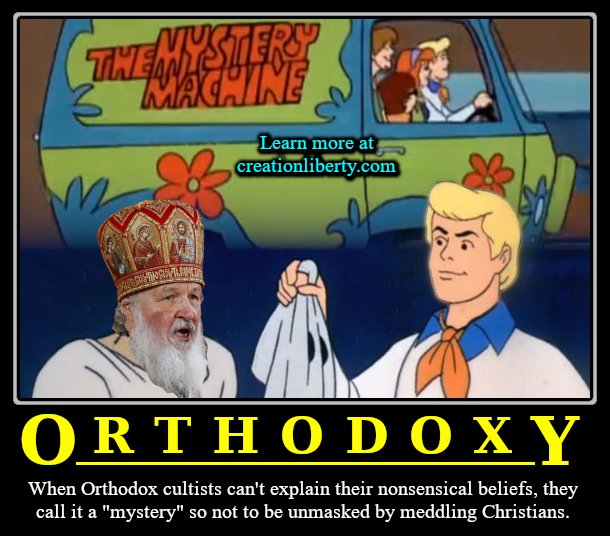
And to the final verse:
This is that bread which came down from heaven: not as your fathers did eat manna, and are dead: he that eateth of this bread shall live for ever.
-John 6:58
Let's read the words of the Holy Ghost through Paul once more:
The cup of blessing which we bless, is it not the communion of the blood of Christ? The bread which we break, is it not the communion of the body of Christ?
-1 Corinthians 10:16
I have another question for Orthodox churchgoers based on the next verse:
For we being many are one bread, and one body: for we are all partakers of that one bread.
-1 Corinthians 10:17
Orthodoxy teaches that you must ignore the doctrine of Jesus Christ and participate in consumptions of human flesh and blood to be saved, as the Holy Apostles Orthodox Church said on their website, explaining how they believe men are saved:
"It is only in and through Christ that we can be saved (John 14:6). Salvation cannot be earned. It's a free gift from God.But being saved requires our cooperation with God, because God will not violate our free will. A life of repentance is needed - that's turning away from our sin and toward God. Along with repentance, participation in the sacraments, like baptism and holy communion, [i.e. Eucharist] is how we cooperate with God. "
-Holy Apostles Orthodox Church, "Salvation," retrieved Oct 24, 2024, [https://holyapostles.org/salvation]
Orthodox churchgoers rarely state their beliefs plainly, often preferring complexity to confuse the understanding of laymen to create a superficial reliance on clergy, so I commend this Orthodox website for clearly defining their terms, as it allows me to readily expose their heresy. They assert salvation is in Christ alone and cannot be earned, yet in contradiction, claim salvation "
require (v): to have need of; to impose need or occasion for; make necessary or indispensable
(See 'require', Random House Dictionary, 2024, [dictionary.com]; See also Collins English Dictionary, 10th Edition, William Collins Sons & Co, 2012)
Woe unto you, scribes and Pharisees, hypocrites! for ye compass [i.e. travel across] sea and land to make one proselyte, [i.e. a convert to a religious belief] and when he is made, ye make him twofold [i.e. twice] more the child of hell than yourselves.
-Matthew 23:15
The word 'penance' has to do with punishment as a discipline for sin:
penance (n): a punishment undergone in token of penitence for sin; a sacrament, as in the Roman Catholic Church, consisting in a confession of sin, made with sorrow and with the intention of amendment, followed by the forgiveness of the sin
(See 'penance', Random House Dictionary, 2025, [dictionary.com]; See also Collins English Dictionary, 10th Edition, William Collins Sons & Co, 2012)
The Saint George Antiochian Orthodox Church says:
"The sacrament of Penance is the vehicle by which we formally reconcile ourselves with God. It is a three step process: Admitting our weakness and expressing sincere sorrow for our sin; openly confessing our sin in the presence of a priest and receiving the prayer of absolution, and finally making an honest commitment and pledging our utmost effort to resist future temptation of sin. The Orthodox Church follows strictly the teaching of the Bible that only God can forgive sins. Christians are encouraged to take part in this sacrament of reconciliation on a regular basis. "
-Saint George Antiochian Orthodox Church, "Penance," retrieved May 13, 2025, [https://www.stgeorgechi.org/church-doctrines/sacraments-beliefs/penance/]
This begs the question, if only God can forgive sins, as this Orthodox cultist just told us, then why do we need to go to a special priest in a special temple to receive forgiveness of sins? Is the Almighty God limited to the structures of men? When Jesus taught us the manner in which we were to pray, He told us to pray to God the Father:
But when ye pray, use not vain repetitions, as the heathen do: for they think that they shall be heard for their much speaking. Be not ye therefore like unto them: for your Father knoweth what things ye have need of, before ye ask him. After this manner therefore pray ye: Our Father which art in heaven, Hallowed be thy name.
-Matthew 6:9
For there is one God, and
-1 Timothy 2:5
This Orthodox organization is quite deceptive in their description because they claim that parishioners are "
"Reconciliation with our Lord is a pre-requisite to receiving Holy Communion. "
-Saint George Antiochian Orthodox Church, "Penance," retrieved May 13, 2025, [https://www.stgeorgechi.org/church-doctrines/sacraments-beliefs/penance/]
This means their corrupt Eucharist ritual, and as we learned earlier, is a REQUIREMENT for Orthodox churchgoers, else (according to their beliefs) they cannot be saved. Thus, they believe that penance is a requirement for salvation, despite the fact that there is no such thing as confession to a priest in Scripture; confession of sins is mentioned in Scripture (1Jo 1:8-10), but nowhere does it say that we must confess them to men, or any other imagined religious clergy, such as an Orthodox priest.
In Matthew 6 (quoted earlier), we were told by Jesus Christ not to be "like unto" the heathen who use "vain repetitions" in prayer because they are not heard, just as God does not hear the vain repetitious prayers of those in the Orthodox cult. Like their Catholic counsins, Orthodox churchgoers have a vain repetitious prayer of penance called the "Jesus prayer," and although there are some minor variations, it simply says, "Lord Jesus Christ, Son of God, have mercy on me, a sinner."
Orthodox priests claim their tradition stems from the apostles (citing Luke 18:13 & 18:38), but this is an unsubstantiated claim. The Orthodox tradition traces back to foolish heretic Gregory Palamas in the 4th and 5th centuries, and their commonly prescribed "Jesus prayer" involves repeating it 50-300 times per session, sometimes 50-100 times daily for a week, but as Jesus so aptly taught, they are not "heard for their much speaking."
Palamas said:
"Let no one think, my brother Christians, that it is the duty only of priests and monks to pray without ceasing, and not of laymen. No, no; it is the duty of all of us Christians to remain always in prayer. "
-Gregory Palamas, "'Prayer without Ceasing' Is Necessary For All Christians," Orthodox Prayer, retrieved June 20, 2025, [https://www.orthodoxprayer.org/]
This is based on another misinterpretation of cherry-picked Scripture, this time in 1st Thessalonians:
Pray without ceasing.
-1 Thessalonians 5:17
Paul says this in the sense that daily prayer should be a foundation of the duties of a Christian, not that one sins if he does not pray, but that prayer is a necessity because we rely on the grace and blessings of God to accomplish all the duties we have in this world. God invites us to ask of Him for His blessings as a child would with his father, so He would give us wisdom, knowledge, understanding, prosperity (both spiritual and physical), resolve, motivation, strength, persistant, and fervence for the things of heaven, and that we ought to do these things both in our personal and private prayers, as well as the church together.
This interpretation requires reliance on correlating Scripture, which Palamas, as well as his heretical Orthodox brethren, refuse to do. Instead, they believe they should pray non-stop, and not only pray, but offer vain repititious prayers that are nonsensical.
If we continue reading Palamas, he demonstrates that he is basing this on the commentary of other men, not on the Scriptures themselves:
"For look what the most holyPatriarch of Constantinople, Philotheus, writes in his life of St. Gregory of Thessalonica . This saint had a beloved friend by the name of Job, a very simple but most virtuous man. Once, while conversing with him,His Eminence said of prayer that every Christian in general should strive to pray always, and to pray without ceasing , as Apostle Paul commands all Christians, 'Pray without ceasing' (I Thessalonians 5:17), and as the prophet David says of himself, although he was a king and had to concern himself with his whole kingdom: 'I foresaw the Lord always before my face' (Psalms 15:8), that is, in my prayer I always mentally see the Lord before me.Gregory the Theologian also teaches all Christians to say God's name in prayer more often than to breathe. So, my Christian brethren, I too implore you, together also with St. Chrysostom, for the sake of saving your souls, do not neglect the practice of this prayer. Imitate those I have mentioned and follow in their footsteps as far as you can."
-Gregory Palamas, "'Prayer without Ceasing' Is Necessary For All Christians," Orthodox Prayer, retrieved June 20, 2025, [https://www.orthodoxprayer.org/]
This must have been a typo because the phrase "I foresaw the Lord always before my face" comes from Acts 2:26, which refers back to Psalm 16:8. In Psalm 16, David is not saying that he said "
Alongside John Chrysostom (i.e. another heretic labeled a "saint" by the Orthodox cult, to be discussed further in chapter six), Palamas elevated commentaries to the level of reverence given to the Holy Scriptures alone, supporting their conclusions by citing short, cherry-picked Bible passages. However, you may have noticed no mention of a "Jesus prayer," because, as I noted earlier, it was not established as a common Orthodox tradition until the 19th century.
The evolution of the modern Orthodox penance tradition can be found in The Way of a Pilgrim by Reginald French:
"The continuous interior Prayer of Jesus is a constant uninterrupted calling upon the divine Name of Jesus with the lips, in the spirit, in the heart; while forming a mental picture of His constant presence, and imploring His grace, during every occupation, at all times, in all places, even during sleep. The appeal is couched [i.e. expressed] in these terms, 'Lord Jesus Christ, have mercy on me.' One who accustoms himself to this appeal experiences as a result so deep a consolation andso great a need to offer the prayer always, that he can no longer live without it , and wit will continue to voice itself within him of its own accord."
-Reginald M. French, The Way of a Pilgrim and the Pilgrim Continues His Way, 1884, p. 8-9, retrieved June 20, 2025, [https://archive.org/details/wayofpilgrim00fren/page/8/mode/2up]
There is no documentation of this specific tradition being done in Orthodoxy prior to the 19th century, and is a prime example of religiosity:
religiosity (n): excessive devotion to religion
(See 'religiosity', Random House Dictionary, 2025, [dictionary.com]; See also Collins English Dictionary, 10th Edition, William Collins Sons & Co, 2012)
This is sometimes referred to as "extreme unction," and the word 'unction' comes from the late 14th century latin, which means an "act of anointing as a religious rite." Orthodox churchgoers will argue that there are commandments to do this in James, but as I stated at the beginning of this chapter, this is a gross (and I believe, deliberate) misunderstanding of what James wrote.
An anonymous author for Saint John The Evangelist Orthodox Church said:
"We see clearly in Scripture that Christ and His Apostles practiced Holy Unction. On the Lord's orders, the Apostles 'anointed many sick people with oil and healed them' (Mark 6:13). Moreover, we see these instructions from Saint James, the Brother of the Lord: 'Is anyone among you sick? Let him call the presbyters of the Church to pray over him and anoint him with oil in the name of the Lord. The prayer offered in faith will make the sick person well; the Lord will raise him up. And if he has sinned, he will be forgiven' (James 5:14-15). "
-Saint John The Evangelist Orthodox Church, "What is Holy Unction?" Apr 19, 2022, retrieved May 13, 2025, [https://www.saintjohnchurch.org/what-is-holy-unction/]
The anointing of oil was a tradition of the Jews, which was sometimes used for medicinal purposes, and was not always successful. However, in the instance of Mark 6:13, this was done with the miraculous power of the Holy Ghost to heal the sick, which is why Mark mentioned the extraordinary gifts together:
And they went out, and preached that men should repent. And they cast out many devils, and anointed with oil many that were sick, and healed them.
-Mark 6:12-13
Then he called his twelve disciples together, and gave them power and authority over all devils, and to cure diseases.
-Luke 9:1
Because the Holy Ghost's miraculous gift of healing ceased, it therefore stands to reason that the practice of anointing with oil should also cease. As is common with false religious cults, they conflate Mark 6 with James 5, and the major difference between the two is that in Mark, the apostles were doing miracles through the gifts of the Holy Ghost, while in James 5, the elders of the church were praying to the Lord:
Is any among you afflicted? let him pray. Is any merry? let him sing psalms. Is any sick among you? let him call for the elders of the church; and let them pray over him, anointing him with oil in the name of the Lord: And the prayer of faith shall save the sick, and the Lord shall raise him up; and if he have committed sins, they shall be forgiven him.
-James 5:13-15
The anointing of oil at the time was done in some cultures for medicinal purposes, so this is emphasizing that the practice of common medicine should not cease to rely solely on prayer, which is not to say we should not have faith in prayer to heal, but that our calling of the Lord Jesus Christ is to works of charity, that we should do all in our power for ourselves and others when it comes to healing sickness. For example, we can pray for someone with a fever, while at the same time providing a wet rag over the forehead to reduce swelling and lower temperature, charitably assisting in the process of healing by ordinary means. Some readers may think that because I freely confess the Scriptures teach prayer over the sick, that there would be no contradiction with the Orthodox teaching on unction, but it needs to be understood that what is called "unction" is an occult practice far beyond simply having the elders of the church pray for the sick.
The anonymous author goes on to describe what they do, which is a far cry from what the Bible instructed in James. They must recite prescribed prayers (in vain repetition, contrary to what Christ taught in Mat 6:7), read certain passages from the Psalms, chant songs, pray to the "saints" (i.e. the dead men who make up Orthodox gods; a form of necromancy), which includes "
None of this is commanded, inferred, or even vaguely hinted at in the Scriptures, and by praying to their false gods (i.e. "saints"), they are nothing more than pagans reciting heathen ideology, which means their prayers are worthless. They might lift up their hands to pray their vanity to God, but He does not hear them.
And when ye spread forth your hands, I will hide mine eyes from you: yea, when ye make many prayers, I will not hear: your hands are full of blood. Wash you, make you clean; put away the evil of your doings from before mine eyes; cease to do evil;
-Isaiah 1:15-16
Before addressing the strange, heathen practices of Orthodoxy regarding marriage, I must clarify that many Christians are unaware that no passage in the Bible describes the modern marriage ceremonies practiced in most church buildings. When I was a young man, I believed the words spoken in typical marriage ceremonies came from Scripture, but they do not.
Nearly every tradition that is practiced today for marriage ceremonies is not mandated in Scripture, and most churchgoers are completely unaware of this fact. I wrote a separate book on this called The Biblical Understanding of Marriage, and in it, I cover everything from how couples were married in Scripture to the modern-day use of licenses, and why Christians ought not to get marriage licenses from the state or any other religious institution except under rare circumstances.
Many churchgoers are shocked when I explain that Christians need only give their word to be married. Our spoken word is our contract with another, taken with utmost seriousness by God, who will hold us accountable for every word we speak on the Day of Judgment:
But I say unto you, That every idle word that men shall speak, they shall give account thereof in the day of judgment.
-Matthew 12:36
But the fearful, and unbelieving, and the abominable, and murderers, and whoremongers, and sorcerers, and idolaters, and
-Revelation 21:8
|
✅ BIBILCAL we can show where these things were done, and have logical reasons for them |
❌ UNBIBLICAL only there as a show of pomp to justify the paychecks of Orthodox clergy |
|
There are more ridiculous requirements and details than this, but as we can see, outside of having a wedding celebration, there is nothing Biblical about any of this. However, in their minds, they do not need to justify it because, according to them, it is "
It should be noted that the only parties involved in a marriage are the husband, wife, and the Lord. There is no place in Scripture where it is commanded, inferred, or vaguely hinted that should be a third party religious guru authorized to marry two people, but modern-day churchgoers have swallowed this hook, line, and sinker, because it makes them feel like they are "righteous" by their works.
Ye shall not do after all the things that we do here this day,
every man whatsoever is right in his own eyes.
-Deuteronomy 12:8
This is the process by which the Orthodox cult creates priests, an office that does not exist in the New Testament church because we who are born again in Christ are all priests under Jesus according to the will of God the Father:
And from Jesus Christ, who is the faithful witness, and the first begotten of the dead, and the prince of the kings of the earth. Unto him that loved us, and washed us from our sins in his own blood, And hath made us kings and priests unto God and his Father; to him be glory and dominion for ever and ever. Amen.
-Revelation 1:5-6
As newborn babes, desire the sincere milk of the word, that ye may grow thereby: If so be ye have tasted that the Lord is gracious. To whom coming, as unto a living stone, disallowed indeed of men, but chosen of God, and precious, Ye also, as lively stones, are built up a spiritual house, an holy priesthood, to offer up spiritual sacrifices, acceptable to God by Jesus Christ.
-1 Peter 2:2-5
But ye are a chosen generation, a royal priesthood, an holy nation, a peculiar people; that ye should shew forth the praises of him who hath called you out of darkness into his marvellous light: Which in time past were not a people, but are now the people of God: which had not obtained mercy, but now have obtained mercy.
-1 Peter 2:9
But this man [i.e. Jesus Christ], because he continueth ever, hath an unchangeable priesthood. Wherefore he is able also to save them to the uttermost that come unto God by him, seeing he ever liveth to make intercession for them. For such an high priest became us, who is holy, harmless, undefiled, separate from sinners, and made higher than the heavens; Who needeth not daily, as those high priests, to offer up sacrifice, first for his own sins, and then for the people's: for this he did once, when he offered up himself.
-Hebrews 7:24-27
For those of us born again in Christ, our sins were nailed to the cross, not to the cup:
And you, being dead in your sins and the uncircumcision of your flesh, hath he quickened together with him, having forgiven you all trespasses; Blotting out the handwriting of ordinances that was against us, which was contrary to us, and took it out of the way, nailing it to his cross;
-Colossians 2:13-14
"Holy Ordination, also called the Sacrament of Holy Orders, is the sacredMystery (Sacrament) through which men are set apart by the Church to serve as deacons, priests, or bishops.Through ordination, the candidate receives the grace of the Holy Spirit and becomes a servant of Christ and His Church. "
-Saint George Greek Orthodox Church, "Holy Ordination in the Greek Orthodox Church," May 14, 2025, [https://www.stgeorgemedia.org/ordination]
Once again, Orthodox churchgoers do not believe they need to justify their doctrine with proper Scripture and reasoning, because they can label it a "mystery" without any need for consideration. The Word of God has ordained that there would be elders (also called 'bishops', 1Ti 3:2) and deacons if necessary, but these are only set in the local church, and they are to be servants of the church to oversee certain matters of service, doctrine, and dispute.
Whereas we in Christ's church have only members, deacons, and bishops/elders (with a few various duties of preaching, such as apostles, pastors, evangelists, and teachers, who are granted ordinary gifts of understanding by Christ for that duty, Eph 4:11), the Orthodox cult goes far beyond this, defying the establishment of the church by Christ and His apostles, creating lofty positions for themselves, with fancy hats and ceremonies to go with the station, so the people will glorify them. The Orthodox priests come into the temple wearing their fancy garbs, demanding to be called by the title "father" in contradiction to the commandments of Christ (because He told us not to do that), and are given high seats in the synagogues, while the poor plebs are to sit in the lowly places and respect the persons of the priests.
But all their works they do for to be seen of men: they make broad their phylacteries, and enlarge the borders of their garments, And
-Matthew 23:5-12
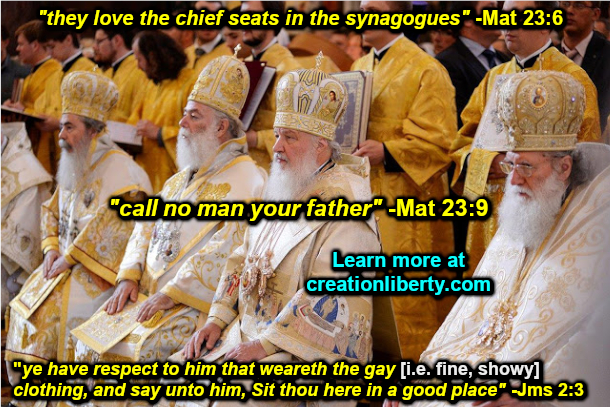
My brethren, have not the faith of our Lord Jesus Christ, the Lord of glory, with respect of persons. For if there come unto your assembly a man with a gold ring, in goodly apparel, and there come in also a poor man in vile raiment; And
-James 2:1-9
|
By my count, there are no less than 26 offices, when the church only has two general offices (i.e. elder/bishop and deacon), and in Christ's church, we do not use (nor have need for) honorifics. There are many church buildings and organizations out there who love to use titles, like "Pastor Bob" or "Reverend Joe," but the examples set by the apostles showed no such use of fancy titles, nor was it commanded by the Lord Jesus Christ, and furthermore, when churchgoers call a man "reverend," they are calling him "holy," which is a title that is reserved only for the name of God the Father, not men.
He sent redemption unto his people: he hath commanded his covenant for ever: holy and reverend is his name.
-Psalm 111:9
The concept of a monk or nun is not supported Biblically, especially not for the New Testament church because Christ and His apostles never taught anything vaguely inferrable to it. Therefore, none of the practices that are established for what Orthodox churchgoers call "Monastic Tonsure" have any spiritual benefit whatsoever.
According to the St. Herman of Alaska Orthodox Church, "
(See St. Herman of Alaska Orthodox Church, "The Monastic Tonsure, retrieved May 15, 2025, [https://www.sthermansoca.org/orthodox-christianity/the-monastic-tonsure/])
We are supposed to go out into the world to preach repentance for the remission of sins and faith in Christ, and you cannot do that sitting in a cave or monestary doing meditations and chanting vain, repetitive nonsense:
Go ye therefore, and teach all nations, baptizing them in the name of the Father, and of the Son, and of the Holy Ghost: Teaching them to observe all things whatsoever I have commanded you: and, lo, I am with you alway, even unto the end of the world. Amen.
-Matthew 28:19-20
What I tell you in darkness [i.e. privately], that speak ye in light: [i.e. openly] and what ye hear in the ear, that preach ye upon the housetops. [i.e. where all can see and hear]
-Matthew 10:27
The Orthodox article goes on to state that "
By this we know that we love the children of God, when we love God, and keep his commandments. For this is the love of God, that we keep his commandments: and his commandments are not grievous.
-1 John 5:2-3
Master, which is the great commandment in the law? Jesus said unto him, Thou shalt love the Lord thy God with all thy heart, and with all thy soul, and with all thy mind. This is the first and great commandment. And the second is like unto it, Thou shalt love thy neighbour as thyself. On these two commandments hang all the law and the prophets.
-Matthew 22:36-40
Funeral services are never mentioned in Scripture because the Jews carried their dead out of the camp or city almost immediately and buried the body, just as they did with Ananias and Sapphira. (Acts 5:5-6) Funeral services are mostly centered around pagan ideology, and are just another way that pastors and preists portray themselves as having some sort of function that justifies a paycheck.
According to Orthodox Church in America, Orthodox funeral services are supposed to include "
(See Orthodox Church in America, "Funeral," retrieved May 15, 2025, [https://www.oca.org/orthodoxy/the-orthodox-faith/worship/the-sacraments/funeral])
The "Consecration of the Church" is the process by which Orthodox priests establish an Orthodox temple for use. Not only do they offer more vain repetitious prayers to their false gods (who they deceptively call "saints"), and invoke the use of what they call "holy relics" (i.e. witchcraft charms), there is nothing in the Scriptures to justify this practice, and it completely contradicts the meaning of the word 'church' in the Word of God.
People claiming to be Christians commonly use the phrase "go to church," but according to the Scriptures, it is impossible to "go to church," which is why you will not find that phrasing in the Bible. This is also why I call them "churchgoers" instead of Christians because, to them, the church is a building crafted by the hands of men, and they do not believe what the Bible teaches us, namely, that the church is the collective members of the body of Christ.
And when they were come, and had gathered the church together, they rehearsed all that God had done with them, and how he had opened the door of faith unto the Gentiles.
-Acts 14:27
Who have for my life laid down their own necks: unto whom not only I give thanks, but also all the churches of the Gentiles.
-Romans 16:4
They don't.
How do buildings lay down their lives?
They don't.
Churchgoers will often tell you they believe the church is a group of believers, but their language indicates otherwise. In other words, their language reflects their philosophy. If they believed the truth of the Scriptures, they would not say "go to church," or that the building itself is the "house of God," because we who are of Christ are the "house of God" in which the Holy Spirit dwells.
Flee fornication. Every sin that a man doeth is without the body; but he that committeth fornication sinneth against his own body. What? know ye not that your body is the temple of the Holy Ghost which is in you, which ye have of God, and ye are not your own? For ye are bought with a price: therefore glorify God in your body, and in your spirit, which are God's.
-1 Corinthians 6:18-20
Please note that according to Orthodox liturgy (which are hymns sung, and are considered to be official Orthodox teaching), if you deny any of their false doctrine and pagan ideology in their so-called "sacraments," you are an anathema, which (as we learned earlier in this chapter) is a curse of damnation and destruction to hell. The following is taken from the Synodikon of Orthodoxy, and is read during what they call their "Divine" Liturgy:
"To those who reject any of the Holy Sacraments held by the Church of Christ: ANATHEMA! "
-Romanian Orthodox Episcopate of America, "Synodikon of Orthodoxy," p. 4, retrieved June 4, 2025, [https://roea.org/files/Liturgical-Texts/The-Synodikon-of-Orthodoxy-I.pdf]
As indicated in the list at the beginning of this chapter, there are more absurd and antichrist "sacraments" taught by Orthodoxy. I will dedicate more time to inspecting these because it will uncover Orthodoxy's witchcraft and spell-casting rituals.
physical (adj): of or relating to that which is material
(See 'physical', Random House Dictionary, 2025, [dictionary.com]; See also Collins English Dictionary, 10th Edition, William Collins Sons & Co, 2012)
science (adj): systematic knowledge of the physical or material world gained through observation and experimentation
(See 'science', Random House Dictionary, 2025, [dictionary.com]; See also Collins English Dictionary, 10th Edition, William Collins Sons & Co, 2012)
He that trusteth in his own heart is a fool:
but whoso walketh wisely, he shall be delivered.
-Proverbs 28:26
Every way of a man is right in his own eyes:
but the LORD pondereth the hearts.
-Proverbs 21:2
The heart is deceitful above all things, and
desperately wicked: who can know it?
-Jeremiah 17:9
We must remember that devils can transform their appearance to be perceived as angels of light:
For such are false apostles, deceitful workers, transforming themselves into the apostles of Christ. And no marvel; for Satan himself is transformed into an angel of light. Therefore it is no great thing if his ministers also be transformed as the ministers of righteousness; whose end shall be according to their works.
-2 Corinthians 11:13-15
But continue thou in the things which thou hast learned and hast been assured of, knowing of whom thou hast learned them; And that from a child thou hast known the holy scriptures, which are able to make thee wise unto salvation through faith which is in Christ Jesus. All scripture is given by inspiration of God, and is profitable for doctrine, for reproof, for correction, for instruction in righteousness: That the man of God may be perfect, throughly furnished unto all good works.
-2 Timothy 3:14-17
And the LORD said unto Samuel, Hearken unto the voice of the people in all that they say unto thee: for they have not rejected thee, but they have rejected me, that I should not reign over them.
-1 Samuel 8:7
For rebellion is as the sin of witchcraft, and stubbornness is as iniquity and idolatry. Because thou hast rejected the word of the LORD, he hath also rejected thee from being king.
-1 Samuel 15:23
"Those who make unto themselves many Gods, unto whom they render Worship and Adoration as unto the true God, as did the Heathen... Those who sell themselves to the Devil, as Conjurers, and those who practise magical Arts and use Charms and Spells... Those who give themselves up to Superstitions and put their Trust in them; "
-Peter Mogila, The Orthodox Confession of the Catholic and Apostolic Eastern Church, published by T. Baker, 1898, p. 147, Cornell University Library, retrieved May 9, 2025, [https://archive.org/details/cu31924029363094/page/n153/mode/2up]
Orthodox priests claim those who participate in rituals of witchcraft have turned from the Living God and created other gods to worship. Please try to keep this in mind as we investigate Orthodox rituals because this is why I have called Orthodoxy "paganism repackaged."
Here are the general defintions of these terms:
witchcraft (n): the practices of witches; sorcery; enchantments; intercourse with the devil
enchantment (n): the act of producing certain wonderful effects by the invocation or aid of demons, or the agency of certain supposed spirits; the use of magic arts, spells or charms; incantation
spell (n): a charm consisting of some words of occult power
charm (n): words, characters or other things imagined to possess some occult or unintelligible power [i.e. a "mystery"]; hence, a magic power or spell, by which with the supposed assistance of the devil, witches and sorcerers have been supposed to do wonderful things
magic (n): the art or science of putting into action the power of spirits; or the science of producing wonderful effects by the aid of superhuman beings, or of departed spirits; sorcery; enchantment
(See 'witchcraft', 'enchantment', 'spell', 'charm' & 'magic', American Dictionary of the English Language, Noah Webster, 1828, retrieved May 10, 2025, [webstersdictionary1828.com])
We will begin our investigation by looking at the Orthodox cult's use of what they call "holy water," a practice shared by their Catholic cousins, as well as many other pseudo-Christian cults. This is one of their "sacraments" (which we covered in the previous chapter) and considered to be another of their so-called "mysteries" (i.e. an excuse to do it without Biblical justification).
I am aware that the phrase "holy water" is mentioned once in Scripture, but it is not referring to anything remotely close to what the Orthodox cult is doing, and we will go over those details shortly. According to the website Orthodox Christianity 101, holy water allows people to actively participate in "
"From an Orthodox perspective, Holy Water is not just a symbolic gesture but a real, active participation in the divine life. It's seen as a channel through which God's grace is made manifest in the material world. The water doesn't merely symbolize purity or holiness; it becomes sanctified, embodying the very presence of the Holy Spirit. "
-Orthodox Christianity 101, "Understanding Holy Water in Orthodox Christianity," Dec 31, 2024, retrieved May 16, 2025, [https://www.orthodoxchristianity101.com/post/understanding-holy-water-in-orthodox-christianity]
I will be referring to so-called "holy" water many times in this chapter, and I will write it without any quotations around it or modifiers to it, but I want readers to understand that I take offense in applying the adjective 'holy' (preserved for the Lord Jesus Christ and His Word) to the disgusting Orthodox practice of witchcraft. For the purpose of simplicity, I will reluctantly write the phrase 'holy water' as they do in their documentation.
To clarify, this anonmyous Orthodox author claims that their holy water is the grace of God "
The following article from St. Andrew Greek Orthodox Church in Indiana believes that their holy water cleanses sin:
"During our entire life there is a great blessing next to us --holy water. Blessed water is a form of God's grace: it cleanses the Christian believers from spiritual uncleanness and sanctifies and strengthens them for the spiritual struggle of salvation in God. "
-George, "The Orthodox Sacred Tradition of Holy Water," St. Andrew Greek Orthodox Church, Jan 7, 2019, retrieved May 16, 2025, [https://saintandrewgoc.org/blog/2019/1/7/the-orthodox-sacred-tradition-of-holy-water]
To be "
The Orthodox author goes on to note that they use holy water in their baptisms because they believe in the works-based heresy that a physical method (involving witchcraft rituals) can be relied upon to wash away sins. This is one of the reasons why their "sacrament" of baptism is an antichrist abomination because they do NOT believe they are regenerated by the blood of Christ; rather, they believe they are regenerated by their use of holy water magic:
"Holy water of the Mystery of Baptism washes away sinful uncleanness of man; it renews and revives him into a new life in Christ. "
-George, "The Orthodox Sacred Tradition of Holy Water," St. Andrew Greek Orthodox Church, Jan 7, 2019, retrieved May 16, 2025, [https://saintandrewgoc.org/blog/2019/1/7/the-orthodox-sacred-tradition-of-holy-water]
According to NanLT, a pagan witch who has practiced witchcraft in London for most of her life, pagans have a number of steps to create holy water. These include getting water from a natural source (e.g. lakes, rivers, oceans, rainwater, etc), but tap water can be used if needed.
(See NanLT, "Water Blessings," Writings of a Pagan Witch, Apr 30, 2015, retrieved May 16, 2025, [https://writingsofapaganwitch.wordpress.com/2015/04/30/water-blessings/])
NanLT then instructs that witches should say a ritualistic prayer over the water, invoking the name of the gods or goddesses of worship. Many witches advise that this should be done in a supposedly "consecrated" space (created by a pagan ritual, similar to the Orthodox "Consecration of the Church" sacrament), and also at special times, such as when moonlight is at its greatest, or during high holidays and sabbats. They dip a ritualistic object (like a consecrated knife or other symbolic tool) into the water three times (as witches often do in honor of their trinitarian moon goddess), and they may add some salt to the water or essential oil depending on the purpose for which it is used.
Orthodoxy does the same witchcraft process because they get their water from natural sources, or have it shipped to them from the Jordon River, because they have a ridiculous belief that water from the Jordon River is somehow spiritually significant, which makes no sense because it is a normal river, like any other, meaning that its water is not special from anywhere else in the world since it is recycled through natural processes. Orthodox priests only perform this at special times (i.e. on their alleged "holy days") in a supposedly "consecrated" space, and according to the Greek Orthodox Archdiocese of America, they must speak/sing ritualistic prayers over the water, dip a cross symbol in the water three times, and then it is ready for use.
(See Greek Orthodox Archdiocese of America, "The Order for the Lesser Sanctification of the Water," retrieved May 16, 2025, [https://www.goarch.org/-/the-order-for-the-lesser-sanctification-of-the-water])
To simplifiy it, by comparing both rituals in the following chart:
| WITCHCRAFT "HOLY WATER" RITUAL | ORTHODOX | PAGAN |
| Used for spiritual purposes, such as purification and protection | ✅ | ✅ |
| Prefer water from natural sources | ✅ | ✅ |
| Ritual takes place in a consecrated space | ✅ | ✅ |
| Use of consecrated tools | ✅ | ✅ |
| Use of symbolic gestures | ✅ | ✅ |
| Power in appointed times | ✅ | ✅ |
| Repeating prescribed ritualistic prayers (i.e. invocations) | ✅ | ✅ |
| Use of salt (although more common in Wicca) | ✅ | ✅ |
| Performed only by preapproved religious hierarchy | ✅ | ❌ |
| Holy water frequently used in other rituals | ✅ | ✅ |
| Claim holy water has sanctifying spiritual power | ✅ | ✅ |
| Invoke the name of Jesus in the ritual | ✅ | ❌ |
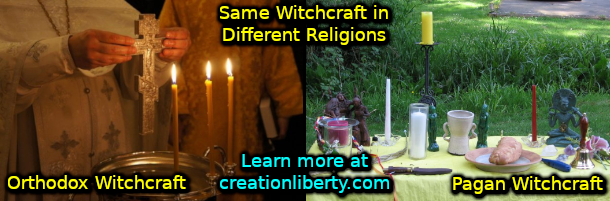
There are very minor differences between paganism and Orthodoxy, like how witches use salt in their holy water more often than Orthodox priests, and that Othodoxy requires a pre-approved priest to perform the ritual. Other than that, the ONLY major difference between witchcraft and Orthodoxy is that Orthodox churchgoers slap a "Jesus" sticker on their witchcraft and call it "good."
Woe unto them that call evil good, and good evil; that put darkness for light, and light for darkness; that put bitter for sweet, and sweet for bitter!
-Isaiah 5:20
"[H]oly water blessed by some other religion's deity can be used, as long as your tradition has no mandates against such a thing. If you decide to visit your local Christian [i.e. corrupt, so-called] church in search of holy water, be courteous and ask before dipping a jar into the font; most of the time, pastors are more than happy to let you have some water. "
-Patti Wigington, "Consecrated Water for Ritual," Learn Religions, Mar 31, 2019, retrieved May 16, 2025, [https://www.learnreligions.com/consecrated-water-for-ritual-2562332]
Both witches and Orthodox churchgoers use holy water to overcome negative influences (e.g. evil spirits or negative energy), both invoke a higher power to convert the water, both use physical actions to imbue the water with allegedly "spiritual qualities," both use a consecrated space with symbols of their cults, and both believe the water is divinely transformed. Remember earlier that we learned the definition of witchcraft through enchantments was "
Now the works of the flesh are manifest, which are these; Adultery, fornication, uncleanness, lasciviousness, Idolatry,
-Galatians 5:19-21
And the priest shall take holy water in an earthen vessel; and of the dust that is in the floor of the tabernacle the priest shall take, and put it into the water:
-Numbers 5:17
"The idea of holy water is encountered even in the Old Testament: 'and the priest shall take holy water in an earthen vessel' (Numbers 5:17). But water that is altogether special runs in the Jordan River. Our Lord Jesus Christ appeared on the Jordan River in order to sanctify the essence of water and to make it a source of blessing for the mankind. "
-George, "The Orthodox Sacred Tradition of Holy Water," St. Andrew Greek Orthodox Church, Jan 7, 2019, retrieved May 27, 2025, [https://saintandrewgoc.org/blog/2019/1/7/the-orthodox-sacred-tradition-of-holy-water]
George does not provide any evidence, Scriptural or otherwise, to support the claim that Jesus "
claim (n): an assertion of something as a fact
assertion (n): a positive statement or declaration, often without support or reason
(See 'claim' & 'assertion', Random House Dictionary, 2025, [dictionary.com]; See also Collins English Dictionary, 10th Edition, William Collins Sons & Co, 2012)
That ye may be the children of your Father which is in heaven: for he maketh his sun to rise on the evil and on the good, and sendeth rain on the just and on the unjust.
-Matthew 5:45
If you thought that example was stupid, then you have seen past the religiousity façade by using basic understanding, but sadly, countless churchgoers believe this holy water garbage on the basis that a man in fancy robes told them it was so. Furthermore, readers need to understand that the "holy water" mentioned in Numbers 5:17 is NOT the same thing as the magic witchcraft water of the Orthodox cult, but the Orthodox priest I quoted performed some linguistic sleight-of-hand to make you think that what he is doing is the same thing because they both use the same term.
I have a simple question for Orthodox churchgoers: If the Levites were using holy water, how did they make it? To this day, no Orthodox website I have read has explained this, because the Levites were not commanded to practice witchcraft, and therefore, the holy water in the Bible was not "made" by any physical or spiritual means.
The "holy water" in Numbers 5:17 was labeled "holy" because of God's commandment for this to be done in their Temple ceremonies, not because it was made "holy" by magic spells. There was no ceremony to "create" holy water. The water was simply clean water they put into the laver (ley-ver), which was a large basin of water they would draw from to wash their hands and feet before performing certain duties in the Temple.
Thou shalt also make a laver of brass, and his foot [i.e. the base of it] also of brass, to wash withal: and thou shalt put it between the tabernacle of the congregation and the altar, and thou shalt put water therein.
-Exodus 30:18
The fallacy looks like this:
B is also called X.
Therefore, A is B.
If that was confusing, let's look at an example:
A key is a musical tone.
Therefore, picking a lock and playing music are the same thing.
Just because two things have the same name, it does not make them the same thing. It would be as absurd as saying that myself and professional baseball player Christopher Johnson believe and teach the same things because we both have the same name.
Likewise, the Orthodox argument looks like this:
Orthodoxy uses holy water as a sacrament.
Therefore, Orthodox holy water is the same Levitical holy water.
I would fully expect and understand this from a child, or perhaps someone who has very little experience in reading, but for this argument to come out of the mouth of an supposedly "educated" religious leader is a joke. This shows that, despite how knowledgeable religious leaders may claim to be, they often lack a true understanding of the subject, and this is why the Bible tells us that such arrogant men can study the Word of God all of their lives and never understand it:
Having a form of godliness, but denying the power [i.e. authority] thereof: from such turn away. For of this sort are they which creep into houses, and lead captive silly women laden with sins, led away with divers lusts, Ever learning, and never able to come to the knowledge of the truth.
-2 Timothy 3:5-7
But the natural man receiveth not the things of the Spirit of God: for they are foolishness unto him: neither can he know them, because they are spiritually discerned.
-1 Corinthians 2:14
The antichrist, works-salvation heresy of the Orthodox Eucharist we learned about in chapter two is also rooted in abominable witchcraft practices. According to Orthodox priests, their Eucharist ritual is a requirement to be saved, and because they use witchcraft in their ceremony, it means they are forcing converts to participate in witchcraft for salvation, but they do not permit anyone to label it witchcraft because it would make them look evil.
The Orthodox Eucharist ritual begins by having members of their temple (traditionally women) bake leavened bread that is stamped with a seal before baking, which they call the "prosphoro." I tried to get more information on this from the Holy Trinity Greek Orthodox Church, but when I went to 'prosphoro', it told me to see "altar bread," when I went to 'altar bread,' it told me to see "sphragis," and when I went to 'sphragis', it told me to see "prosphoro," creating a perfect circle to accurately represent their reasoning.
(See Fotios Litsas, "A Dictionary of Orthodox Terminology," Holy Trinity Greek Orthodox Church, retrieved May 13, 2025, [https://www.holytrinitynr.org/online-resources/a-dictionary-of-orthodox-terminology])
The word 'prosphoro' (or prosphora or prosforo) means "offering," and the following is a picture of what that bread looks like, the left being the baked bread, while the right side is the seal they use to make the shape in the dough:
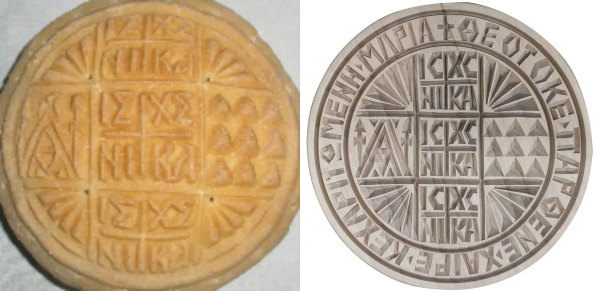
I am sure life-long Orthodox churchgoers will have a hard time understanding this, but this is weird practice that makes no sense. As we continue to learn about the explanation of the symbolism on this bread, please keep in mind that nothing about this is mandated or justified in the Scriptures.
The Greek letters in the middle are abbreviations for what is supposed to say "Jesus Christ Conquers," and are put around a cross symbol. The belief that shaping the dough into these letters gives it some mystic spiritual power is itself a pagan superstition, and no commandment to do such things was ever given to the apostles by the Holy Ghost.
As is common in paganism, the circular shape of the bread is supposed to represent the vagina:
"The round shape of the Offectory symbolizes the womb of the Ever-Virgin Mary , from whom the Only-begotten Son was born."
-Mount Athos, "Holy Bread Prosphora Seal - the Symbolism of the Offertory," retrieved May 20, 2025, [https://www.monastiriaka.gr/en/blog/holy-bread-prosphora-seal-the-symbolism-of-the-offertory]
This vaginal symbol, often called the "yoni" in witchcraft, is a symbol of worship for their goddess, just as the Orthodox cult worships their goddess "Mary." (We will cover more on that in a later chapter.) The following images are what witches call "grids," which are essentially small altars used for casting spells (kept circular to represent the vagina), and although they come with different shapes imprinted on them, they are quite similar to the Orthodox cult's prosphoro.
Orthodox churchgoers call Mary "
Sometimes, on the prosphoro, the 'M' is instead represented by a large triangle, which they claim to be a symbol of the Triune God, and that is also part of their idolatry. It should be noted that Orthodox churchgoers have many gods and a goddess, which we will learn more about in later chapters, but for now, I want readers to note the nine triangles on the opposite side of their altar bread, which represents an assortment of things:
"The nine small triangles on the right are cut to commemorate the angels, prophets, apostles, holy fathers and prelates, martyrs, ascetics, holy unmercenaries, Joachim and Anna, and all saints, including the saint of the day's liturgy. "
-Orthodox Prayer, "Prosphora," May 20, 2025, [https://www.orthodoxprayer.org/Divine_Liturgy/Prosforo.html]
Three of the triangles are for the angels, prophets, and apostles, which is already idolatry, but after that, they start to devolve into their particular cultic ideology, worshiping the so-called "saints" of their corrupt religion. When they say things like "holy fathers," "prelates" (i.e. high-ranking clergy), "martyrs," "ascetics" (i.e. monks, nuns, etc), or "holy unmercenaries" (i.e. healers), they are simply talking about their version of "gods" in paganism, which is a form of worshiping the dead.
Some may argue that possessing pictures or mementos of deceased relatives is not idolatry, and I agree that merely having such items is not idolatrous. However, if you pray to your dead relatives, compose divine hymns in their honor, and carve their faces or symbols of mementos into bread, believing consumption of it grants divine blessings, then it becomes idolatry.
When Orthodox cultists give a triangle to "Joachim and Anna," it means they are worshiping people who they claim to be the grandparents of Jesus Christ, and in chapter five, we will learn that they have no justification for this other than a single, apochryphal (i.e. unverifiable and unreliable) document. They give the final triangle to the "liturgy," or in simple terms, they venerate what they are doing; worshiping their ritual of worshiping false gods in idolatry.
The Orthodox priests bring out this idolatrous bread and wine to say hocus pocus over it, that it might be magically transformed into a different substance. This is precisely what pagans do in their rituals as well, which is why I refer to it as hocus-pocus:
hocus-pocus (n): a meaningless chant or expression used in conjuring or incantation; unnecessarily mysterious or elaborate activity or talk to cover up a deception
(See 'hocus-pocus', Random House Dictionary, 2025, [dictionary.com]; See also Collins English Dictionary, 10th Edition, William Collins Sons & Co, 2012)
(See Melissa, "Day 243: Cakes and Wine," Three Hundred and Sixty-Six Mar 12, 2013, retrieved May 20, 2025, [https://threehundredandsixtysix.wordpress.com/2013/03/12/day-243-cakes-and-wine/])
As we learned in the previous chapter, Orthodoxy holds the same belief as Roman Catholicism regarding the doctrine of transubstantiation, sometimes termed 'metousiosis,' meaning "changing essence." The sole doctrinal difference I have observed between Catholicism and Orthodoxy concerning transubstantiation is the timing of when the alleged change takes place:
"We don't know the exact time in which the change [i.e. transubstantiation] takes place, and this is left to mystery. This view is common among those such as the reposed Fr. Alexander Schmemann and others, although many in the Orthodox tradition will also insist the change does actually take place at the words of institution.The key point of emphasis in the Eastern [Orthodox] tradition, then, is not whether or not a change takes place (even if we can't understand or describe it precisely), but that it does emphatically [absolutely, without doubt] take place. "
-Ancient Faith Ministries, "The Doctrine of Transubstantiation in the Orthodox Church," Aug 14, 2013, retrieved Oct 24, 2024, [https://blogs.ancientfaith.com/orthodoxyandheterodoxy/2013/08/14/the-doctrine-of-transubstantiation-in-the-orthodox-church/]
So if we ask an Orthodox churchgoer when the bread is turned into literal human flesh, and the wine into literal human blood, they would say, "It's a mystery." Once again, this proves the point I made in the previous chapter that the word 'mystery' is their quick one-liner to shut down any objections to their idolatry.
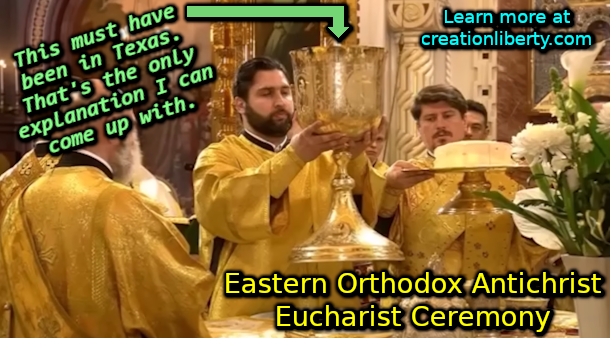
However, this is all a ruse to try and differentiate themselves from their Catholic cousins because if we look at The Orthodox Confession of the Catholic and Apostolic Eastern Church, it says that transubstantiation happens immediately after the hocus-pocus has been spoken in their antichrist Eucharist ritual. We read some of this in the last chapter, but I have included a bit more of the quote, with the new portion in bold to emphasize what we have not yet read:
"In the Moments of Consecration of the holy Gifts,the Priest must firmly and undoubtingly resolve within himself that the Substance of the Bread and the Substance of the Wine are changed into the very Substance of the very Body and Blood of Jesus Christ , by the operation or working of the Holy Ghost, whose Power and Influence let the Priest invoke in these Words, in order to the due Performance of this Mystery: 'O Lord, send down from Heaven thy Holy Spirit upon us, and upon these Gifts now lying before thee; andmake this Bread the precious Body of they Christ, and that which is in this Cup the precious Blood of thy Christ, changing them by thy Holy Spirit.'At these Words there is wrought a Change in the Elements, and the bread becomes the very Body of Christ, and the Wine his very Blood; the Species only remaining, which are perceived by the Sight ;"
-Peter Mogila, The Orthodox Confession of the Catholic and Apostolic Eastern Church, published by T. Baker, 1898, p. 79-80, Cornell University Library, retrieved May 9, 2025, [https://archive.org/details/cu31924029363094/page/n85/mode/2up]
To summarize, Orthodox churchgoers believe that a special recipe of words must be spoken, just like the incantations of spell-casting in witchcraft, to call upon spirits to transform bread and wine into flesh and blood. Not only is it said to be completely transformed, but done so with "
Once the Orthodox priests have finished casting their spell, they believe that the bread they are holding is literal human flesh, and wine in the cup is literal human blood. Therefore, to consume these willingly in a religious ritual means they are participating in cannibalism and vampirism.
transubstantiation (n): the changing of the elements of the bread and wine, when they are consecrated in the Eucharist, into the body and blood of Christ
cannibal (n): a person who eats human flesh, especially for magical or religious purposes
vampirism (n): the acts or practices of vampires
(See 'transubstantiation', 'cannibal' & 'vampirism', Random House Dictionary, 2025, [dictionary.com]; See also Collins English Dictionary, 10th Edition, William Collins Sons & Co, 2012)
Orthodox churchgoers will quickly object, claiming their ritual was commanded by Jesus Christ, often cherry-picking verses from John 6 to justify their position, as we discussed in the previous chapter. They overlook most of Jesus' conversation with the Jewish crowd, jumping to the end and missing that Jesus explained that eating His flesh and drinking His blood was a metaphor for having faith in His promises, leading Orthodox churchgoers to make the same argument as the unfaithful Jews in those verses.
God mentioned cannibalism in the negative sense, not as a commandment, but as a prediction, for an abhorrant punishment:
And ye shall eat the flesh of your sons, and
the flesh of your daughters shall ye eat.
-Leviticus 26:29
And I will cause them to eat the flesh of their sons and the flesh of their daughters, and they shall eat every one the flesh of his friend in the siege and straitness, wherewith their enemies, and they that seek their lives, shall straiten them.
-Jeremiah 19:9
So we boiled my son, and did eat him: and I said unto her on the next day, Give thy son, that we may eat him: and she hath hid her son.
-2 Kings 6:29
"And farthermore, secondly,because that human Nature would abhor and be shocked at the eating of raw Flesh; and yet, nevertheless, by the partaking of the Body and Blood of Christ in this Mystery, a Christian is most closely united with Christ. Therefore, to the End that our Weak Nature might not abominate and reject this necessary Partaking, the divine Goodness hath taken this Method to familiarise and conciliate it unto us, and imparteth unto the Faithful the very Body and the very Blood of Christ for Meat and Drink, under the Covering of Bread and Wine. "
-Peter Mogila, The Orthodox Confession of the Catholic and Apostolic Eastern Church, published by T. Baker, 1898, p. 80, Cornell University Library, retrieved May 9, 2025, [https://archive.org/details/cu31924029363094/page/n87/mode/2up]
If some readers find this statement confusing, I will translate it in simple terms: "We know that it is an abomination to drink the blood and eat the flesh of men, so God put a spoon full of sugar in it to help the medicine go down." Once again, they call it a "mystery" to avoid justifying the practice. If they attempt to justify it, they must return to John 6, and as we learned in chapter two, they adopt the same absurd argument the Jews made against Jesus, as neither the Jews nor Orthodox churchgoers understand what He was teaching.
Let's read these verses again as a reminder to Orthodox churchgoers. Jesus taught us that faith in His Word was what it meant to receive the bread of life:
Then said they unto him, Lord, evermore give us this bread. And Jesus said unto them, I am the bread of life: he that cometh to me shall never hunger; and he that believeth on me shall never thirst. But I said unto you, That ye also have seen me, and believe not... And this is the will of him that sent me, that every one which seeth the Son, and believeth on him, may have everlasting life: and I will raise him up at the last day.
-John 6:34-40
If these verses are to be taken literally, as they so adamantly claim, then why do they still hunger and thirst? Did they not believe strongly enough? The error of the Orthodoxy lies in their rejection of the analogy, refusing to understand that we Christians, granted repentance and faith in Christ, should not be starved of communion with God nor thirst for righteousness because these things are freely given to us by the gift of grace in Jesus Christ.
By participation in their delusional eating of literal human flesh, Orthodox churchgoers demonstrate their hypocrisy. Please note the following image is NOT a real person in a pool of blood:
This Hollywood art show displayed a cake crafted to resemble a murdered body covered in blood, eagerly sampled by a spirit-cooking witch named Marina Abramovic alongside demonic singer Lady Gaga (Stefani Germanotta), causing disgust among many viewers who saw the photo because, though it was fake, it appeared they were consuming real human flesh and blood. We know that likely no one in the Orthodox religion would display this cake in their temples, as most would be repulsed by simply looking at it, but I remind them that it only APPEARS disgusting outwardly while being a delicious cake inside, and yet, when it comes to eating what they believe to be ACTUAL human flesh and drinking REAL human blood, they deem it acceptable and pleasing because it looks and tastes good, revealing their hypocrisy in judging by APPEARANCE only, rather than judging righteous judgment.
Judge not according to the appearance, but judge righteous judgment.
-John 7:24
"In other cases the consumption of particular portions or organs was a ritual means by which certain qualities of the person eaten might be obtained or by which powers of witchcraft or sorcery might be employed. Ritual murder and cannibalism in Africa were often related to sorcery. Headhunters and others oftenconsumed bits of the bodies or heads of deceased enemies as a means of absorbing their vitality or other qualities and reducing their powers of revenge (see also headhunting). The Aztecs apparently practiced cannibalism on a large scale as part of the ritual religious sacrifice of war captives and other victims."
-Britannica, "cannibalism," retrieved May 20, 2025, [https://www.britannica.com/topic/cannibalism-human-behavior]
One might argue that we Christians practice cannibalism through our participation in communion, but there is a huge difference between Orthodoxy and Christianity. We Christians believe what Jesus taught, that the bread represents His flesh sacrificed on the cross, not His literal flesh (because consuming another man is an abomination), and that we partake in communion in remembrance of Him (as He instructed, Luke 22:19), not as a ritual to obtain saving grace.
However, because Orthodox churchgoers believe that they gain the spiritual benefit of saving grace by eating human flesh, they are cannibals. In fact, they are worse than pagan cannibals because they profane the holy name of Christ by slapping a "Jesus" sticker on their cannibalism and calling it "good."

An Orthodox churchgoer on social media got very upset with me over my demotivational poster (as they often do), and he said:
"This is word for word an argument raised by the pagan Romans against Christians in the first and second centuries. "
-@MagMongoose7, x.com, June 12, 2025, retrieved June 13, 2025, [https://x.com/MagMongoose7/status/1933248194244190228]
He cited research papers and books to support his claim that, thousands of years ago, pagans accused his cult's worshipers of cannibalism. The man foolishly believed this was a strong argument, failing to recognize it as a pathetic attempt to poison the well, a logical fallacy.
For example, if I stated that the Jews have committed evil acts, we could all agree because the Bible documents this fact. However, if I then argued that Adolf Hitler said the same, that would not invalidate the argument but would be a feeble attempt to poison the well by linking the statement to someone with a notorious reputation.
The focus should not be on who made the argument, but on whether the argument is correct. This man only demonstrated that pagans in the first few centuries after Christ had more sense than Orthodox churchgoers, because despite their wickedness, they recognized that consuming human flesh is abominable and should not be practiced.
A vampire is a mythical creature said to require consuming human blood to sustain eternal life, a form of cannibalism. Since Orthodox churchgoers believe they gain saving grace and everlasting life by consuming literal human blood, and must do so repeatedly to maintain it, they are engaging in vampirism.
We Christians believe what Jesus taught us, that the wine is an analogy of His blood shed on the cross for our sins, not His literal blood. In His Word, God commanded us (in all dispensations) not to consume blood:
Every moving thing that liveth shall be meat for you; even as the green herb have I given you all things. But flesh with the life thereof, which is the blood thereof, shall ye not eat.
-Genesis 9:3-4
For the life of the flesh is in the blood: and I have given it to you upon the altar to make an atonement for your souls: for it is the blood that maketh an atonement for the soul. Therefore I said unto the children of Israel, No soul of you shall eat blood, neither shall any stranger that sojourneth among you eat blood.
-Leviticus 17:11-12
Wherefore my sentence is, that we trouble not them, which from among the Gentiles are turned to God: But that we write unto them, that they abstain from pollutions of idols, and from fornication, and from things strangled, and from blood.
-Acts 15:19-20
These are only some of the witchcraft rituals performed in the Orthodox cult, but they are sufficient to prove the point. Orthodox churchgoers are often arrogantly enraged to hear me say this, yet this is just the beginning of their many sins, as we will see when we investigate their idolatry.
"Icon. (Gr. "image").A Byzantine-style painting in oil on wood, canvas, paper, or a wall (fresco) representing Christ, the Virgin Mary, or other Saints and scenes from the Bible. The Orthodox Church uses icons for veneration with the understanding that the respect is paid not to the material icon but to the person represented "in spirit and truth" (cf. John 4: 24)"
-Greek Orthodox Archdiocese of America, "Icon," retrieved May 21, 2025, [https://www.goarch.org/-/a-dictionary-of-orthodox-terminology-part-2]
In researching various Orthodox dictionaries, I was disappointed to find no definition of 'idolatry,' as I sought to compare it with their definition of 'icon.' This omission reminded me of how Catholics excluded the second of the Ten Commandments concerning idolatry to sidestep addressing it. To their credit, Orthodox websites included the second commandment in their lists of the Ten Commandments, however, despite its inclusion, my search for a definition of idolatry through their commentary on the Ten Commandments yielded no results.
It should now be unsurprising to readers that, in explaining their worship of images, Orthodox adherents felt compelled to include a justification for this practice. The description of idolatry so closely resembles Orthodox traditions that they are forced to attempt to rationalize them:
"From the earliest times man has been wont to set up and serve gods other than the God of all... Even after the giving of the Ten Commandments at Sinai, the people chased after other gods the Golden Calf, Baal, etc. worshipping objects of wood, stones, or metal, or natural elements such as the sun, moon, stars, etc. Even now we set up idols wealth, money, power, fame, pleasure, etc. and give them the honor and devotion that the Second Commandment tells us is due only to God. The Jews at Sinai were commanded to construct an Ark with golden cherubim at each end (Ex. 25:18-20). When the Israelites were afflicted by poisonous snakes in the Wilderness, Moses constructed a bronze serpent and placed it upon a pole, so that looking upon it, anyone so bitten might live (Num. 21:8-9). When King Solomon constructed the Temple, it was decorated with carved fruits, flowers, trees, and cherubim (1 Kings 6:18,29,32,34-35). The large bronze sea (or basin) in the courtyard was supported by twelve bronze oxen (1 Kings 7:25) and the King's throne was supported by carved lions and had a carved calf's head at the back (1 Kings 10:19-20).
Despite what literalists might say, however, this commandment does not forbid the use of Icons, pictures or representations, whether of wood, stone or whatever.
The key point of this commandment is that these objects are not to be objects of the devotion and worship due solely to God. The devotion that we, as Orthodox, render the icons and other holy objects is a veneration quite apart from that due to God and such was the teaching of the Church Fathers, especially St. John of Damascus. "
-All Saints Greek Orthodox Church, "The Ten Commandments," retrieved May 21, 2025, [https://www.allsaintstoronto.ca/the-ten-commandments]
Pseudo-Christian idolaters of various cults often parrot the same tired argument, twisting Scripture to suit their agenda. They point to God commanding Moses to craft a bronze serpent (Num 21:8-9), claiming it justifies their idolatry.
While they cherry-pick this story to argue that anyone bitten by a venomous snake could look at the serpent and live, they conveniently forget their supposed rejection of sola scriptura. They lean on tradition when it serves them, and when it does not, they lean on their distorted interpretation of the Scriptures, abusing the Word of God in despicable hypocrisy to defend their obsession with crafting and worshiping images.
The obvious point to consider is that God specifically COMMANDED Moses to make the brass serpent. Moses followed instructions directly from God, not made up traditions from a cult feigning itself to be of God. The Lord did this not only as a mercy to the Hebrews, but also to teach them (and us Gentiles) to look to Christ for our spiritual help, not to create images (i.e. icons) and look to them:
And no man hath ascended up to heaven, but he that came down from heaven, even the Son of man which is in heaven. And as Moses lifted up the serpent in the wilderness, even so must the Son of man be lifted up: That whosoever believeth in him should not perish, but have eternal life.
-John 3:13-15
idolatry (n): the worship of idols, images, or any thing made by hands, or which is not God; excessive attachment or veneration for any thing, or that which borders on adoration
veneration (n): the highest degree of respect and reverence; respect mingled with some degree of awe
(See 'idolatry' & 'venerate', American Dictionary of the English Language, Noah Webster, 1828, retrieved May 21, 2025, [webstersdictionary1828.com])
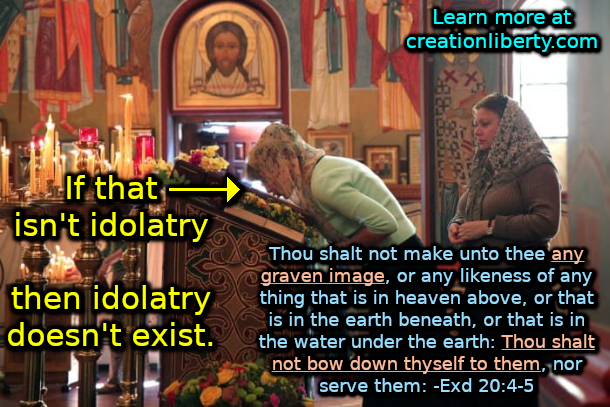
Thou shalt not make unto thee any graven image, or any likeness of any thing that is in heaven above, or that is in the earth beneath, or that is in the water under the earth: Thou shalt not bow down thyself to them, nor serve them: for I the LORD thy God am a jealous God, visiting the iniquity of the fathers upon the children unto the third and fourth generation of them that hate me;
-Exodus 20:4-5
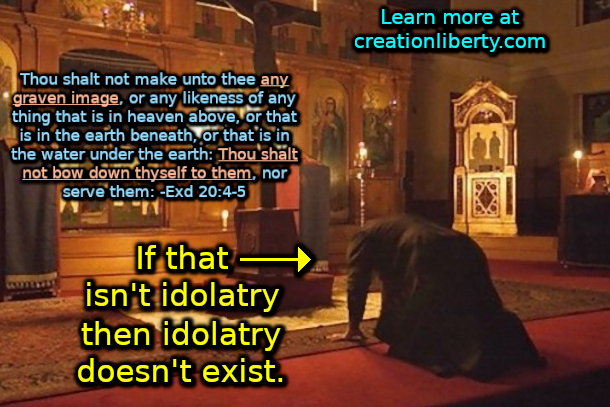
|
If these things are not idolatry, then idolatry does not exist. |
Even though I can show you photographs of Orthodox churchgoers and priests bowing to these images in violation of the commandments of God, an Orthodox priest from the Greek Orthodox Archdiocese of America tells us that the commandment to not bow down to images does not apply to Orthodox churchgoers:
"This commandment does not prohibit the use of icons or other objects of the Church. These objects help the faithful Christian to express his true faith in God;the believer does not 'bow down to them or worship them.' The tabernacle with cherubic pictures on the curtains and sculptured cherubs was not considered idolatry, as it is mentioned in Exodus 36:35-38.The use of statues of a non-existing deity in worship is considered idolatry because the worshipper 'exchanged the glory of the immortal God for images resembling mortal man or birds or animals or reptiles'"
-George Mastrantonis, "The Ten Commandments," Greek Orthodox Archdiocese of America, Aug 13, 1985, retrieved May 23, 2025, [https://www.goarch.org/-/the-ten-commandments]
If the Second Commandment does not apply to the Orthodox cult's use of images, where is that stipulated in Scripture? Short answer: It is not stated anywhere in the Bible; rather, the Orthodox cult declared it of their own volition. Translated, they are saying, "Everyone else is wrong except us because we said so," and that is extreme arrogance.
Furthermore, the Orthodox priest claims their use of icons is justified, asserting it does not involve creating "
For example, the following photograph was taken in the Holy Cross Greek Orthodox Church in Pennsylvania, which shows the altar at which their cult perform all their rituals of worship, and we can see images of mortal men all over the place:
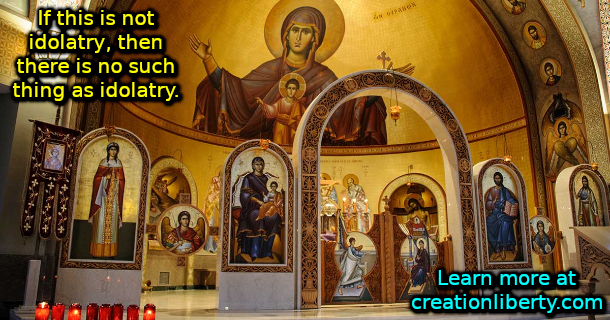
Remember, it was the Orthodox priest who said that idolatry was "
But "NO!" they will cry, "We are not like unto the pagans! How dare you!" However, pagans use the same excuses that Catholic and Orthodox cultists use to justify their worship of images.
The following author is a pagan who was a former Eastern Orthodox churchgoer, and when answering the question "Did the pagans actually worship statues," she said:
"As one of the few modern followers of the ancient Roman Religion, and educated in the fields of archaeology and theology, I can safely say you're on the right track with this. [i.e. She is referring to the question asked.]No pagan religion ever believed the statues, fetishes [i.e. objects associated with religious practice], or images were the gods themselves. Much like Catholic ikonography [i.e. the study of images and their meanings], they were reminders and representations of the gods. Also like the ikons [i.e. the representation of a sacred person], they were made to glorify and praise the god in whose image they were made. "
-Lia Rees, "Did The Pagans Actually Worship Statues?" Quora, Dec 7, 2015, retrieved June 24, 2025, [https://www.quora.com/Did-the-pagans-actually-worship-statues]
I find it amusing whenever Orthodox or Catholic churchgoers echo the arguments of witches, claiming they are not idolaters because they only worship what the image represents. Why not go directly to God to offer praise and honor, as the Bible instructs? Why not abandon all images? They cling to their images because they are clinging to their gods in idolatry, using the logical fallacies of appeal to tradition and appeal to ignorance (i.e. an appeal to "mystery") as a paper shield to avoid accountability for their sins.
In the definition from the Greek Orthodox Archdiocese of America, they said that "
God is a Spirit: and they that
worship him in spirit and in truth.
-John 4:24
Neither Jesus nor His apostles ever instructed us to use material objects in worshiping the Living God, nor did His Word state, "You should not bow down to these things UNLESS you are doing it in my name." No such exception exists. Orthodox churchgoers fail to grasp why idolatry is a sin, and I believe it is imperative to ask: why is it wrong to use material objects as a focal point of worship?
Forasmuch then as we are the offspring of God, we ought not to think that the Godhead is like unto gold, or silver, or stone, graven by art and man's device.
-Acts 17:29
Those who promote idolatry, whether through icons or other means, teach that communication with God requires materialism—or is somehow, without clear explanation, enhanced by it. This belief contradicts the kindness and charity of the Living God.
By implying that one cannot approach God the Father directly through Christ the Son, they proclaim a harsh and uncharitable false god. Thus, icons embody the sin of idolatry—the veneration of an apathetic, cruel deity—and must be wholly condemned, just as we would condemn fornication, drunkenness, or any other sin, because it is a blasphemous description of the Almighty God.
The anonymous author from the Greek Orthodox Archdiocese of America claimed that Orthodox icons do not constitute idolatry, citing the teachings of their "
The following book is used in some Orthodox circles to help train initiates into the Orthodox religion, and the late author, Joan Hussey, was a British Byzantine scholar and historian. She said:
"The position of Constantinople in Christendom was for a time weakened by its eighth and early ninth-century crisis concerning icons, in one sense a continuation of the Christological problem. The long drawn-out dispute in the Eastern Church over the use of icons had deep roots.The early Church avoided figural representation of Christ for various reasons. The second commandment (Exodus 20:4) forbade graven images and there was the strong desire to avoid any kind of idolatry such as was associated with the pagan world. Then both Old and New Testaments stressed that true worship was not concerned with material sacrifices but should be in spirit and in truth. And so in the catacombs Christ was portrayed by means of symbols. Butby the fourth century it was clear that special material objects, such as the Cross and other holy relics, were being widely venerated . Gregory of Nyssa for instance extols the joy of those who touch the very relics of a martyr whom they address with a prayer of intercession just as though he were alive before them.At the same time the pagan cult of the imperial portrait was accepted and integrated into the normal practice of the Christian Empire. It was understandable that this was carried into the practice of the religious world. By the early fifth century the worship of religious images was being practised in the Church [i.e. Catholicism/Orthodoxy], as St Augustine noticed. "
-Joan M. Hussey, The Orthodox Church in the Byzantine Empire, OUP Oxford, 2010, p. ii, ISBN: 9780191614880
Hussey emphasized that the early church avoided icons, recognizing them as idolatrous, and Christians today who have diligently studied and understood the Scriptures continue to identify them as such. Only idolaters, such as those in the Orthodox cult—who kiss, bow, and pray to their icons—claim that these practices are not idolatry.
To preface this next quote, I do not believe that Origen of Alexandria was a Christian, primarily due to his ecumenical belief in "universal salvation," an antichrist heresy which claims all sinners, devils, and even Satan can be purified through works or punishments, exposing his unbelief in the Gospel of Salvation in Christ. Nevertheless, pseudo-Christian cults like Catholicism, Anglicanism, and Orthodoxy highly revere him.
While Origen is not deemed a "saint" in the Orthodox cult, he is still honored, yet it is rarely known that he condemned their practice of praying to icons:
"[I] is not possible at the same time to know God and to address prayers to images... Moreoever, we do not imagine that these images are representations of God, for they cannot represent a being who is invisible and incorporeal. "
-Origen of Alexandria, The Ante-Nicene Fathers: Translations of the Writings of the Fathers Down to A.D. 325, C. Scribner's Sons, 1905, Vol. 4, p. 637, [Princeton University]
Later in the same document (p. 687), Origen quotes statements from Celsus, a Greek philosopher and critic of Christianity, who stated that the Christians he debated at that time "
Wherefore, my dearly beloved, flee from idolatry.
-1 Corinthians 10:14
Orthodox churchgoers greatly revere Justin Martyr as one of their "saints," honoring him through liturgical hymns and prayers, yet he endorsed the antichrist doctrine of infant baptism and the heresy that secular philosophers were "Christians" without faith in Christ. Despite these blatant contradictions to God's Word, Justin Martyr also condemned the use of icons:
"And this is the sole accusation you bring against us, thatwe do not reverence the same gods as you do, nor offer to the dead libations [i.e. drink offerings] and the savour of fat [i.e. sweet smell of roasted fat of a sacrifice], and crowns for their statues, and sacrifices. "
-Justin Martyr, First Apology, Chapter 9, "Folly of idol worship," retrieved June 25, 2025, [https://www.newadvent.org/fathers/0126.htm]; See also The Sacred Writings of Justin Martyr (Annotated Edition), Jazzybee Verlag, 2012, ISNB: 9783849621391
Although Orthodox churchgoers may not put crowns on statues near as much as they put them on paintings, it is the same concept in a different format. Once again I argue that if this is not idolatry, then there is no such thing as idolatry:

Another Orthodox "church father," 4th century author Lucius Lactantius, also wrote condemnation of Orthodox icons:
"Wherefore,it is undoubted that there is no religion wherever there is an image. For if religion consists of divine things, and there is nothing divine except in heavenly things; it follows that images are without religion, because there can be nothing heavenly in that which is made from the earth. And this, indeed, may be plain to a wise man from the very name. [i.e. the translation 'simulacrum' is an image, from 'simulo' to imitate']For whatever is an imitation, that must of necessity be false; nor can anything receive the name of a true object which counterfeits the truth by deception and imitation. "
-Lucius Lactantius, Ante-Nicene Christian Library: Translations of the Writings of the Fathers Down to A.D. 325, T. and T. Clark, 1871, Vol. 1, p. 136, [Yale University Library]
Lactantius made the same the argument I presented at the start of chapter three: spiritual things are unaffected by the material world. Crafted images are mere imitations of the physical, created realm, and thus, objects fashioned by human hands cannot be divine any more than a child's colored pencils can create a rocket ship capable of space travel.
Richard Price, Professor of the History of Christianity at the University of London, wrote a book called The Acts of the Second Council of Nicaea (787), and he said:
"Butthe iconoclast claim that reverence towards images did not go back to the golden age of the fathers, still less to the apostles, would be judged by impartial historians today to be simply correct. The iconophile [i.e. Orthodox] view of the history of Christian thought and devotion was virtually a denial of history, in favour of a myth of a religion that had been perfect from the first and needed no addition or subtraction. "
-Richard Price, The Acts of the Second Council of Nicaea (787), Liverpool University Press, 2020, p. 43, ISBN: 9781789621570
If some readers did not fully understand Price's point, Orthodox teachings on icons lack historical foundation. Orthodox churchgoers have been deceived into accepting a carefully crafted myth that was cultivated over many centuries, but sadly, the vast majority of them do not care about being scammed because they care more about feeling righteous than being righteous by the gift of Christ.
An 'iconoclast' is the term Orthodox churchgoers use for those who reject icons—in other words, Christians who refuse to engage in idolatry. While Price's claim that the church was "
Orthodox teaching also requires that their icons be made in the very creepy and weird style of 4th-5th century artwork. Why this particular style? They call it "tradition," but to believe that a painting's art style would contain some sort of magical powers to grant wishes is nothing more than silly superstition.
Then Paul stood in the midst of Mars' hill, and said, Ye men of Athens, I perceive that in all things ye are too superstitious.
-Acts 17:22
superstition (n): excessive, exactness or rigor in religious opinions or practice; extreme and unnecessary scruples in the observance of religious rites not commanded, or of points of minor importance; excess or extravagance in religion; the doing of things not required by God, or abstaining from things not forbidden; or the belief of what is absurd, or belief without evidence
(See 'superstition', American Dictionary of the English Language, Noah Webster, 1828, retrieved May 29, 2025, [webstersdictionary1828.com])
-Eusebius, Church History (Book I), Chapter 13, New Advent, retrieved June 13, 2025, [https://www.newadvent.org/fathers/250101.htm]
In the story, Jesus wrote a letter to Abgarus, promising to send someone to heal him later. After Jesus' death and resurrection, Thaddeus, purportedly one of the 70 disciples chosen by Christ (Luke 10:17), visited the city and healed Abgarus. I will not debate the story's truthfulness, because it seems plausible, but not only is this unverifiable, Eusebius never mentioned any images in this account. Later, Orthodox "traditions" stemming from the Doctrine of Addai, written in the late 4th to early 5th century (over a century after Eusebius), mysteriously inserting a "painting of Jesus" into the narrative.
Evidently, this story evolved over time, gradually incorporating the abominations of idolatry. To be clear, a painting itself is not inherently idolatrous, but by the late 6th century, when Ecclesiastical History was published, it described the painting as an image sent to Abgarus by Jesus Christ, bearing an imprint of His face:
"In this state of utter perplexity, they bring the divinely wrought image, which the hands of men did not form, but Christ our God sent to Abgarus on his desiring to see Him. Accordingly, having introduced this holy image into the mine, and wahsed it over with water, they sprinkled some upon the timber; and the divine power forthwith being present to the faith of those who had so done, the result was accomplished which had previously been impossible;"
-Evagrius, Ecclesiastical History (A.D. 431-594), translated by E. Walford, p. 220, retrieve June 13, 2025, [https://archive.org/details/evagrius-church-history-431-594/page/220/mode/2up]
Again, this story remains unverifiable, shifting from reasonably plausible to foolish to utterly absurd within 300 years. Yet, this is the tradition Orthodox cultists call the "Mandylion" or "Image Made Without Hands," and now these idolaters believe they can bow and pray to this image, and receive spiritual blessings from it.
Numerous other examples exist to prove that Orthodoxy is long-term hyperbole, but it is unnecessary to address them all; I simply aim for readers to recognize this is not an isolated case. The Orthodox cult claims to be the "unchanging" church (which we will explore in chapter six), but as is evident, they have changed repeatedly, adapting their rituals to align with unsubstantiated pagan ideology.
Orthodox churchgoers frequently scoff in rage that if you do not accept their icons, you are an anathema, accursed to damnation and destruction, as was stated by the Second Council of Nicaea in the sixth century:
"We salute the venerable images.We place under anathema those who do not do this. Anathema to them who presume to apply to the venerable images the things said in Holy Scripture about idols. Anathema to those who do not salute the holy and venerable images. Anathema to those who call the sacred images idols. Anathema to those who say that Christians resort to the sacred images as to gods. "
-Second Council of Nicaea, Session 6, "The Decree," retrieved June 25, 2025, [https://www.newadvent.org/fathers/3819.htm]
Furthermore, the Orthodox cult states that if you do not accept icons, you reject salvation:
"To them who in words accept the Economy of the Incarnation of the Word of God, but will not tolerate its representation by icons, and thus in word they make a pretense of accepting, but in fact deny our salvation, Anathema... To them who consider the declarations of Divine Scripture against the idols as referring to the venerable icons of Christ our God and His saints, Anathema... If anyone does not worship our Lord Jesus Christ depicted in the icons according to His humanity, let him be, Anathema. "
-The Synodikon of Orthodoxy, "Synodicon of the Holy and Ecumenical Seventh Council for Orthodoxy," 843, retrieved June 25, 2025, [https://oodegr.com/english/ekklisia/synodoi/synodicon_of_orthodoxy.htm]
Without hestitation, I boldly declare to anyone who holds such beliefs that you stand anathematized by the Living God for your heresies that contradict the Holy Scriptures. The Holy Ghost, through Paul's writings, clearly stated that all who preach another gospel are accursed:
But though we, or an angel from heaven, preach any other gospel unto you than that which we have preached unto you, let him be accursed. As we said before, so say I now again, If any man preach any other gospel unto you than that ye have received, let him be accursed.
-Galatians 1:8-9
The following comes from the Orthodox Church in America website, in a Q&A section where another anonymous Orthodox priest attempts to answer the contradiction of a sinless woman:
"I can say, in short, thatthe Orthodox Church believes that Mary, as a human being, could indeed have sinned, but chose not to. "
-Orthodox Church in America, "Sinlessness of Mary," retrieved May 23, 2025, [https://www.oca.org/questions/saints/sinlessness-of-mary]
By asserting that Mary "
However, that leaves us with a compelling question: Why did she need a savior? Mary called God her savior, but if she was without sin, why would she need salvation?
And Mary said, My soul doth magnify the Lord,
And my spirit hath rejoiced in God my Saviour.
-Luke 1:46-47
And she shall bring forth a son, and thou shalt call his name JESUS: for he shall save his people
-Matthew 1:21
This concept is so straightforward, it is shameful to explain it to Orthodoxy's elite hiearchy, as if I were teaching children. These men hypocritically claim to uphold the traditions of Christ and His apostles, but do not understand the basics of these principles.
For when for the time ye ought to be teachers, ye have need that one teach you again which be the first principles of the oracles of God; and are become such as have need of milk, and not of strong meat. For every one that useth milk is unskilful in the word of righteousness: for he is a babe. But strong meat belongeth to them that are of full age, even those who by reason of use have their senses exercised to discern both good and evil.
-Hebrews 5:12-14
In chapter three, we read from an Orthodox website, explaining that Orthodoxy gives Mary the title, "Ever-Virgin," and Orthodox priest John Hainsworth of the Greek Orthodox Archdiocese of America parrots this by presuming that everyone should accept this heresy:
"Why not believe in her ever-virginity? The Eastern Church has witnessed to the perpetual virginity of the Theotokos steadfastly for two thousand years and shows no sign of tiring. "
-John Hainsworth, "The Ever-Virginity of the Mother of God," Greek Orthodox Archdiocese of America, Aug 17, 1989, retrieved May 23, 2025, [https://www.goarch.org/-/the-ever-virginity-of-the-mother-of-god]
Orthodox cultists frequently use Greek phrases, much like Catholic cultists use Latin ones, knowing that the average person does not understand them, as it creates an illusion of intellectual superiority. However, when their words are closely examined, their arguments quickly reveal themselves to be utterly foolish.
For example, in this quote, the word 'Theotokos' simply means Mary gave birth to the Son of God, but Orthodox cultists add that she was, is, and always will be a virgin. Thus, the Orthodox priest argues that because their cult has taught this for a long time, it should be accepted by all without question, committing a fallacy of presumption by taking the idea for granted without providing evidence.
The Orthodox "Theotokos" (or their idea that Mary is "ever-virgin") is nothing more than pagan philosophy because Mary had other children with her husband, Joseph, after the birth of Christ:
Is not this the carpenter's son? is not his mother called Mary? and his brethren, James, and Joses, and Simon, and Judas?
-Matthew 13:55
Is not this the carpenter, the son of Mary, the brother of James, and Joses, and of Juda, and Simon? and are not his sisters here with us? And they were offended at him.
-Mark 6:3
In chapter three, when we looked at the witchcraft symbolism on the Orthodox altar bread, the left side sometimes had a giant 'M', which stands for "Mary" or "Mother of God," and that is supposed to represent their "ever-virgin" concept. They claim this practice is supported by Psalm 45:
Kings' daughters were among thy honourable women: upon thy right hand did stand the queen in gold of Ophir.
-Psalm 45:9
Husbands, love your wives, even as Christ also loved the church, and gave himself for it; That he might sanctify and cleanse it with the washing of water by the word, That he might present it to himself a glorious church, not having spot, or wrinkle, or any such thing; but that it should be holy and without blemish.
-Ephesians 5:27-29
Let us be glad and rejoice, and give honour to him: for the marriage of the Lamb is come, and his wife hath made herself ready. And to her was granted that she should be arrayed in fine linen, clean and white: for the fine linen is the righteousness of saints. And he saith unto me, Write, Blessed are they which are called unto the marriage supper of the Lamb. And he saith unto me, These are the true sayings of God.
-Revelation 19:7-9
I will greatly rejoice in the LORD, my soul shall be joyful in my God; for he hath clothed me with the garments of salvation, he hath covered me with the robe of righteousness, as a bridegroom decketh himself with ornaments, and as a bride adorneth herself with her jewels.
-Isaiah 61:10
Despite these facts, Hainsworth makes an appeal to tradition, the logical fallacy which we covered in the introduction to this book. This fallacy is the only hope Orthodox churchgoers have to defend their ideology. To answer the question of why churchgoers should believe that Mary was "
This response is insane because, as I have shown, there is no Biblical basis for it, making it not only an appeal to tradition, but once again, an argument from ignorance (i.e. argumentum ad ignorantiam), which is their "mystery" fallacy. Instead of offering evidence to support his claim, he deflects by turning the question back on the questioner and then relies on the appeal to tradition fallacy to justify it.
I would like to see the proof that an "ever-virgin" Mary was taught "
From my observation, Orthodox churchgoers rarely state their true beliefs about Mary directly, because doing so would expose them to be idolaters, even by their own definition of idolatry. They are indeed idolaters but strive to avoid appearing as such. A focused picture of their beliefs emerges by examining the lyrics of their "liturgy," which refers to their hymns or songs of praise.
What someone sings in praise to God should be in accordance with their beliefs, and even the Bible teaches us that we should sing with understanding:
For God is the King of all the earth:
sing ye praises with understanding.
-Psalm 47:7
What is it then? I will pray with the spirit, and I will pray with the understanding also: I will sing with the spirit, and I will sing with the understanding also.
-1 Corinthians 14:15
"The living experience of the Christian [i.e. Orthodox]sacramental and liturgical life is a primary source of Christian doctrine . In the liturgy of the Church, the Bible and the Holy Tradition come alive and are given to the living experience of the Christian people. Thus,through prayer and sacramental worship, men are 'taught by God' as it was predicted for the messianic age (Jn 6.45) ."
-Orthodox Church in America, "The Liturgy," retrieved May 28, 2025, [https://www.oca.org/orthodoxy/the-orthodox-faith/doctrine-scripture/sources-of-christian-doctrine/the-liturgy]
This author claims that being "
This author further proves that Orthodoxy selectively cherry-picks Scripture, often citing verses that fail to support their claims. For example, while John 6:45 states that Christians are "taught by God," it does NOT suggest that this occurs through "
It is written in the prophets, And they shall be all taught of God. Every man therefore that hath heard, and hath learned of the Father, cometh unto me.
-John 6:45
Search the scriptures; for in them ye think ye have eternal life: and they are they which testify of me.
-John 5:39
These were more noble than those in Thessalonica, in that they received the word with all readiness of mind, and searched the scriptures daily, whether those things were so.
-Acts 17:11
For he mightily convinced the Jews, and that publickly, shewing by the scriptures that Jesus was Christ.
-Acts 18:28
And that from a child thou hast known the holy scriptures, which are able to make thee wise unto salvation through faith which is in Christ Jesus.
-2 Timothy 3:15
"Calling to remembrance our all-holy, immaculate, most blessed and glorious Lady Theotokos and ever-virgin Mary , with all the Saints, let us commend ourselves and each other, and all our life unto Christ our God."
-St. John Chrysostom Antiochian Orthodox Church, "Divine Liturgy of St. John Chrysostom," retrieved May 28, 2025, [https://www.orthodoxyork.org/liturgy.html]
As we can see from their liturgy, which they take to be the official doctrine of the Orthodox cult, they believe that Mary was "
Wherefore gird up the loins of your mind, be sober, and hope to the end for the grace that is to be brought unto you at the revelation of Jesus Christ; As obedient children, not fashioning yourselves according to the former lusts in your ignorance: But as he which hath called you is holy, so be ye holy in all manner of conversation; Because it is written, Be ye holy; for I am holy.
-1 Peter 1:13-16
holy (adj): Properly, whole, entire or perfect, in a moral sense. Hence, pure in heart, temper or dispositions; free from sin and sinful affections. Applied to the Supreme Being, holy signifies perfectly pure, immaculate and complete in moral character; and man is more or less holy as his heart is more or less sanctified, or purified from evil dispositions. We call a man holy when his heart is conformed in some degree to the image of God, and his life is regulated by the divine precepts. Hence, holy is used as nearly synonymous with good, pious, godly.
(See 'holy', American Dictionary of the English Language, Noah Webster, 1828, retrieved May 28, 2025, [webstersdictionary1828.com])
As Noah Webster correctly noted, to be immaculate (i.e. free from spot or stain) applies solely to Almighty God, not mortal men, yet Orthodox cultists describe Mary as "
Here is more of their liturgy from Saint Jonah Orthodox Church:
"We praise Thee, we bless Thee, we give thanks unto Thee, O Lord; and we pray unto Thee, O our God.Especially for our most holy, most pure, most blessed, glorious Lady Theotokos and Ever-Virgin Mary. It is truly meet to bless thee, the Theotokos, ever-blessed and most blameless, and Mother of our God. More honorable than the Cherubim, and beyond compare more glorious than the Seraphim, thee who without corruption gavest birth to God the Word, the very Theotokos, thee do we magnify. "
-Saint Jonah Orthodox Church, "The Divine Liturgy," retrieved May 28, 2025, [https://www.saintjonah.org/services/liturgydoc.htm]
Need I say more? They lift Mary up to divine status, claiming that she is "
(Read Feminism: Castrating America at creationliberty.com for more details.)
Orthodox churchgoers typically argue that Jesus said that Mary was blessed, but nearly every time they allude to that verse, they are paraphrasing or cherry-picking what is in it, instead of reading the whole passage. Lets take a look for ourselves:
And it came to pass, as he spake these things, a certain woman of the company lifted up her voice, and said unto him, Blessed is the womb that bare thee, and the paps which thou hast sucked. But he said,
-Luke 11:27-28
Therefore, we Christians ought to study the Word of God to show ourselves approved of Him, rather than rely on the vanity of pretentious rituals:
Study to shew thyself approved unto God, a workman that needeth not to be ashamed, rightly dividing the word of truth. But shun profane and vain babblings: for they will increase unto more ungodliness.
-2 Timothy 2:15-16
Here are some more heretical passages of Orthodox liturgy:
"Commemorating our most holy, pure, blessed, and glorious Lady, the Theotokos and ever-virgin Mary, with all the saints, let us commend ourselves and one another and our whole life to Christ our God. "
-Greek Orthodox Archdiocese of America, "The Divine Liturgy of Saint John Chrysostom," retrieved May 29, 2025, [https://www.goarch.org/-/the-divine-liturgy-of-saint-john-chrysostom]
Some readers might be confused why I would say it is heresy to dedicate one's life to Jesus Christ, but we need to read it carefully. They are dedicating their lives to Christ IN HONOR OF MARY, which is what the word 'commemorate' means, that is, to do or observse something in the memory of, in this case, their goddess.
When someone requests a moment of silence from an audience, do they fall silent for the sake of silence itself? Is silence revered? No, they remain silent to honor the person being commemorated, meaning it is not the silence that is honored, but the individual to whom the silence is dedicated, and this is precisely what we see in the Orthodox liturgy, where their lives are offered to Christ FOR Mary, making her the foundation of their faith.
Here is more of the Orthodox liturgy:
"So that they may be for those who partake of them for vigilance of soul, remission of sins, communion of Your Holy Spirit, fullness of the Kingdom of Heaven, boldness before You, not for judgment or condemnation. Again,we offer You this spiritual worship for those who have reposed in the faith: forefathers, fathers, patriarchs, prophets, apostles, preachers, evangelists, martyrs, confessors, ascetics, and for every righteous spirit made perfect in faith,Especially for our most holy, pure, blessed, and glorious Lady, the Theotokos and ever-virgin Mary. "
-Greek Orthodox Archdiocese of America, "The Divine Liturgy of Saint John Chrysostom," retrieved May 29, 2025, [https://www.goarch.org/-/the-divine-liturgy-of-saint-john-chrysostom]
As we can see, Orthodox churchgoers offer spiritual worship to God for the sake of others, not Jesus Christ, revealing that their worship is not truly directed toward Him. They emphasize a host of figures as the foundation of their worship, most notably Mary, proving once again that the gods of their faith are their so-called "church fathers" (to be addressed in the next chapter), who all rest on the shoulders of their primary goddess.
The following is an Orthodox liturgy used during Lent:
"O Christ, the True Light, Who enlightenest and sanctifiest every man that cometh into the world: Let the Light of Thy countenance be signed upon us, that in it we may see the Unapproachable Light, and guide our steps in the doing of Thy commandments,through the intercessions of Thy most pure Mother, and of all Thy saints. Amen.To Thee, the Champion Leader, we Thy servants dedicate a feast of victory and of thanksgiving as ones rescued out of sufferings, O Theotokos [i.e. Mary]: but as Thou art one with might which is invincible, from all dangers that can be do Thou deliver us, that we may cry to Thee: Rejoice, Thou Bride Unwedded!
-St. Jonah Orthodox Church, "The First Hour," retrieved May 29, 2025, [https://www.saintjonah.org/services/firsthour.htm]
At first glance, when they said "
Notice the enlightenment of Christ, His sanctification, and His guiding the steps of mankind is dedicated to the intecession of Mary and a bunch of dead men they call "saints." The Bible tells us there is only one mediator between God and men, and that is Jesus Christ, but Orthodox theology teaches that Mary and bunch of other dead guys are the mediators that make intercession for us.
For there is one God, and
God and men, the man
-1 Timothy 2:5
Likewise the Spirit also helpeth our infirmities: for we know not what we should pray for as we ought: but the Spirit itself maketh intercession for us with groanings which cannot be uttered. And he that searcheth the hearts knoweth what is the mind of the Spirit, because he maketh intercession for the saints according to the will of God.
-Romans 8:26-27
Who is he that condemneth?
-Romans 8:34
By so much was
-Hebrews 7:22-25
"Today the Virgin stands in the midst of the Church, and with choirs of saints she invisibly prays to God for us. Angels and bishops worship, apostles and prophets rejoice together, since for our sake she prays to the pre-eternal God. "
-The Liturgy Archive, "Orthodox Readings for The Protection of the Mother of God," retrieved May 29, 2025, [https://www.liturgies.net/saints/mary/protection/readings.htm]
Worship and praise are given to Mary in these passages, not Jesus Christ. They can claim that they give praise to Christ in other passages of their hymns, but that is irrelevant when Mary overwrites Jesus in other places, or in other words, worship of her negates worship of Him. They may pretentiously say they are giving their worship to Jesus Christ, but in truth they are doing it because of Mary, not because of Christ, which means that, no matter how many excuses they want to make, they worship Mary as their goddess of salvation.
If you think I am exaggerating Mary's role in the pagan cult of Orthodoxy, read this next passage carefully:
"O Theotokos [i.e. Mary], with your veil which shines brighter than the rays of the sun, God sanctified you with the Holy Spirit even more than the ark of Aaron. You enlighten the Church and the people, and drive away the darkness of our sins. Save from tribulation and affliction those who honour with faith the feast of your holy Protection. "
-The Liturgy Archive, "Orthodox Readings for The Protection of the Mother of God," retrieved May 29, 2025, [https://www.liturgies.net/saints/mary/protection/readings.htm]
To clarify, they claim that Mary has more authority than the high priests appointed by God, which is more feminist ideology. They claim that Mary enlightens (i.e. gives knowledge to) the church, remits sin, and saves people from tribulation and affliction, but only to those who worship HER in Orthodox rituals.
To argue against the accusation of idolatry and heresy, the website Orthodox Christianity has an article by Orthodox archbishop Dmitri Royster, in which he says:
"Objections to the veneration of the Theotokos are based primarily on what is called 'a lack of scriptural evidence to support such a practice.' While it is true that the Church depends heavily on her Tradition other than Holy Scripture (Ecumenical Councils, liturgical books, and the writings of the Fathers) for details and the precise definition of the nature of the veneration of the Virgin Mary, there are several passages of the New Testament that really form the basis for our practice."
-Dmitri Royster, "The Veneration of the Virgin Mary in the Orthodox Church," Orthodox Christianity, May 29, 2025, [https://pravoslavie.ru/58526.html]
This is incorrect because the argument extends far beyond a mere "
Royster continues:
"The angel Gabriel was sent by God to announce to the Virgin the birth of the Saviour: 'Hail, full of grace, the Lord is with thee. Blessed art thou among women.' (Luke 1:28) This angelic salutation forms a part of the hymn of the Church most frequently sung in her honor. Could we be wrong in repeating the words of the very messenger of God? Elizabeth, the Virgin's cousin, considered it an honor for the Mother of her Lord to visit her. 'And whence is this to me that the Mother of my Lord should come to me?' (Luke 1:43) Is there any real difference between saying 'Mother of God' and 'Mother of the Lord'? Surely, God is the Lord! (Psalm 118:27) In the course of her visit to Elizabeth, the Blessed Virgin spoke the words that form the principal hymn sung in her honor at the Matins service."
-Dmitri Royster, "The Veneration of the Virgin Mary in the Orthodox Church," Orthodox Christianity, May 29, 2025, [https://pravoslavie.ru/58526.html]
I included this quote to warn Christians about the subtle and cunning ways Orthodox cultists justify their beliefs, requiring careful discernment to avoid being sidetracked from the core issue with their ideology. He claims there is nothing wrong with calling Mary blessed or the Mother of God, and I agree because that is NOT the point of contention for those of us rebuking Orthodox ideology; rather, Orthodox churchgoers center their worship on her as a goddess with divine power and influence, as I have already shown, rendering his Scriptural references irrelevant to addressing the fundamental problem with their doctrine.
And the angel came in unto her, and said, Hail, thou that art highly favoured, the Lord is with thee: blessed art thou among women.
-Luke 1:28
Orthodox churchgoers claim they do not worship Mary, but worship involves giving divine honor to that which is not God, which is precisely what they do. In contrast, Scripture states that Joseph, son of Jacob, was also highly favored, and if Orthodox churchgoers would be consistent in their philosophy, then they ought to worship Jacob as well.
And it came to pass from the time that he had made him overseer in his house, and over all that he had, that the LORD blessed the Egyptian's house for Joseph's sake; and the blessing of the LORD was upon all that he had in the house, and in the field. And he left all that he had in Joseph's hand; and he knew not ought he had, save the bread which he did eat. And Joseph was a goodly person, and well favoured.
-Genesis 39:5-6
The answer is simple. The Marian worship of Orthodoxy is a logical fallacy because it is nothing more than appeal to tradition, relying on the inventions of men for a pretense of righteousness.
The Bible describes Mary as a woman blessed by God, but does it follow that she should be worshiped in song as the savior of mankind? Is it reasonable to claim that Christ should be served because of her graces? Only the ravings of a deranged mind would leap to the conclusion—without any Biblical or other historical proof—that because God favored a woman for a specific purpose, she now roams the earth in spiritual form (have godlike omnipresent to be in all Orthodox temples at the same time), interceding for Orthodox cultists who worship her.
Orthodoxy is pagan repackaged.
Royster, I suspect, secretly knows there is no justification to be had in these weak, senseless arguments, so he is forced to dive head first into a lake of absurdity:
"Finally, when Jesus saw His mother and the disciple John standing by the cross, He entrusted him with her care, butHe also established a new spiritual relationship between them in saying to the disciple: 'Behold thy Mother!' (John 19:27) What possible significance could this declaration of our Lord have except to make His Mother the Mother of all Christians? If she really had other children would she be in need of an outsider's home? "
-Dmitri Royster, "The Veneration of the Virgin Mary in the Orthodox Church," Orthodox Christianity, May 29, 2025, [https://pravoslavie.ru/58526.html]
Then saith he to the disciple, Behold thy mother! And from that hour that disciple took her unto his own home.
-John 19:27
Unlike Orthodox priests, who revel in luxury and bask in the splendor of their ornate hats and polished temples, Jesus owned nothing in this world. (Mat 8:20) In Jewish society, sons had a duty to provide for their mothers in times of need, and I would argue such a practice should still be done today because it is charitable. This would not have been necessary if Joseph, Mary's husband, were still alive, suggesting he was likely deceased by then. Thus, in a remarkable act of humility and kindness, while bleeding and suffering on the cross, Jesus prioritized the care of others over Himself, and by ensuring His mother's care, He honored the fifth commandment (Exd 20:12), pleasing God the Father.
Furthermore, in the verse that follows, Jesus said "I thirst," and this is because He had been hanging and bleeding in extraordinary pain on that cross for hours. The fact that He had consciousness to speak the words "Behold, thy mother!" is amazing, and it would be unreasonable to suggest that He should have clarified in contractual terms the details about caring for Mary's carnal needs, especially since He died moments after that point.
If we are take this passage to mean that Mary then became John's mother, and subesquently everyone's mother, based on no evidence whatsoever, then I want Orthodox churchgoers to be consistent in their ideology and start worshiping me. Please do not misunderstand my point because I have no desire to be worshiped, nor is it conceivable that I, as a wicked sinner given grace by Christ, would ever deserve to be worshiped in any sense, but hear out my argument by considering the following verses:
There came then his brethren and his mother, and, standing without, sent unto him, calling him. And the multitude sat about him, and they said unto him, Behold, thy mother and thy brethren without seek for thee. And he answered them, saying, Who is my mother, or my brethren? And he looked round about on them which sat about him, and said, Behold my mother and my brethren! For
-Mark 3:31-35
The Jews expected Jesus to prioritize His fleshly blood relatives, but He demonstrated that, spiritually, blood ties hold no significance or relevance. The Almighty God values those who tremble at His Word, making those who come to repentance and faith in Christ His true family. Just as Orthodox churchgoers can grasp that Jesus was addressing the nature of family in the church, they should also understand that John was called by Christ to care for Mary in her old age, ensuring she had a man to provide for her, knowing that it is just as absurd to worship me as it is to worship Mary.
For this cause I bow my knees unto the Father of our Lord Jesus Christ, Of whom the whole family in heaven and earth is named,
-Ephesians 3:14-15
For all those things hath mine hand made, and all those things have been, saith the LORD: but to this man will I look, even to him that is poor and of a contrite spirit, and trembleth at my word.
-Isaiah 66:2
Despite the lack of indication or correlating Biblical support, the ridiculous interpretation that Mary somehow magically became "
"All-holy Lady, Theotokos, the light of my darkened soul, my hope and protection, my refuge and consolation, and my joy, I thank you that you have made me worthy, though I am unworthy, to partake of the pure Body and precious Blood of your Son. But as the one who gave birth to the true Light: enlighten the noetic eyes of my heart. You who conceived the source of immortality, give life to me, dead in sin. You who are the compassionately loving Mother of the merciful God, have mercy on me and give my heart compunction and contrition, humility in my thoughts, and release from my captive thoughts. And make me worthy until my final breath to receive without condemnation the sanctification of the pure Mysteries for the healing of both soul and body. And grant me tears of repentance and confession, that I may praise and glorify you all the days of my life. For you are blessed and glorified unto the ages. Amen. "
-Greek Orthodox Archdiocese of America, "The Divine Liturgy of Saint John Chrysostom," retrieved May 30, 2025, [https://www.goarch.org/-/the-divine-liturgy-of-saint-john-chrysostom]
The word 'amen' means "truly" or "of truth," and they say "
In their insanity, Orthodox churchgoers worship Mary in their so-called "holy" feast days, such as the Dormition of the Theotokos (Aug 15), the Nativity of the Theotokos (Sept 8), and the Presentation of the Theotokos in the Temple (Nov 21), just to name a few. Obviously, Orthodox priests did not draw these things from the Holy Scriptures, so where did they get these ideas?
There is a well-known book among Orthodox churchgoers called The Life of the Virgin Mary, the Theotokos, written in the late 1980s by the priests of the Holy Apostles Convent in Colorado. These priests explain that the details of the life of Mary in Orthodox beliefs come from apocryphal books:
"What is known about her [i.e. Mary's] background is to be found in the Holy Gospels, the Acts of the Apostles, and only those portions of various apocryphal accounts which have, in part, been accepted by the Church. [i.e. Orthodoxy]"
-Holy Apostles Convent, The Life of the Virgin Mary, the Theotokos, Dormition Skete, 1989, p. vii-viii, ISBN: 0944359035, retrieved June 4, 2025, [https://archive.org/details/lifeofvirginmary0000unse/page/n17/mode/2up]
There are not many details about Mary in the Bible, which means that God did not want us to concern ourselves with the details about her life. We Christians ought to concern ourselves with the life of Christ. The details of the life of Mary, such as the name of her parents, allegedly being Joachim and Anna, are found in apochryphal books.
apocrypha (n): books whose authors are not known; whose authenticity, as inspired writings, is not admitted, and which are therefore not considered a part of the sacred canon of the scripture; when the Jews published their sacred books, they called them canonical and divine; such as they did not publish, were called apocrypha
(See 'apocrypha', American Dictionary of the English Language, Noah Webster, 1828, retrieved June 4, 2025, [webstersdictionary1828.com])
The authors point out that they are not referring the apocryphal books found in corrupt bible versions, such as Maccabees, Esdras, Tobit, Judith, etc. The authors note that the apocryphal books they are talking about are those written "
-Holy Apostles Convent, The Life of the Virgin Mary, the Theotokos, Dormition Skete, 1989, p. viii, ISBN: 0944359035, retrieved June 4, 2025, [https://archive.org/details/lifeofvirginmary0000unse/page/n19/mode/2up]
Based on this testimony, any reasonable person would conclude that we cannot trust what is written in such books, but as you can probably guess, the Orthodox cult trusts in them anyway, despite the fact that their own scholars have condemned them. Please read the following carefully while remembering their condemnation of the texts because this is insanity that I cannot hope to cure:
"However, in several instances the holy Fathers of the Church, together with the hymnographers and the iconographers—with great spiritual discernment—borrowed from and expanded certain episodes within the Apocrypha. They believed that these accounts, like buried pearls, were valid and edifying, and, having incorporated them into their writings, these accounts have become part of the ancient Tradition. "
-Holy Apostles Convent, The Life of the Virgin Mary, the Theotokos, Dormition Skete, 1989, p. viii, ISBN: 0944359035, retrieved June 4, 2025, [https://archive.org/details/lifeofvirginmary0000unse/page/n19/mode/2up]
By their own admission, the Orthodox priests confirmed these books were of skeptical and unknown authorship, they contradict the Holy Scriptures, and they incorporate heathen ideologies, but these crackpot lunatics chose to embrace them anyway, and over time, they built all their crazy rituals and traditions out of them. The reason this is important for this chapter is because one of the apocryphal books, the Protoevangelium of James, is the justification used for Orthodoxy's Marian worship, as they go on to explain:
"There is above all, the Protoevangelium of James of Judeo-Christian origin, a composite work, in which the part concerning the Virgin Mary goes back to the date 130-140.The venerable antiquity of this source allows the acceptance of the veracity of certain particulars that it gives about her family. Later modifications of this primitive account gave rise to discordant traditions. These books have been adjudged unfit for public use, not only because of certain errors, but because of the depth and difficulty of their contents. Therefore, only those accounts that have received the approbation of the conscience of the Church and have proved constructive, have we chosen to narrate herein. "
-Holy Apostles Convent, The Life of the Virgin Mary, the Theotokos, Dormition Skete, 1989, p. viii, ISBN: 0944359035, retrieved June 4, 2025, [https://archive.org/details/lifeofvirginmary0000unse/page/n19/mode/2up]
Let's make sure we understand this before continuing because it is easy to miss the deception if we do not slow down and consider what these Orthodox priests are saying. When they said that "
If I were to translate this more clearly for the average layman, they said, "These books are bad, but because they are really old and we highly respect them, we decided parts of them were true." The level of hypocrisy, stupidity, and deception are so great, I am having trouble grasping the level of foolishness it takes to accept this without a hint of skepticism.
If that absurdity were not enough, my eyebrow raised in suspicion when they said that these documents were judged by them to be "
Some readers might think I am exaggerating their meaning, so let's read the next paragraph to remove all doubt:
"It should be understood that all that is good and edifying in the Apocrypha has already been absorbed by the Church. These true accounts have been presented to the faithful through hymns, iconography and writings of the holy Fathers, and there is no need for the Orthodox Christian to search these writings. "
-Holy Apostles Convent, The Life of the Virgin Mary, the Theotokos, Dormition Skete, 1989, p. ix, ISBN: 0944359035, retrieved June 4, 2025, [https://archive.org/details/lifeofvirginmary0000unse/page/n19/mode/2up]
These Orthodox priests claimed they have extracted good things out of corrupt documents, and that you should not bother investigating to find out for yourself. You should just take their word for it. They suggest you simply trust the priesthood because, apparently, ignorance is a virtue in Orthodoxy.
Orthodox priests persistently claim that their proof lies in their hymns (which, as we will discover later in this chapter, are filled with heresies), their iconography (which, as discussed in the previous chapter, constitutes idolatry), and the "
And call no man your father upon the earth:
for one is your Father, which is in heaven.
-Matthew 23:9
According to Orthodox priest Lawrence Barriger of the American Carpatho-Russian Orthodox Diocese of North America, the Protoevangelium of James is a vital document they must rely on:
"One of the most important books in the history of the Church as it relates to Mary, the Mother of God, is The Protoevangelium of St. James. Although this book has been regarded as 'apocryphal' and even condemned by the Church, it relates traditions about the Mother of God that simply are not to be found anywhere else ... The influence of this work in the life of the Church in regards to Mary is difficult to overestimate. AlthoughChurch councils condemned it repeatedly on the grounds that it was not an authentic writing of the New Testament , these condemnations did not discourage its reputation in the least. Although most people have never seen or heard of it,this book gives us many details concerning the life of the Mother of God that have become familiar through the Feast Days dedicated to her memory. In The Protoevangelium of St. James we discover that the names of the Virgin Mary's parents were Joachim and Anna. It relates to us the events of her conception, birth, presentation in the Temple, her betrothal to Joseph and the Nativity in Bethlehem. "
-Lawrence Barriger, "The Protoevangelium of St. James," American Carpatho-Russian Orthodox Diocese of North America, retrieved June 6, 2025, [https://www.acrod.org/orthodox-christianity/articles/scripture/protoevangelium]
When Barriger said the Protoevangelium of James was "
Now that we have established these apocryphal books are indeed garbage, that they have been condemn by Orthodox scholars, while also claimed by Orthodox priests to be one of "
"The Mother of God was simple and child-like not just when she was young but throughout her whole life, which is whythe Archangel Gabriel bowed down to her as one pure and holy addressing her as 'full of grace' (Lk. 1:28). In regards to this, Vlachos also mentions that the grace she had, was received from the Word of God, who contains the fullness of grace. Likewise, he makes the important distinction that 'she is lower than Christ because Christ has grace by nature,while the Panagia has it by participation ' (Vlachos, p. 26). He also mentions that St. Gregory Palamas as well as other Fathers of the Church who say, 'the Panagia had already been full of grace before the day of the annunciation,living in the holy of holies of the spiritual life, which is deification ' (Vlachos, p. 25)."
-Timothy Pavlatos, "The Sinlessness of Mary the Mother of God," St. John the Baptist Greek Orthodox Church, July 18, 2013, retrieved June 5, 2025, [https://stjohngoc.org/the-sinlessness-of-mary-the-mother-of-god/]
The Bible never said that Gabriel "
And the angel came in unto her, and said, Hail, thou that art highly favoured, the Lord is with thee: blessed art thou among women.
-Luke 1:28
Notice that Mary is claimed to have gone through "
deify (v): to make a god of; exalt to the rank of a deity; to adore or regard as a deity
(See 'deify', Random House Dictionary, 2025, [dictionary.com]; See also Collins English Dictionary, 10th Edition, William Collins Sons & Co, 2012)
Based on the Protoevangelium of James (i.e. the apocryphal book which Orthodox scholars condemned as corrupt), they claim that Mary had lived in the Temple in Jerusalem, in the Holy of Holies, for 9 years (from the age of 3 to 12), receiving food from an angel. Remember, this is one of the documents that Orthodox priests have declared that is "
When I first examined this paragraph in the Protoevangelium of James, I dismissed it and continued searching for the correct reference, assuming I had made a mistake. Hours later, I realized I had the right paragraph all along, but my confusion stemmed from the fact that it never actually says what Orthodox priests claim it does:
"And her months were added to the child. And the child was two years old, and Joachim said: Let us take her up to the temple of the Lord, that we may pay the vow that we have vowed, lest perchance the Lord send to us, and our offering be not received. And Anna said: Let us wait for the third year, in order that the child may not seek for father or mother. And Joachim said: So let us wait. Andthe child was three years old , and Joachim said: Invite the daughters of the Hebrews that are undefiled, and let them take each a lamp, and let them stand with the lamps burning, that the child may not turn back, and her heart be captivated from the temple of the Lord. And they did so untilthey went up into the temple of the Lord . And the priest received her, and kissed her, and blessed her, saying: The Lord has magnified your name in all generations. In you, on the last of the days, the Lord will manifest His redemption to the sons of Israel. Andhe set her down upon the third step of the altar , and the Lord God sent grace upon her; and she danced with her feet, and all the house of Israel loved her. And her parents went down marvelling, and praising the Lord God, becausethe child had not turned back. And Mary was in the temple of the Lord as if she were a dove that dwelt there, and she received food from the hand of an angel. And when she was twelve years old there was held a council of the priests, saying: Behold, Mary has reached the age of twelve years in the temple of the Lord. "
-New Advent, Protoevangelium of James, Paragraphs 7 & 8, retrieved June 5, 2025, [https://www.newadvent.org/fathers/0847.htm]
It never said she dwelt in the "Holy of Holies." It says they brought her to the "
That is monumental insanity coming from people who hypocritically condemn us Christians for reliance solely on the Word of God. Knowing that almost no Orthodox churchgoer would ever read this book, I am at a loss how I could ever help them understand that they are being scammed.
If the Protoevangelium of James were true, then why has the Orthodox cult not made the document canon? If the testimony of the Protoevangelium of James is as divine as they claim, then why have they not made it part of the Holy Scriptures?
ANSWER: Because they made it up. Those who have read this document know it is false. It stems from imagination, which is why Orthodox priests do not want anyone reading it. Neither Christ nor His apostles verified any of this, and no Jewish archives or apostolic epistle provide evidence for it because it is a lie.
If any of this were true, Mary would have been worshiped in Jewish society. She would have had no need to give birth in a barn because the town would have rolled out a red carpet for her arrival, but that is not what happened because the Protoevangelium of James contains false information, as Orthodox scholars have admitted.
Orthodox priests do not have the courage to say it is a fact, but rather, they can only say that they trust "
"The Entrance into the Temple of the Most Pure Virgin Mary is a great Church feast, and a miracle for all Orthodox Christians.The three-year-old girl ascended the tall steps of the Temple without any help from others, entered the Holy of Holies—the sacred place where no one but the high priest could enter , and at that only once a year. Isn't this a miracle? However in our skeptical times even some Christians place this event under doubt. Priest Valery Dukhanin, Deacon Vladimir Vasilik, Archpriest Andrei Khvilya-Olinter, and Archpriest Artemy Vladimirov talk about why this happens.'The Church, moved by the Holy Spirit, trusts in this event as a fact.' "
-Orthodox Christianity, "There Was An Entrance Into The Temple!" retrieved June 5, 2025, [https://orthochristian.com/108872.html]
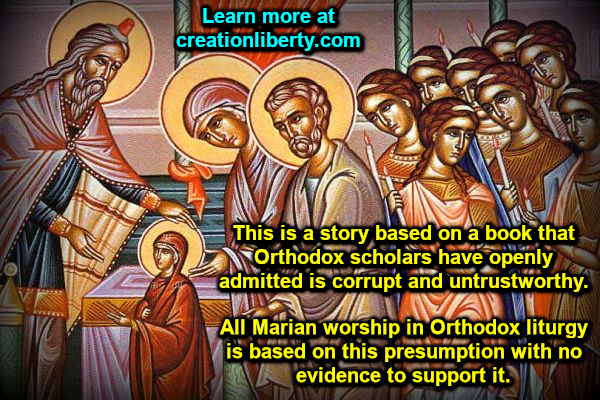
Based on this lie, Orthodoxy is nothing more than a feminist cult, worshiping a woman, crawling to her feet, and begging her for mercy. Again, Orthodox churchgoers object, but their words are meaningless because they say everything we need to know in their liturgy, which is their official doctrine:
"Eagerly did the Virgin, hosting God in her body, then hasten to visit Elizabeth, whose own infant recognized the voice of her greeting at once and rejoiced in the womb; and with leaps and bounds for songful sounds, he shouted to the Theotokos:
Rejoice, the branch with its shoot unwithered.
Rejoice, the ranch with its fruit unblemished.
Rejoice, for the man-loving Husbandman you cultivate.
Rejoice, for the Gardener of our life you germinate.
Rejoice, arable land yielding tender mercies hundredfold.
Rejoice, banquet table whereupon has forgiveness overflowed.
Rejoice, for the meadow of delight you make flourish.
Rejoice, for a haven of our souls do you furnish.
Rejoice,accepted incense of intercession .
Rejoice,the universe's expiation .
Rejoice,the good pleasure of God unto mortals .
Rejoice,the confidence of mortals before God .
Rejoice,O unwedded Bride ."
-Greek Orthodox Archdiocese of America, "Learn to Chant - The Akathist," retrieved June 5, 2025, [https://www.goarch.org/-/learn-to-chant-the-akathist]
Notice that these verses are directed at Mary, not at Jesus Christ, so there is no excuse here because these things are "
Mary is once again called "unwedded," even though she was married. Therefore their liturgies are lies. She is called "
Mary is also called "the universe's expiation," a phrase that should trigger loud alarm bells in Christians' minds, though it often will not because most are unfamiliar with the meaning of 'expiation':
expiate (v): to atone for; make amends or reparation for
(See 'expiate', Random House Dictionary, 2025, [dictionary.com]; See also Collins English Dictionary, 10th Edition, William Collins Sons & Co, 2012)
And not only so, but we also joy in God through our Lord Jesus Christ, by whom we have now received the atonement.
-Romans 5:11
"So it is, and this is why She, from the beginning of time, was chosen from among the chosen.She Who is manifest as the Holy of Holies , Who has a body even purer than the spirits purified by virtue, is capable of receiving ... the Hypostatic Word of the Unoriginate Father. Today the Ever-Virgin Mary, like a Treasure of God, isstored in the Holy of Holies , so that in due time, (as it later came to pass) She would serve for the enrichment of, and an ornament for, all the world. Therefore,Christ God also glorifies His Mother , both before, and also after His birth."
-Orthodox Church in America, "The Entry of the Most Holy Mother of God into the Temple," retrieved June 5, 2025, [https://www.oca.org/saints/lives/1000/11/21/103357-the-entry-of-the-most-holy-mother-of-god-into-the-temple]
This is all made up by a document that was condemn by Orthodox scholars. I cannot emphasize that enough. There is no other documentation to support these wild claims.
I am the LORD: that is my name: and my glory will I not give to another, neither my praise to graven images.
-Isaiah 42:8
Here is more liturgical proof that Orthodox churchgoers worship Mary as their goddess:
"Most Holy Theotokos, save us. Rejoice,Virgin Bride of God, the restoration of fallen man, the mortification of Hades, O blameless one , and the palace of the only King and Sovereign, rejoice...
Most Holy Theotokos, save us... Bride of God, rejoice,all-blameless Maiden who saved the world from the flood of sin ...
Most Holy Theotokos, save us. The undefiled chamber of the Word,for all the cause of deification, O Immaculate , rejoice...
Most Holy Theotokos, save us... Rejoice, O veritable vine that cultured the ripened cluster dripping with wine,making glad the hearts and souls of all who faithfully praise and glorify you daily ...
Most Holy Theotokos, save us.Insufficient is the tongue of any orator for hymns extolling you who were exalted above the Seraphim, having given birth to Christ the King; Whom,O Lady, beseech to rescue now from every harm those who bow in faith before you ...
Most Holy Theotokos, save us. So that we may cry,rejoice, unto you through whom we faithful have become sharers of eternal joy, O Maiden, rescue us from temptations all, barbarian invasions and from every other scourge , which are bound to follow on the multitude of transgressions committed by sinful man...
Most Holy Theotokos, save us.Since you have appeared, our light and our surety, we therefore shout to you :
Most Holy Theotokos, save us. Come andlet us stand rev'rently within the temple of our God and say: Mistress of the world, rejoice. Rejoice, O Mary, the Lady of us all. Rejoice, foramong women you alone are blameless and fair ... Rejoice, O tabernacle of God the Logos.
Rejoice,O holier than the holies .
Rejoice, ark that was gilt by the Spirit.
Rejoice,life's inexhaustible treasure .
Rejoice, exquisite diadem of kings with true beliefs.
Rejoice,reverential pride of profoundly pious priests .
Rejoice,the Church's unshaken citadel .
Rejoice,the Empire's fortress that never fell .
Rejoice, through whom rise trophies of victory.
Rejoice, through whom fall enemies utterly.
Rejoice,my bodily health's restoration .
Rejoice,my soul's everlasting salvation ."
-Greek Orthodox Archdiocese of America, "Learn to Chant - The Akathist," retrieved June 6, 2025, [https://www.goarch.org/-/learn-to-chant-the-akathist]
Let's summarzie this in a list so it is easier to understand. This is what the Orthodox cult believes according to their own liturgy:
|
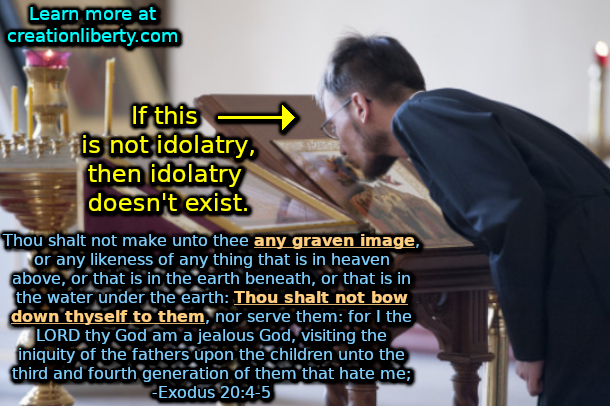
Now prepare yourself because Orthodox priests are about to falsely accuse Christians of making false accusations against them. They are about to tell you how your eyes are vicious liars, and your ears are great deceivers:
"Orthodox Christians bless, venerate, and honor Mary, butwe never worship her ."
-The Orthodox Faith, "Worship of Mary," retrieved June 6, 2025, [http://theorthodoxfaith.com/article/worship-of-mary/]
worship (v): to adore; to pay divine honors to; to reverence with supreme respect and veneration
(See 'worship', American Dictionary of the English Language, Noah Webster, 1828, retrieved June 6, 2025, [webstersdictionary1828.com])
"Part of the confusion about the worship of Mary stems from the very idea of worship itself. In modern churches when one talks about worship they usually mean the singing that takes places before the sermon. When a visitor hears us singing about Mary, they associate that singing with worship of Mary. Butin the Orthodox church, worship is understood as sacrifice. When we offer the Eucharist we participate in the sacrifice of the body and blood of Jesus. Orthodox would never offer a sacrifice to Mary. "
-The Orthodox Faith, "Worship of Mary," retrieved June 6, 2025, [http://theorthodoxfaith.com/article/worship-of-mary/]
Setting aside the fact that their Eucharist involves witchcraft that includes cannibalism and vampirism, their definition of worship as "sacrifice" is absurd and can be examined in two ways, either sacrifice of blood or sacrifice of time/effort. First, most pagans have never offered blood sacrifices to their gods, meaning that, by this definition, Orthodox churchgoers would have to concede that pagans do not worship false gods—a notion they know full well is ridiculous.
The second point to consider is the meaning of "sacrifice." If dedicating one's time, thoughts, and energy to something divine qualifies as "worship" under their definition, then Orthodox churchgoers are undeniably guilty of worshiping Mary.
The Orthodox author continues to give us a comically hypocritical statement:
"We honor Mary due to her relationship with Christ,it is never done in isolation or based on her own merit ."
-The Orthodox Faith, "Worship of Mary," retrieved June 6, 2025, [http://theorthodoxfaith.com/article/worship-of-mary/]
We have read many examples where the Orthodox cult worships Mary as immaculate, spotless, blameless, guiltless, and without sin, but if you remember back to the beginning of this chapter, the Orthodox Church in America told us, according to their beliefs, why Mary was allegedly sinless:
"I can say, in short, that the Orthodox Church believes thatMary , as a human being,could indeed have sinned, but chose not to ."
-Orthodox Church in America, "Sinlessness of Mary," retrieved May 23, 2025, [https://www.oca.org/questions/saints/sinlessness-of-mary]
According to the Orthodox cult, Mary CHOSE, by her own merit, not to sin, which is why they call her "sinless" in their liturgies. Simultaneously, we are told that Orthodox cultists do not worship Mary based on her own merit.
These people are liars who lie about their lies. This all done for the sake of justifying Orthodox churchgoers (who are pagans at heart) to be holy and righteous, so these corrupt priests can gain religious clout and a paycheck.
Finally, I want readers to consider that their faith, songs, and prayers to Mary is part of divinition:
diviner (n): one who professes divination; one who pretends to predict events, or to reveal occult things, by the aid of superior beings, or of supernatural means
(See 'diviner', American Dictionary of the English Language, Noah Webster, 1828, retrieved June 10, 2025, [webstersdictionary1828.com])
necromancer (n): one who pretends to foretell future events by holding converse with departed spirits
(See 'necromancer', American Dictionary of the English Language, Noah Webster, 1828, retrieved June 10, 2025, [webstersdictionary1828.com])
They sacrificed unto devils, not to God; to gods whom they knew not, to new gods that came newly up, whom your fathers feared not.
-Deuteronomy 32:17
But I say, that the things which the Gentiles sacrifice, they sacrifice to devils, and not to God: and I would not that ye should have fellowship with devils.
-1 Corinthians 10:20
There shall not be found among you any one that maketh his son or his daughter to pass through the fire [i.e. abortion], or that useth divination, or an observer of times, or an enchanter, or a witch, Or a charmer, or a consulter with familiar spirits, or a wizard, or a necromancer. For all that do these things are an abomination unto the LORD: and because of these abominations the LORD thy God doth drive them out from before thee.
-Deuteronomy 18:10-12
I hate, I despise your feast days, and I will not smell in your solemn assemblies. Though ye offer me burnt offerings and your meat offerings, I will not accept them: neither will I regard the peace offerings of your fat beasts. Take thou away from me the noise of thy songs; for I will not hear the melody of thy viols. But let judgment run down as waters, and righteousness as a mighty stream.
-Amos 5:21-24
Bring no more vain oblations; incense is an abomination unto me; the new moons and sabbaths, the calling of assemblies, I cannot away with; it is iniquity, even the solemn meeting. Your new moons and your appointed feasts my soul hateth: they are a trouble unto me; I am weary to bear them. And when ye spread forth your hands, I will hide mine eyes from you: yea, when ye make many prayers, I will not hear: your hands are full of blood. Wash you, make you clean; put away the evil of your doings from before mine eyes; cease to do evil; Learn to do well; seek judgment, relieve the oppressed, judge the fatherless, plead for the widow.
-Isaiah 1:13-17
At that time Jesus answered and said, I thank thee, O Father, Lord of heaven and earth, because thou hast hid these things from the wise and prudent, and hast revealed them unto babes. Even so, Father: for so it seemed good in thy sight. All things are delivered unto me of my Father: and no man knoweth the Son, but the Father; neither knoweth any man the Father, save the Son, and he to whomsoever the Son will reveal him. Come unto me, all ye that labour and are heavy laden, and I will give you rest. Take my yoke upon you, and learn of me; for I am meek and lowly in heart: and ye shall find rest unto your souls. For my yoke is easy, and my burden is light.
-Matthew 11:25-30
However, because Orthodox churchgoers are prideful in the rebellion of their idolatry, most of them will never read this message that they might know the truth to be saved. They close their eyes and cover their ears, lest at anytime they might believe the Word of God, because they are so hell-bent on their works being the savior of their souls.
For this people's heart is waxed gross, and their ears are dull of hearing, and their eyes they have closed; lest at any time they should see with their eyes, and hear with their ears, and should understand with their heart, and should be converted, and I should heal them.
-Matthew 13:15
But he giveth more grace. Wherefore he saith, God resisteth the proud, but giveth grace unto the humble.
-James 4:6
I tell you, Nay: but, except ye repent, ye shall all likewise perish.
-Luke 13:3
I quoted these verses from Jeremiah in the introduction, explaining the analogy that men can rely on other men for help in times of physical need, but not spiritually:
Thus saith the LORD; Cursed be the man that trusteth in man, and maketh flesh his arm, and whose heart departeth from the LORD. For he shall be like the heath in the desert, and shall not see when good cometh; but shall inhabit the parched places in the wilderness, in a salt land and not inhabited.
-Jeremiah 17:5-6
For what man knoweth the things of a man, save the spirit of man which is in him? even so the things of God knoweth no man, but the Spirit of God. Now we have received, not the spirit of the world, but the spirit which is of God; that we might know the things that are freely given to us of God. Which things also we speak, not in the words which man's wisdom teacheth, but which the Holy Ghost teacheth; comparing spiritual things with spiritual. But the natural man receiveth not the things of the Spirit of God: for they are foolishness unto him: neither can he know them, because they are spiritually discerned.
-1 Corinthians 2:11-14
Therefore, brethren, stand fast, and hold the traditions which ye have been taught, whether by word, or our epistle.
-2 Thessalonians 2:15
Now we command you, brethren, in the name of our Lord Jesus Christ, that ye withdraw yourselves from every brother that walketh disorderly, and not after the tradition which he received of us.
-2 Thessalonians 3:6
As astonishing as it seems due to its lack of logic, Orthodox churchgoers are indoctrinated to believe that their traditions (e.g. iconography, symbols, the Eucharist, liturgies, etc) were practiced by Christ and His apostles in the first-generation church. Clearly, the Bible does not support this claim, neither in precedent nor doctrine, which is why they reject sole reliance on the Holy Scriptures, despite the fact Paul instructed us to do so. Instead, they impose their religious assumptions onto Paul's writings, asserting that he endorsed Orthodox rituals and traditions that emerged centuries later, a notion that is completely nonsensical.
For example, this author from Christ the Savior Orthodox Church said:
"Throughout its 2000-year history Orthodox Christianity has remained faithful to the teachings and practices passed on from the Apostles and early Church Fathers (2 Thessalonians 2:15). "
-Christ the Savior Orthodox Church, "What is the Orthodox Church?" retrieved May 23, 2025, [https://orthodoxdelmarva.org/w_orthodoxy]
As we can see, they attempt to blend the teachings of Christ and His apostles with the corrupt doctrines of false converts who emerged much later. What they fail—or rather, refuse—to grasp is that the apostles of Christ and the so-called "early church fathers" are not the same.
Christ's church and doctrine were established by the Holy Ghost through the words and writings of the first-generation apostles, as Christ promised:
Judas saith unto him, not Iscariot, Lord, how is it that thou wilt manifest thyself unto us, and not unto the world? Jesus answered and said unto him, If a man love me, he will keep my words: and my Father will love him, and we will come unto him, and make our abode with him... But the Comforter, which is the Holy Ghost, whom the Father will send in my name, he shall teach you all things, and
-John 14:22-26
These things have I written unto you concerning them that seduce you. But the anointing which ye have received of him abideth in you, and ye need not that any man teach you: but as the same anointing teacheth you of all things, and is truth, and is no lie, and even as it hath taught you, ye shall abide in him.
-1 John 2:26-27
Orthodox churchgoers worship their so-called "saints" and "church fathers," treating the commentaries of these men as if they were words taken directly from the mouth of God. These corrupt men emerged centuries after Christ and His apostles, yet Orthodox believers elevate them to divine status, equating their words with the authority of Holy Scripture, despite the fact that, to my knowledge, none of these men ever claimed divine inspiration.
Orthodox cult members claim they do not worship their so-called "church fathers" but merely "venerate" them, however, as established in the previous chapter, veneration is a form of worship, particularly when it involves religious or spiritual figures. In 2025, during a discussion with Catholic, Orthodox, and Anglican churchgoers on a Discord call (see reference below), I pointed out that their revered "church father" Ignatius was a heretic, and they became upset, unable to accept that Ignatius could be mistaken, revealing their belief that his writings hold the same authority as the Word of God.
(See Creation Liberty Evangelism, "DEBATE: Christian vs Catholic Orthodox Anglican | 4-5-25," Apr 5, 2025, [https://rumble.com/v6rpn69-debate-christian-vs-catholic-orthodox-anglican-4-5-25.html])
Ignatius of Antioch, writing in the early 2nd century A.D., promoted the antichrist notion of the Eucharist, teaching that a ritual transforms bread and wine into the literal flesh and blood of Christ—a heresy I exposed in chapter two. His teachings paved the way for practices involving witchcraft, cannibalism, and vampirism, as discussed in chapter three. Although Ignatius did not originate all the rituals associated with this heresy, they evolved within the supposedly "unchanging" Orthodox cut, and by claiming this ritual imparts saving grace, Ignatius revealed his misunderstanding of the Gospel of Salvation, spreading a heresy that has led countless souls toward damnation in hell.
The only defense Orthodox churchgoers offer is to revere Ignatius' person (a sin, as stated in Jms 2:9), relying on the logical fallacy of "appeal to authority." Truth stands on factual evidence alone, regardless of who supports or opposes it, making the "qualifications" of the person irrelevant to the accuracy or inaccuracy of their claims.
The formal argument looks like this:
Person A said X is true.
Therefore, X is true.
An example would look like this:
Mayor Bob says communism is the best political system.
Therefore, communism is the best political system.
Many well-reasoned arguments and historical examples can disprove the claim that "communism is the best political system," and therefore, Mayor Bob's statement does not become true simply because it came out of his mouth. Mayor Bob could have said that free-market capitalism is the best system, and although there are many well-reasoned arguments to support that claim, it would not become true just because Bob said it.
Likewise, the Orthodox fallacy is as follows:
Ignatius said that the Eucharist should be practiced.
Therefore, Christians should practice the Eucharist.
Ignatius made the same error that many religious cults still make today, namely, the literalist fallacy we covered in chapter two, taking the metaphor of the bread of life being broken for the sins of man as a commandment to eat human flesh via the witchcraft ritual of transubstantiation. Just because a false convert wrote it down a long time ago does not automatically make it true because that is merely another form of the appeal to tradition fallacy.
Orthodox churchgoers have argued to me that Ignatius was a disciple of John, a claim rooted entirely in the fallacy of Orthodox tradition rather than historical evidence. Ignatius' writings contain no reference to him being John's disciple, nor do any contemporary sources support this assertion, but rather, the idea was speculated by later authors, such as Eusebius and Jerome, centuries after Ignatius' death.
For example, Regis Martin, Professor of Theology in Franciscan University of Steubenville, said that Jerome argued that Ignatius was John's disciple based only on the relationship between people they commonly knew:
"Could it be, then, that Ignatius knew John? While there is no internal evidence from the correspondence itself to suggest that either one knew the other, on the authority of St. Jerome, who lived in Bethlehem two centuries later and translated the Bible from Greek to Latin, one might imagine otherwise. 'John the Apostle,' he records in his Chronicon, 'survived all the way to the time of Trajan; after whom his notable disciples were Papias, Bishop of Hierapolis, Polycarp of Smyrna, and Ignatius of Antioch.' "
(See Regis Martin, "The Witness of St. Ignatius of Antioch," Crisis Magazine, Sept 2, 2023, retrieved June 3, 2025, [https://crisismagazine.com/opinion/on-the-trail-of-ignatius])
Again, the idea that Ignatius was John's disciple rests on pure speculation, not evidence, as Martin openly admitted that "
This is another fallacy known as "jumping to conclusions," where a claim is made without sufficient evidence to support it. Orthodox scholars leapt to the conclusion that their antichrist Eucharist doctrine connects to one of Christ's original apostles, desperately seeking legitimacy due to the absence of Biblical support for their false doctrine.
I find it laughable that they scramble to establish a traditional link to John while ignoring the Holy Ghost's writings through John himself, which clearly teach us salvation through faith alone, apart from works and religious rituals:
For God sent not his Son into the world to condemn the world; but that the world through him might be saved. He that believeth on him is not condemned: but he that believeth not is condemned already, because he hath not believed in the name of the only begotten Son of God.
-John 3:17-18
He that believeth on the Son hath everlasting life: and he that believeth not the Son shall not see life; but the wrath of God abideth on him.
-John 3:36
"Familiarity with the Liturgy provokes at least two questions for the Western Christian:How did a rite which claims to go back to the early Church come to assume a form so different from what we know of early Christian worship? "
-Hugh Wybrew, The Orthodox Liturgy: The Development of the Eucharistic Liturgy in the Byzantine Rite, St Vladimir's Seminary Press, 1990, p. 11, ISBN: 9780881411003
Notice that Wybrew does NOT question IF the doctrines of Orthodox liturgies differ from those of the early centuries; rather, he asserts that a change undeniably occurred and questions HOW it happened. That is a presupposed conclusion before analyzing the evidence. It should not take much consideration to realize that, for example, a ritual involving consumption of a bizarre, pagan, superstitious piece of bread adorned with symbolism—somehow imparting mystical, spiritual blessings—was not a tradition practiced by the early church. Clearly, this was not instituted by the apostles (or it would have been recorded by the Holy Ghost in the New Testament Scriptures), and therefore, it must have been introduced later, proving that Orthodox traditions evolved over time.
Orthodox churchgoers regurgitate the narrative that Orthodoxy is an "unchanging" religion. The website Orthodox Christianity says:
"The [Orthodox] Church must proclaim the Good News of Christ in all its purity, so that the mystical and sacramental core of her very being be clearly seen bya world that so needs this ancient, unchanging faith ."
-Abbot Tryphon, "Our Unchanging Faith," Orthodox Christianity, Dec 22, 2015, retrieved June 10, 2025, [https://orthochristian.com/89055.html]
The website Orthodox Christianity Information Center says:
"Dogmatic decisions concernthe inner truths of [Orthodox] faith, which are unchanging and mandatory for all , aloof from time and absolute."
-Nicholas N. Afanasiev, "The Canons of the Church: Changeable or Unchangeable?," Orthodox Christianity, retrieved June 10, 2025, [http://orthodoxinfo.com/general/the-canons-of-the-church-changeable-or-unchangeable.aspx]
Orthodoxy Q&A from the Massachusetts Institute of Technology says:
"The Orthodox Church remains unchanged in doctrine and faith since the early Church of the Apostles. "
-Massachusetts Institute of Technology, "Some Straight Answers About the Orthodox Church," retrieved June 10, 2025, [https://web.mit.edu/ocf/www/orthodox_qna.html]
Author Trevin Wax in his book, The Thrill of Orthodoxy, said that the Orthodox religion is so unchanging, that it changes to remain unchanged:
"An unchanging orthodoxy is marked by ever-changing expressions so that the essence remains unchanged. The expressions are always developing in order to ensure the unchanging, eternal truth can be communicated consistently in changing times."
-Trevin Wax, The Thrill of Orthodoxy: Rediscovering the Adventure of Christian Faith, InterVarsity Press, 2022, ISBN: 9781514005019
That is one of the most absurdly laughable statements I have encountered in all my years of ministry. It stands as a testament to the futile circular reasoning that ensnares a man when he builds his foundation on the shifting sand of works-based heresy.
The author of the book Orthodox Christians in America stated his belief that, "
(See John H. Erickson, Orthodox Christians in America: A Short History, Oxford University Press, 2010, ISBN: 9780199951321; See also Stoyan Tanev, Energy in Orthodox Theology and Physics: From Controversy to Encounter, Wipf and Stock Publishers, 2017, ISBN: 9781532614873)
Despite the robotic parroting of willfully ignorant Orthodox authors, Wybrew notes that the Liturgy of St. John Chrysostom, which is one of the Orthodox cult's most "sacred" liturgies, has changed over time:
"It is of course the case with the Liturgy of St John Chrysostom as with that of St Basil that even if the anaphoras and certain other prayers areheld to be by Chrysostom and Basil themselves, other prayers and formulae even in the earliest text of the Liturgies cannot belong to their time. Some are known to have been added later, and others certainly belong to later stages of liturgical development. "
-Hugh Wybrew, The Orthodox Liturgy: The Development of the Eucharistic Liturgy in the Byzantine Rite, St Vladimir's Seminary Press, 1990, p. 57, ISBN: 9780881411003
Although Wybrew is just as spiritually blinded by the pride of his works-based false gospel as all the other Orthodox authors I just quoted, the major difference between them is that one has done historical research, while the others have opted to believe and repeat a religious narrative without question. Wybrew's research unveiled that doctrine in the Orthodox religion changed over time, not just adding in new features, but removing old ones, and transforming others.
Wybrew covers many significant changes in the "
(See Hugh Wybrew, The Orthodox Liturgy: The Development of the Eucharistic Liturgy in the Byzantine Rite, St Vladimir's Seminary Press, 1990, p. 8, ISBN: 9780881411003)
The reason it is important to note these changes when discussing the Orthodox pantheon of false gods is that their so-called "early church fathers" were the heretics who introduced the corrupt doctrine upon which these traditions were built. What is said and done in Orthodox church buildings today is a far cry from what the early Christian church did.
Ignatius said:
"They abstain from the Eucharist and from prayer, because they confess not the Eucharist to be the flesh of our Saviour Jesus Christ ,"
-Ignatius, "The Epistle of Ignatius to the Smyrnaeans," Chapter 7, New Advent, retrieved June 26, 2025, [https://www.newadvent.org/fathers/0109.htm]
When you teach that the bread is the literal flesh of Jesus Christ, you are teaching that the sacrifice of Christ was done through bread, and not on the cross. That is heresy, and these Orthodox heretics (like their father heretic, Ignatius) abstain from communion with Christ (choosing instead participation in witchcraft) and reject praying to God the Father (choosing instead their goddess Mary) because they confess not the Son of God in the Scriptures.
Irenaeus of Lyons is another revered "saint" of Orthodoxy, and he said:
"But our opinion is in accordance with the Eucharist, and the Eucharist in turn establishes our opinion. For we offer to Him His own, announcing consistently the fellowship and union of the flesh and Spirit.For as the bread, which is produced from the earth, when it receives the invocation of God, is no longer common bread, but the Eucharist, consisting of two realities, earthly and heavenly; so also our bodies, when they receive the Eucharist, are no longer corruptible, having the hope of the resurrection to eternity. "
-Irenaeus, "Against Heresies," Book 4, Chapter 18, New Advent, retrieved June 26, 2025, [https://www.newadvent.org/fathers/0103418.htm]
By teaching that the witchcraft of transubstantiation in the Eucharist purges corruption in the spirit to grant people "
For by grace are ye saved through faith; and that not of yourselves: it is the gift of God: Not of works, lest any man should boast.
-Ephesians 2:8-9
"We call this food Eucharist , and no one else is permitted to partake of it, except one who believes our teaching to be true and who has been washed in the washing which is for the remission of sins and for regeneration [i.e., has received baptism] and is thereby living as Christ enjoined. For not as common bread nor common drink do we receive these; butsince Jesus Christ our Savior was made incarnate by the word of God and had both flesh and blood for our salvation, so too, as we have been taught, the food which has been made into the Eucharist by the Eucharistic prayer set down by him, and by the change of which our blood and flesh is nurtured, is both the flesh and the blood of that incarnated Jesus. "
-Justin Martyr, First Apology, retrieved June 26, 2025, [https://web.ics.purdue.edu/~ctl/handout/ChurchFathers.pdf]
Martyr taught that the bread and wine was the literal flesh of Jesus Christ, and therefore, he is a heretic. It is ironic that these men were all writing against what they called heretics, without understanding their own heresy.
To save time, here is a short list of these so-called "early church fathers" (better called "the early heretics") all teaching the same antichrist doctrine, and all the short quotes are in the context of eating literal human flesh and blood in their Eucharist:
|
These men taught many other false doctrines that I listed out in chapter two, the only difference was that the details of the rituals had not been developed into the religious circus we see today. So if they were simply teaching false doctrine, and Orthodox churchgoers have simply been misled into those false doctrines, why do I say that these men are the gods of Orthodoxy?
Orthodox churchgoers will immediately object to this, claiming that they merely honor these men, but do not worship them or pray to them as gods. Please read the following prayers, taken from Orthodox liturgies, and decide for yourself.
To begin, let's read the prayers they offer to Ignatius, who they call a "hieromartyr," that is, a man who they claim was a "martyr" who also had a high clergy rank, or in better put, it is a title bestowed by people who are so puffed up, they love the smell of their own flatulence:
"Holy Hieromartyr, Ignatius, pray to God for us.
Guiding my life to virtue, O God-bearer Ignatius, illumine me with the light of the grace which shineth in thee, and by thy supplications set at naught the tumult of the passions.
Holy Hieromartyr, Ignatius, pray to God for us.
Thou wast like most fertile soil, increasing its seed a hundredfold at the harvest, O God-bearer Ignatius, for Christ Who watereth souls with the rain of the Spirit.
Holy Hieromartyr, Ignatius, pray to God for us...
Heal thou my mind which hath been afflicted with grievous carnal passions, O ever-memorable Ignatius, martyr of Christ.
Holy Hieromartyr, Ignatius, pray to God for us.
Knowing well that thou wast of one mind with the apostles, Christ appointed thee as a teacher shining with divine light upon all the Churches... Having beheld the Bestower of life slain for thy sake, O Ignatius, with love thou didst hasten to endure death for His sake."
-Mark, "The Translation of the Relics of St Ignatius the God-Bearer," Parish of the Kazan Icon of the Mother of God, Feb 11, 2025, retrieved June 26, 2025, [https://russianorthodoxchurchcardiff.com/the-translation-of-the-relics-of-st-ignatius-the-god-bearer]
I will not continue this quote to save time because this goes on for many pages. Orthodox churchgoers will tell you not to believe your lying eyes and deceiving ears, but as evident in this quote, they sing hymns and make prayers to dead men.
They believe Ignatius, a dead man who has never heard a prayer from anyone, is interceding to God on their behalf (which the Bible says only Christ and the Holy Ghost can do for us, Rom 8:27-34), that he can guide them to virtue, can grant them the light of grace, can quell passions, and can heal the mind. Furthermore, they claim that he saw Jesus and was selected by Him to be one of His apostles, and I would like to know how or when that was supposed to happen since he was not born until nearly 40 years after the death and resurrection of Christ.
One might argue that Paul had been called to be an apostle after Christ's death and resurrection, but there is a drastic difference between Paul and Ignatius. Paul had other apostles in the Bible acknowledge him to be an apostle by the Holy Ghost (2Pe 3:15-16), but Ignatius had no such affirmation.
Their prayers claim that Ignatius anoints those who receive divine crowns, praising him for his suffering (rather than Christ) and glorifying him as one who "
Orthodox churchgoers will say that their liturgies and prayers are offered to God, but that is not the case, as we can see from their liturgy of John Chrysostom:
"May He Who rose from the dead, Christ our true God,through the intercessions of His all-pure and all-immaculate holy Mother; the power of the precious and life-giving Cross ; the protection of the honorable, bodiless powers of heaven;the supplications of the honorable, glorious prophet and forerunner John the Baptist; of the holy, glorious, and praiseworthy apostles; of the holy, glorious, and triumphant martyrs; of our righteous and God-bearing fathers; of [insert name of the saint of the church]; of our father among the saints John Chrysostom, archbishop of Constantinople; of the holy and righteous ancestors of God Joachim and Anna; of [insert saint of the day], whose memory we celebrate today; and of all the saints; have mercy on us and save us, for He is good and loves mankind. "
-Greek Orthodox Archdiocese of America, "The Divine Liturgy of Saint John Chrysostom," retrieved July 1, 2025, [https://www.goarch.org/-/the-divine-liturgy-of-saint-john-chrysostom]
Let's slow this down and read it carefully because, despite Orthodox churchgoers' belief that this is praise to Jesus Christ, it is not praise of Christ at all. This is a song of worship of their false gods and goddesses.
They start out addressing God and Christ, but then emphasize that they only address Him through their goddess. They also mention the power of the "
Not only do they address their goddess as a mediator in this prayer, but they also treat men like John the Baptist, Christ's initial apostles (by calling them "
Many years ago, I worked security at a building that was owned by Donald Trump, but I never met Trump. I worked for a company who was hired by building management who was employed by Trump. The analogy would be like me saying that I worked directly for Donald Trump, via his regional manager, by the intercessions of the building manager, by the supplications of the owner of the security company, and in remembrance of my shift supervisor.
Donald Trump does not know that I exist. And why should he? I did not go directly to him. If you do not go to God the Father directly through the Lord Jesus Christ, then He does not know you anymore than Trump knows me.
And then will I profess unto them,
-Matthew 7:23
|
Let's examine heretic Jerome's claim that it is unreasonable to suggest that, after death and entering the Kingdom of Heaven, the prayers of the saints are no longer heard by God. I am not debating whether individuals in God's Kingdom offer humble requests to Him, as I am not there and lack knowledge about the third heaven. However, I can point to Scripture, specifically an instance where a man prayed to Abraham in paradise:
And it came to pass, that the beggar died, and was carried by the angels into Abraham's bosom: the rich man also died, and was buried; And in hell he lift up his eyes, being in torments, and seeth Abraham afar off, and Lazarus in his bosom. And he cried and said, Father Abraham, have mercy on me, and send Lazarus, that he may dip the tip of his finger in water, and cool my tongue; for I am tormented in this flame. But Abraham said, Son, remember that thou in thy lifetime receivedst thy good things, and likewise Lazarus evil things: but now he is comforted, and thou art tormented. And beside all this, between us and you there is a great gulf fixed: so that they which would pass from hence to you cannot; neither can they pass to us, that would come from thence.
-Luke 16:22-26
Then he said, I pray thee therefore, father, that thou wouldest send him to my father's house: For I have five brethren; that he may testify unto them, lest they also come into this place of torment. Abraham saith unto him, They have Moses and the prophets; let them hear them. And he said, Nay, father Abraham: but if one went unto them from the dead, they will repent. And he said unto him, If they hear not Moses and the prophets, neither will they be persuaded, though one rose from the dead.
-Luke 16:27-31
Thus saith the LORD; Cursed be the man that trusteth in man, and maketh flesh his arm, and whose heart departeth from the LORD.
-Jeremiah 17:5
Orthodox churchgoers will ignore this warning and continue to put their faith into something I have heard referred to as "affirmation prayers," although that is not an official term used by the Orthodox cult (as far as I know). It is meant to be a prayer offered to their dead pantheon of gods, "affirming" or confessing those false gods to be their intercessors, rather than Jesus Christ.
Outside of liturgies, Orthodox churchgoers are taught a script of vain repetitious prayers to regurgitate on their own at home. For example, the following quote is a generic prayer taught by Basilica of St. Mary, allowing the Orthodox cultist to put the name of his/her false god in the "name" slot:
"Saint (Name), Holy Mother of God and all the saints, who have pleased God in Your lives; pray to Christ my Lord that I might live this day in peace love and humility. Pray unto God for me, O Holy Saint (Name), well-pleasing to God: for I turn to you, who are a speedy helper and intercessor for my soul. "
-Basilica of St. Mary, "Prayers to Your Patron Saint," retrieved July 2, 2025, [https://stmarylivonia.com/prayers-to-your-patron-saint/]
Orthodox churchgoers highly revere Theophan the Recluse, not for his reclusive life as a hermit, but for his guidance on prayer, and here is just some of his absurd doctrine in which he creates rules about prayer that are not supported in the Holy Scriptures:
"You ask about a prayer rule.Yes, it is good to have a prayer rule on account of our weakness so that on the one hand we do not give in to laziness, and on the other hand we restrain our enthusiasm to its proper measure. The greatest practitioners of prayer kept a prayer rule. They would always begin with established prayers, and if during the course of these a prayer started on its own, they would put aside the others and pray that prayer. If this is what the great practitioners of prayer did, all the more reason for us to do so. Without established prayers, we would not know how to pray at all. Without them, we would be left entirely without prayer. "
-Theophan the Recluse, "A Prayer Rule," Saint Nicholas Orthodox Church, retrieved July 31, 2025, [https://www.orthodox.net/articles/prayer-rule-by-st-theophan.html]
The argument boils down to this: Other people did it, so we should do it too. That is not a logical or moral argument. He said that the "
Theophan first assumes that the "
We know how to pray because even children understand how to pray to their father; in other words, they know how to humbly request things they desire. We pray from the heart because that is what God sees and judges:
Every way of a man is right in his own eyes:
but the LORD pondereth the hearts.
-Proverbs 21:2
Trust in the LORD with all thine heart; and
lean not unto thine own understanding.
-Proverbs 3:5
The fining pot is for silver, and the furnace
for gold: but the LORD trieth the hearts.
-Proverbs 17:3
Let the word of Christ dwell in you richly in all wisdom; teaching and admonishing one another in psalms and hymns and spiritual songs, singing with grace in your hearts to the Lord.
-Colossians 3:16
And he answering said, Thou shalt love the Lord thy God with all thy heart, and with all thy soul, and with all thy strength, and with all thy mind; and thy neighbour as thyself.
-Luke 10:27
Flee also youthful lusts: but follow righteousness, faith, charity, peace, with them that call on the Lord out of a pure heart.
-2 Timothy 2:22
Do we enjoy hearing repetitive phrases in conversation? Is it pleasant to listen to empty words spoken merely to placate us? For instance, do we find it appealing when politicians endlessly repeat the same vain talking points while seeking your approval? Or would we prefer someone to speak honestly, from the heart, with words grounded in truth and understanding?
|
If mortal men hate such vanities, why would we think God loves it? |
Orthodox churchgoers willfully ignore that when another entity replaces Jesus Christ as the intercessor, true intercession ceases because communication with God stops at that point. A dead man who has never heard a prayer from anyone cannot deliver that message to the Lord, and God is not going to take it seriously either because it proves that the man praying has no faith in God to come directly to Him.
Of course, God is omniscient (i.e. all-knowing), and records everything that men say or do, even in secret. However, that does not mean what God records is pleasing and acceptable to Him by default, and for Orthodox churchgoers to presume God is pleased with their ramblings is arrogant and dangerous.
How can a man become an intercessor by other men declaring him to be one? How can a man become an intercessor when he has his own need of an intercessor? To whom did their so-called "saints" pray for intercession before the "saints" existed?
If the answer to that last question is "the apostles and Mary," did they pray to themselves before their deaths? It is fascinating to me that Christ's apostles set the example of approaching God the Father through Christ the Son, yet Orthodoxy's supposedly "unchanging" religion creates a patheon of mediators, which is clear evidence of change. They transform dead men into gods like pagan occultists, mimic the consumption of human flesh and blood like savage beasts, and then brazenly label born-again Christians "heretics" for teaching the very doctrines of Christ and His apostles found in Scripture.
Jesus told us not to pray as heathen hypocrites, like Orthodox cultists do:
And when thou prayest, thou shalt not be as the hypocrites are: for they love to pray standing in the synagogues and in the corners of the streets, that they may be seen of men. Verily I say unto you, They have their reward. But thou, when thou prayest, enter into thy closet, and when thou hast shut thy door,
-Matthew 6:5-8
After this manner therefore pray ye: Our Father which art in heaven, Hallowed be thy name. Thy kingdom come. Thy will be done in earth, as it is in heaven. Give us this day our daily bread. And forgive us our debts, as we forgive our debtors. And lead us not into temptation, but deliver us from evil: For thine is the kingdom, and the power, and the glory, for ever. Amen.
-Matthew 6:9-13
Many of these pagan prayer structures come from an Orthodox prayer book called the Synekdemos, and from it, they are taught to ask their dead gods for deliverance from evil and temptation. Here is an example from the Saints Constantine & Helen Orthodox Christian Church:
"Ever grant deliverance to those who approach your sacred Relics, and who entreat your fervent intercessions,delivering them from temptations and dangers, and all trials and terrible afflictions, O Hieromartyr Saint Ephraim, as a most-fervent healer of the Savior ."
-Saints Constantine & Helen Orthodox Christian Church, "Parkaklesis to Saint Ephraim of Nea MAkri, the Newly-revealed Hieromartyr and Wonderworker," retrieved July 2, 2025, [https://www.orthodoxcheyenne.org/prayers/supplications-to-saint-ephraim-of-nea-makri]
The Orthodox cult instructs its followers to recite the "Lord's Prayer" from Matthew 6 in vain repetition, which speaks of God delivering us from evil and temptation, while simultaneously urging them to pray to their dead gods for the same deliverance, as we can see in the quoted Orthodox prayer. If the Lord God is perfect in protecting us from evil and temptation, why would we need to pray to a dead man for it? And if we can approach God directly, as Jesus taught in Matthew 6, why would we ever need to pray to any man, dead or alive?
I am not asking these questions seeking an answer because there is no logical answer that can be given. Any answer presented to us by the Orthodox cult will be a repeat of the logical fallacies we have already covered in this book, such as an appeal to tradition and an appeal to authority, which carry no philosophy, intellectual, or spiritual weight.
Most Orthodox churchgoers will cover their eyes and close their ears to these arguments, and the vast majority are not willing to research it for themselves. Therefore, all I can do is provide the information in hopes that (peradventure, by the will of God) they might hear the truth about the history of the corrupt Orthodox cult and understand it.
The Orthodox cult is filled with men of corrupt minds, who have assumed roles of religious leadership, gaining power and influence, gradually molding the traditions of their institution over centuries into the demonic form we see today. Orthodoxy is a fragrant façade masking a pile of dung, where they worship heretics as gods, revel in their idolatry, and make a fortune by deceiving the masses.
Yea, they are greedy dogs which can never have enough, and they are shepherds that cannot understand: they all look to their own way, every one for his gain, from his quarter.
-Isaiah 56:11
Servants, obey in all things your masters according to the flesh; not with eyeservice, as menpleasers; but in singleness of heart, fearing God:
-Colossians 3:22
"The hierarchy of the Orthodox Church is structured in a way that ensures order and unity among its clergy and faithful. At the top of the hierarchy is the Patriarch or Archbishop, who serves as the spiritual leader of a specific region or jurisdiction. Below the Patriarch are the Bishops, who oversee individual dioceses within the region. Each diocese is further divided into parishes, which are led by Priests. Deacons assist Priests in their duties, while Subdeacons and Readers support the clergy in various ways. The hierarchy also includes Monks and Nuns, who live in monasteries and dedicate their lives to prayer and reflection. Understanding the Orthodox Church hierarchy is essential for members of the faith to grasp the roles and responsibilities of each clergy member. This structure has been in place for centuries and plays a crucial role in maintaining the traditions and teachings of the Church. By recognizing and respecting the hierarchy, Orthodox Christians can strengthen their connection to the Church and its rich history."
-Western Church, "Understanding the Orthodox Church Hierarchy: A Complete Breakdown," June 2, 2023, retrieved Oct 24, 2024, [https://westernchurch.net/churches/understanding-the-orthodox-church-hierarchy-a-complete-breakdown/]
The author is correct that Orthodox hierarchy is structured to keep order because they are a cult that is filled to brim with false converts who practice idolatry. While their souls are still corrupt, carnal sinners gather in a religious setting, but they must have worldly mandates to keep them in order because, without the Holy Ghost, they cannot discipline themselves.
For as many as are led by the Spirit of
God, they are the sons of God.
-Romans 8:14
Hold fast the form of sound words, which thou hast heard of me, in faith and love which is in Christ Jesus. That good thing which was committed unto thee keep by the Holy Ghost which dwelleth in us.
-2 Timothy 1:13-14
This stance is a near carbon copy of the Catholic cult, and they draw on the fallacy of tradition instead of putting confidence in the Word of God. Offices like bishop/elder or deacon—which ARE established by the Holy Ghost in the New Testament Scriptures (1Ti 3:2, 1Ti 3:8)—have been corrupted by the Orthodox cult, transforming them into things they were never intended to be.
Some readers may not know that the words 'elder' and 'bishop' are used interchangeably in the Bible. Notice in these verses that Paul begins by talking about elders in his description, and then calls them a "bishop" in the same context, without a break in the sentence:
For this cause left I thee in Crete, that thou shouldest set in order the things that are wanting, and ordain elders in every city, as I had appointed thee: If any be blameless, the husband of one wife, having faithful children not accused of riot or unruly. For a bishop must be blameless, as the steward of God; not selfwilled, not soon angry, not given to wine, no striker, not given to filthy lucre; But a lover of hospitality, a lover of good men, sober, just, holy, temperate; Holding fast the faithful word as he hath been taught, that he may be able by sound doctrine both to exhort and to convince the gainsayers.
-Titus 1:5-9
In fact, there is no evidence of priests being mentioned as an office of station until 2nd century heretics came along, and that is because the Bible teaches us that all those born again in Christ are priests:
But ye are a chosen generation, a royal priesthood, an holy nation, a peculiar people; that ye should shew forth the praises of him who hath called you out of darkness into his marvellous light:
-1 Peter 2:9
And from Jesus Christ, who is the faithful witness, and the first begotten of the dead, and the prince of the kings of the earth. Unto him that loved us, and washed us from our sins in his own blood, And hath made us kings and priests unto God and his Father; to him be glory and dominion for ever and ever. Amen.
-Revelation 1:6
Although Orthodox churchgoers claim to have a different structure than Catholicism, the truth is that Orthodoxy only changed a couple of names, but they are identical in every general aspect:
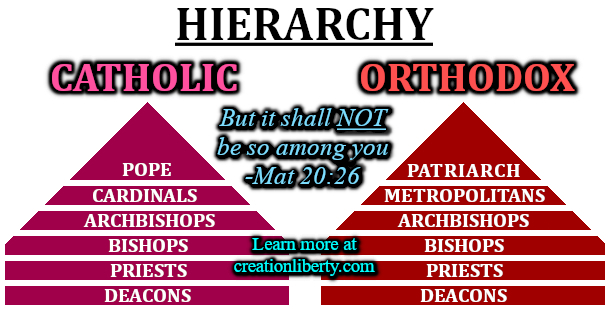
As I quoted in the image, Jesus commanded us Christians not to have this type of structure in the church, which is designed after Gentile governments:
But Jesus called them unto him, and said, Ye know that the princes of the Gentiles exercise dominion over them, and they that are great exercise authority upon them. But
-Matthew 20:25-28
ministry (n): service; aid; interposition [i.e. mediation]
(See 'ministry', American Dictionary of the English Language, Noah Webster, 1828, retrieved June 11, 2025, [webstersdictionary1828.com])
Take heed therefore unto yourselves, and to all the flock, over the which the Holy Ghost hath made you overseers, to feed the church of God, which he hath purchased with his own blood.
-Acts 20:28
Rebuke not an elder, but intreat him as a father;
and the younger men as brethren;
-1 Timothy 5:1
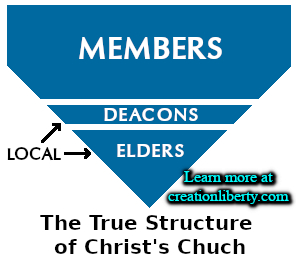
Orthodoxy has corrupted this structure by adding many other unbiblical offices. Like the corrupt Jews before them, Orthodox churchgoers rely almost entirely on man-made traditions, render God's Word ineffective by obstructing the truth.
Making the word of God of none effect through your tradition, which ye have delivered: and many such like things do ye.
-Mark 7:13
Let's look closely at Matthew 23 to get a better understanding:
Then spake Jesus to the multitude, and to his disciples, Saying, The scribes and the Pharisees sit in Moses' seat:
-Matthew 23:1-2
Like the Pharisees, Orthodox priests have religious and political influence among the masses, being perceived as "holy" men, and at times, they may speak truths aligned with God's Word. Yet, as hypocrites, they say one thing while doing another, as Jesus went on to say:
All therefore whatsoever they bid you observe, that observe and do; but do not ye after their works: for they say, and do not. For they bind heavy burdens and grievous to be borne, and lay them on men's shoulders; but they themselves will not move them with one of their fingers.
-Matthew 23:3-4
However, what many people do not understand is that the Pharisees ADDED to the Word of God many other things that were not commanded. They imposed heavy burdens of strict religious observance, far beyond reason, to create a pretense of religious piety, and expected everyone else to follow their invented rituals for so-called "holiness."
Like the Pharisees before them, Orthodox priests expect others to pray prescribed prayers, to worship dead men and women, to practice idolatry, and many other rituals that waste a lot of time and money. Meanwhile, the burden of fincancial responsibility for all this pretense of "holiness" is laid at the feet of the ignorant laity, who must shoulder the costs through tithe, which is unbiblical in the New Testament Church, and we will tackle that subject later in this chapter.
Through this abuse and manipulation of their neighbors, the Orthodox cult funds lavish temples where people can come to glorify the Orthodox hierarchy, making themselves feel "holy." The following photograph is only one of many that could be shown to demonstrate the high cost of their idolatry.
But all their works they do for to be seen of men: they make broad their phylacteries, and enlarge the borders of their garments, And love the uppermost rooms at feasts, and the chief seats in the synagogues,
-Matthew 23:5-6
(The cross symbol is
As you can see in the following photograph, Orthodox priests love the chief seats in lofty and pious meetings, and they hypocritically broaden their religious symbols to make themselves look more "holy" among men. In fact, many of these symbols are granted to them when they move up in rank of the Orthodox hierarchy, similar to the stripes and pins of a military officer. They also enlarge the boarders of their garments by wearing long flowing robes to distinguish themselves from us filthy plebs.
Men often crave titles to gain honor and respect for their status, which is driven by a sinful desire for glorification among others, and Orthodox priests are no different. They want their person to be respected by those who they consider beneath them.
But if ye have respect to persons, ye commit sin,
and are convinced of the law as transgressors.
-James 2:9
(Read "Titles Are Unbiblical in the Church" and "Respecting Persons is Sin" here at creationliberty.com for more details.)
And greetings in the markets, and to be called of men, Rabbi, Rabbi. But be not ye called Rabbi: for one is your Master, even Christ; and all ye are brethren.
-Matthew 23:7-12
Anyone who is a true servant (i.e. minister) of the church should NOT be called "Father" as a title of honor because, in the spirit, we have only one Father. In fact, the Bible does not teach us Christians to use titles at all, and if any readers want more details, I have an article at creationliberty.com called "Titles Are Unbiblical in the Church."
In rebellion against Christ, the Orthodox cult does exactly what Jesus told us Christians not to do. Obviously, Jesus is not restricting us from using the term 'father' in reference to a relationship between a biological father and son, and the term is used in that context in various places throughout the Bible. This is a common understanding we would need to know to interpret the loving relationship between God and Christ. As we just read, Matthew 23 is talking about the spiritual corruption of religious leadership, meaning that those in positions of authority, in any institution that claims to be Christian, should not be addressed with fancy titles, to repsect persons, nor should they be called "Father" because they are supposed to be humble servants of Christ.
Knowing the commandments of Christ in the context of Matthew 23, the Orthodox priests will need to come up with some unbiblical reason why they are doing exactly the opposite of what Jesus told us to do. I figured they would have some singular reason they would all give, but I was wrong. It was a bit surprising to find an assortment of reasons for doing it, ranging anywhere from the standard logical fallacy of appeal to tradition, to claiming that they call them "Father" for the purpose of making sure one priest was not different from another.
For example, Orthodox priest Lawrence Farley from Orthodox Church in America argued that the Pharisees were wrong for calling their teachers "Rabbi" and "Father," but then said:
"It is usually otherwise among the Orthodox and those groups that use the title 'Father' as an honourific for their clergy. Orthodox clergy all dress alike—the same black cassock, the same pectoral cross. Their teaching is the same, so that it scarcely matters whether one goes to Father Lawrence's parish or Father Justin's.The use of common title and of common clerical garb are intended to obscure and impede such personal style as would promote a cult of personality. "
-Lawrence Farley, "Call No Man 'Father'," Orthodox Church in America, Nov 3, 2022, retrieved Oct 29, 2024, [https://www.oca.org/reflections/fr.-lawrence-farley/call-no-man-father]
To clarify, Farley argued that Jesus' command to call no man "father" in a spiritual sense applied only to priests who dressed differently from others. In other words, he is claiming that this rebuke and instrution from Christ only applies to those with an uncoordinated outfit. Just when I thought I had heard the most absurd argument from the Orthodox cult, another priest surpasses it with something even dumber.
This statement lacks any Biblical foundation because Jesus did NOT say, "Call no man your father, unless you think you have a justified reason for it." He rebuked Jewish religious leaders not because of their varied appearances, but because, as stated in verse five, they performed their works "to be seen of men." Being seen and applauded by men for an appearance of "holiness" is the motivation behind both the Pharisee and Orthodox attire.
Farley's justification for using the title 'Father' (i.e. to signify equal rank among Orthodox clergy) lacks a logical foundation. One could achieve the same sense of shared identity WITHOUT using the title 'Father'. Another neutral term could be adopted, perhaps even the title 'Priest', but they will not do that, and use the appeal to tradition fallacy to protect themselves from accountability. Ultimately, Farley's excuse is begging the question: it assumes the validity of using 'Father' without addressing why this practice overrides Christ's explicit command to 'call no man your father.'
There is only one commonality I saw between all the Orthodox articles I read, and that was their claim that 1st Corinthians 4 justifies them to call their priests "Father." Once again, Orthodox cultists have cherry-picked a single verse out of context and created false doctrine that contradicts Christ.
Let's take a look at the claim of Orthodox priest James Guirguis after he quotes from 1st Corinthians 4:
"[H]ere he clearly calls himself 'father' to those Christians at Corinth. It wasn't that He was ignorant of the teaching of Christ. It was that He understood it much better than we do.It [Mat 23:9] was not meant as a hard and fast rule to be blindly followed. It was meant to mold and guide our understanding of reality in Christ. It also pointed to what was lacking within the leadership of the people of Israel at the time of Christ."
-James Guirguis, "Why Do We Call The Priest 'Father'?" pravmir.com, Aug 23, 2022, retrieved Oct 29, 2022, [https://www.pravmir.com/why-do-we-call-the-priest-father/]
For though ye have ten thousand instructors in Christ, yet have ye not many fathers: for in Christ Jesus I have begotten you through the gospel.
-1 Corinthians 4:15
This is why Paul said (in the previous verse, 1Co 4:14) that he wrote those things not to shame them, because the previous verses describe the prideful nature of false teachers, especially their selfishness in contrast to the sufferings of prison and beatings that Paul and his companions received for preaching the Gospel of Christ, but rather, he wrote this as a "WARNING" against wolves that would spring up among the church. (Acts 20:28-31) Therefore, he requested their consideration of how much he cared and sacrificed for them, as a father would do for his own son, so they would not be led astray from the Gospel of Christ that was first preached to them (and which they first believed) when they were saved, comparing his loving commitment to the pious pretense of false teachers.
The aforementioned Orthodox priest then fools his readers by saying, "
I write not these things to shame you, but as my beloved sons I warn you. For though ye have ten thousand instructors in Christ, yet have ye not many fathers: for in Christ Jesus I have begotten you through the gospel. Wherefore I beseech you, be ye followers of me. For this cause have I sent unto you Timotheus, who is my beloved son, and faithful in the Lord, who shall bring you into remembrance of my ways which be in Christ, as I teach every where in every church.
-1 Corinthians 4:14-17
In summary, Paul used a father/son analogy because, in this life, children quickly learn that most people oppose them and lack genuine concern for their well-being, having no personal stake in it, whereas a father is deeply invested in his son's prosperity. Thus, this analogy properly expresses Paul's love for the Corinthian Christians, but it does not justify Orthodox priests adopting grandiose titles to gain prestige.
Arrogant men often masquerade as "children of light" while drenched in hypocrisy, misapplying the metaphors of Scripture literally, while twisting literal statements metaphorically to justify their anti-biblical actions. Once again, we see Orthodox cultists refusing the understanding of Paul's metaphor, leaning on a foolish literal interpretation to defend their rebellion against Christ within their man-made religion.
To take something literal as metaphorical, and metaphors as literal, is an equivocation fallacy known as misinterpretation of intent, and I am not singling out one instance and extrapolating that into a generalized accusation without cause. For example, when I visited the website, Coptic Orthodox Answers, the Orthodox priest on that site overtly stated, "
(See Coptic Orthodox Answers, "Should you address a priest as 'father'?" June 5, 2019, retrieved Oct 29, 2024, [https://copticorthodoxanswers.org/faith-sacraments-theology/should-you-address-a-priest-as-father/])
Let's go back to Matthew 23 because Jesus is not done with His explanation. There are many more descriptions that aptly fit the Orthodox cult because they so closely match the scribes and Pharisees of the Jewish culture:
But woe unto you, scribes and Pharisees, hypocrites! for ye shut up the kingdom of heaven against men: for ye neither go in yourselves, neither suffer ye them that are entering to go in.
-Matthew 23:13
Woe unto you, scribes and Pharisees, hypocrites! for ye devour widows' houses, and for a pretence make long prayer: therefore ye shall receive the greater damnation.
-Matthew 23:14
Those who would "devour widows' houses" are men who take advantage of women who were left with fatherless children, knowing they are weak and prone to suggestion. This is a concept called "Noble Cause Corruption," which we will expound upon in the next chapter, but essentially, Orthodox priests use their religious influence to get people to hand over material wealth, as do many who are in positions of religious leadership.
For example, The Orthodox Church in America, a 501(c)(3) corporation, functions merely as an upper-management organization, not a collective of Orthodox temples. It consists of high-ranking officers who issue "official" statements, address sexual misconduct allegations, and engage in various political operations—in essence, a group of men overpaid through donations to handle public relations nonsense.
(See Orthodox Church in America, "About the OCA," retrieved Oct 29, 2024, [https://www.oca.org/about])
To obtain 501(c)(3) incorporated status, one must sign contractual agreements declaring that Jesus Christ is NOT the head of the church. Instead, you must acknowledge the IRS (U.S. Internal Revenue Service) as the church's creator, the pastor (or priest, in this case) as the corporation's CEO, and the U.S. military as having authority over the corporation's property whenever the federal government deems it fit. For readers unfamiliar with this, I strongly recommend my book (free to read at creationliberty.com) called 501c3: The Devil's Church.
The following is a 2020-2021 financial statement for Orthodox Church in America:

This shows their NET assets, which is AFTER deductions, fees, and costs, and it comes out to $5.2 million of profits in 2020, up to $6.4 million in 2021. Remember, this is not an Orthodox church building. This is solely a media corporation for Orthodoxy. The document reveals over $1 million paid in salaries, including travel and meal expenses, an exorbitant level of luxury for what is essentially a human resources department for the Orthodox cult. Keep in mind, this is just one such organization; many similar Orthodox entities exist worldwide.
(See The Orthodox Church in America Financial Statements, December, 2020-2021, retrieved Oct 29, 2024, [https://www.oca.org/files/PDF/finances/2021_OCA_audited_financial_statements.pdf])
It is unclear where all the money is coming from becuse, even though they claim it all comes through donations, where are the donations coming from? Although this is a question I would love to explore, I do not have the means to do a deep dive investigation into their cult's financial details, so we will have to leave that to wonder, but as I have listened to interviews with former Orthodox priests, I am hearing that a lot of the funding is coming through American churchgoers, businesses, and tax-funded programs because, on a worldwide scale, Orthodox temples are struggling to keep their doors open.
For instance, in 2011, journalists learned that the country of Greece was using tax funds to pay the salaries of roughly 9,000 Orthodox priests, about 100 metropolitans, and a bunch of pensions for retired clergymen, costing the Greek public nearly 300 million euros every year. That is quite the cozy arrangement for an otherwise failing religion. The only way many of them can keep their doors open is by forcing an unjust tax on all Greek citizens to pay for it, even requiring farmers to pay rent to the Orthodox cult in some instances, while the cult's elite have ownership in "
(See Paul Taylor & Renee Maltezou, "Debt crisis taxes cozy Greek Church-state ties," Reuters, July 15, 2011, retrieved July 3, 2025, [https://www.reuters.com/article/us-greece-church/debt-crisis-taxes-cozy-greek-church-state-ties-idUSTRE76E38N20110715/])
According to news reports, the Orthodox cult in Greece alone has a "
Part of the scam was uncovered by Eric Wheeler, a protodeacon, who was a former treasurer in the Orthodox Church in America. He claimed there was nefarious financial transactions taking place in the higher levels of the Orthodox corporation, and although Wheeler resigned from his treasurer position in the 90s, it took about a decade to get the Orthodox cult to do anything about it.
In 2006, Proskauer Rose LLP was hired to do an internal investigation into Orthodoxy's spending habits, and that investigation led to the dismissal of the chancellor of the treasury for neglect. However, as typical of the Orthodox cult, they would not release the details of who was abusing their power for financial gain, nor where the money went.
"The Holy Synod of Bishops and the Metropolitan Council, which oversees church administration, said that financial controls had been 'circumvented' at least since 1998, and that auditors had uncovered a 'pattern of personal use of church money' for years. The person believed responsible for the misconduct was not identified in the Dec. 12 statement and no figure was released on the amount of money involved. A spokesman for the 400,000-member church, based in Syosset, N.Y., said he could provide no further details. "
-Deseret News, "Orthodox Church finds financial impropriety," Dec 30, 2006, retrieved July 3, 2025, [https://www.deseret.com/2006/12/30/19993434/orthodox-church-finds-financial-impropriety/]
This is very sketchy because they insist that we "trust them" despite their initial lack of trustworthiness, which allowed the fraud to occur in the first place. Without Eric Wheeler's whistleblowing, their scam would likely have continued unchecked, and for all we know, it still might be—they may have released this story merely to appease their parishioners.
Eric Wheeler accused the former metropolitan, Theodosius, and the chancellor, Robert Kondratick, of leading a money-laundering scheme. However, the released report curiously claimed only one individual was responsible, oddly refused to name the culprit, did not disclosing whether that person was removed or relocated for "misconduct," nor revealed if criminal charges were filed against him.
To my knowledge, no other media reports have emerged regarding arrests or trials, suggesting the Orthodox cult concealed the matter. Frankly, I do not trust them any farther than I could throw them. If it were truly just one individual, transparency through criminal charges and public disclosure would have been preferable, and could restore trust. Their cover-up fuels justified suspicion that the corruption extended far beyond a single thief, indicating the Orthodox cult hid the truth to shield favored insiders and protect their reputation, which they know would suffer if exposed, leading to a loss of donations.
Orthodoxy produces a fake hierarchy of elites that not only contradict the Scriptures, but it seems there are hidden scams going on behind the scenes. In addition, to the deception and crimes, they preach a coersive false doctrine on tithe.
Before addressing this subject, I was surprised to learn that Orthodoxy teaches tithing because no historical evidence supports their practice of it. In fact, those they call "Protestants" introduced this money-driven false doctrine in the early 20th century, and the so-called "unchanging" Orthodox cult adopted it upon realizing the potential for financial gain, demonstrating their faith extends only as far as their wallets.
An anonymous Orthodox author from Saint John The Evangelist Orthodox Church wrote an article called "
-Saint John The Evangelist Orthodox Church, "Yes, Orthodox Christians Should Tithe. Regularly," retrieved June 12, 2025, [https://www.saintjohnchurch.org/orthodox-christians-should-tithe/]
As I kept reading his article, I started laughing because the author said, "
Furthermore, I might ask, why not go to the Orthodox Church in America, and other such organizations, for some of the millions of dollars they are raking in every year? We cannot ask that question because it would innapropriate; after all, the elites of the Orthodox religion must enjoy the lap of luxury, afforded to them by poor plebs who pay them for the privilege to worship idols in their temples.
Before we continue, I agree that there is no requirement of Christians to pay tithe. The New Testament church was taught charity, not tithe, and if any readers want to learn more about that, I highly recommend checking out my teaching on the subject at creationliberty.com, called "Tithe is Not a Christian Requirement."
Thus, the Orthodox author contradicted himself by saying that Orthodox churchgoers should tithe, while also saying there is no requirement for them to do so, and this means he must have some justification for his claim that it "ought" to be done. He continues to say:
"Similarly, nothing specifically says it is not. To understand what Christ taught His Apostles, and what they taught the Church, we must look beyond the pages of Scripture to the ongoing presence of the Holy Spirit as expressed through the Holy Tradition of the Church. "
-Saint John The Evangelist Orthodox Church, "Yes, Orthodox Christians Should Tithe. Regularly," retrieved June 12, 2025, [https://www.saintjohnchurch.org/orthodox-christians-should-tithe/]
Once again, we have an Orthodox author appealing to tradition, a logical fallacy. He knows that he cannot go to the New Testament Scriptures to get justification for tithe, so he proceeds to quote from heretics who wrote their commentaries centuries after Christ and His apostles, and this author specifically refers to heretic John Chrysostom, who taught the idolatry of Marian worship.
It should be unsurprising to learn that the anonymous Orthodox author (who is likely a priest), wrote that the model of giving in tithe is not a commitment "
This parrots the same greedy message given by pastors in church buildings of all denominations. Of course, he did not directly call for Orthodox churchgoers to give him 100%, but he heavily implied it by noting that some Christians in the days of the early church had given "
But they that will be rich fall into temptation and a snare, and into many foolish and hurtful lusts, which drown men in destruction and perdition. For the love of money is the root of all evil: which while some coveted after, they have erred from the faith, and pierced themselves through with many sorrows. But thou, O man of God, flee these things; and follow after righteousness, godliness, faith, love, patience, meekness.
-1 Timothy 6:9-11
It is an almost unimaginable blindness that afflicts a man who acknowledges there is no biblical basis for tithing in the New Testament, yet insists churchgoers should do it anyway. That is like the IRS saying that income taxes are "voluntary compliance," meaning that you must do it, but that your performance of it is volunteered, which is a contradiction. Christians practice charity, which is the fulfillment of the law and prophets, but before preaching about charitable giving, this deceitful author should recognize that it is not charitable to demand money to sustain a paycheck for the worthless task of making people feel "holy" by leading them in idolatry and witchcraft.
Sadly, Orthodox churchgoers continue to ignorantly pour money into the religious institution, enabling those at the top of the Orthodox hierarchy to launder it, as financial schemes have long plagued Orthodoxy. The following Religion in the News article discusses the celebration of a non-cradle (i.e. convert) metropolitan's election for the Orthodox Church of America:
"But most of the giddiness bubbled up from an unanticipated outbreak ofhope that the OCA might finally escape a grinding decade of squalid scandal that has discredited virtually all of the church's leadership on charges of financial corruption or collusion to cover it up. It is hard to think of a church scandal that has involved so large a proportion of a significant church's leadership—not that many American journalists have noticed ."
-Andrew Walsh, "Scandalous Days in the OCA," Religion in the News, Winter 2009, Vol. 11, No. 3, retrieved July 15, 2025, [https://www3.trincoll.edu/csrpl/RINVol11No3/Scndalous%20Days%20in%20the%20OCA.htm]
This journalist highlights similar things I discovered in my research, namely, that Orthodoxy receives far less media scrutiny for its scandals compared to Catholicism. Orthodox churchgoers often claim moral superiority due to fewer reported scandals, but this is wishful thinking from biased churchgoers. The research I did showed that Orthodox scandals face minimal questioning and investigation, largely because the media gains more viewers and readers by focusing on Catholic scandals, while Orthodoxy, being mostly an imitation of Catholicism, draws less public interest.
In other words, Orthodox churchgoers should pray to their pagan gods that their religious institution does not gain more notoriety, lest it face the same investigative spotlight as Catholicism. The article continues to give details about certain aspects of one of the scandals we covered earlier:
"Paffhausen's [i.e. the new leader's] predecessor, Metro-politan Herman Swaiko, a 75-year-old who ruled with an iron first,had been chased out of office in September after the publication of an internal investigation that, in the words of the October 21 Christian Century [publication], 'confirmed accusations that church leaders had either "squandered" millions of dollars or participated in covering up the diversion of funds for personal expenses and to cover shortfalls.' Some of the diversions were little short of humiliating for a church—including the pocketing of funds raised for the relief of 9/11 survivors and an attempt to do the same with funds raised for the families of the children killed in the 2004 school massacre in Beslan, North Ossetia. "
-Andrew Walsh, "Scandalous Days in the OCA," Religion in the News, Winter 2009, Vol. 11, No. 3, retrieved July 15, 2025, [https://www3.trincoll.edu/csrpl/RINVol11No3/Scndalous%20Days%20in%20the%20OCA.htm]
To clarify, Orthodox churchgoers were informed that the Orthodox Church in America was collecting donations from parishioners to support 9/11 survivors (many who were suffering from life-threatening respiratory issues), and families who lost children to criminals attacking public schools. These churchgoers believed donating to these causes would enhance their "holiness" and "righteousness," only to discover later that the hierarchy misappropriated their funds for personal gain or to cover financial mismanagement. Naturally, no lawsuits were filed, no state prosecuters brought criminal charges, and of course, the Orthodox cult never refunded the donors.
As we discovered earlier, the Orthodox cult attempted to blame a single individual, but this author points out that many were involved, not just ringleaders but also their subordinates. Again, due to the smaller scale compared to Catholic scandals, and due to the lower amount of stolen funds because of Orthodoxy's overall lower income (i.e. millions compared to billions in the Catholic cult), it receives little media attention. The author further notes that numerous priests have rebelled against the hypocritical Orthodox institution, citing the frequent money laundering, drunkenness, and sexual atrocities witnessed among the Orthodox hierarchy (the latter of which we will cover in the next chapter).
The most coverage of these incidents was the Orthodox Church in America, masquearading a pretense of "transparency," when in reality, they wanted to be the first to report what was happening so they could skew the story in their favor:
"If professional journalism played a minor role in the OCA story (much smaller than in the widely covered controversy in the Greek Orthodox Archdiocese of America in the late 1990s), cyberspace glowed.The ocanews.org website developed into a huge agglomeration [i.e. jumbled mess] of documents, reports on developments, and commentary from a cadre [i.e. nucleus] of anguished laity and priests, many of whom were reluctant (especially priests fearful of hierarchical retribution) to sign their contributions. As editor, Stokoe, who has a long record of OCA activism and served intermittently on its metropolitan council, strove for a trenchant but even-handed tone, while pushing an agenda of vigorous investigation and transparency. "
-Andrew Walsh, "Scandalous Days in the OCA," Religion in the News, Winter 2009, Vol. 11, No. 3, retrieved July 15, 2025, [https://www3.trincoll.edu/csrpl/RINVol11No3/Scndalous%20Days%20in%20the%20OCA.htm]
The laity and priests, fearing retaliation from the Orthodox cult for exposing corruption, often withheld their names. Some readers may be shocked that a religious institution like Orthodoxy would target those revealing crimes and sins, but this is typical behavior for large religious institutions, as I have documented in my other books at creationliberty.com, where I expose various cults. As we will discover in the next chapter, the clergy and laity more frequently attack the witness than the criminal to protect the institution.
Accoring to various reports provided in this article, these scandals stretched back to the 1980s, and I suspect much further back in time because, once you get about 40 years out from a scandal, there are few left alive who remember it, let alone will they risk their few remaining years to go to war against a well-funded institution. We also cannot rely on much documentation because, uncoincidentally, the accounts were "
"The preponderance of evidence clearly shows Metropolitan Theodosius, Metropolitan Herman, the Holy Synod, the Metropolitan Council, the Administrative Committee, the former Chancellor, the part-time Treasurers, and the Comptroller had varying and sometimes multiple roles in this tragedy. "
-Andrew Walsh, "Scandalous Days in the OCA," Religion in the News, Winter 2009, Vol. 11, No. 3, retrieved July 15, 2025, [https://www3.trincoll.edu/csrpl/RINVol11No3/Scndalous%20Days%20in%20the%20OCA.htm]
The fake legacy news media uses the term "misinformation" instead of the truthful word "lie." When discussing illegal aliens, dishonest politicians substitute "undocumented" for the accurate term "criminal." Likewise, deceitful religious leaders use the word "
As I mentioned earlier, they designated a scapegoat (who was already close to retirement), but in truth, numerous high-ranking Orthodox officials were implicated in the scandal. With so many involved, others working under them in various roles undoubtedly knew about it and remained silent out of fear of retaliation.
Eric Wheeler, the treasurer who uncovered the scandal, was fired by those in charge for attempting to block their transactions and was "
Where are civil suits to get the money back? Why not make an attempt to return the stolen money to the Orthodox laity?
To their credit, some local Orthodox temples began withholding contributions until the issue was addressed, but how can we be certain these local temples are not engaging in similar misconduct on a smaller scale? Keep in mind, investigation of one might lead to investigation of others, therefore it is vital to stifle probes. I prefer not to adopt a skeptical stance on financial matters of institutions without hard evidence, but the absence of criminal referrals to a state prosecutor raises serious questions because so-called "Christians" shielding men who stole from parishioners' goodwill donations is highly suspicious.
In another instance, a Wisconsin Orthodox priest was caught embezzling over $100,000 from the Annunciation Greek Orthodox Church in Milwaukee, and thankfully, he was prosecuted by the state. However, in a plea agreement, he paid the money back and did 40 hours of community service to get the charges dropped from a felony to a misdemeanor.
Orthodox churchgoer and reporter for the Chicago Tribune, John Koss, pointed out the obvious:
"If you stole $100,000 from a church, a reasonable person would expect that you'd get some jail time for your crimes. If a poor kid was charged with stealing a fraction of that much cash from a sandwich shop, chances are that jail would be waiting. But a Wisconsin priest stealing from a church trust, a priest with a fondness for luxury goods and fine restaurants, a priest with a powerful ally in the Chicago Greek Orthodox church hierarchy? Well, that's a different story, because that's no poor kid. That's a holy man with the robes to prove it. And in this one, the priest walks and doesn't serve a day in jail. "
-John Koss, "Handling of Priest's Theft Did Real Harm to Greek Orthodox Church," Chicago Tribune, Feb 24, 2016, retrieved July 17, 2026, [https://www.bishop-accountability.org/news2016/01_02/2016_02_24_Kass_HandlingOf.htm]
Well said John, and hopefully, in years to come, journalists will invest more time in researching the financial crimes of Orthodoxy because the institution is designed to protect itself from inquiry. However, when Orthodox churchgoers are unwilling to hear and address the sins from the highest levels of their organization, they certainly will have no interest in the scams I have reported in this chapter.
Few Orthodox churchgoers realize that the Orthodox hierarchy has long engaged in pay-to-play schemes, allowing men to purchase positions of power. This sin, known as "simony" in Catholic and Orthodox circles, is rarely mentioned in Christ's true church, as we lack hierarchical power structures available for purchase.
For example, Symeon I of Constantinople paid to be appointed to the Patriarchal throne of Orthodoxy:
"Early in 1466, Symeon raised the sum of 2,000 pieces of gold, 1,000 from his own resources and 1,000 from his friens, and presented the money to the Sultan's ministers, who then obligingly ordered the Holy Synod to depose Mark [Xylocaraves] and elect Symeon."
-Steven Runciman, The Great Church in Captivity, London, Cambridge U.P., 1968, p. 193-194, retrieved July 31, 2025, [https://archive.org/details/greatchurchincap0000runc/page/192/mode/2up]
How can one claim that the Orthodox religion has been "unchanged" in a pure lineage from the apostles when that lineage was broken through bribery? If you thought that was bad enough, let's read the rest of the story:
"News of the simoniacal transaction reached the ears of Murad's Christian [i.e. Orthodox] widow, the Lady Mara. She hastened from Serres to the Sultan's court, prudently bringing with her another 2,000 pieces of gold. The Sultan greeted her with the words: 'What is this, my mother?' She begged him to solve the problem by having both Mark and Symeon desposed in favour of her own candidate, the saintly Dionysius, a Peloponnesian who was Metropolitan of Philippopolis. Her request was granted. But Symeon was undefeated. In 1471 he accused Dionysius before the Synod of having been circumcised as a Muslim when as a child he had spent some time in captivity. Though Dionysius was able to provide visible proof that the charge was false, the Synod deposed him; and a further payment of 2,000 gold pieces to the Sublime Porte secured Symeon's re-election."
-Steven Runciman, The Great Church in Captivity, London, Cambridge U.P., 1968, p. 194, retrieved July 31, 2025, [https://archive.org/details/greatchurchincap0000runc/page/194/mode/2up]
This history of Orthodoxy is not only unknown to the average churchgoer but is also something Orthodox priests often avoids discussing, as it undermines the "holy" narrative of their cult. Orthodox churchgoers may attempt to excuse this by claiming it was an isolated incident, but not only is that no justification (for reasons I will explain shortly), it is also untrue:
"The period that followed was chaotic. Ever since Symeon of Trebizond had introduced the practice,each election to the Patriarchate involved the payment of money to the Sublime Porte [i.e. the house of governing offices]; and the price was rising. An annual sukbvention was also expected. Dionysius II paid a peshkesh [i.e. offering] of 3,000 gold pieces to have his election ratified, but succeeded in having the yearly tribute paid by the Church reduced to a maximum of 2,000 pieces of gold. In return, the Patriarch was permitted to add to the Patriarchal residence and offices...Disputed elections began to involve an auction sale, the Sublime Porte naturally favouring the candidate who could pay most... Not unnaturally, the Turkish authorities welcomed frequent changes on the Patriarchal throne. "
-Steven Runciman, The Great Church in Captivity, London, Cambridge U.P., 1968, p. 200, retrieved July 31, 2025, [https://archive.org/details/greatchurchincap0000runc/page/200/mode/2up]
To argue that this was just a one-time thing that happened under the Ottoman Empire is ignore the truth of Christ's doctrine, namely, that you cannot get good fruit out of an evil tree:
A good tree cannot bring forth evil fruit, neither
can a corrupt tree bring forth good fruit.
-Matthew 7:18
"The climax was reached early in the eighteenth century, in 1726, when the Patriarch Callinicus III paid no less than 36,400 piastres [i.e. Ottoman currency] for his election—roughly 5,600 gold pounds. [i.e. roughly $1.3 million in 2025 American fiat currency]"
-Steven Runciman, The Great Church in Captivity, London, Cambridge U.P., 1968, p. 200, retrieved July 31, 2025, [https://archive.org/details/greatchurchincap0000runc/page/200/mode/2up]
This proves conclusively that Orthodoxy's claim to be an allegedly "pure" church is a lie. Their leadership has spent centuries gaining power through bribery, allowing only the wealthy to hold authority, forcing them into a position where they must claim to thread a camel through a needle's eye:
It is easier for a camel to go through the eye of a needle, than for a rich man to enter into the kingdom of God.
-Mark 10:25
(See Misti Reed, "More churches file lawsuit against Gov. Ferguson over new mandatory child abuse reporting law," KXLY, June 16, 2025, retrieved [https://www.kxly.com/news/more-churches-file-lawsuit-against-gov-ferguson-over-new-mandatory-child-abuse-reporting-law/article_af57d2db-d653-415a-8bce-7ed9af3d3c8b.html)
It is a valid criticism against the U.S. government that citizens should not be required by law to report crimes, which only pits neighbor against neighbor. If a man is convicted in his heart and mind to report a crime for sake of the Lord, and to protect his family and neighbors, then he should be free to make that decision for himself without being under threat of punishment.
A few points need consideration, the first of which is that if people believe law enforcement will investigate child abuse based on information obtained from confession booths, parishioners may stop attending Orthodox church buildings, reducing the organization's profits. The second unmentioned reason concerns the Orthodox hierarchy because mandating reports of child abuse among clergy could lead to charges against those who kept quiet, implicating their leadership.
The final point worth considering is that Orthodox priests who harbor the secrets of many people also hold power over them, and can use it against them for purposes of blackmail. If you think that notion is farfetched, I would refer you to a news article reporting on the Malankara Orthodox Syrian Church, in which they "
(See Saji Thomas, "Rape-accused Orthodox Priest Suspended in Kerala" UCA News, Aug 11, 2020, retrieved July 18, 2025, [https://www.ucanews.com/news/rape-accused-orthodox-priest-suspended-in-kerala/89105])
Pedophilia and sexual abuse are as persistent a problem in the Orthodox cult as in the Catholic cult. Unlike their Catholic cousins, Orthodoxy permits some clergy to marry, which may mitigate some lust-driven sexual assaults, however, they still enforce many of the same restrictive practices as Catholicism, ensuring that such vile issues persist.
For example, in Orthodoxy, if the wife of a priest or deacon dies, he is not allowed to remarry, or he will be "defrocked," meaning he will be stripped of his title and lose his job. Furthermore, monks, nuns, and bishops are not allowed to marry at all, despite that these rules and regulations defy the doctrine of the apostles of Christ.
Now the Spirit speaketh expressly, that in the latter times some shall depart from the faith, giving heed to seducing spirits, and doctrines of devils; Speaking lies in hypocrisy; having their conscience seared with a hot iron; Forbidding to marry, and commanding to abstain from meats, which God hath created to be received with thanksgiving of them which believe and know the truth.
-1 Timothy 4:1-3
Melanie Sakoda is a director of SNAP, the Survivors Network of those Abused by Priests, and she manages the Orthodox wing of the organization. She was interviewed about why she started working with SNAP:
"We had an incident in our Church in San Francisco where there was a layman who was a child abuser with multiple convictions. They were allowing him free rein in our parish. Many children got hurt, as far as we can tell. That started it. The reaction when the families came forward was such a backlash. We thought, 'Oh my goodness, we are complaining about someone who was only Orthodox for two weeks before his last arrest. What if you were trying to complain about the priest?' "
-Melanie Sakoda, quoted by Scott D. Jacobsen, "Melanie Sakoda on Orthodox Clergy-Related Misconduct," The Good Men Project, June 23, 2024, retrieved July 4, 2025, [https://goodmenproject.com/featured-content/melanie-sakoda-orthodox-clergy-relared-misconduct-sjbn/]
In this context, the "
Commonly, this phenomenon is known as "cognitive dissonance," which is a behavioral science term for someone who is living a lie by hypocritically holding two opposing positions about a person or thing:
cognitive dissonance (n): anxiety or discomfort that results from simultaneously holding contradictory or otherwise incompatible attitudes, beliefs, or the like, such as when someone likes a person but disapproves strongly of one of their habits
(See 'cognitive dissonance', Random House Dictionary, 2025, [dictionary.com]; See also Collins English Dictionary, 10th Edition, William Collins Sons & Co, 2012)
|
Most churchgoers choose to protect the religious institution rather than follow God's Word. |
In 2016, an Orthodox priest fled his diocese in Russia to hide in Israel after being exposed for various sexual acts with minors in an Orthodox youth camp from 2009 to 2013. After a seven-month trial, he was found guilty and sentenced to 14 years in prison, and the author of this Newsweek article pointed out that this is a common problem in Orthodoxy:
"Sex abuse is a common problem within religious institutions around the world, and the Orthodox Church has not been an exception. In 2013, an Orthodox Bishop in Serbia was forced resign after a video emerged of him having sex with underage boys. Allegations later emerged that he had organized frequent orgies with minors. In 2015, a priest from the Greek Orthodox Church in the U.S. was convicted of sexually assaulting a boy. "
-Cristina Maza, "Priest Found Guilty of Violent Sex Acts With Children at Orthodox Christian Youth Camps," Newsweek, Jan 17, 2018, retrieved July 8, 2025, [https://www.newsweek.com/priest-guilty-violent-sex-acts-children-orthodox-christian-youth-camps-783725]
The following article provides more details about the Serbian incident:
"The Serbian Orthodox Church has approved the resignation of a powerful cleric amid sex-scandal claims that culminated this week withthe publication of a graphic video appearing to show him engaged in sexual activity with young men. Vasilije Kacavenda, the bishop of Tuzla and Zvornik in Bosnia-Herzegovina, retreated from his clerical duties months ago as allegations mounted that he had used his position for years to stage frequent orgies and rape underage boys and girls. But the April 22 decision by the Holy Synod to accept his resignation appears to be the first acknowledgment of the church's growing unease with the crush of lurid accusations that seem better suited to Caligula's court than an Orthodox diocese. "
-Daisy Sindelar, "Serbian Orthodox Church Rocked By Sex Scandal," Radio Free Europe, Apr 22, 2013, retrieved July 8, 2025, [https://www.rferl.org/a/serbia-orthodox-church-bishop-orgies-rape-scandal/24965214.html]
An Orthodox priest voluntarily resigned after a video emerged showing him raping young boys, yet the Orthodox elite had to schedule a meeting to deliberate whether to accept his resignation, as if any debate were needed. The author rightly compared this to "
extravagance (n): excessive or unnecessary expenditure or outlay of money
(See 'extravagance', Random House Dictionary, 2025, [dictionary.com]; See also Collins English Dictionary, 10th Edition, William Collins Sons & Co, 2012)
"Bojan Jovanovic,a former theological student in Bijeljina, the seat of Kacavenda's diocese,says he observed numerous orgies organized by the 74-year-old bishop and attended by fellow clerics and prominent businessmen. Jovanovic says Kacavenda personally appealed to him to supply young children for sexual purposes and frequently called on high-ranking church officials to organize trysts with young theological students. "
'They tried on many occasions to put me in a compromising situation myself or to pull me into their circle,' Jovanovic says. '[The bishop] also suggested that I should use the school where I was teaching science to bring him children up to the age of 10, but of course I refused. I was also a witness when abbots from other monasteries would bring theology students who would spend the night with the bishop. One morning, one of them called me and asked me to unlock the bishop's room so he could get his things. I said, "What are your things doing in the bishop's room?" He said, "Come on, it's not like you don't know. Don't pretend to be stupid."'
-Daisy Sindelar, "Serbian Orthodox Church Rocked By Sex Scandal," Radio Free Europe, Apr 22, 2013, retrieved July 8, 2025, [https://www.rferl.org/a/serbia-orthodox-church-bishop-orgies-rape-scandal/24965214.html]
Just like Catholicism, Orthodoxy's structure is built to conceal secrets, and with marriage restrictions deemed "holy" and "sanctified," it creates an ideal environment to attract and harbor pedophiles. Parents in the Orthodox cult, brainwashed to blindly follow the institution, recklessly entrust their children to the Orthodox hierarchy, and as Melanie Sakoda discovered, in some cases, they will fiercely attack anyone who dares challenge their faith in the corrupt institution they revere.
As we can see, the Orthodox cult combined their resources to supply children for orgies. The clergy has the infrastructure to hide the sin, while businessmen have the resources to keep interested parties quiet and provide necessities while they fulfill their reprobate lusts—a match made in hell.
The excuse is always "negligence," implying their priests are merely lazy and careless. For a so-called "pastor" to act this way is reprehensible, as it reveals greed for gain, extorting money from hardworking people while doing nothing. However, they have a much greater preference to be viewed as idle and greedy, rather than be implicated in a conspiracy to engage in sex with minors.
The following quote is about a 2016 case in Maine:
"Advocates for sexual abuse victims on Tuesday called for the removal of a top official in the Greek Orthodox church in New England, alleging he was 'at least grossly negligent' in supervising a priest who was convicted last year of assaulting a boy in Maine. Verne E. Paradie, a lawyer for the victim in the Maine case, said in a statement that Rev. Father Theodore J. Barbas, chancellor of the Greek Orthodox Metropolis of Boston, had an 'ethical duty to ensure that this [convicted] priest... was not a predator... Barbas failed categorically in this capacity , resulting in lifelong physical, psychological and spiritual damage' to the victim in Maine, Paradie said. "
-Travis Andersen, "Advocates call for removal of top Greek church official," Boston Globe, Oct 12, 2016, retrieved July 8, 2025, [https://www.bostonglobe.com/metro/2016/10/12/advocates-call-for-removal-top-greek-church-official/9TfnKC22sD8ddMYTcIxbCJ/story.html]
I acknowledge that what I am about to say is speculative, but how can we be certain this "
For instance, in 2020, an Orthodox priest was convicted and sentenced to prison for raping at least seven children. This priest was renowned for having a family of 70 adopted children and operated a foster home since the early 1990s. However, he was not arrested or investigated until 2019, which offers evidence that the Orthodox cult is complicit in concealing crimes, much like every other large religious institution I have investigated, and their claim of "negligence" is deliberate negligence, sort of a "don't-ask-don't-tell" policy for pedophiles.
(See BBC, "Russian priest who adopted 70 children jailed for abuse," Dec 24, 2021, retrieved July 9, 2025, [https://www.bbc.com/news/world-europe-59779376])
Although various Orthodox organizations worldwide post public relations articles on their websites declaring a "zero tolerance" policy toward the sexual abuse of children, the existence of the statement exposes the truth behind their claims. Should it not be obvious that we should abhor sexual abuse, especially against children? You will notice that my website, creationliberty.com, lacks a public relations statement against child sex abuse, because I do not partake in it, nor has it ever occurred in my ministry or the church I belong to. Such a statement would be as absurd as proclaiming a "zero tolerance" policy against tossing maidens into volcanoes to appease pagan gods—there is no need to state what should be common understanding, particularly for those who are of Christ. Therefore, if an organization feels compelled to issue a public relations statement against child sexual assault, it likely indicates they have a history of such abuse, and you should approach them with caution.
(See Greek Orthodox Archdiocese of America, "SCOBA Issues Statement on Sexual Misconduct in the Church," retrieved July 9, 2025, [https://www.goarch.org/whats-new/-/asset_publisher/rlvS19snJYAk/content/scoba-issues-statement-on-sexual-misconduct-in-the-church])
Although allegations against Orthodox clergy are not as widespread as those in Catholicism (as of 2025), this is due to the Catholic cult being a much larger entity with far greater funding, which means it is easier for them to pay lawsuit settlements. Catholicism has been the main focus of media exposés on child sexual abuse since the frenzy of investigative reporting began in the late 1990s, while Orthodoxy has been gradually attracting similar scrutiny over the past 10-15 years.
(See Chapter 10, "Priests and Sexual Abuse" in my book, Corruptions of Christianity: Catholicism here at creationliberty.com for more details.)
As I detailed in my exposé on the Catholic cult, Orthodoxy has faced old sex abuse cases after a number of U.S. states passed laws removing statutes of limitations that typically prevent criminal prosecution for sexual abuse of children. For instance, St. Demetrios Greek Orthodox Church, a school in Jamaica, Queens, New York City, was sued twice under the 2019 Child Victims Act for child sex abuse from the 1970s and 1980s. The plaintiff alleged that the school "
(See David Brand, "Jamaica church, ex-teacher sued twice for child sex abuse under state victim's law," Queens Daily Eagle, Jun 11, 2020, retrived July 9, 2025, [https://queenseagle.com/all/jamaica-church-ex-teacher-sued-twice-for-child-sex-abuse-under-state-victims-law])
There are a few organizations that track abuse by priests and bishops in the Catholic cult, but I know of none that have centralized monitoring of Orthodoxy specifically. This makes it challenging to determine the total amount paid in lawsuit settlements, especially with private settlements bound by NDAs (Non-Disclosure Agreements). Most Orthodox churchgoers fail to grasp that the more they conceal these sins, the more lawsuits arise, increasing the financial burden, and this strains a religious organization that already relies primarily on U.S. funding and donations to keep its doors open worldwide.
And please keep in mind, this only covers sex acts with children. There are many more examples of general fornication and adultery going on among Orthodox clergy.
For instance, George Passias, a 67-year-old married priest at Saint Spyridon Greek Orthodox Church in New York, impregnated his 45-year-old (also married) mistress, who served as the principal of an Orthodox parish school. Both were suspected of an affair for years, and both continually denied it. Passias, once chancellor of the Greek Orthodox Archdiocese of America and known for his strict fundamentalism, abandoned that façade in fetish sex videos he recorded with his mistress squatting over a table, using her bare rearend to crush banana bread—a bizarre fetish called "cake sitting."
(See Isabel Vincent & Melissa Klein, "Kinky Orthodox priest brought down by 'cake porn' sex tape," New York Post, Oct 4, 2015, retrieved July 9, 2025, [https://nypost.com/2015/10/04/kinky-orthodox-priest-brought-down-by-cake-porn-sex-tape/])
Frankly, what you and your spouse choose to do privately in your bedroom is none of my business. I do not care. Do not tell me about it. However, these two individuals were committing adultery against their respective spouses, resulting in a pregnancy that will create a difficult situation for the young man or woman born from that affair.
The Orthodox cult did everything possible to conceal the issue until it could no longer remain hidden from public scrutiny. Only when it became widely known, threatening the reputation of their religious institution, did they cast out the guilty as scapegoats to maintain a façade of innocence in the eyes of the public.
The female was fired from her position at the school, while Passias was only "
"Passias, in his farewell note to parishioners, said he was following the direction of 'my spiritual father Geronda Ephraim.' Ephraim presides over St. Anthony's Greek Orthodox monastery in Florence, Ariz. The family of a young man who lived there and committed suicide in 2012 contends the death was the result of 'six years of physical and psychological abuse' at the monastery. "
-Isabel Vincent & Melissa Klein, "Kinky Orthodox priest brought down by 'cake porn' sex tape," New York Post, Oct 4, 2015, retrieved July 9, 2025, [https://nypost.com/2015/10/04/kinky-orthodox-priest-brought-down-by-cake-porn-sex-tape/]
This is more indication of extreme, long-term child abuse, and yet, by some strange divine wind of Orthodox providence, no investigations are made public. Like corrupt government institutions, Orthodox hierarchy secretly investigate themselves, and miraculously find themselves innocent of all wrongdoing.
SNAP sent a letter to the Orthodox Church in America, warning them about appointing candidate Gerasim Eliel to a large diocese due to his affiliation with known pedophiles:
"While the resume mentions that Eliel's monastery, St. Herman of Alaska in Platina, California, went into schism from the Orthodox Church in the 1980s, it chooses to omit the fact that the abbot who led the monastery into schism, Podmoshensky, left the [Orthodox] Church in the wake of allegations that he sexually abused young men and boys. The [Orthodox] Church never made any findings on the abuse allegations, electing instead to defrock Podmoshensky on the easier to prove charge of disobedience. Eliel, unlike most of the Platina brotherhood, chose to follow this sexual predator into schism. The resume also neglects to mention that after leaving the Orthodox Church Podmoshensky and Eliel joined a group led by a convicted child molester, Metropolitan Pangratios Vrionis. The metropolitan has two convictions for abusing minor boys, one in 1970 and one in 2003. He was defrocked by the Orthodox Church following his first conviction, but started his own church and made himself a bishop. "
-SNAP, "New Bishop Nominated for Orthodox Church Victims Disapprove of Candidate & Urge Reconsideration," Feb 19, 2015, retrieved July 17, 2025, [https://www.bishop-accountability.org/news2015/01_02/2015_02_19_SNAP_NewBishop.htm]
Some readers may find it unfair to judge a man by his association, but I argue: why should we not? For example, if a Christian evangelist said that his close friends and collegues were frequent participants in gay pride parades, would that not bring his moral foundation and credibility into question? If a judge was close friends with the leader of a murderous street gang, would you trust his judgments in court? Better yet, let me ask you, the reader this: Do you have friends who are pedophiles? Would you hang out or work together with people who you suspect were involved in molesting children? If you do not have any friends who are pedophiles, then what business does the leader of a religious organization have with them?
Cappy Larson, one of the leaders of SNAP then made a stupid statement:
"The OCA is still reeling from the conviction of Archbishop Seraphim Storheim for the sexual abuse of a child. I can't believe assembly would seriously consider a man who spent so much time in the company of two notorious sexual predators, and has yet to say a public word against either. "
-SNAP, "New Bishop Nominated for Orthodox Church Victims Disapprove of Candidate & Urge Reconsideration," Feb 19, 2015, retrieved July 17, 2025, [https://www.bishop-accountability.org/news2015/01_02/2015_02_19_SNAP_NewBishop.htm]
I accuse Larson of stupidity because such behavior is typical among many large religious institutions, a fact that Larson should recognize because it is a primary reason SNAP exists. We should not find it "
Larson mentioned Canadian Orthodox archbishop of Canada, Kenneth Storheim, and this 2010 BBC news article gives us more details:
"The head of the Canadian diocese of the Orthodox Church in America (OCA) has been charged with two counts of sexual assault. Police in Winnipeg, Manitoba, said Archbishop Kenneth William Storheim had been released on bail.They said the archbishop had turned himself in on Wednesday. The OCA said he had taken a leave of absence from his post in October after an investigation into the allegations was launched. Reports said the allegations concerned young boys and dated from the 1980s when he was the rector of a Winnipeg parish. "
-BBC, "Canadian Orthodox archbishop charged with sex assaults," Nov 25, 2010, retrieved July 17, 2025, [https://www.bbc.com/news/world-us-canada-11843792]
In summary, Storheim molested young boys while overseeing a parish in the 1980s, and possibly earlier, though we cannot confirm it. The important thing to note is that Storheim rose through Orthodoxy's ranks to manage a major diocese in Canada, indicating that the Orthodox cult ignored his rape of children for nearly three decades, or rather, they rewarded him for it with promotions.
Orthodox bishop Hilarion Alfeyev was temporarily suspended after his young, male personal assistant came forward with allegations of sexual harassment. Eleven Orthodox priests came forward with a signed statement declaring Alfeyev was innocent, the victim of a "
(See Kristina Millare, "Russian Orthodox bishop of Budapest-Hungary suspended following reports of sexual misconduct," Catholic News Agency, July 26, 2024, retrieved July 18, 2024, [https://www.bishop-accountability.org/2024/07/russian-orthodox-bishop-of-budapest-hungary-suspended-following-reports-of-sexual-misconduct/])
Once again, Orthodox priests are quick to defend the institution before examining the evidence, showing their uncharitable hearts, that they care more for the organization than the potential victim. We do not have to believe every accusation because people lie, but we should at least look at the facts before drawing conclusions, which is the opposite of what Orthodox priests tend to do. This leads us to question if the eleven priests who signed that letter are involved in the same vile sexual crimes as Alfeyev.
Numerous reports like this exist worldwide, but showing more of them in this book serves little purpose because the examples I have provided clearly reveal an institutional problem. Orthodoxy has established an unbiblical hierarchical structure rooted in the glorification of men, and if I provided a thousand more examples, it would not persuade an Orthodox cultist that Orthodoxy is not Christianity.
I can confidently state that the church I belong to has no instances of sexual assault or pedophilia; this is because the church is a body of faithful in the Lord Jesus Christ, not a building or institution. Typically, if I discovered a church with such cases that concealed the truth and lied about the events, I would dismiss it as a corrupt cult, and yet, for some odd reason, when a cult grows large with a pyramid scheme of religious ranks, society forbids calling it a "cult," even though its size is irrelevant.
I hope those who have read this information will take steps to protect your children from institutions like Orthodoxy. As I stated earlier, I am not claiming every priest is a pedophile, nor that the majority of the Orthodox hierarchy are guilty of sexual abuse, but a house does not need to be entirely covered in mold to cause illness; it only takes a little.
Ye did run well; who did hinder you that ye should not obey the truth? This persuasion cometh not of him that calleth you. A little leaven leaveneth the whole lump.
-Galatians 5:7-9
conceited (adj): endowed with fancy, or imagination; entertaining a flattering opinion of ones self; having a vain or too high conception of ones own person or accomplishments; vain
(See 'conceited', American Dictionary of the English Language, Noah Webster, 1828, retrieved July 18, 2025, [webstersdictionary1828.com])
Answer not a fool according to his folly,
lest thou also be like unto him.
Answer a fool according to his folly,
lest he be wise in his own conceit.
-Proverbs 26:4-5
The key to understanding these two verses is WHEN to answer the fool. There are times that it is wise to answer the fool, and times when it is unwise to answer.
For example, when you make a rational statement, and the fool calls you a monkey while dancing around making monkey noises, the best thing to do is depart from the encounter. To answer him will only increase the foolishness, so it is best to leave the fool to suffer the conseqences of his foolishness because that is the only way he will learn.
However, if the fool makes a mocking statement in the presence of others who might hear the truth, it may be wise to respond to him. This will put him to shame in the presence others, so he will not consider himself wise in the pride of his imagination, and by charitably considering the audience, others can learn from the experience to gain wisdom.
Thus, this book is my answer to the fools of the Orthodox cult, lest they be wise in their own conceit. They fancy themselves "Christians," when in reality, they are merely repackaged pagans.
Orthodox churchgoers often become irritated when labeled "Catholic," but the reality is that they are so remarkably similar to Catholicism, the average person cannot distinguish between them. While some differences exist between Catholicism and Orthodoxy, they are minor and largely political, with their similarities far outweighing any distinctions.
My view (after thorough investigate), despite their claims, is that both groups practice the same religion, divided by disputes of imagined authority. I will briefly address this without excessive detail because the specifics are ultimately unimportant. The religious authority they both assert is false, lacking Biblical justification from the teachings of Christ and His apostles (as discussed in chapter seven), rendering any claims outside the authority of God's Word irrelevant to a sincere student of Scripture.
Like Catholics who illogically assert that Peter was the first pope (despite the fact that no such office as a "pope" exists in Christ's church), Orthodox churchgoers claim that Andrew, who was fishing with Peter when Christ called them, was the first leader of their sect by being the founder of the church in Byzantium, part of the eastern Roman Empire centered in Constantinople, now modern-day Istanbul. There is no historical or Biblical evidence whatsoever to support that; the claim emerged much later in Byzantium, and the Orthodox cult has propogated the myth.
In the early 2nd century, Ignatius (the heretic we learned about in chapter six) claimed to be a bishop of Antioch, and later authors asserted he was a disciple of John, despite the fact that Ignatius never claimed to be, and no evidence exists to support it. These are the flimsy justifications Orthodox churchgoers rely on to assert their pathetic claims to apostolic authority.
From there, they claim that their cult had a handful of influencial bishops, some of whom were mentioned in previous chapters. After Constantine (the true first pope of the Catholic cult) established the Council of Nicea, he renamed Byzantium "Constantinople," and slowly over the next few decades, the Council of Constantinople gained more religious clout and influence, making the late 4th century (roughly 381 A.D.) the actual formation of the Orthodox religion, as opposed to the imaginary "unchanging" succession they assert.
Orthodoxy and Catholicism closely collaborated until their childish disputes over authority erupted in 1054 A.D., when Pope Leo IX (i.e. 9th) excommunicated Cerularius and the Eastern headquarters at the Hagia Sophia in Constantinople. After this event, Catholic leaders declared that Orthodox churchgoers could not be saved without converting to Catholicism, while Orthodox leaders insisted that Catholic churchgoers could not be saved unless they converted to Orthodoxy—hilariously ignoring the fact that neither have salvation in Christ.
This is known today as The Great Schism of 1054, with the word schism used in terms of a division. These debates continue today, primarily over the authority of the popes (or lack thereof) and the "Filioque Controversy," a petty argument about whether the phrase "and the Son" should be included in the Nicene Creed's statements about the Holy Ghost proceeding from God.
(See Theology Academy, "The Great Schism of 1054: How the Church Became Divided," Jan 7, 2022, retrieved Oct 30, 2024, [https://youtu.be/trMsytBdawc?t=194])
I am well aware of Orthodox churchgoers' claims that they lack a single leader, but they submit to the Ecumenical Patriarchate of Constantinople (EPC), which is a group of 12 men (plus one Ecumenical Patriarch, comically referred to as "His All-Holiness") who collectively rule with the same power as the Catholic Pope. They even call Constantinople the "New Rome." Prior to 15th century, the EPC used their influence to help establish and remove kings from ruling authority, just as the popes have done, but similar to how the Catholic Pope lost his power over kings during the 19th century Italian revolution, the EPC lost their power in the 16th century under Ottoman rule.
Despite the reality, Orthodox cultists continue to assert their imaginary unbroken lineage of apostolic succession, as do their Catholic cousins. However, the absence of evidence for their historical claims is astonishing, which is why this exposé on Orthodoxy is substantially shorter than my exposé on Catholicism because, to credit of the Catholic cult, they have kept better records than Orthodoxy.
Orthodox churchgoers often cite "oral tradition" in response, but a fallacious appeal to tradition remains a fallacious appeal to tradition, regardless of the method of communication. The Pharisees and scribes in Christ's day also relied on oral tradition, invoking the "tradition of the elders" as imagined authority over the Son of God, rather than using God's Word as a logical basis for legitimate authority.
The scribes and Pharisees heard of Christ's miracles, and visited him to find a way to accuse him of a wrongdoing:
Then came together unto him the Pharisees, and certain of the scribes, which came from Jerusalem. And when they saw some of his disciples eat bread with defiled, that is to say, with unwashen, hands, they found fault. For the Pharisees, and all the Jews, except they wash their hands oft, eat not, holding the tradition of the elders. And when they come from the market, except they wash, they eat not. And many other things there be, which they have received to hold, as the washing of cups, and pots, brasen vessels, and of tables. Then the Pharisees and scribes asked him, Why walk not thy disciples according to the tradition of the elders, but eat bread with unwashen hands?
-Mark 7:1-5
This is exactly what Orthodox churchgoers do with their Eucharistic and liturgical traditions. They condemn us, the born-again faithful in Christ, for neglecting the traditions handed down by their elders, deeming themselves "righteous" for performing their religious rituals, much like the Pharisees and scribes.
The Pharisees had meticulous rules for hand washing from the finger tips to the elbow. Therefore, because the disciples of Christ did not perform this esteemed ritual, they were accused of uncleanness, which is an accusation of sin according to their perspective.
Jesus responded to the Pharisees the same way I will respond to Orthodox churchgoers:
He answered and said unto them, Well hath Esaias prophesied of you hypocrites, as it is written, This people honoureth me with their lips, but their heart is far from me. Howbeit in vain do they worship me, teaching for doctrines the commandments of men. For laying aside the commandment of God, ye hold the tradition of men, as the washing of pots and cups: and many other such like things ye do. And he said unto them, Full well ye reject the commandment of God, that ye may keep your own tradition.
-Mark 7:6-9
As you have seen, I have referred to Orthodoxy as a cult from the start of this book, and while I know most people will never open this book, let alone reach this point, I want the few who have made it this far to understand my meaning. The word 'cult' generally refers to a "group" with varied definitions, but when I use the term cult, I mean the following definition:
cult (n): a religion or sect considered to be false, unorthodox, or extremist, with members often living outside of conventional society under the direction of a charismatic leader
(See 'cult', American Dictionary of the English Language, Noah Webster, 1828, retrieved June 10, 2025, [webstersdictionary1828.com])
The word 'orthodox' means adherence to the traditions of the faith, while 'catholic' indicates the universal collective of Christians. We Christians are both orthodox and catholic, but heretics have established incorporated cults, deceitfully naming themselves "Orthodox" and "Catholic" to deceive the masses into believing they represent what they do not.
(Read Corruptions of Christianity: Catholicism at creationliberty.com for more details.)
Orthodox churchgoers are very prideful people, hell-bent on their works for righteous, becoming infuriated when informed that Orthodoxy is unorthodox, and that what we born-again Christians believe is truly orthodox. They are at liberty to get angry as they want, but we can clearly see the cultic nature of their religion in the documentation of their gurus.
According to Orthodox priest Joseph Miller of the Orthodox Christian Information Center, the most common feature of a cultist is control:
"Cultists and cultic behavior have the following characteristics: 1) The most common feature—the trait of cultists most commonly observed—is the apparently insatiable desire to control... One man or one group of cultists, however, can only control within the limits of his or its energy and attention, and those limits are usually the limits of the cult. The great need to control is for the sake of power. "
-Joseph Miller, "Cults and Cultism in American Religion," Orthodox Christian Information Center, retrieved July 30, 2025, [http://orthodoxinfo.com/praxis/cultism.aspx]
Although Miller and his fellow Orthodox churchgoers would label our church in Christ as a "cult," just as I have done with his, the difference is stark. For example, in our church, all are encouraged to study the Word of God on a regular basis, and we come together every week to learn about it, opening discussion to all so we can work out anything we may not understand or agree on, but that is not how the Orthodox cult operates.
As stated in the Orthodox Synod of Jerusalem, study of the Scriptures by everyone is morally wrong and forbidden, and should be kept under strict control of the Orthodox cult:
"Ought the Divine Scriptures to be read in the vulgar [i.e. common] tongue by all Christians? No... they should not be read by all , but only by those who with fitting research have inquired into the deep things of the Spirit, and who know in what maner the Divine Scriptures ought to be searched, and taught, and in fine read. But to such as are not so exercised, or who cannot distinguish, orwho understand only literally, or in any other way contrary to Orthodoxy what is contained in the Scriptures, the Catholic Church, as knowing by experience the mischief arising therefrom, forbiddeth the reading of the same. So thatit is permitted to every Orthodox to hear indeed the Scriptures , that he may believe with the heart unto righteousness, and confess with the mouth unto salvation; butto read some parts of the Scriptures , and especially of the Old Testament,is forbidden for the aforesaid reason and others of the like sort."
-Eastern Orthodox Church, "Synod of Jerusalem," 1672, AMS Press, 1969, p. 132, retrieved July 30, 2025, [https://archive.org/details/actsanddecreess00lucagoog/page/n164/mode/2up]
To forbid the reading of the text for oneself is exactly what the Orthodox priest described as a primary sign of a cult. They show little concern for whether those outside Orthodoxy hear the Scriptures, focusing instead on tightly controlling the indoctrination of Orthodox churchgoers inside the cult.
I burst out laughing in my office when I read this quote, as they condemned those who read the Scriptures and "
The aforementioned priest offers another description of a cult we should note:
"Adherence to and dissemination of a particular doctrine, enunciated and interpreted by the cultist idiosyncratically. The cultic personality says, and this is my paraphrase, I alone possess the real, the whole truth. I have truth that will lead you to your best destiny. I have truth or a true explication of the truth that you cannot otherwise obtain. I alone can interpret this doctrine accurately. "
-Joseph Miller, "Cults and Cultism in American Religion," Orthodox Christian Information Center, retrieved July 30, 2025, [http://orthodoxinfo.com/praxis/cultism.aspx]
The comical part about Miller's first sentence is that he attempted to apply cultic terminology only to a single cultist, like Jim Jones, an example he uses in his article. This is what he meant by "
Miller's definition becomes strange and hypocritical when we consider that Jesus Christ was one person. I understand God the Father, Christ the Son, and the Holy Ghost are one; that is not what I am talking about in this context. All of us Christians are commanded to adhere to Christ, to disseminate His doctrine, according to His interpretations, which would make all Christians cultists in that regard, and that, I argue, is proof that his definition of a cult is faulty on the limitation of individual leadership.
Remember, Orthodox churchgoers insist that participation in their Eucharist is essential for salvation. Thereby, they limit access to heaven to their organization alone, a sign of cult-like behavior according this Orthodox priest's assessment.
Miller's description perfectly describes his own Orthodox cult, as we just read that the Synod of Jerusalem declared certain parts of the Bible forbidden to those deemed unworthy, asserting that Orthodoxy "
The Bible does not tell us that understanding comes from the wisdom of learned men; rather, it comes from the wisdom of the Holy Ghost who imparts understanding:
Which things also we speak, not in the words which man's wisdom teacheth, but which the Holy Ghost teacheth; comparing spiritual things with spiritual. But the natural man receiveth not the things of the Spirit of God: for they are foolishness unto him: neither can he know them, because they are spiritually discerned.
-1 Corinthians 2:13-14
We Christians have no need to rely on the commentaries of men. Commentaries can be useful tools (presuming the author is not teaching heresy), but they are not the foundation of Christian faith.
In the Bible, we are told the opposite of what Orthodoxy teaches:
And that from a child thou hast known the holy scriptures, which are able to make thee wise unto salvation through faith which is in Christ Jesus. All scripture is given by inspiration of God, and is profitable for doctrine, for reproof, for correction, for instruction in righteousness: That the man of God may be perfect, throughly furnished unto all good works.
-2 Timothy 3:15-17
Few people understand that Orthodox churchgoers will lie about their reliance on the Word of God, and that they follow the traditions of the apostles. If not lying, they are deceived and repeating a lie without concern that they hurt others by their error. Their cult crafted and slowly molded their doctrine and rituals into their own image, then fraudulently claimed that they follow the traditions of Christ's apostles, when nothing could be further from the truth.
They can make the claim that they hold the Bible and tradition with equal reverence, but as I have proven in this book, they hold their traditions far above the Word of God. I can now answer the question I posed as the beginning of this book. When they must choose between what the Bible says and what Orthodox tradition teaches, they choose tradition every time.
As you might recall, the Orthodox tradition requires your attendance in an "official" Orthodox temple to perform their antichrist Eucharist ritual (among other things), else you cannot gain the saving grace of Christ. According to them, you must do this many times throughout your life. Why should I need to do this when the Holy Ghost in the Scriptures has instructed me that Jesus Christ authored and completed my faith in Him, and He delivered it ONCE to me for my salvation, which is sufficient for eternity?
Looking unto Jesus the author and finisher of our faith; who for the joy that was set before him endured the cross, despising the shame, and is set down at the right hand of the throne of God.
-Hebrews 12:2
Beloved, when I gave all diligence to write unto you of the common salvation, it was needful for me to write unto you, and exhort you that ye should earnestly contend for the faith which was once delivered unto the saints.
-Jude 1:3
For I am persuaded, that neither death, nor life, nor angels, nor principalities, nor powers, nor things present, nor things to come, Nor height, nor depth, nor any other creature, shall be able to separate us from the love of God, which is in Christ Jesus our Lord.
-Romans 8:38-39
Despte what Orthodox churchgoers may tell you in ignorance, or what lies they might tell to convince you otherwise, please note the following facts:
|
Therefore, if Orthodox churchgoers will be honest with the public, they must openly declare that the following verses are heresy:
For all have sinned, and come short of the glory of God; Being justified freely by his grace through the redemption that is in Christ Jesus: Whom God hath set forth to be a propitiation through faith in his blood, to declare his righteousness for the remission of sins that are past, through the forbearance of God; To declare, I say, at this time his righteousness: that he might be just, and the justifier of him which believeth in Jesus. Where is boasting then? It is excluded. By what law? of works? Nay: but by the law of faith. Therefore we conclude that a man is justified by faith without the deeds of the law.
-Romans 3:23-28
|
Orthodoxy does not support these doctrines, even though many will lie to your face and tell they do. For example, the clergy at Saint John the Evangelist Orthodox Church were asked if "
"In conclusion, we leave you with professor Vlassios Pheidas' summary of the Orthodox position on grace and salvation outside the Church: 'Patristic tradition teaches that Christ, through His overall redeeming work, is the Source of Divine grace, and the Holy Spirit is the Bestower and the Operator of Divine grace is the faithful.' He further states that, 'the Orthodox tradition , by accepting the Holy Spirit as the Bestower of the Divine grace, which flows from the saving work of Christ,does not recognize the efficacy of the Divine grace outside the canonical boundaries of the Orthodox Church .'"
-Saint John the Evangelist Orthodox Church, "Is There Grace Outside the Church?" Jan 23, 2024, retrieved July 31, 2025, [https://www.saintjohnchurch.org/salvation-outside-the-church/]
These Orthodox cultists are liars because they will initially tell churchgoers that not everyone outside their cult are damned, but if you read their article, they only mean those who have not yet chosen to be baptized in an Orthodox temple. This is linguistic sleight-of-hand. They said "
Moreover, the Orthodox cult has declared itself infallible. The following quote is not referring to the Roman Catholic Church, but use the term "Catholic" in the sense of a "universal" church, or in other words, they mean Orthodoxy:
"Wherefore, the witness also of the Catholic Church [i.e. Orthodoxy] is, we believe, not of inferior authority to that of the Divine Scriptures. For one and the same Holy Spirit being the author of both, it is quite the same to be taught by the Scriptures and by the Catholic Church. Moreover, when any man speaketh from himself he is liable to err, and to deceive, and be deceived; butthe Catholic [i.e. Orthodox] Church , as never having spoken, or speaking from herself, but from the Spirit of God—who being her teacher, she is ever unfailingly rich—it is impossible for her to in any wise err, or to at all deceive, or be deceived; but like the Divine Scriptures, is infallible, and hath perpetual authority. "
-Eastern Orthodox Church, "Synod of Jerusalem," 1672, AMS Press, 1969, p. 132, retrieved May 7, 2025, [https://archive.org/details/actsanddecreess00lucagoog/page/n124/mode/2up]
Yet, their arrogance has exposed them to the very deception from which they claim to have immunity. I have cited this passage several times in this book, but it is worthy of revisiting in this context:
But evil men and seducers shall wax worse and worse, deceiving, and being deceived. But continue thou in the things which thou hast learned and hast been assured of, knowing of whom thou hast learned them; And that from a child thou hast known the holy scriptures, which are able to make thee wise unto salvation through faith which is in Christ Jesus.
-2 Timothy 3:13-15
I have experienced the hatred of Orthodox churchgoers for exposing the truth about them, but they seem to be unaware that I do not care about their sentiments. I have the Word of God, and by putting my faith completely in Him and His Word, I have Him as a shield:
Every word of God is pure: he is a shield
unto them that put their trust in him.
-Proverbs 30:5
Stand fast therefore in the liberty wherewith Christ hath made us free, and be not entangled again with the yoke of bondage.
-Galatians 5:1
Before I began writing this book, I debated whether or not this would be worth my time because I knew I would have to go through many books that are completely unnecessary for my understanding of the doctrines of Scripture. These books only document the writings of heretics who rejected the Gospel of Salvation, but I thought that my efforts to write this book might strengthen the resolve of the faithful in Christ, to stand firmly in the doctrines that He taught us, to never be turned away to the childish whims of priests who toil daily to attain grace they could get for free, if only they trusted Jesus.
Like the Pharisees before them, Orthodox cultists are of their father the devil, and are too arrogant and blind to see otherwise:
Why do ye not understand my speech? even because ye cannot hear my word. Ye are of your father the devil, and the lusts of your father ye will do. He was a murderer from the beginning, and abode not in the truth, because there is no truth in him. When he speaketh a lie, he speaketh of his own: for he is a liar, and the father of it. And because I tell you the truth, ye believe me not. Which of you convinceth me of sin? And if I say the truth, why do ye not believe me? He that is of God heareth God's words: ye therefore hear them not, because ye are not of God.
-John 8:43-47
Then came his disciples, and said unto him, Knowest thou that the Pharisees were offended, after they heard this saying? But he answered and said, Every plant, which my heavenly Father hath not planted, shall be rooted up. Let them alone: they be blind leaders of the blind. And if the blind lead the blind, both shall fall into the ditch.
-Matthew 15:12-14
A man can dress up as a woman and call himself a "woman," but he will never be a woman because his inwards parts are male, and likewise, an Orthodox churchgoer can call himself a "Christian," but he will never be one because his spirit is corrupt. A man cannot simply identify as something and become it, rather, he must be born a new creature in Christ, something which Orthodox churchgoers do not have.
Therefore if any man be in Christ, he is a new creature: old things are passed away; behold, all things are become new.
-2 Corinthians 5:17
For those who see this as positive change, I could somewhat agree, but something important is missing. The main draw is NOT salvation in Jesus Christ, but simply a moral framework, which is why Orthodox churchgoers often display pride, looking down their noses on others they deem less righteous.
For by grace are ye saved through faith; and that not of yourselves: it is the gift of God: Not of works, lest any man should boast.
-Ephesians 2:8-9
Where is boasting then? It is excluded. By what law? of works? Nay: but by the law of faith.
-Romans 3:27
boast (v): to brag, or vaunt one's self; to make an ostentatious display, in speech, of one's own worth, property, or actions; to glory; to speak with laudable pride and ostentation of meritorious persons or things
(See 'boast', American Dictionary of the English Language, Noah Webster, 1828, retrieved Aug 6, 2025, [webstersdictionary1828.com])
We who are of Christ have the Holy Ghost for our discipline, making us into creatures that have no need for the structure of worldly religious institutions, which is why we can be at liberty in Christ. The world lacks this liberty, and since they cannot be trusted to act with goodness and charity, they rely on church-ianity institutions to babysit them.
Stand fast therefore in the liberty wherewith Christ hath made us free, and be not entangled again with the yoke of bondage.
-Galatians 5:1
Pride goeth before destruction, and
an haughty spirit before a fall.
-Proverbs 16:18
For what is a man profited, if he shall gain the whole world, and lose his own soul? or what shall a man give in exchange for his soul?
-Matthew 16:26
When listening to former Orthodox churchgoers, I noticed the same issue as with Catholics, Mormons, and Jehovah's Witnesses—they spoke as if being in the wrong religion was merely an oopsy-daisy mistake. Nearly every testimony I heard focused on leaving Orthodoxy without mentioning repentance (i.e. grief and godly sorrow) for the remission of their sins, such as idolatry, witchcraft, and the pride of seeking salvation through their works.
If they believe Orthodox churchgoers are headed to hell with a false gospel, why do they think they were exempt when they were members of the Orthodox cult? Why are they the exception? I hear no confession that they had rejected Christ in favor of their works, nor that they were born again when He granted them repentance and faith, leading me to conclude that, whatever sect they joined, they jumped out of the Catholic-esque frying pan into the Protestant hellfire, both believing and teaching a false gospel on salvation.
I do not believe all who claim to be "Protestant" are going to end up in hell, but most who identify as "Protestant" today are preaching a false gospel. Though their heresies may differ from Orthodoxy's, heresy remains heresy because there is only one truth, and salvation comes only through faith in Jesus Christ's gospel as clarified in His Word, not a man-made traditional gospel or one custom fit for a "modern audience."
A growing number of Protestant cults are teaching a false gospel according to the following diagram:
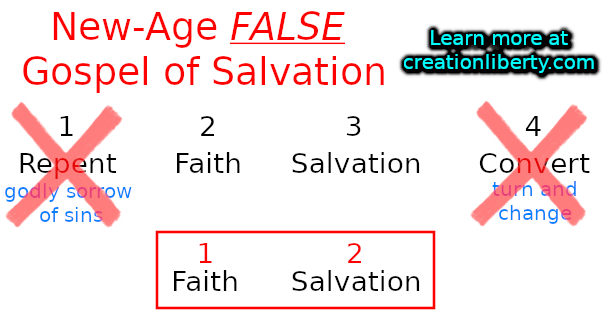
The lazy, lackadaisical church buildings of the 21st century prioritize money and popularity over truth, drawing in those indifferent to repentance and conversion. Their false preachers discard Biblical repentance, which is godly sorrow for wrongdoing, and as long as churchgoers submit to their imagined authority, these corrupt preachers will not teach the discipline of conversion, which requires turning from sin and changing how one speaks and acts.
The next image depicts the traditional, works-based false gospel of many religious cults, including Orthodoxy:
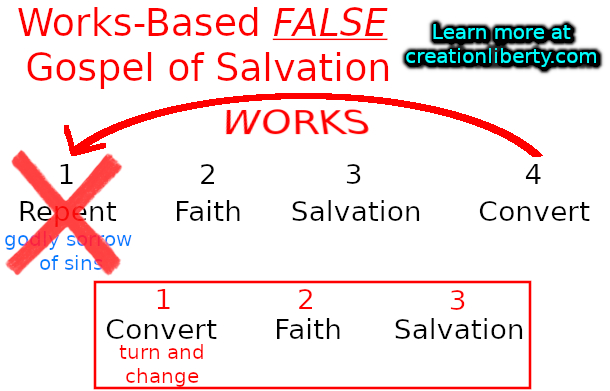
These corrupt institutions burden people with works for salvation, demanding endless rituals as a price for grace. They teach "repentance," but redefine 'repent' to mean 'convert' (i.e. to turn and change, instead of godly sorrow for sins), essentially promoting conversion for salvation, when conversion occurs AFTER salvation.
The final diagram shows the proper, Biblical gospel, which Jesus and His apostles taught in the Holy Scriptures:
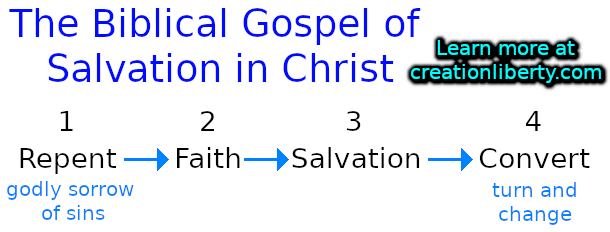
A man must have the Holy Ghost come to Him by the will of God, and open his understand to see his own sin and wretchedness, which hopefully will bring him to tears of godly sorrow. Once that happens, if he comes in humility to the Lord Jesus Christ, to ask of His mercy, that man will have his spirit regenerated by the Holy Ghost, and he will begin the process of growth, turning from his sins and changing his mind to match the philosophy of Christ.
Beware lest any man spoil you through philosophy [i.e. a way of thinking] and vain deceit [i.e. useless lies], after the tradition of men, after the rudiments [i.e. first teachings you learn] of the world, and not after Christ.
-Colossians 2:8

I created this book to get the message to churchgoers. Though few are interested to read, I seek discussions only with those open to listen, not those who shut their eyes and ears to the truth and refuse to engage.
For this people's heart is waxed gross, and their ears are dull of hearing, and their eyes they have closed; lest at any time they should see with their eyes, and hear with their ears, and should understand with their heart, and should be converted, and I should heal them.
-Matthew 13:15

If I were to give one message to the Orthodox churchgoer, it would be the message Jesus gave to the Jews:
At that time Jesus answered and said, I thank thee, O Father, Lord of heaven and earth, because thou hast hid these things from the wise and prudent, and hast revealed them unto babes. Even so, Father: for so it seemed good in thy sight. All things are delivered unto me of my Father: and no man knoweth the Son, but the Father; neither knoweth any man the Father, save the Son, and he to whomsoever the Son will reveal him.
-Matthew 11:25-30
It is unlikely that any Orthodox churchgoer will read this book, but if you have, I thank you for your time and commend your effort to consider a perspective different from what you typically hear or read. I hope you will learn of the Lord Jesus Christ and pray to Him for a heart of repentance, that He would forgive your sin as a gift, without requiring works, so you may find liberty in His righteousness and, at the end of your days, join us in Heaven.
I greatly appreciate all of you who took the time to read my book, and I pray the Lord Jesus Christ will bless each of you abundantly with His mercy. If this book has been helpful, please consider sharing it with others, as all my books are freely available to read on my website at creationliberty.com.
Let's end with the words of the Holy Ghost through Paul, and I exhort Christians to place your faith in these words of divine wisdom:
For therein is the righteousness of God revealed from faith to faith: as it is written, The just shall live by faith.
-Romans 1:17
Even the righteousness of God which is by faith of Jesus Christ unto all and upon all them that believe: for there is no difference:
-Romans 3:22
Therefore we conclude that a man is justified
by faith without the deeds of the law.
-Romans 3:28
Therefore being justified by faith, we have
peace with God through our Lord Jesus Christ:
-Romans 5:1
What shall we say then? That the Gentiles, which followed not after righteousness, have attained to righteousness, even the righteousness which is of faith. But Israel, which followed after the law of righteousness, hath not attained to the law of righteousness. Wherefore? Because they sought it not by faith, but as it were by the works of the law. For they stumbled at that stumblingstone;
-Romans 9:30-32
But that no man is justified by the law in the sight of God,
it is evident: for, The just shall live by faith.
-Galatians 3:11
For we through the Spirit wait for the hope of righteousness by faith.
-Galatians 5:5
And be found in him, not having mine own righteousness, which is of the law, but that which is through the faith of Christ, the righteousness which is of God by faith:
-Philippians 3:9


Reader Discussion
Scripture-based insights and questions welcome. First comment requires approval.
Having trouble posting? Try temporarily turning off your VPN.
Your email address is kept strictly private for spam prevention—never published.